


Digital marketing company for hospitals in India: what a proper scope actually looks like
A digital marketing company for a hospital in India does more than run Facebook ads and a Google Business Profile. The scope that produces booked consultations covers service-line campaign architecture, NMC and DPDP Act compliance review on every asset, referring-physician conten
No pitch. Written root-cause diagnosis. AI-powered, healthcare only.
Direct answer
A digital marketing company for a hospital in India does more than run Facebook ads and a Google Business Profile. The scope that produces booked consultations covers service-line campaign architecture, NMC and DPDP Act compliance review on every asset, referring-physician conten
TL;DR
A digital marketing company for a hospital in India does more than run Facebook ads and a Google Business Profile. The scope that produces booked consultations covers service-line campaign architecture, NMC and DPDP Act compliance review on every asset, referring-physician content, and attribution that ties consultations booked in the hospital's HIS back to the acquisition source. Getting one that isn't a rebranded generic agency means checking six specific things before signing, and the CPQL benchmarks below explain how to test whether a proposal is honest before the retainer starts.
What separates a hospital-focused agency from a generic digital agency
Hospitals are not clinics with more floors. The marketing problem is structurally different. A single-doctor clinic markets one line of care to a defined patient profile. A 200-bed multi-specialty hospital markets 12 to 20 service lines to distinct audiences, half of whom arrive through physician referral rather than search, while operating inside NMC Ethics Code 2026 restrictions that a generic agency has probably never read.
A generic digital marketing agency treats the hospital site as one campaign object. That is wrong even for a mid-sized secondary-care facility. Cardiology campaigns need to reach both patients researching a diagnosis and referring GPs building a shortlist. Oncology campaigns cannot use survival or cure language at all. IVF campaigns cannot cite success rates. Aesthetic dermatology has its own before-and-after ban. A generic agency that runs the same creative template across all of it will get an ad account suspended inside a quarter.
A hospital-focused agency also owns the tracking loop back to the hospital's HIS or PMS. Without that loop, the hospital pays for form fills and Meta form-lead volume that never becomes a booked consultation. With it, the same monthly retainer moves the number that matters — appointments booked, revenue-generating procedures, referring-physician relationships that renew — and the marketing team can defend spend to the CFO with real numbers.
Six questions to ask before signing
 Meta Catalyst IQ Naming Intelligence deconstructing Meta Ads campaign names into audience, format, funnel-stage and offer components" width="1200" height="675" loading="lazy" decoding="async" style="width:100%;height:auto;display:block;">
Ask any hospital digital marketing company to name the last three healthcare accounts they ran, and describe what NMC or platform compliance issue came up on each. A firm that has genuinely run healthcare cannot answer this without specifics. A firm that will use the hospital as its first healthcare account will answer with generalities.
Then ask what their attribution back to the hospital's HIS or PMS actually looks like. If the answer is "we track form submissions and calls," that is not attribution — that is reporting. Real attribution tags every enquiry, follows it to a consultation, and reports cost per booked consultation, not cost per form fill.
A related question worth asking directly: who reviews creative for NMC Section 6 and ASCI guidelines 2022 compliance? The right answer names an editor or a compliance workflow separate from the creative team. If the same designer who made the ad also signs off on its compliance, there is no compliance review at that agency.
Service-line separation is the next test. A hospital with cardiology, orthopedics and IVF cannot run a single Meta pixel with mixed audiences without polluting the algorithm's learning. Ask how creative, landing pages and audiences are separated per service line. If the answer suggests one shared setup, the agency has never actually run a multi-specialty account.
Ask about physician-facing content specifically. In cardiology, orthopedics, oncology and neurology, a large share of hospital patients arrive via physician referral. The agency should have a specific view on referring-physician content, not treat "digital marketing" as a synonym for patient acquisition.
Finally, ask when they have turned down a client. An agency that has never said no to a healthcare brand has taken on work it should not have. Compliance-heavy verticals require the agency to decline creative asks that cross a line. Ask for a real example.
What a competent hospital digital marketing scope actually covers
The core scope for a multi-specialty hospital breaks into six work areas that a proper retainer covers, and any one of them missing tends to be where the CPQL number quietly worsens over the year.
Service-line campaign architecture — separate Google Ads accounts or campaigns per specialty, separate Meta ad sets with specialty-specific audiences, landing pages that speak to one condition or one procedure rather than a hospital-wide overview page. Cardiology needs to feel like a cardiology page, not a hospital homepage with a stethoscope image.
Local SEO and Google Business Profile — every hospital location, every relevant Google category, review-response cadence, and consistency across the entire NAP (name, address, phone) footprint. Multi-location hospitals lose more traffic to a bad GBP setup than to almost any other single technical failure.
Website technical health — Core Web Vitals, MedicalOrganization and Physician schema on doctor pages, indexation control (a hospital site can generate thousands of near-duplicate URLs through specialty and doctor templates), and clean handling of doctor-transfer redirects when consultants move.
Content operations — condition explainers written to satisfy the NMC ethics code, doctor Q&A that establishes expertise without crossing into testimonial territory, referring-physician letters and CME-adjacent content, and a schedule that keeps pages fresh without generating throwaway blog posts.
Attribution and CRM integration — Meta CAPI feeding the hospital's HIS or PMS, Google Enhanced Conversions with hashed patient data respecting DPDP Act consent boundaries, and a monthly reconciliation between marketing-reported leads and hospital-recorded consultations.
Compliance review — every creative asset, landing page, email and WhatsApp template reviewed against NMC Ethics Code 2026, ASCI guidelines 2022 and platform-specific policies before publish, not after a suspension.
What good pricing looks like
Real healthcare-focused agencies price hospital retainers in bands, not from a package menu. For a single-location hospital of 100-200 beds, expect ₹1.5 lakh to ₹4 lakh per month for full-scope work. Multi-location chains sit at ₹4-10 lakh per month depending on the number of locations and the specialty count. Media spend is separate; a hospital that is not spending at least ₹3-5 lakh a month on paid media across its priority service lines will not generate statistically reliable optimization signals for the agency to work with.
If a proposal comes in materially below ₹1 lakh per month for a hospital, one of the six scope areas above has been dropped without saying so. The most commonly dropped: compliance review, HIS attribution, and referring-physician content. All three are the exact areas that decide whether the retainer produces booked consultations six months in.
Red flags to walk away from
 sie" style="color:inherit;text-decoration:underline;text-decoration-color:rgba(42,126,200,.5);text-underline-offset:2px">Rank OS scoring a GBP across five dimensions — Completeness, Consistency, Authority, Activity, Sentiment — refreshed daily" width="1200" height="675" loading="lazy" decoding="async" style="width:100%;height:auto;display:block;">
The single loudest red flag is an agency that guarantees a specific number of leads per month. Healthcare marketing does not work that way. Google's and Meta's algorithms need 30-60 days per specialty to stabilize, patient consideration cycles run weeks to months, and any guarantee is either based on junk lead volume that will not book, or based on the agency taking on the media risk itself (in which case they will drop the account the moment it stops being profitable for them).
Also worth walking away from: any agency that shows patient testimonials with real names and photographs on their own website. If they do it for themselves, they will do it for the hospital, and NMC Section 6 does not permit it.
Watch for pitches built around targeting patients by health condition on Meta. Meta retired sensitive interest categories, and any pitch that mentions "we can target diabetics" or "we can reach IVF-considering couples" describes something the platform does not permit. Either the agency is out of date, or it is proposing a workaround that will trigger a ban.
The last red flag is subtler: pricing tied to media spend as a percentage. A 15% media-spend commission incentivises the agency to increase spend regardless of return. Fee-based retainers align interests better; hybrid structures with a fixed base plus performance bonuses tied to booked consultations align them best.
Related reading
- The full decision framework for choosing a healthcare marketing agency, which extends this to non-hospital healthcare brands
- Healthcare marketing agency India — ICG's own scope for hospitals and clinic groups
- Healthcare CPQL benchmarks — what to test any agency proposal against
- Best healthcare CRM India — the tracking layer that makes hospital attribution possible
FAQ
Is a hospital digital marketing company different from a hospital marketing consultant? Yes. A consultant advises and hands the work to the hospital's in-house team or another agency. A digital marketing company executes the work end-to-end. Some hospitals use both: a consultant sets strategy, then an agency runs the campaigns. Others use the same firm for both. A single provider is faster; a split model gives the hospital a check on the agency's recommendations.
Should a hospital hire a local agency or a national one? It depends on the hospital's catchment. Purely local hospitals with a 15-20 km catchment benefit from an agency that knows the specific city — its search patterns, its physician network, its media buying rates. Multi-location or medical-tourism-focused hospitals need national scope. What matters more than local vs national is healthcare specialization; a local agency without healthcare experience is worse than a national one with 10 years in the vertical.
How long before a hospital sees results from a digital marketing engagement? Local SEO and Google Business Profile changes move within 4-8 weeks. Paid campaigns produce first bookings inside 30 days but need 60-90 days to stabilize cost per booked consultation. Organic search and content typically take 4-6 months for measurable ranking, longer for competitive specialty terms. A hospital expecting proof inside 30 days will either be sold junk leads or will churn agencies faster than any of them can produce a result.
What is the difference between a healthcare marketing agency and a hospital marketing agency? Overlapping terms in India, but hospital marketing usually means multi-specialty and inpatient-focused; healthcare marketing covers everything including single-specialty clinics, dental chains, IVF centres and diagnostic labs. Most agencies use the terms interchangeably. When shopping, ignore the label and ask about experience with the specific hospital profile: number of specialties, number of beds, number of locations, and whether they have run cardiology and oncology accounts specifically (both have compliance profiles that catch agencies out).
Can a hospital run its digital marketing in-house instead? Yes, and some do, particularly larger corporate chains. The in-house math works when the hospital has enough scale to justify a full team: at minimum a marketing head, a paid media lead, a content lead, an SEO specialist, and a compliance reviewer. That runs ₹20-40 lakh a month in salary alone. Below that scale, an agency retainer is usually cheaper per booked consultation, because the agency spreads specialist salaries across multiple clients.
What is CPQL and why does it matter for a hospital? CPQL is cost per qualified lead — what a hospital spends to acquire one patient who actually books a consultation, versus one who just fills a form. In healthcare, form-fill counts overstate real demand by 3-5×. CPQL is the number that tells the hospital whether the marketing engagement is generating economically meaningful patients. ICG publishes CPQL benchmarks by specialty so hospitals can test any agency's numbers against the market.
Book a free 30-minute Brand & Growth Diagnostic.
It's a working session, not a sales pitch — you leave with a written root-cause analysis you can act on, whether or not you engage ICG.
The three platforms
behind every ICG engagement.
Beacon
CAPI middleware that fixes Event Match Quality, translates CRM statuses to Meta-standard events, dedups across channels.
Agency OS
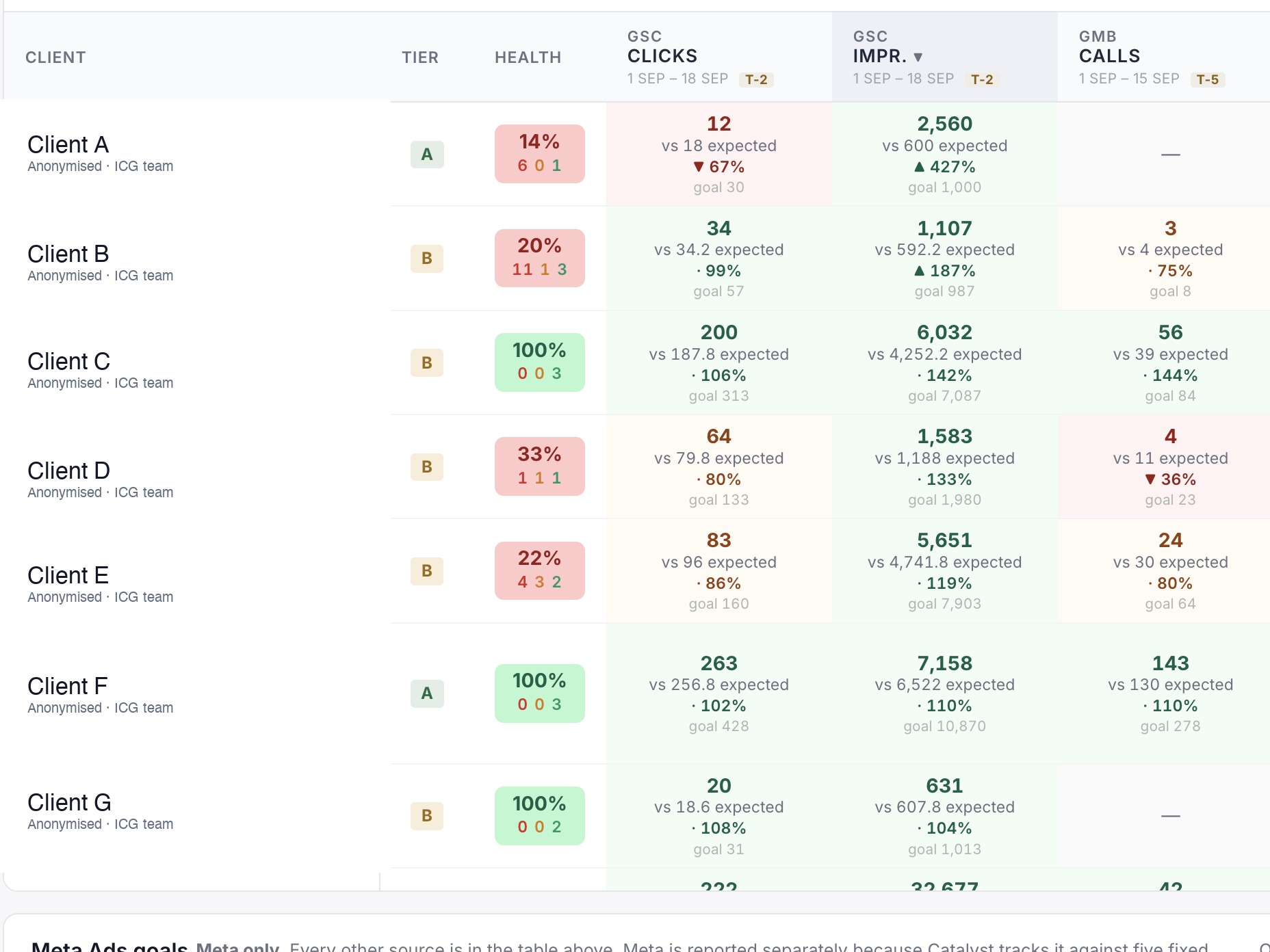
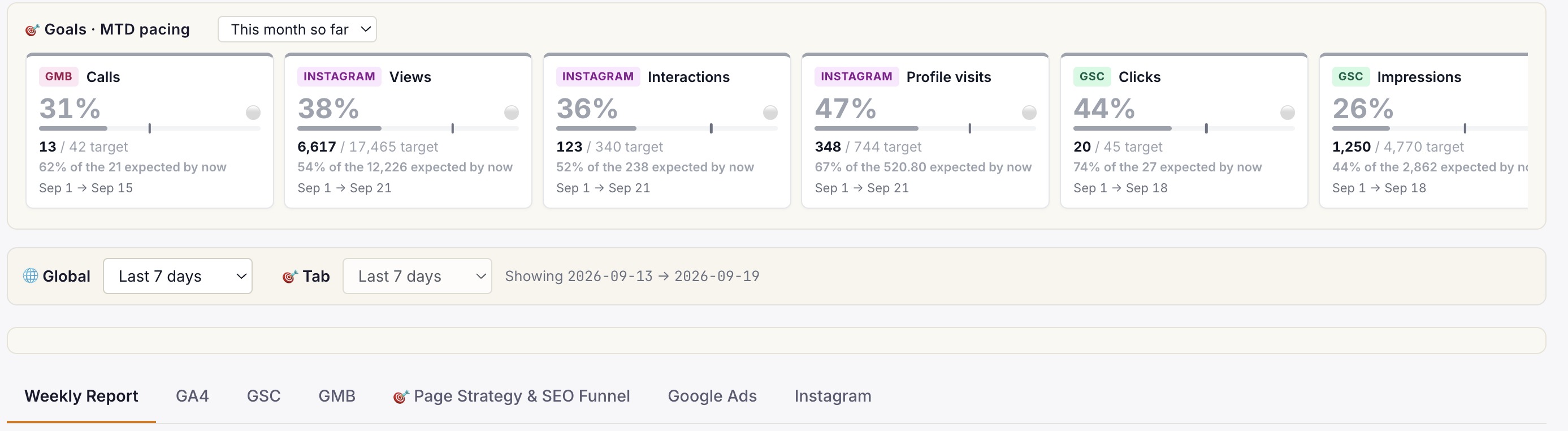
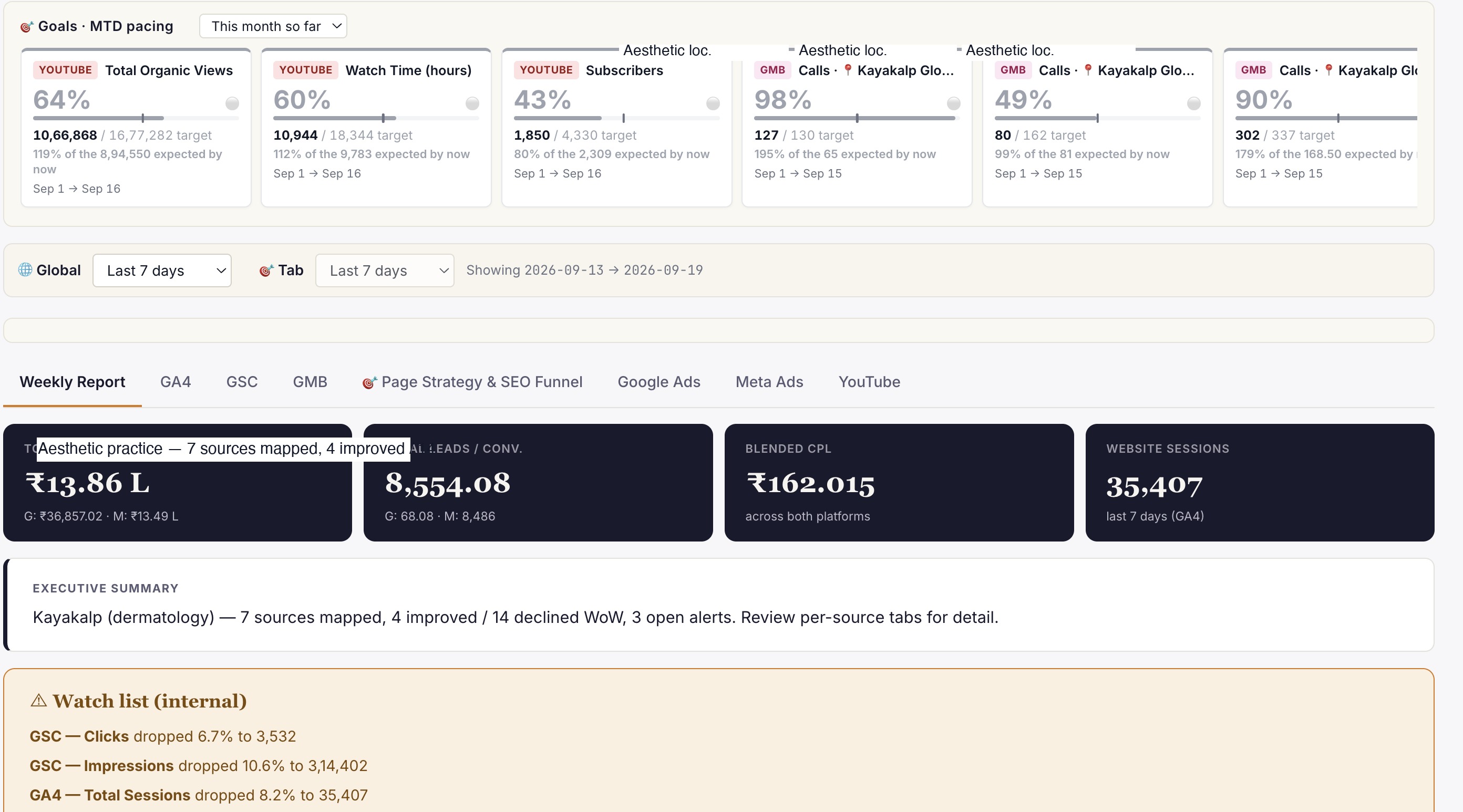
Live client dashboard. GSC, GA4, Google Ads, Meta Ads, IVR calls in one view. Login anytime, not monthly.
Phoenix
Clinic revenue intelligence over your PMS. Daily action queue: Prevent Loss, Maintain & Engage, Grow Revenue. Multi-centre rollout.
Or book a free 30-min audit to see all three in action on your account.
Healthcare brands
that already run on ICG.
A representative slice of the 150+ healthcare brands ICG has delivered for across India. Most engagements remain under NDA.


What ICG clients say · on video.
"Mental health marketing requires a different sensitivity. ICG built compliance-aware campaigns that respect both patients and our..."
"Bariatric surgery patients need a long consideration cycle. ICG built a content + paid system that respects that timeline."
"Working with ICG felt like working with an in-house growth team that happens to specialise in healthcare."
Need help operationalising this?
Every ICG service is healthcare-only, NMC + DPDP-aware, and built around the patient-research patterns that drive Indian healthcare growth in 2026.
Every practice welcome — packages from ₹20,000/mo.
Goals-Driven engagements · Performance-Linked Payout Models available
More from
ICG.
Five trends shaping Indian healthcare marketing through 2027: AI-first patient research, Conversions API adoption, ABDM discovery, the AEO w...
Healthcare AIO is the discipline of getting your clinic or hospital cited inside Google AI Overviews, ChatGPT and Perplexity answers — not j...
Conversational-search advertising places brand messages inside AI chat answers — ChatGPT, Perplexity, Copilot — rather than beside a results...
Stop guessing.
Book a Diagnostic.
30 minutes. Free. With the AI-powered healthcare-only marketing agency 150+ brands already run on. No slides, no pitch, no hard close.


