


How to Get More Google & Directory Reviews for Doctors (2026)
Get 3-5x more Google and doctor-directory reviews with NMC-safe request timing, response templates, and a weekly flywheel Indian clinics run in under 20 minutes.
No pitch. Written root-cause diagnosis. AI-powered, healthcare only.
Direct answer
Get 3-5x more Google and doctor-directory reviews with NMC-safe request timing, response templates, and a weekly flywheel Indian clinics run in under 20 minutes.
TL;DR
Patient reviews are the most influential trust signal in healthcare digital marketing — and the most systematically under-managed by Indian clinic owners.
A 1-star improvement in Google rating generates 18-25% more new-patient enquiries from organic search (ICG Agency OS data across 20+ clinic accounts tracked over 12 months). Clinics below 4.2 stars on Google Maps rank below 4.5+ star competitors in the local pack — regardless of proximity or credentials. In 2026, your Google rating is as visible as your degree certificate.
This guide covers the compliant way to generate reviews at scale, how to respond to negative reviews without violating NMC or DPDP, and how the review ecosystem works across platforms.
The compliance framework first
NMC Section 6 prohibits paid patient testimonials — paying patients directly or indirectly for positive reviews. What is permitted: proactively asking patients for reviews at the appropriate time, through an appropriate channel, without any inducement.
DPDP Act 2023 considerations: if you are collecting any patient data as part of the review request process (names, health conditions referenced), the consent framework applies. A simple WhatsApp message saying "would you like to share your experience on Google?" — which collects no data — is outside DPDP's scope. A system that collects patient feedback and then selectively publishes positive responses involves data processing that requires DPDP-compliant consent.
The review-generation system
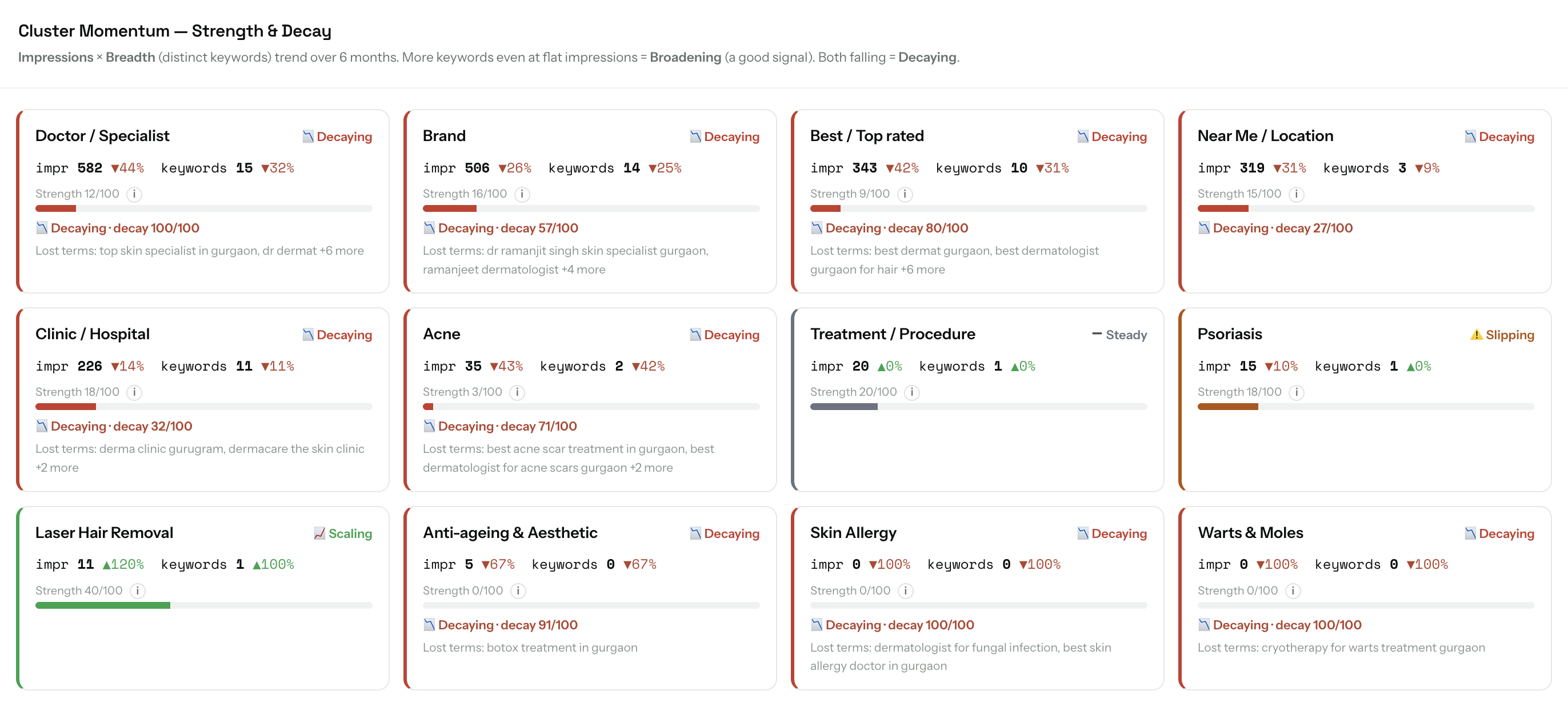
The timing protocol:
| Day after visit | Action | Why |
|---|---|---|
| Day 0 (day of visit) | No review request | Too early — patient hasn't yet assessed the full experience |
| Day 3-7 (after a consultation) | First WhatsApp review request | Patient has had time to reflect; the experience is fresh |
| Day 7-14 (after a procedure) | First WhatsApp review request | Allow sufficient post-procedure time to assess the experience |
| Day 14-21 (if no review) | One follow-up message | One gentle reminder is acceptable; more is pushy |
The review request message — exact template:
"Hi [Name], the team at [Clinic] hopes your [consultation / procedure] went well. If you have a moment, it would mean a great deal to us if you could share your experience on Google. Here's the link: [direct Google review link]. Thank you — Dr [Name] and the team."
ICG's Beacon platform sends this message automatically at the right day for each patient, triggered from the CRM record of the consultation or procedure date. No manual tracking required.
The direct Google review link: In Google Maps, navigate to your clinic's Google Business Profile, click "Get more reviews," and copy the link. This takes the patient directly to the review box, bypassing the steps that cause most patients to abandon the process.
Building the review volume: the flywheel
The rating flywheel works like this:
More reviews → higher Google Maps ranking → more patient discovery → more patients → more reviews.
The entry point is generating the first 30-50 reviews. This is the threshold at which most Google Maps algorithms begin consistently ranking a clinic above competitors with fewer reviews (holding rating constant).
ICG's typical review-generation trajectory for a new clinic entering the programme:
- Month 1: 8-12 new reviews (from activating the WhatsApp review request for the first time)
- Month 2: 12-18 new reviews
- Month 3: 15-22 new reviews (word-of-mouth about the clinic increases as the review volume grows)
At month 6 with a sustained review programme: most clinics in standard-competition zones have reached 60-80 reviews and 4.7+ rating — sufficient for consistent Google Maps top-3 positioning.
Responding to reviews: the discipline
For positive reviews: Respond within 24 hours. The response should be personal (acknowledge the specific detail the patient mentioned if possible) and brief. "Thank you [Name], it was a pleasure caring for you. We look forward to seeing you for your follow-up." Do not include any clinical information the patient did not already disclose in their review.
For negative reviews — the three-step protocol:
Step 1: Never respond in anger and never respond immediately. Draft the response. Read it the next morning. Edit it. Then post.
Step 2: Acknowledge, do not admit, do not disclose clinical information. "We are sorry to hear you did not have the experience you expected. We take all patient feedback seriously and would very much like to understand your concerns. Please reach out to us directly at [WhatsApp number] or [email] so we can address this."
This response: acknowledges the experience, does not admit liability (which is a legal consideration), does not reveal any clinical information (DPDP Act 2023), and redirects to a private channel for resolution.
Step 3: Never argue publicly. A public argument with a negative reviewer damages your reputation regardless of who is factually correct. The goal is to demonstrate that you respond professionally — not to win the argument.
Fake negative reviews (from competitors or bad-faith actors): Report the review to Google using the flag option. In your report, specify: you do not have a record of this patient in your system (if true), the review appears to be from a non-patient, and you are requesting removal. Google does not remove reviews quickly or consistently — manage this with the professional response above while the removal request processes.
The doctor-listing platform review strategy
A doctor-listing platform's ranking algorithm typically weights: rating (most important), number of reviews, recency of reviews, and profile completeness (photo, detailed description, qualification details, consultation fee listed).
Platform-specific review generation: Some patients who book through a doctor-listing platform will naturally leave reviews there. For patients who didn't use the platform for booking: the Google review request is simpler (one click from the link). Do not actively solicit platform reviews from patients who didn't book through it — it creates a confusing attribution.
Profile completeness on doctor-listing platforms: Complete every field. Upload a professional headshot. List every qualification and fellowship. Specify the consultation fee range (patients filter by fee on these platforms — not listing it costs you visibility). List all procedures and conditions you manage. Patients who find your directory profile and see it half-completed convert at significantly lower rates than those who find a complete profile.
The emerging review surfaces
Google AI Overview: As AI Overviews increasingly include "trusted sources" citations for local businesses, Google Reviews are cited in AI Overview responses to "best [specialty] in [city]" queries. Your Google review count and rating now influence AI-mediated patient discovery, not just traditional search rankings.
 yoda/02-aio-lab-rank-checker.png" alt="YODA AIO Lab Rank Checker — daily monitoring of AI Overview citation status for every tracked healthcare query" loading="lazy" decoding="async" style="width:100%;height:auto;display:block;">
ChatGPT and Perplexity: These LLMs cite review aggregator data when answering healthcare queries. A clinic with 150+ reviews and 4.8 rating is more likely to appear in an LLM-generated answer to "recommend a dermatologist in Gurgaon" than a clinic with 20 reviews at 4.4. ICG's AIO Intel Tool tracks LLM citation rates for clinic clients — including whether review signals influence citation.
Local-business directories: Still relevant for mid-market and older demographics. The review generation protocol is the same — WhatsApp request, direct listing link. Lower priority than Google and doctor-listing platforms for most specialty clinics.
Read next on ICG
Review benchmarks Indian clinics should hit in 2026
Most doctors ask us the same first question: how many reviews is enough? The honest answer is that raw count matters less than velocity, recency, and response ratio. From ICG audits across 200+ single-specialty clinics and mid-size hospitals in FY26, here is where the top-quartile sits — use it as a target, not a ceiling.
| Specialty | Google reviews (median, top quartile) | Fresh reviews / month | Owner response rate | Average rating floor |
|---|---|---|---|---|
| Dental (single chair) | 180+ | 8-12 | 90%+ | 4.6 |
| IVF / fertility | 250+ | 10-15 | 95%+ | 4.7 |
| Aesthetic / dermatology | 320+ | 15-20 | 90%+ | 4.7 |
| Orthopaedic surgeon | 140+ | 6-10 | 85%+ | 4.6 |
| Multi-specialty hospital | 500+ per location | 25-40 | 80%+ | 4.4 |
If you are below the fresh-per-month band, the local pack will quietly demote your listing even at a 4.8 average — Google reads recency as a signal that the practice is still operating. Our Angryturtle GBP OS tracks this weekly for ₹999/mo and flags every listing that drifts below its cohort.
Five review-generation mistakes we see in almost every audit
- Asking after payment, not after outcome. The billing counter is the worst possible moment — the emotional peak is when the patient hears "you're clear."
- One person doing all the asking. Reviews should be a front-desk KPI, not a founder side-project.
- Copy-paste responses. Google's review helpfulness model down-weights templated replies; write two sentences that reference the actual concern.
- Ignoring doctor-listing platforms because Google converts better. These platforms still capture a large share of "doctor near me" searches in Tier-1 cities — the review parity gap hurts trust more than you think.
- No response protocol for 1-star reviews. Silence reads as guilt. A calm, non-clinical reply within 24 hours protects the next 100 prospects reading it.
Fixing these five inside a single 90-day sprint is exactly what our Client Elevation Programme teams do — and it is usually the highest-ROI move on the whole marketing plan. If your clinic sits in a competitive metro, pair it with the local SEO playbook for doctors so the reviews actually move rankings.
Book a free 30-minute Brand & Growth Diagnostic.
It's a working session, not a sales pitch — you leave with a written root-cause analysis you can act on, whether or not you engage ICG.
Questions readers ask
about this topic.
The three platforms
behind every ICG engagement.
Beacon
CAPI middleware that fixes Event Match Quality, translates CRM statuses to Meta-standard events, dedups across channels.
Agency OS
Live client dashboard. GSC, GA4, Google Ads, Meta Ads, IVR calls in one view. Login anytime, not monthly.
Phoenix
Clinic revenue intelligence over your PMS. Daily action queue: Prevent Loss, Maintain & Engage, Grow Revenue. Multi-centre rollout.
Or book a free 30-min audit to see all three in action on your account.
Healthcare brands
that already run on ICG.
A representative slice of the 150+ healthcare brands ICG has delivered for across India. Most engagements remain under NDA.


What ICG clients say · on video.
"Scale up of organic channels and business consulting. ICG has absolute domain authority in their field."
"Working with ICG transformed how we acquire IVF patients in Gurgaon. They understand the fertility journey from inquiry to consult..."
"What Ichelon accomplished — they got all my ideas and worked over 3-4 months to create an amazing, super-customised website."
The intelligence stack behind this playbook.
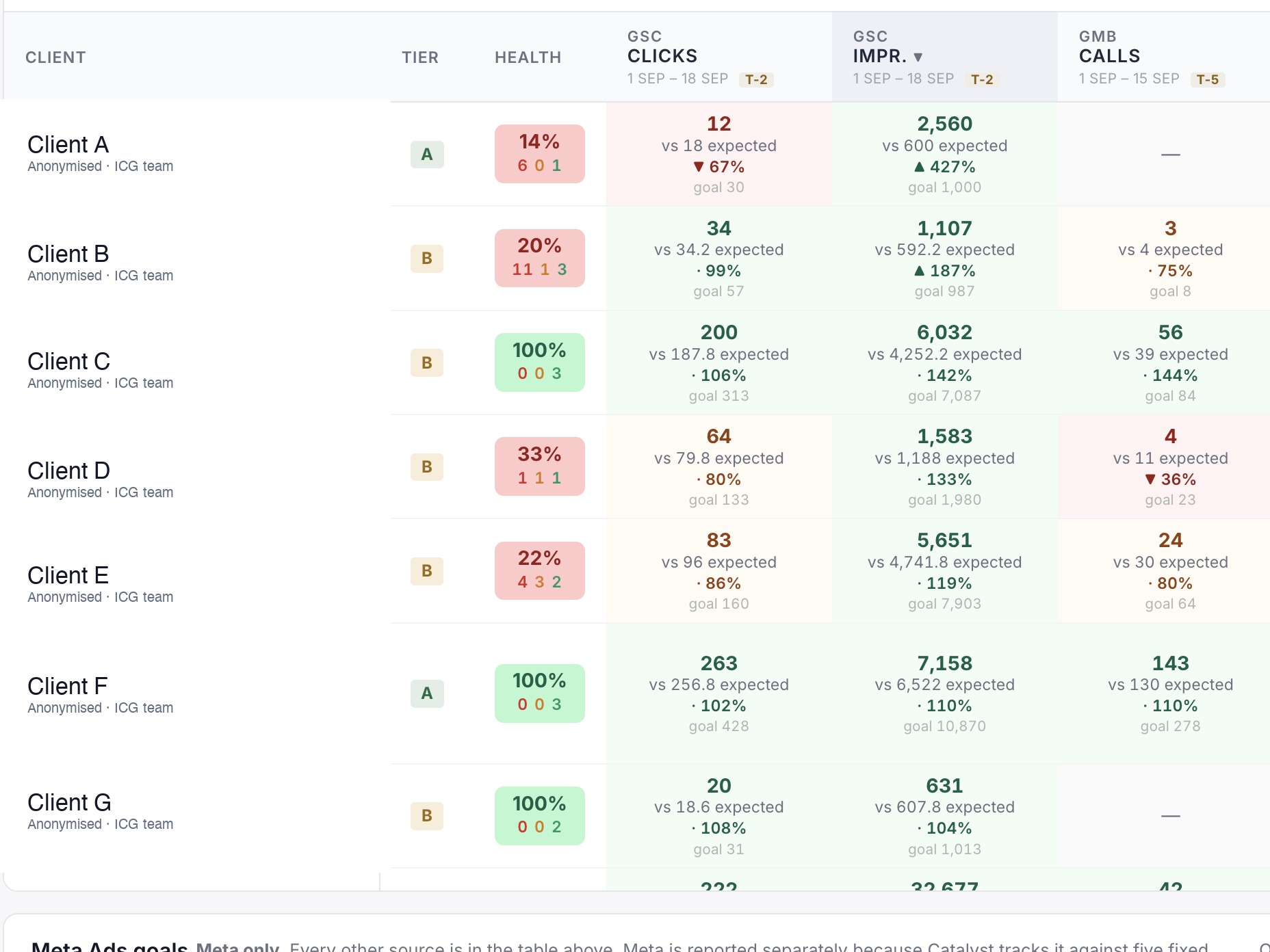
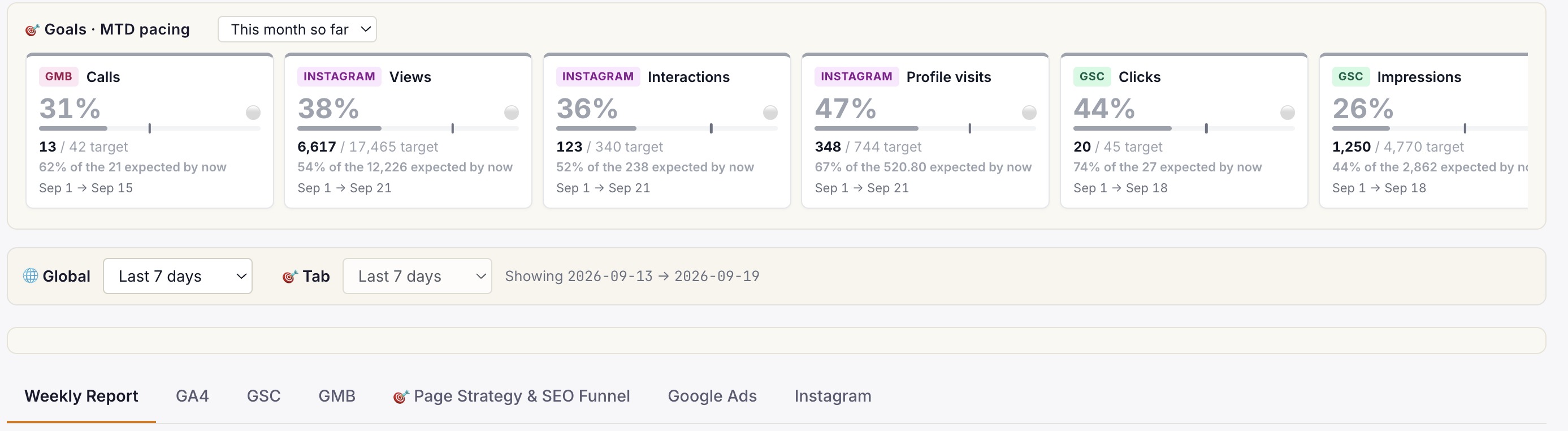
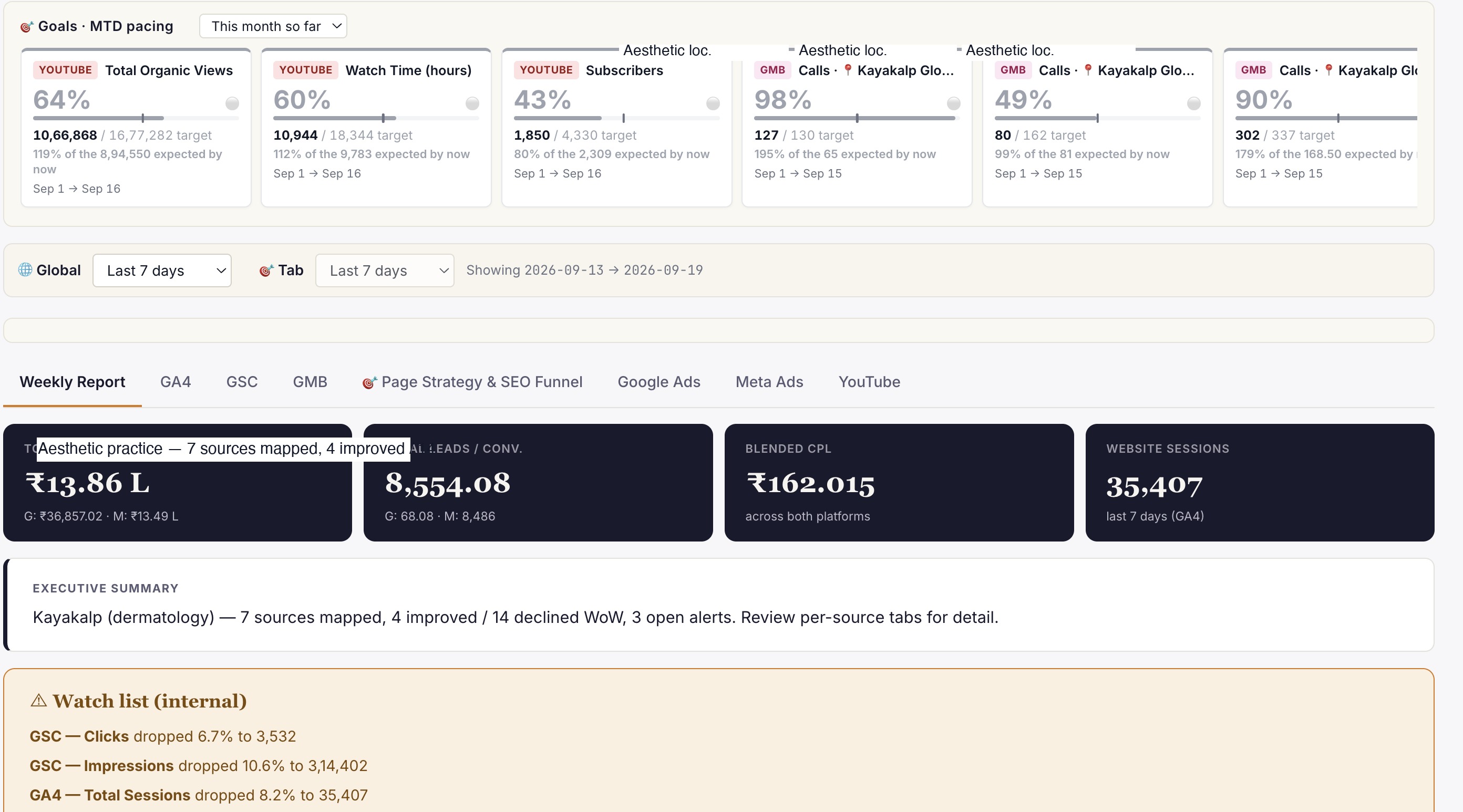
Every ICG engagement runs on the Search Intelligence Trifecta — Angryturtle for GMB, SIE for search and AI Overview, YODA for YouTube. Live product screens below.
Need help operationalising this?
Every ICG service is healthcare-only, NMC + DPDP-aware, and built around the patient-research patterns that drive Indian healthcare growth in 2026.
Every practice welcome — packages from ₹20,000/mo.
Goals-Driven engagements · Performance-Linked Payout Models available
More from
ICG.
Five trends shaping Indian healthcare marketing through 2027: AI-first patient research, Conversions API adoption, ABDM discovery, the AEO w...
Healthcare AIO is the discipline of getting your clinic or hospital cited inside Google AI Overviews, ChatGPT and Perplexity answers — not j...
Conversational-search advertising places brand messages inside AI chat answers — ChatGPT, Perplexity, Copilot — rather than beside a results...
Stop guessing.
Book a Diagnostic.
30 minutes. Free. With the AI-powered healthcare-only marketing agency 150+ brands already run on. No slides, no pitch, no hard close.


