


How to Track Instagram Enquiries — From Reach to Lead in 5 Steps
A practical, healthcare-specific attribution system for connecting Instagram reach to actual clinic enquiries — from bio link setup to Prism Pulse tagging discipline.
No pitch. Written root-cause diagnosis. AI-powered, healthcare only.
Direct answer
A practical, healthcare-specific attribution system for connecting Instagram reach to actual clinic enquiries — from bio link setup to Prism Pulse tagging discipline.
TL;DR

The most honest gap in Instagram analytics for a healthcare clinic is the gap between reach and enquiries. Meta shows you views, reach, saves, shares and profile taps. It does not show you which specific Reel or carousel triggered the DM that arrived on Tuesday morning asking about IVF consultation availability. Closing that gap is not a tooling problem alone — it is a workflow discipline that requires the right bio setup, the right WhatsApp deeplinks, the right tagging cadence and the right console. This piece walks through the five-step system ICG uses across the healthcare clinic accounts we advise, and how Prism Pulse — our Instagram analytics and reporting console — supports the attribution workflow without pretending to solve it magically.
Why Instagram enquiry attribution is fundamentally hard
Instagram is a discovery platform that does not close its own loop. When someone taps through from a Reel to your profile, then taps your bio link, then lands on your website, then fills your enquiry form — Meta stops reporting somewhere in the middle. The last piece of Meta-native data is the profile tap or the website tap at the account level, not at the post level. Which specific Reel drove the tap is not exposed in the Insights API.
This is not a bug — it is a design choice by Meta to protect user privacy and to keep the algorithm as the mediator of the audience. It does mean that any agency running healthcare accounts has to build attribution around Meta rather than assume Meta will provide it.
Step 1: Fix the bio link before anything else
The bio link is the single highest-leverage attribution touchpoint on Instagram. Every enquiry that comes through a website form or a WhatsApp deeplink from the bio can be tracked back to Instagram — but only if the link is set up correctly.
Use a hosted bio link page (Linktree, Beacons, or a custom subdomain on the clinic's own site). Never link directly to the clinic's homepage from the Instagram bio without UTM parameters — the traffic will show up in GA4 as "instagram / referral" without any post-level context. With UTM tags, the same traffic shows up as "instagram / bio / [post-slug]" and can be pivoted month over month.
The bio-link page itself should have at most four destinations: book a consultation (the primary CTA), WhatsApp us (the secondary CTA), see patient stories (the trust builder), and read our latest guide (the education CTA). More than four choices and conversion rate drops noticeably.
Step 2: Route WhatsApp enquiries through deeplinks with context
WhatsApp is where most healthcare enquiries in India actually happen. The Instagram DM system is used for early curiosity messages; WhatsApp is used for the serious enquiry that expects a response within hours. Making sure Instagram-sourced WhatsApp enquiries are tagged as such is the second attribution win.
Use a wa.me deeplink with a pre-filled contextual message that identifies the source. Example: https://wa.me/91XXXXXXXXXX?text=Hi%20clinic%2C%20I%20came%20via%20Instagram%20and%20wanted%20to%20know%20about.... The pre-filled text lets the receptionist or the front-desk team classify the enquiry source without asking, and creates a searchable record of Instagram-sourced conversations for the monthly attribution review.
For agencies running Prism Pulse alongside a WhatsApp CRM, the WhatsApp deeplink can be tagged with a UTM parameter that the Prism Pulse workspace can read back into the enquiries KPI card. That is the closest to end-to-end attribution most healthcare accounts get.
Step 3: Set up a weekly enquiry review discipline
Attribution that only happens once a month is attribution that is always guessing. The teams we see doing this well run a 20-minute enquiry review every Monday morning. The account lead pulls the DMs and WhatsApp enquiries from the last seven days, cross-references the content published in the same week, and tags each enquiry against the most likely triggering post.
The tagging does not need to be perfect. If a patient explicitly mentions a specific Reel ("I saw your patient story from last week"), that is a clean attribution. If a patient DMed the day after a specific Reel went viral without naming it, that is a probable attribution. If a patient DMed with no context and there is no obvious triggering post, that is an unattributed enquiry. Prism Pulse's Content view holds all three tag statuses so the monthly rollup can distinguish confirmed, probable and unattributed.
Six to eight weeks of this discipline is usually enough for the account team to trust the numbers. Before that, the tagging is noisy. After that, the monthly enquiry-per-Reel numbers become the most valuable strategic input the calendar-building process has.
Step 4: Report enquiries the same way you report reach
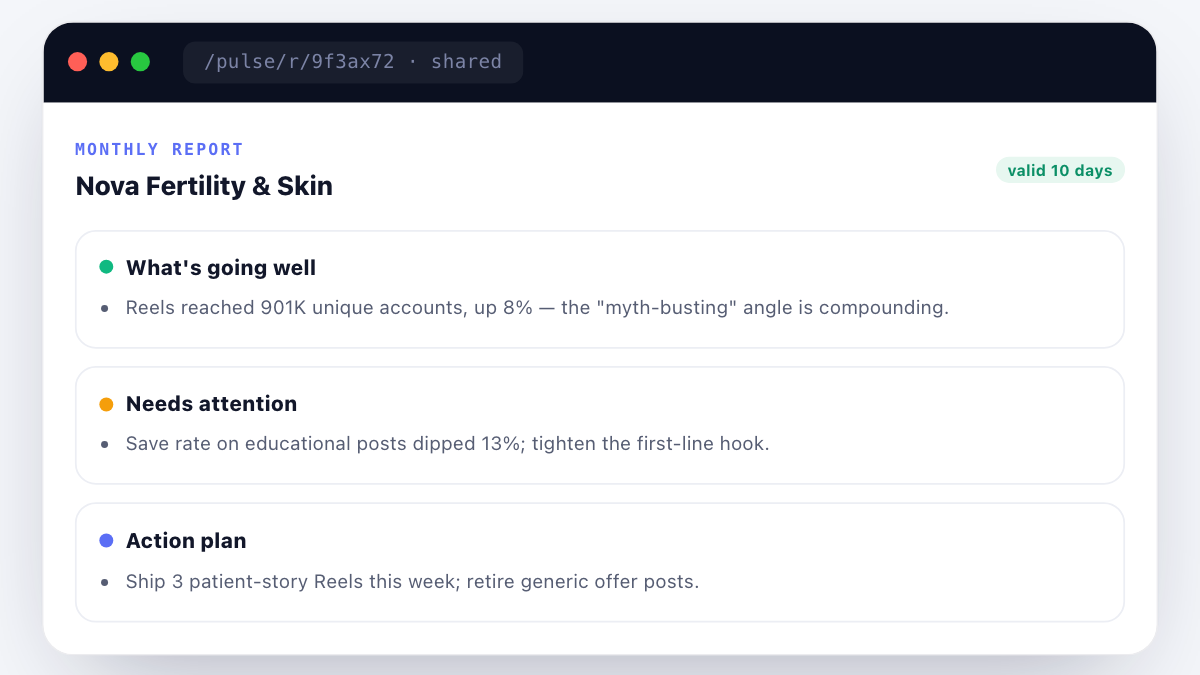
Once attribution is running, put enquiries on the client's monthly report at the same level of prominence as reach. The four headline KPIs on the Prism Pulse shareable report — reach, interactions, saves, enquiries — should be visually identical in weight. If enquiries live in a footnote, the client will start treating them as a footnote too.
The specific enquiry numbers to include: total DMs, total WhatsApp taps from bio, total website form-fills sourced from Instagram, and the top three posts that drove attributed enquiries in the month. Do not include vanity metrics like "potential reach converted" — they are unverifiable and erode credibility.
Step 5: Close the loop with the clinic's front-desk team
The final and most under-invested piece of the attribution system is the front-desk workflow at the clinic itself. Every enquiry that arrives — DM, WhatsApp, website form, phone call — should have a single field on the intake CRM: "where did you hear about us." The receptionist asks the question, ticks the box, and the CRM aggregates the answer into a weekly report.
This is the most reliable attribution data any clinic gets, because it is self-reported by the patient. Cross-referenced with the Prism Pulse enquiries KPI, it gives the agency a defensible answer to the founder's inevitable question: "how many of last month's consultations came from Instagram."
How this attribution system compounds over 12 months
An agency running this five-step attribution system for a healthcare clinic typically reports three specific compounding effects. First, the calendar shifts noticeably — more of the content that actually drives enquiries, less of the content that doesn't. Second, the monthly review conversation moves from vanity metrics (reach, followers) to business metrics (enquiries, consultation bookings), which changes the tone of the client relationship. Third, the clinic's own perception of Instagram shifts from "nice to have" to "measurable pipeline channel," which is when the retainer conversation gets easier.
Where enquiry attribution fits in the broader stack
Instagram enquiry attribution is one channel of a healthcare clinic's full lead-source picture. Prism Pulse handles the Instagram layer. ICG's Angryturtle handles the Google Business Profile layer, where the attribution problem is different (direct calls, direction requests, GBP-sourced website taps). Together they cover the two largest organic discovery channels for most Indian healthcare clinics, and the same attribution vocabulary carries across both.
Frequently asked questions
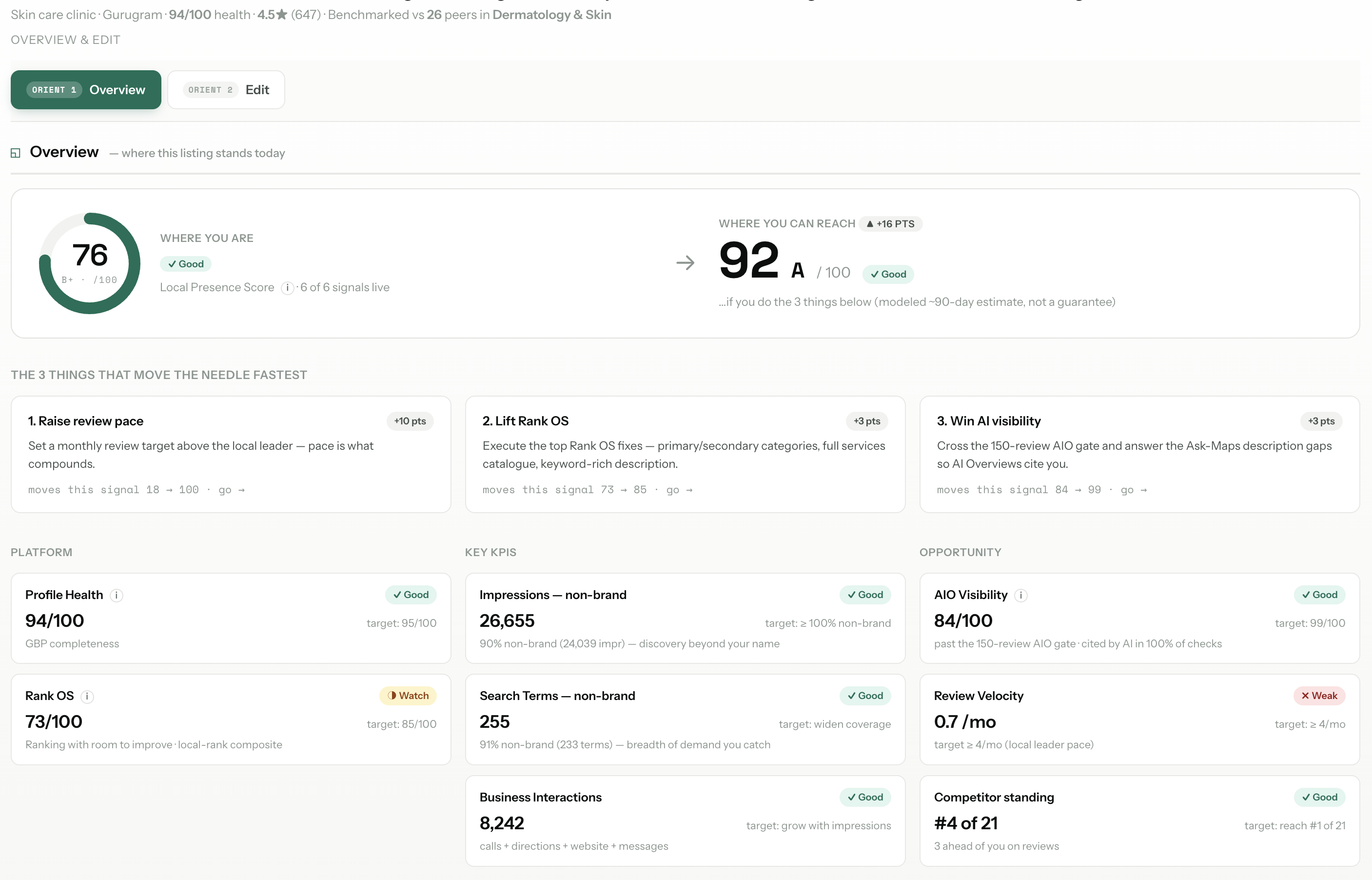
Want to see Prism Pulse on your own Instagram account? Book a 20-min walkthrough →
Book a free Meta ads account audit.
Raman Soni's team pulls your account, checks CAPI/EMQ, reviews creative for NMC compliance, and shows where CPQL is leaking. 45 minutes, actionable output.
Questions readers ask
about this topic.
The three platforms
behind every ICG engagement.
Beacon
CAPI middleware that fixes Event Match Quality, translates CRM statuses to Meta-standard events, dedups across channels.
Agency OS
Live client dashboard. GSC, GA4, Google Ads, Meta Ads, IVR calls in one view. Login anytime, not monthly.
Phoenix
Clinic revenue intelligence over your PMS. Daily action queue: Prevent Loss, Maintain & Engage, Grow Revenue. Multi-centre rollout.
Or book a free 30-min audit to see all three in action on your account.
Healthcare brands
that already run on ICG.
A representative slice of the 150+ healthcare brands ICG has delivered for across India. Most engagements remain under NDA.


What ICG clients say · on video.
"Scale up of organic channels and business consulting. ICG has absolute domain authority in their field."
"Working with ICG transformed how we acquire IVF patients in Gurgaon. They understand the fertility journey from inquiry to consult..."
"What Ichelon accomplished — they got all my ideas and worked over 3-4 months to create an amazing, super-customised website."
Need help operationalising this?
Every ICG service is healthcare-only, NMC + DPDP-aware, and built around the patient-research patterns that drive Indian healthcare growth in 2026.
Every practice welcome — packages from ₹20,000/mo.
Goals-Driven engagements · Performance-Linked Payout Models available
More from
ICG.
Five trends shaping Indian healthcare marketing through 2027: AI-first patient research, Conversions API adoption, ABDM discovery, the AEO w...
Healthcare AIO is the discipline of getting your clinic or hospital cited inside Google AI Overviews, ChatGPT and Perplexity answers — not j...
Conversational-search advertising places brand messages inside AI chat answers — ChatGPT, Perplexity, Copilot — rather than beside a results...
Stop guessing.
Book a Diagnostic.
30 minutes. Free. With the AI-powered healthcare-only marketing agency 150+ brands already run on. No slides, no pitch, no hard close.


