How to get more Google reviews for your medical practice, the compliant way
The way to get more Google reviews is to ask every patient, at the same moment in every visit, with a one-tap link to your review form, and never to offer anything in return or filter out unhappy patients first. That last part is not optional: Google bans incentives and selective requests, and the FTC's 2024 rule on consumer reviews carries civil penalties. This guide sets out a step-by-step system, the scripts, the text and email rules, and how to measure it.

- Ask every patient the same way. Google prohibits selectively soliciting positive reviews and offering any incentive for a review.
- The FTC's Consumer Reviews and Testimonials Rule took effect on October 21, 2024. It bans fake reviews, sentiment-conditioned incentives, undisclosed insider reviews and review suppression.
- Ask at the moment of relief or satisfaction, usually the same day, with a direct link to the location's review form.
- Texts need documented consent and an opt-out that is honored quickly. Marketing emails must follow CAN-SPAM.
- Measure new reviews per location per month, the share of patients asked, and reply rate.
- Every practice welcome — retainers from $499/mo, Goals-Driven engagements, Performance-Linked Payout Models available.
- Dallas, Texas LLC
- 10-person US client team · Central Time (CST)
- 25+ US healthcare clients
- BAA signed with every client
- HIPAA compliance training across client and delivery teams
- Contracts and invoices in USD
-
 Primary Care · North Dallas, TXCase study →
-
 MedSpa · North Dallas, TX
-
 Skin Care · Beverly Hills, CA
-
 Dental · Christiansburg, VACase study →
-
 Pediatrics · Blacksburg, VACase study →
-
 Pediatric Dentistry · Blacksburg, VACase study →
-
 Dental · Roanoke, VACase study →
-
 Functional Medicine · Telehealth · USACase study →
“They were able to get all my ideas and work with me over a period of three to four months and create this amazing website. It's super customized, very modern, and it incorporates all the elements that I had wanted — the patient portal, nice pictures, a very interactive website, patient reviews. I would highly recommend their company to anyone who wants to make an excellent website.”
What Google and the FTC allow, in one table
Most review problems at practices come from well-meant shortcuts: a raffle for reviewers, a survey that only sends happy patients to Google, or a staff member "helping out". Here is what each rulebook says. When they differ, follow the stricter one.
| Practice | Google review policy | FTC |
|---|---|---|
| Asking every patient for an honest review | Allowed | Allowed |
| Gift cards, discounts, raffles for a review | Prohibited for any review | Prohibited if conditioned on sentiment; any incentive may also need disclosure |
| Only sending the link to satisfied patients (review gating) | Prohibited ("selectively solicit positive reviews") | Not specifically banned by the rule, but the FTC says it could violate the FTC Act |
| Employees, owners or relatives reviewing | Prohibited (conflict of interest) | Undisclosed insider reviews by officers or managers prohibited |
| Telling patients what to write or what rating to give | Prohibited | Can make the review misleading |
| Pressuring patients to post on-site, or giving staff review quotas | Prohibited | Not addressed directly |
| Threats or legal action to remove a negative review | Not allowed; report policy violations instead | Prohibited when unfounded or groundless (review suppression) |
| Buying or writing fake reviews, including AI-written ones | Prohibited | Prohibited |
The FTC rule (16 CFR Part 465) was published in August 2024 and took effect on October 21, 2024. Courts can impose civil penalties for knowing violations, and in December 2025 the FTC sent warning letters to ten companies about review practices. Google enforces its own policy by removing reviews and restricting profiles.
HIPAA adds a healthcare-specific layer: your request message and your replies must not reveal health information. "Thanks for visiting Lakeside Dental today" is fine. "We hope your root canal is healing well, please review us" is not, because it puts treatment details in a text that others may see.
An eight-step review system for a practice
- Get the right link for each location. In your Business Profile, use "Ask for reviews" to copy the short review link. Multi-location practices need one link per office, so reviews land on the right profile.
- Pick one moment per visit type. Routine visits: the same afternoon. Procedures with recovery: when the patient is likely feeling better, for example after the follow-up appointment. Write the rule down so every patient is treated the same.
- Collect consent at intake. Add a plain-language line to your intake or registration form asking permission to text and email the patient about appointments, feedback and review requests, with how to opt out. Store the consent record.
- Send a short, neutral message. Name the practice, thank them, include the link, and include opt-out wording for texts. No treatment details, no star requests.
- Ask in person, too. A front-desk line at checkout ("If you have a minute later, an honest Google review really helps other families find us") plus a QR code at the desk. Don't ask patients to post while they wait.
- Route problems to people, not away from Google. Give every patient a way to reach the practice manager directly. This is good service, as long as it isn't used to decide who gets the review link.
- Reply to every review within a few business days. Thank positive reviewers generically. Use our HIPAA-safe negative review replies for the rest.
- Train and audit. Front desk, providers and managers should know the rules in the table above. Check monthly that messages go to everyone and that nobody on staff has posted a review.
Message scripts you can adapt
Text message (same day)
"Hi, it's Lakeside Family Medicine. Thanks for coming in today. If you have a minute, an honest Google review helps other people in the area find us: [link]. Reply STOP to opt out."
Email (after a procedure)
Subject: "Thank you from Lakeside Dental"
"Thank you for choosing us. We'd value your honest feedback on Google: [link]. If anything about your visit fell short, please contact our practice manager at [phone]." Include your postal address and an unsubscribe link.
Front desk, in person
"Thanks for coming in. We'll send you a link later. If you have a minute, an honest Google review really helps." Then stop. No follow-up pressure, no asking for five stars.
Words to avoid
- "If you were happy with your visit, please leave us a review." This invites only happy patients and edges toward gating.
- "Leave us 5 stars." Google prohibits asking for specific ratings or content.
- "Get $10 off your next cleaning when you post a review." An incentive, prohibited by Google.
- Any mention of a procedure, condition, test result or medication.
TCPA and CAN-SPAM: the basics for review requests
Text messages (TCPA)
Under the FCC's TCPA rules, automated calls and texts that include an advertisement or constitute telemarketing need the recipient's prior express written consent. There is an exception for calls that deliver a "health care" message by or on behalf of a HIPAA covered entity, but a review request is hard to fit into that exception. The safe approach is to treat review texts as needing written consent.
- Collect written consent that clearly covers review and feedback requests.
- Honor opt-outs. The FCC says replies such as "stop", "quit", "end", "revoke", "opt out", "cancel" or "unsubscribe" are a reasonable way to revoke consent, and revocations must be honored within ten business days.
- Send during reasonable local hours, and only one request per visit.
- Use a texting vendor that will sign a BAA, since your patient list is PHI.
Our TCPA patient outreach guide and TCPA deep guide cover consent language and quiet hours.
Email (CAN-SPAM)
If a review request email is commercial, the FTC's CAN-SPAM requirements apply: accurate sender information, a truthful subject line, your valid postal address, a clear way to opt out, and opt-outs honored within ten business days. The obligation stays with the practice even when a vendor sends the email. Our CAN-SPAM healthcare email guide has more detail.
How to measure your review program
Count the right things each month, per location:
- Patients asked as a share of patients seen. If it's far below 100%, the process isn't running.
- New reviews per month and the conversion rate from requests to reviews.
- Average rating of new reviews, separately from the lifetime average.
- Reply rate and reply time.
- Themes in negative reviews: wait times, billing, front-desk communication. These are operations problems that marketing can't fix alone.
For context from our own research: in a sample of 120 dental practices, the median gain was about five new Google reviews a month, and practices replied to 49% of reviews on average (dental study). In a sample of 115 med spas, the median was about six new reviews a month and the average reply rate was 61% (med spa study). The monthly review pace page breaks this down further.
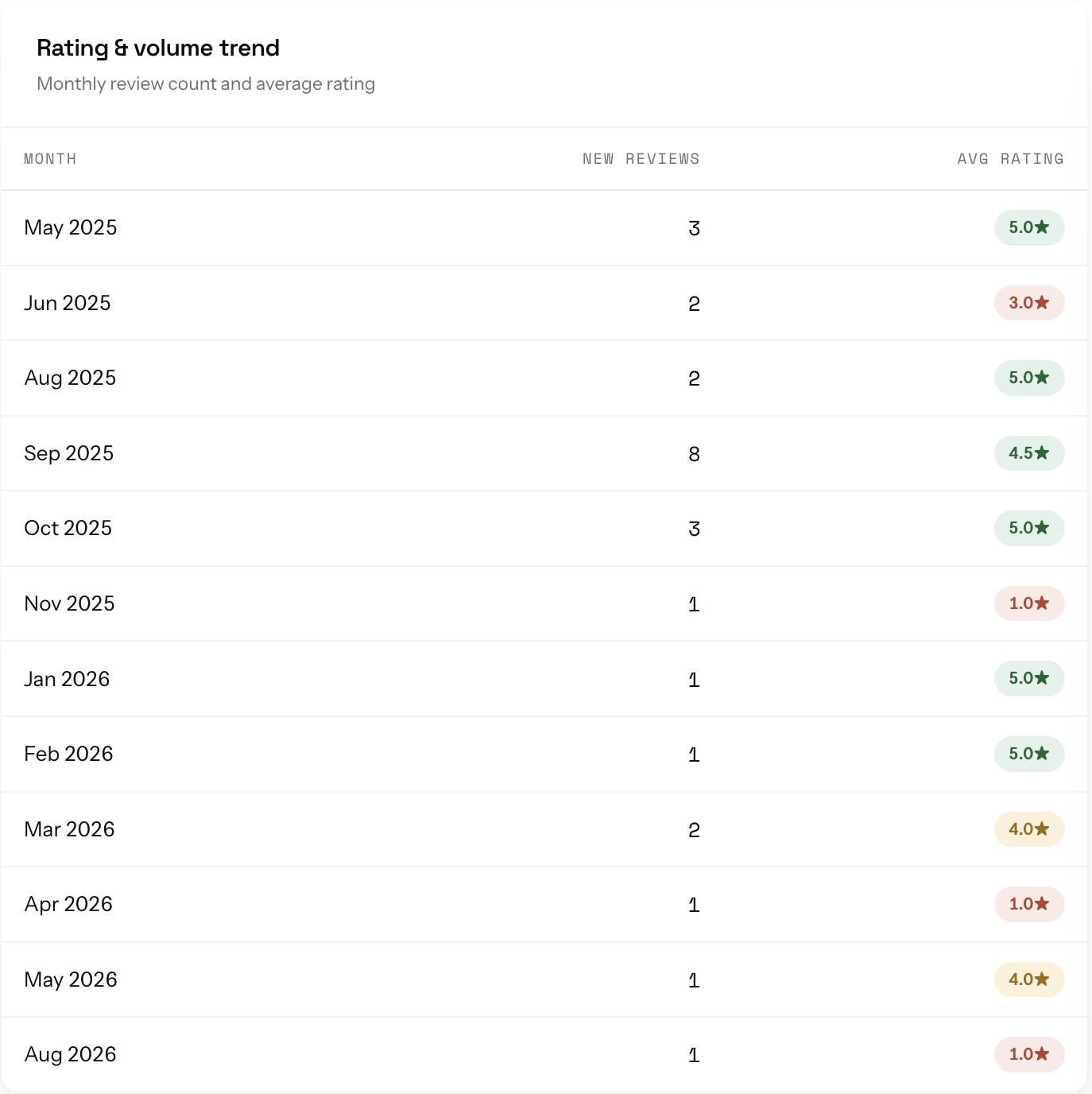
Angryturtle → Monthly new reviews and average rating for one location, the two numbers worth watching every month.
Ichelon Consulting US runs review programs as part of our reputation management and local SEO work, with Angryturtle tracking review pace and replies by location. More practical guides are in the US guides library.
Review program checklist
- One review link per location, tested on a phone.
- Written rule for when each visit type gets asked, applied to every patient.
- Consent language on intake forms covering texts and emails for feedback.
- Neutral scripts with no treatment details, no star requests and opt-out wording.
- No incentives, no gating, no staff or family reviews, no quotas.
- Texting and email vendors under a BAA.
- Replies to every review within a few business days, using generic wording.
- Monthly report: asked, new reviews, rating of new reviews, reply rate, themes.
Sources
- Google Maps user-generated content policy: fake engagement
- FTC: Final rule banning fake reviews and testimonials (August 2024)
- FTC: Consumer Reviews and Testimonials Rule, questions and answers
- FTC business blog: warning letters on the Consumer Review Rule (December 2025)
- 47 CFR 64.1200: TCPA consent rules and the HIPAA health care message exception
- FCC: Strengthening the ability of consumers to stop robocalls (revocation of consent)
- FTC: CAN-SPAM Act compliance guide for business
- Ichelon Consulting US: Dental Google presence study 2026 and Med spa Google presence study 2026
Related pages from the US team
Reputation management for US practices
How we run review requests, replies and monitoring for practices.
Responding to negative reviews under HIPAA
What not to confirm, with reply templates.
Reviews and FTC rules for pediatric practices
The rules explained for practices that serve families.
How many Google reviews does a dentist need?
Benchmarks from our 2026 dental study.
TCPA-safe patient outreach
Consent, quiet hours and opt-outs for practice texting.
Google Business Profile for doctors
Setting up the profile your reviews live on.
Every practice welcome — Goals-Driven engagements from $499/mo
We benchmark your last 90 days, agree monthly goals with you, and track them live on Ichelon Agency OS with a report every Monday. Performance-Linked Payout Models are available. Our US leadership is based in Dallas, and strategy calls run in US business hours.
Common questions
Is it legal to ask patients for Google reviews?
Yes. Google allows businesses to ask customers for reviews as long as they don't offer incentives, don't ask only happy customers, and don't pressure people or tell them what to write. HIPAA does not stop you asking, but your request and any reply must not disclose health information, and texts and emails must follow TCPA and CAN-SPAM rules.
Can we offer a gift card or raffle entry for leaving a review?
Not for Google reviews. Google's policy prohibits offering payment, discounts, free goods or services in exchange for posting any review, positive or negative. The FTC rule specifically prohibits incentives conditioned on a particular sentiment, but Google's policy is stricter, so the answer for your Business Profile is no.
What is review gating and why is it a problem?
Review gating means asking patients a satisfaction question first and only sending the review link to those who answer positively. Google's policy prohibits selectively soliciting positive reviews. The FTC has said the practice is not specifically banned by its review rule but could violate the FTC Act. Send everyone the same link.
When is the best time to ask a patient for a review?
Usually the same day as the visit, after checkout, while the experience is fresh. For procedures with recovery time, a follow-up message once the patient is feeling better works well. Choose one moment per visit type and apply it to everyone.
Do we need consent to text patients a review request?
Get it. Review requests are not appointment reminders, and the TCPA requires prior express written consent for many automated marketing texts. Collect written text-message consent at intake that clearly covers feedback and review requests, honor STOP and other opt-out requests within ten business days, and confirm your setup with counsel.
Can staff leave reviews or ask family to?
No. Google prohibits reviews from people with a conflict of interest, including current and former employees. The FTC rule prohibits undisclosed reviews by officers and managers and restricts businesses from soliciting reviews from employees and relatives without disclosure.
How many Google reviews does a practice need?
There is no fixed number, but compare yourself with the practices that rank above you. In our 2026 study of 2,318 dental profiles across 20 US metros, the median was about 320 reviews, and a sample of 120 practices gained a median of about five new reviews a month.
A note on this guide: it explains marketing practice, not legal advice. Rules on privacy, advertising and insurance change and vary by state, so confirm anything compliance-related with your own counsel.
Reviews stuck at a trickle?
A 30-minute benchmarking call with the US team. We'll compare your review pace with the practices around you and map out a request process your front desk can run.