


YouTube vs Podcast for Doctor Personal Brand in India: An Honest Buyer Guide
A neutral, feature-based comparison of YouTube long-form, Shorts, audio-only podcast, and video podcast for Indian doctors — cost, discovery, NMC and DPDP compliance, and which format fits a solo dental clinic vs a 100-bed hospital vs a mid-tier IVF chain.
No pitch. Written root-cause diagnosis. AI-powered, healthcare only.
Direct answer
A neutral, feature-based comparison of YouTube long-form, Shorts, audio-only podcast, and video podcast for Indian doctors — cost, discovery, NMC and DPDP compliance, and which format fits a solo dental clinic vs a 100-bed hospital vs a mid-tier IVF chain.
TL;DR
TL;DR
- For an Indian doctor building a personal brand in 2026, long-form YouTube gives you the widest discovery surface any format currently offers — videos surface in Google search, YouTube search, and increasingly inside AI Overviews with timestamped citations.
- Audio-only podcasts win on trust density per minute. A 30-minute listen builds more confidence in your clinical judgement than five 2-minute clips can — but total reach for Indian healthcare topics is roughly 8 to 15 times smaller than the same content on video.
- Video podcasts — the same recording pushed to YouTube plus audio distribution — capture around 80% of the upside of either single format at close to 1.3x the production cost of one alone. For most consultants aiming at personal brand, this is the correct default.
- Solo consultant under Rs 5 lakh a month clinic revenue: start with YouTube Shorts plus one long-form a week. Delay podcast till month 4 or later when the recording rhythm is dependable.
- NMC 2022 advertising guidelines and the DPDP Act 2023 apply equally to both formats. Video carries the higher compliance surface — before-after images, patient testimonials on camera, and drug-name mentions are all easier to slip into a video than an audio track.
- An established healthcare YouTube channel (3,000+ subscribers, one speciality) typically delivers a cost-per-qualified-consult 40-60% lower than paid Google search for the same speciality in the same city.
Table of contents
- Why this comparison matters for Indian doctors right now
- The 8 axes worth comparing on
- Main comparison table
- Per-axis breakdowns
- Which format fits which doctor
- Where ICG fits in this decision
- The 70-30 pricing model for YouTube and AIO services
- FAQ
Why this comparison matters for Indian doctors right now
The last eighteen months quietly rewrote the arithmetic of personal brand for Indian doctors. Google now cites video timestamps inside AI Overviews when someone searches for a symptom, a treatment, or a second-opinion query. YouTube subscription growth for Indian healthcare topics roughly doubled between 2024 and the first half of 2026 across most specialities we track. On the other end, podcast listenership inside India crossed 200 million monthly listeners on the last industry count — a number that would have looked like a rounding error in 2020.
Both formats work. Neither is obviously wrong. But the resources they eat, the discovery mechanics they unlock, and the compliance load they carry are not the same. Pick the wrong one for your practice and you have burned six to twelve months of your Saturday mornings on the wrong asset — one that does not compound in the way you needed it to.
There is also a specifically Indian layer here. NMC's 2022 advertising guidelines still leave a lot of grey around what a doctor can and cannot say on public content. The DPDP Act 2023 quietly shifted the ground under patient testimonials and case discussions. ABDM is normalising the idea that a doctor's public content should be discoverable alongside their verified HPR profile. None of that is a reason to avoid content. It is a reason to pick the format whose compliance surface you can actually manage on top of a full OPD.
The 8 axes worth comparing on
Every doctor we have advised through this decision landed on the same set of eight criteria — sometimes weighted differently, but rarely different in kind:
- Upfront production cost (equipment plus editing)
- Ongoing per-episode cost in rupees
- Time to first visible traction
- Discovery surface (Google search, AI Overviews, in-platform search)
- Trust density per minute of content consumed
- Consult-inquiry conversion mechanics
- Repurposing yield from one recording
- NMC 2022 and DPDP Act 2023 compliance surface
We are deliberately leaving out follower count, view count, and download count as top-line axes. For a doctor, none of those matter until they convert into a consult, a referral, or a peer citation. A channel with 8,000 real subscribers in your city and speciality outperforms a channel with 80,000 subscribers scattered across geographies you will never treat.
Main comparison table
Read the table as a rough calibration, not gospel. The numbers below are ranges we have seen across roughly 120 doctor-led content programmes in India over the last two years, across specialities from dental and dermatology to IVF, orthopaedics, and interventional cardiology.
| Axis | Long-form YouTube (10-25 min) | YouTube Shorts (under 60 sec) | Audio-only Podcast | Video Podcast (both surfaces) |
|---|---|---|---|---|
| One-time equipment cost | Rs 60,000 - 2,00,000 | Rs 15,000 - 60,000 (phone-first is viable) | Rs 25,000 - 80,000 | Rs 80,000 - 2,50,000 |
| Per-episode production cost | Rs 8,000 - 25,000 | Rs 1,500 - 4,000 | Rs 3,000 - 8,000 | Rs 10,000 - 30,000 |
| Time to first 100 real subs/listeners | 60 - 120 days | 30 - 60 days | 120 - 240 days | 60 - 120 days (video side pulls the audio side) |
| Discovery surfaces | Google, YouTube, AIO citations | YouTube, some Google Discover | Audio directories, in-app search | All video surfaces plus audio directories |
| Trust density per minute | Medium-high | Low | High | High |
| Consult inquiry conversion path | Description link, pinned comment, end-card | Bio link, verbal callout | Show notes, verbal callout | All of the above |
| Repurposing yield from one recording | 3-5 short clips, 1 blog, 1 email | 1 asset only | 1 blog, 1 email, 2 quote graphics | 3-5 short clips, 1 blog, 1 email, 2 quote graphics, audio version |
| NMC + DPDP compliance surface | High (visual before-after risk) | Medium-high | Lower | High |
Per-axis breakdowns
1. Upfront production cost
An audio-only podcast can be set up in the corner of your consultation room with two Rs 12,000 dynamic mics, an interface, and a laptop. It is genuinely the cheapest path into content that a consultant can take seriously. YouTube long-form asks more of you on day one — a decent camera or a modern phone on a solid tripod, a lav mic, one soft light, and a small acoustic treatment. Video podcasts sit at the top of the cost curve because two cameras and matched audio are non-negotiable if the recording is going to look professional on the video side. Do not underestimate the sunk-cost dynamic here. Doctors who spend Rs 2 lakh on studio equipment record more consistently than those who spend Rs 20,000, purely because the setup penalty is now behind them.
2. Ongoing per-episode cost
The per-episode cost is where most doctor-led channels fail quietly. A single 15-minute YouTube episode, done properly, needs script review, recording, cuts, colour, thumbnails, on-screen text, chapter markers, and description writing. Farmed out to a competent editor in India that is Rs 8,000 to 25,000 depending on complexity. Shorts are the cheapest per unit but the most demanding on your calendar because you need 2-3 a week to keep any algorithmic momentum. An audio podcast costs less to produce because you edit only one track and the visual bar is a static waveform. The video podcast format inherits the cost of the video side plus a modest audio-only export overhead.
3. Time to first visible traction
Shorts move fastest because YouTube deliberately over-distributes new short-form content into the Shorts feed for signal collection. Long-form YouTube in a defined healthcare speciality typically hits its first 100 real subscribers in 60 to 120 days if the topic and thumbnail hygiene are right. Audio-only podcasts are the slowest to visible traction — 120 to 240 days is normal — because listening is a habit and habit formation is slow. This is the single most under-appreciated fact in the podcast-first decision. Doctors who pick audio-only without a video sibling often quit at month three because the download counter looks flat, when in reality they were on the normal curve.
4. Discovery surface
This is the axis that has moved the most in the last year. Long-form YouTube is now cited inside AI Overviews with timestamped anchors for a widening range of symptom, procedure, and second-opinion queries in India. That means a well-structured 15-minute video on, say, when a slipped disc actually needs surgery, can pull organic Google traffic on top of its YouTube search traffic. Shorts get some Google Discover pickup but sit mostly inside YouTube. Audio-only podcasts live in audio directories and in-app search — a completely separate discovery graph from Google. Video podcasts are the only format that plays on both graphs at once, which is why the audience-per-hour-recorded number is highest here.
5. Trust density per minute consumed
A patient who listens to 30 minutes of a doctor's voice on the way to work builds a different kind of confidence than a patient who watches five 90-second clips. The listening context is intimate and undistracted. This is the single strongest argument for audio-only, and it is the reason podcast-first works disproportionately well for high-consideration specialities — IVF, oncology, transplant, complex spine, mental health. The trade-off is total reach. You are building deeper trust with fewer people. For a sub-specialist consultant this may be exactly the correct trade. For a general dentist competing on volume it is probably not.
6. Consult-inquiry conversion mechanics
Every format lets you ask for the consult. The ways they let you ask are different. YouTube gives you the description link, the pinned comment, the end-card, and now a growing set of chapter-linked calls to action inside the player. Shorts have the bio link and whatever the presenter says on camera. Audio podcasts rely on the show notes, an in-episode callout, and any linked website. Video podcasts get all of the above. In our own tracking, video podcasts run the highest end-to-end consult-inquiry rate per hour of content produced, largely because the video description and the audio show notes each carry their own link surface.
7. Repurposing yield
One 45-minute video podcast recording, treated properly, produces a long-form YouTube upload, an audio-only episode across podcast directories, three to five vertical Short clips, a written blog article that transcribes and structures the core answers, an email newsletter issue, and two or three quote graphics for Instagram and LinkedIn. That is roughly 12 discrete assets from a single 45-minute block on your calendar. An audio-only podcast produces maybe four. A Short produces exactly one. Repurposing yield is the least discussed axis and probably the most important for a full-time consultant with limited hours to spare.
8. NMC and DPDP compliance surface
NMC's 2022 advertising guidelines restrict a registered medical practitioner from soliciting patients, claiming superiority over other doctors, and using patient testimonials that promise outcomes. These rules apply to every format, but the risk of tripping them is not evenly distributed. Video makes it easy to accidentally show a patient face, an unblurred before-after, a hospital signboard that reads as promotional, or an on-screen text overlay that names a specific drug. Audio strips out all of the visual risks by construction and leaves you only with what you say. The DPDP Act 2023 sits on top of this — consent for using any patient's identifiable data, including their voice, must be documented, informed, and specific. Doctors we work with treat the compliance surface as a design constraint, not a paperwork afterthought. Both formats can be run compliantly. Video simply asks more of your editor and your review cycle.
Which format fits which doctor
Solo dental clinic in a Tier-2 city (owner-operator, 1-2 chairs)
Start with YouTube Shorts plus one long-form a week. Dental is a visual speciality — patients want to see the before, the process, and the after. Shorts fit that instinct and give you a monthly upload cadence that will not collapse when a Friday clinic runs late. Keep the long-form to 8-12 minutes for the first quarter. Do not touch podcast until you have shipped 12 consecutive weeks of video without a miss. The reason is boring but important: a solo owner-operator has one recording window a week, and audio-only would compete with video for that slot without adding proportional discovery.
100-bed multispecialty hospital in a metro (marketing head)
Video podcast is the right default. You have the budget for a proper studio setup, you have five to eight consultants who can each carry a monthly episode, and the hospital brand benefits from a single recurring show that features your senior doctors in conversation with each other or with an external clinician. This format also solves the compliance review problem — one editor, one review cycle, one show note template. It also gives your SEO team enough written spin-off material to keep your speciality landing pages fresh without briefing new blog writers every month.
Mid-tier IVF chain across 3 to 5 centres
Consider a hybrid. Run a video podcast featuring your fertility specialists on the flagship channel for authority and long-tail search. Simultaneously run a lightweight audio-only podcast — the kind a patient listens to over 4-6 episodes during their evaluation window — that is designed specifically for the pre-consultation education journey. IVF is a high-consideration purchase in India, often with a 60-120 day decision window and multiple family members involved. The audio format meets that decision journey in a way pure video cannot.
Sub-specialist consultant (interventional cardiology, complex spine, foetal medicine)
Audio-first, with selective long-form video for the two or three highest-search-volume topics inside your sub-speciality. Your audience is small, focused, high-value, and often self-refers or comes through peer referral. Trust density is more valuable to you than raw reach. A monthly 40-minute audio episode with a fellow senior consultant will do more for your referral network than 30 Shorts. Save the video budget for the four or five evergreen explainers that a well-shot 12-minute upload will do the SEO work of for the next 24 months.
Where ICG fits in this decision
Ichelon Consulting Group runs YODA, our AI-native YouTube programme built specifically for Indian healthcare, alongside our broader personal-brand and content-strategy work across 300+ healthcare clients. Even so, our advisory position on this exact question is deliberately format-neutral. We have moved doctors from a struggling audio-only podcast to a video podcast that finally began compounding. We have also, in the last quarter, advised a fertility consultant to drop YouTube entirely and put every recording hour into a private audio show for referring gynaecologists. Format follows the doctor's speciality, the buying journey of the patient, the compliance appetite of the practice, and the honestly-available calendar time — in that order. If any advisor picks the format first and works backwards, they are selling their production stack rather than solving your problem.
The 70-30 pricing model for YouTube and AIO services
For doctors who decide the video path is right and want managed support beyond the recording room, ICG runs YouTube and AI-Overview programmes on a 70-30 fee structure. Seventy percent of the monthly fee is fixed and covers the operating machinery — thumbnail testing, script framework, video SEO, chapter markers, HowTo schema, description hygiene, comment moderation, and monthly reporting. Thirty percent is tied to a defined 12-month target agreed at the start of the engagement — subscriber growth, qualified consult inquiries, or AI-Overview citation count, depending on which one matters most to the practice. This same 70-30 shape extends across our SEO packages (Foundation Rs 49,999, Growth Rs 74,999, Scale Rs 99,999 a month), Google Ads engagements from Rs 5 lakh media budgets upwards, and YouTube plus AIO programmes from Rs 50,000 a month. The point of tying 30% to the outcome is boring but important — it forces both sides to keep talking about what the content is actually doing, not what got shipped.
Podcast-only engagements sit outside the productised catalogue and are handled inside a bespoke advisory shape because production overheads for audio-only are genuinely small and the value ICG adds is more strategic than operational. Where a doctor picks video podcast, the video side runs on the 70-30 model and the audio distribution is bundled without a separate line item.
FAQ
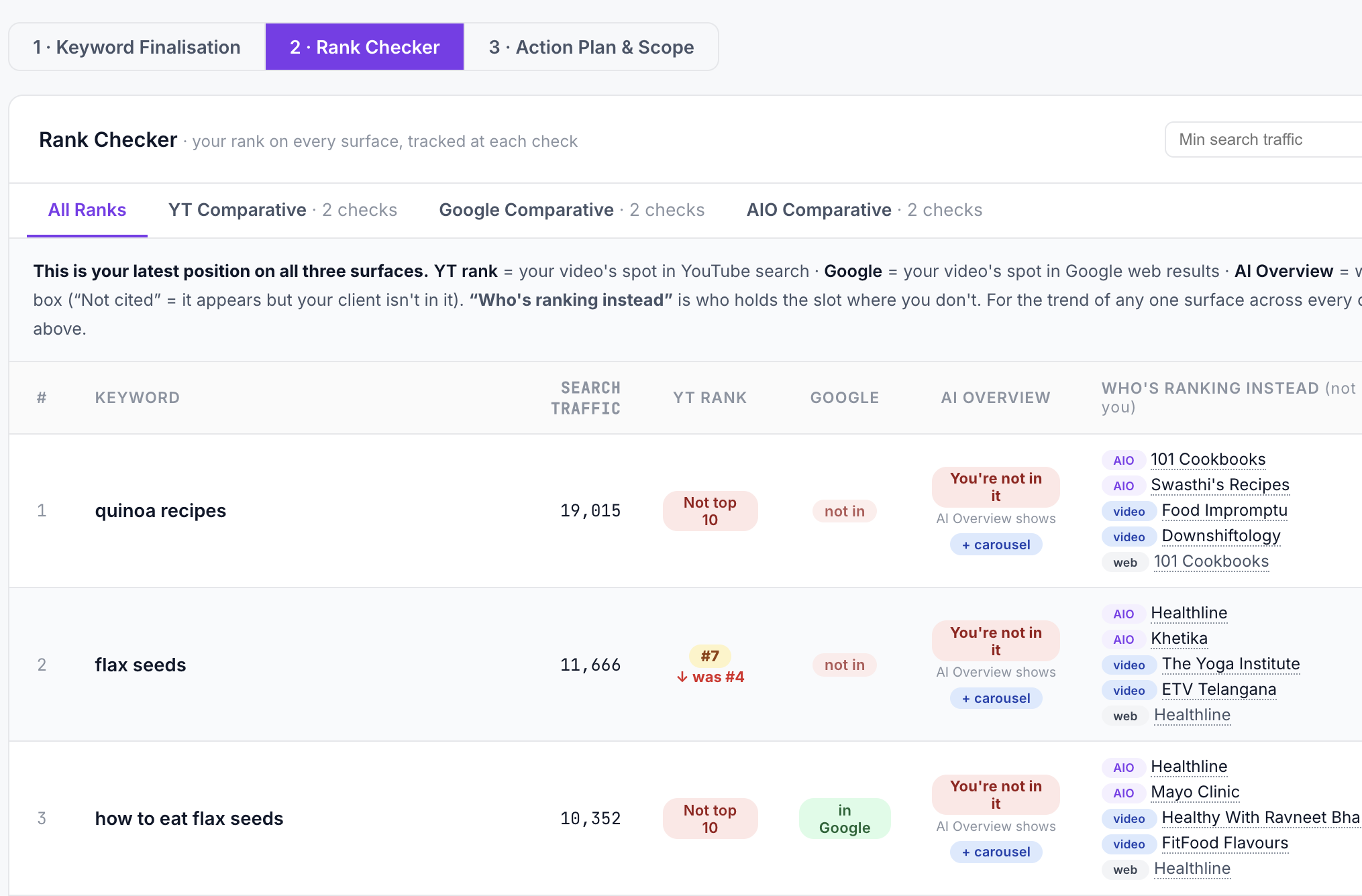 AI Overview citation status per tracked healthcare query with green/yellow/red state" width="1200" height="675" loading="lazy" decoding="async" style="width:100%;height:auto;display:block;">
Can an Indian doctor legally use patient testimonials on YouTube or a podcast?
Only under narrow conditions. NMC's 2022 advertising guidelines restrict testimonials that imply guaranteed outcomes or that solicit patients. The DPDP Act 2023 requires explicit, informed, purpose-specific consent for using any patient's identifiable data — including their voice, face, or medical detail. A testimonial that stays within these two frames — no outcome promises, no comparative claims, documented consent, right to withdraw — can be published. In practice, most compliant doctor channels avoid testimonials entirely and rely on explanatory content, procedure walk-throughs, and second-opinion education, which sidesteps the whole surface.
How long before a healthcare YouTube channel starts generating consult inquiries?
The first genuine consult inquiries usually arrive between month 3 and month 6 if the videos are speciality-specific, targeted at the patient's city, and end with a clear call to action. Meaningful, monthly inbound flow typically starts between month 6 and month 12. Anyone who promises inbound consults from month one either is running paid amplification or is defining consult very loosely.
Do podcasts show up in Google search or AI Overviews at all?
Rarely, and only through the show notes page if it is well written, structured, and indexable. Audio itself is not being cited inside AI Overviews for healthcare queries at any noticeable rate in India as of mid-2026. This is the single strongest structural reason to record on video even if you distribute on audio.
What is the minimum equipment we need to start a doctor's YouTube channel that looks professional?
A modern smartphone on a solid tripod, one lavalier microphone (wired or wireless), a single soft key light, a plain uncluttered background, and free editing software. Total setup cost can be under Rs 40,000. Everything beyond that improves the ceiling, not the floor. Doctors who over-invest on day one often delay their first upload by 2-3 months, which is a worse outcome than launching with modest equipment.
How does a doctor's YouTube channel connect to the rest of the clinic marketing stack?
Directly, if the plumbing is set up. Video views feed retargeting audiences for Meta and Google Ads. Comments and inbound queries can be routed into a lightweight CRM — ICG's AtomCRM at Rs 14,999 a month handles this shape well for a single-clinic or small-chain practice. For hospital groups running an RCM or EHR overlay like HealthPro 360, YouTube-sourced inquiries can be tagged distinctly so the marketing team can see cost-per-consult by content asset. None of this requires a heavyweight stack — but none of it happens by accident either.
Is a video podcast worth it if we already have a working YouTube long-form channel?
Usually yes, but not always as a separate show. The common path is to reformat one of the existing monthly long-form episodes as a two-person conversation, distribute the audio-only version, and treat the podcast as an extension rather than a new asset. Launching a genuinely separate podcast show only makes sense if the guest format lets you interview clinicians and referrers you would not otherwise put on your main channel.
How do we handle the compliance review cycle without slowing down publishing?
Set the compliance review at script stage, not at edit stage. Script-stage review takes 20 minutes per episode and catches almost every NMC risk before an editor spends 4 hours cutting. Edit-stage review catches the same problems but wastes production time and creates awkward re-recordings. A written script framework — with named sections that are explicitly flagged as testimonial-adjacent, comparative, or claim-adjacent — cuts review cycles roughly in half.
What does a realistic 12-month YouTube target look like for a solo consultant in India?
For a defined speciality in a defined city, publishing one long-form a week and 2-3 Shorts a week without missing more than 4 weeks in the year: 3,000 to 8,000 subscribers, 15-40 monthly consult inquiries by month 12, and 30-60% of your Google branded-search traffic sitting on videos rather than the clinic website. These are ranges, not guarantees. The variance is driven mostly by the topic-market fit and the thumbnail discipline in months 1-6.
Can we run both a YouTube channel and a podcast with one recording session?
Yes, and this is the shape most doctor-led programmes converge to by month 6-9 anyway. A single 45-60 minute recording block, if structured with chapter breaks and clean handoffs, yields a long-form YouTube upload, an audio-only podcast episode, and 3-5 vertical Shorts. This is the video-podcast format the earlier table refers to. Set-up cost is higher on day one; ongoing calendar cost is materially lower than running two separate shows.
How much of this should we do in-house versus outsource?
Recording, presenting, and clinical review must stay in-house — nobody else can be the doctor. Everything downstream of the recording — editing, thumbnails, description writing, chapter markers, schema markup, distribution, comment triage, monthly reporting — can and generally should be outsourced to a specialist team that runs multiple healthcare channels at once, because the pattern recognition compounds across accounts. The right split for most practices is: the doctor gives 2-3 hours a week to recording and script sign-off, the agency runs the rest.
Book a free 30-minute Brand & Growth Diagnostic.
It's a working session, not a sales pitch — you leave with a written root-cause analysis you can act on, whether or not you engage ICG.
Questions readers ask
about this topic.
The three platforms
behind every ICG engagement.
Beacon
CAPI middleware that fixes Event Match Quality, translates CRM statuses to Meta-standard events, dedups across channels.
Agency OS
Live client dashboard. GSC, GA4, Google Ads, Meta Ads, IVR calls in one view. Login anytime, not monthly.
Phoenix
Clinic revenue intelligence over your PMS. Daily action queue: Prevent Loss, Maintain & Engage, Grow Revenue. Multi-centre rollout.
Or book a free 30-min audit to see all three in action on your account.
Healthcare brands
that already run on ICG.
A representative slice of the 150+ healthcare brands ICG has delivered for across India. Most engagements remain under NDA.


What ICG clients say · on video.
"Scale up of organic channels and business consulting. ICG has absolute domain authority in their field."
"Working with ICG transformed how we acquire IVF patients in Gurgaon. They understand the fertility journey from inquiry to consult..."
"What Ichelon accomplished — they got all my ideas and worked over 3-4 months to create an amazing, super-customised website."
Need help operationalising this?
Every ICG service is healthcare-only, NMC + DPDP-aware, and built around the patient-research patterns that drive Indian healthcare growth in 2026.
Every practice welcome — packages from ₹20,000/mo.
Goals-Driven engagements · Performance-Linked Payout Models available



More from
ICG.
Five trends shaping Indian healthcare marketing through 2027: AI-first patient research, Conversions API adoption, ABDM discovery, the AEO w...
Healthcare AIO is the discipline of getting your clinic or hospital cited inside Google AI Overviews, ChatGPT and Perplexity answers — not j...
Conversational-search advertising places brand messages inside AI chat answers — ChatGPT, Perplexity, Copilot — rather than beside a results...
Stop guessing.
Book a Diagnostic.
30 minutes. Free. With the AI-powered healthcare-only marketing agency 150+ brands already run on. No slides, no pitch, no hard close.


