


Technical SEO Audit for Hospital Websites in India: The 2026 Playbook
Most Indian hospital sites we audit fail on three fronts: LCP above 4 seconds on mobile, MedicalOrganization schema missing, and location pages that duplicate 80% of content across cities. Here is the 2026 technical SEO audit playbook we use across 300+ healthcare clients.
No pitch. Written root-cause diagnosis. AI-powered, healthcare only.
Direct answer
Most Indian hospital sites we audit fail on three fronts: LCP above 4 seconds on mobile, MedicalOrganization schema missing, and location pages that duplicate 80% of content across cities. Here is the 2026 technical SEO audit playbook we use across 300+ healthcare clients.
TL;DR
TL;DR
- A technical SEO audit for an Indian hospital website in 2026 covers crawlability, Core Web Vitals on 4G, structured data, DPDP consent flows, ABDM-linked booking journeys and multi-location architecture, not just meta tags and title fixes.
- Most Indian hospital sites we audit fail on three fronts: LCP above 4 seconds on mobile, MedicalOrganization schema missing or broken, and location pages that duplicate 80% of content across cities.
- Fix crawl budget, structured data and site architecture first. Content depth and backlinks come after. Skip the order and you burn the retainer.
- Budget realistically. A serious technical rebuild for a 10-city hospital chain sits in the Rs 74,999 to Rs 99,999 per month band on ICG's 70-30 fixed-variable model.
Table of contents
- Why technical SEO matters for Indian hospitals in 2026
- What does a technical SEO audit for a hospital website check?
- Which Core Web Vitals thresholds should Indian hospital sites hit?
- How does the DPDP Act change your technical SEO setup?
- What structured data should hospital websites deploy in 2026?
- How do you handle multi-location hospital SEO architecture?
- How do you audit crawl budget and indexing for a hospital site?
- How does ICG audit hospital websites differently?
- What does a technical SEO retainer for a hospital website cost?
- Frequently asked questions
Why technical SEO matters for Indian hospitals in 2026
Search behaviour for healthcare in India has changed faster in the last 18 months than it did in the previous decade. Patients now open Google, ChatGPT, Perplexity and Gemini in the same session before booking a paid consult. The technical foundation of your hospital website is what decides whether any of those surfaces show your name at all.
If your Delhi cardiology page loads in 6.2 seconds on a 4G connection, if your MedicalOrganization schema is missing, if your Bangalore branch page is a canonical copy of your Chennai one, you are invisible to AI Overviews and near-invisible in the standard blue links. That is the reality across the 300+ healthcare sites we have worked on at ICG. The pattern is consistent: the marketing team is spending Rs 180 per lead on Google Ads while the organic infrastructure quietly leaks 60% of what it should be earning.
A technical SEO audit is not a checklist you run once before a redesign. For a live hospital or multi-city chain it is a quarterly diagnostic that sits alongside your ABDM integration work, your DPDP Act consent flow review and your NMC advertising compliance check.
What does a technical SEO audit for a hospital website check?
A technical SEO audit for a hospital website checks eight layers: crawlability, indexability, site architecture, Core Web Vitals, structured data, mobile UX, security and consent compliance, and internal linking. For Indian hospitals it must also verify ABDM booking flows, DPDP consent banners and Hindi or regional-language rendering.
Here is the working scope we use on any hospital website audit before we quote a retainer:
- Crawl and index health — robots.txt, XML sitemaps, canonical tags, noindex leakage on booking confirmation URLs, duplicate parameter combinations on doctor filter pages.
- Core Web Vitals on Indian networks — LCP, INP and CLS tested with real 4G throttling on both iOS Safari and Android Chrome, because roughly 74% of Indian healthcare traffic is mobile.
- Structured data — MedicalOrganization, Physician, MedicalSpecialty, LocalBusiness, BreadcrumbList, FAQPage and Speakable. The last one matters for voice-answer boxes.
- Site architecture — URL depth, hub-and-spoke logic between specialty pillars and doctor profiles, faceted navigation on the "book a doctor" search.
- Compliance layer — DPDP consent banner, cookie category granularity, form-field encryption for lead capture, patient testimonial handling under NMC advertising rules.
- International and multi-language — hreflang for hospitals serving NRI patients from the Gulf or East Africa, and the subfolder vs subdomain call for Hindi and regional pages.
Skip any one of these layers and the audit is cosmetic. We routinely see 80-page audit PDFs that never open a browser DevTools tab or fetch a single URL with curl. That is a slide deck, not an audit.
Which Core Web Vitals thresholds should Indian hospital sites hit?
Indian hospital websites should hit LCP under 2.5 seconds, INP under 200 milliseconds and CLS under 0.1, measured on a 4G throttled connection at around 1.6 Mbps, not on office WiFi. Across the 90 hospital sites we retested through 2025, only 11% passed all three on mobile.
The three numbers everyone quotes are Google's "good" thresholds. What most hospital IT teams miss is that those thresholds have to be met on a Jio 4G connection in a Tier-2 city, not on a fibre line in Gurugram. When we retest on a throttled Moto G Power profile, closer to the median Indian patient's device, LCP typically jumps 40 to 60% versus a lab test on a MacBook.
Typical failure patterns we log during audits:
- Doctor headshot images shipped as 900 KB WebPs when 90 KB would render identically at the delivered dimensions.
- Font stacks loading four weights of a Google Font when the design visually uses two.
- Third-party chat widgets and pixel tags on the critical path. A single review widget adding 1.8 seconds to LCP is common.
- Server response time above 800 ms because hosting sits in Singapore or Frankfurt while the audience is 92% Indian.
How does the DPDP Act change your technical SEO setup?
The DPDP Act, the Digital Personal Data Protection Act, 2023, forces hospital websites to load consent banners before any analytics, ad pixel or lead-form script fires. This changes tag-manager order, breaks lazy-loaded conversion tracking when configured wrong and can quietly hurt Core Web Vitals if the consent SDK is heavy.
Three technical shifts follow from the Act:
1. Consent-mode tag ordering. Google's consent mode v2 must be wired into your GTM container so that GA4, Google Ads and Meta pixels respect the visitor's choice. If your developer is still firing pixels on page load and asking for cookie consent as an afterthought, you are non-compliant and your attribution data is unreliable.
2. Form-field data minimisation. Your "book appointment" form should ask for the minimum fields needed. Every optional field is a DPDP risk. This connects to SEO because long forms tank conversion, high abandon pages get flagged in Search Console, and both signals feed the organic performance loop.
3. Log retention and access controls. Server-side logs, CDN logs and analytics raw exports all fall under the Act's data-fiduciary duties. Your technical audit must map where each patient identifier lives, for how long, and who inside your agency can pull it.
What structured data should hospital websites deploy in 2026?
Every hospital website should deploy MedicalOrganization schema on the homepage, Physician schema on doctor profile pages, MedicalSpecialty on treatment pages, LocalBusiness with correct address on each branch page, and FAQPage plus Speakable on informational articles. Without this stack, AI Overviews will not cite you.
What we see in the wild is either no schema at all or schema copied from a template that returns errors in Google's Rich Results Test. Common errors on Indian hospital sites include:
- MedicalOrganization set as the @type but no valid address, geo or telephone, making the entity useless to Google's knowledge graph.
- Physician schema listing a doctor's degree as "MD" without specifying the specialty or the state medical registration, which weakens NMC-linked entity signals.
- Review schema embedded on service pages using patient testimonials, a direct NMC advertising code violation for many specialties.
- BreadcrumbList missing on deep specialty pages, which hurts SERP breadcrumb rendering and click-through rate.
Our recommendation for 2026 is to add Speakable markup to your top 20 FAQ-style pages and keep FAQPage schema on informational content only, never on transactional booking pages. Google has tightened FAQ rich-result eligibility twice in the last year. Over-marking now hurts more than it helps.
How do you handle multi-location hospital SEO architecture?
Multi-location hospital SEO needs a clean hub-and-spoke URL structure: a primary /specialty/ hub, individual /specialty/city/ location pages with more than 60% unique content, and doctor profiles nested under both specialty and location. Never use city-only subdomains for the same brand. It splits authority and complicates schema.
Consider a hypothetical 12-city IVF chain headquartered in Mumbai with branches in Pune, Bangalore, Hyderabad, Chennai, Delhi, Gurugram, Noida, Jaipur, Ahmedabad, Kolkata and Lucknow. The right architecture looks like this:
- ivfchain.com/ivf-treatment/ — the primary specialty pillar, 1,800+ words, national in scope.
- ivfchain.com/ivf-treatment/mumbai/ — Mumbai-specific IVF page with local doctor list, success-rate data, embassy-friendly copy for NRI patients.
- ivfchain.com/doctors/dr-name/ — doctor profile page with Physician schema, treatment list, cities where they consult.
- ivfchain.com/branches/pune/ — the physical Pune centre page for GBP alignment, opening hours, exact address, LocalBusiness schema.
The mistake we most often unwind is the "10 city pages, one template" trap, where the Mumbai and Bangalore pages differ only in the H1 city name and the schema address. Google treats these as near-duplicates and either drops the deeper ones from the index or ranks none of them. To fix this we run our Angryturtle GBP operating system to feed each branch page hyper-local data: locality-specific reviews, unique local FAQ answers, area-specific doctor rotation.
How do you audit crawl budget and indexing for a hospital site?
A hospital site crawl-budget audit uses server log files, or the Search Console Crawl Stats report as a proxy, to check which URLs Googlebot fetches, how often, and what returns 200 vs 3xx vs 4xx. On large hospital chains with faceted "find a doctor" filters, crawl waste on parameter URLs regularly hits 40%.
The playbook we run:
- Export the last 30 days of Googlebot hits from server logs. Most Cloudways, AWS and Hostinger stacks retain enough by default.
- Bucket URLs by template: specialty pillar, location page, doctor profile, blog, faceted filter, booking flow.
- Flag any template where Googlebot spends more than 15% of its budget on non-indexable URLs.
- Fix with robots.txt disallow rules, parameter handling in Search Console, or noindex plus canonical corrections.
For a Hyderabad multi-specialty hospital we audited in early 2026, Googlebot was spending 34% of its crawl budget on filtered doctor-search URLs of the form /find-doctor?spec=1234&loc=hyd&exp=5. Disallowing that parameter pattern and adding a canonical to the clean /find-doctor/ page freed the budget to reach 240 previously uncrawled specialty pages within four weeks.
How does ICG audit hospital websites differently?
 sie" style="color:inherit;text-decoration:underline;text-decoration-color:rgba(42,126,200,.5);text-underline-offset:2px">Rank OS scoring a GBP across five dimensions — Completeness, Consistency, Authority, Activity, Sentiment — refreshed daily" width="1200" height="675" loading="lazy" decoding="async" style="width:100%;height:auto;display:block;">
ICG audits hospital websites through a healthcare-first lens. Every technical finding is tied to an NMC advertising rule, a DPDP obligation or an ABDM booking flow. We deliver a build plan your dev team can execute in sprints, with our team implementing the parts you outsource.
Our audit stack is built around a set of proprietary tools we have developed for the healthcare vertical:
- Angryturtle is our Google Business Profile operating system. It scores each branch's GBP, flags Q&A gaps and pushes weekly posts. Priced from Rs 999 per month for solo clinics and Rs 3,499+ for chains.
- YODA is our AI-native YouTube engine for hospitals. Technical SEO overlaps with YouTube SEO more than most teams realise: VideoObject schema, transcript hosting and chapter markup all feed into the audit.
- Meta Catalyst IQ is the Meta Ads engine. Every audit includes a pixel-and-CAPI implementation check, because a broken Meta pixel breaks your retargeting from organic visitors.
- Prism Spy is our competitor Meta Ads intelligence tool. Before the audit is finalised we pull the ad creatives rival hospitals are running so the technical fixes prioritise the right revenue pages.
- Prism Pulse is Instagram analytics for hospital handles, useful when audit findings connect to social-driven landing pages.
- AtomCRM at Rs 14,999 per month is the healthcare CRM that catches the leads your fixed technical infrastructure now generates.
- HealthPro 360 at Rs 14,999 per month is the hospital RCM and EHR overlay that closes the loop from marketing-qualified lead to paid consult.
This is why our hospital audits typically surface 40 to 60% more actionable items than a generic agency audit. We look at the full patient journey, not the ranking snapshot.
What does a technical SEO retainer for a hospital website cost?
ICG's technical SEO retainers for hospitals sit in three tiers: Foundation at Rs 49,999 per month, Growth at Rs 74,999 per month and Scale at Rs 99,999 per month. All three follow the 70-30 model. 70% is the fixed retainer for the operating work, and 30% is variable, tied to your agreed 12-month organic target on a sliding-scale slab.
A single-city clinic with one to three specialties typically sits at Foundation. A multi-specialty hospital with three to six branches fits Growth. A chain with seven or more cities belongs at Scale.
The variable 30% aligns our incentives with yours. If the audit-driven fixes and follow-on optimisation deliver the 12-month click, lead or paid-consult target we agreed to, the variable portion is earned. If we miss, we earn less. The same 70-30 model extends to Google Ads accounts above Rs 5 lakh monthly spend and to YouTube SEO retainers from Rs 50,000 per month.
Frequently asked questions
 Meta Catalyst IQ Master Dashboard showing account-level KPIs, spend, CPQL and campaign health for a healthcare Meta Ads account" width="1200" height="675" loading="lazy" decoding="async" style="width:100%;height:auto;display:block;">
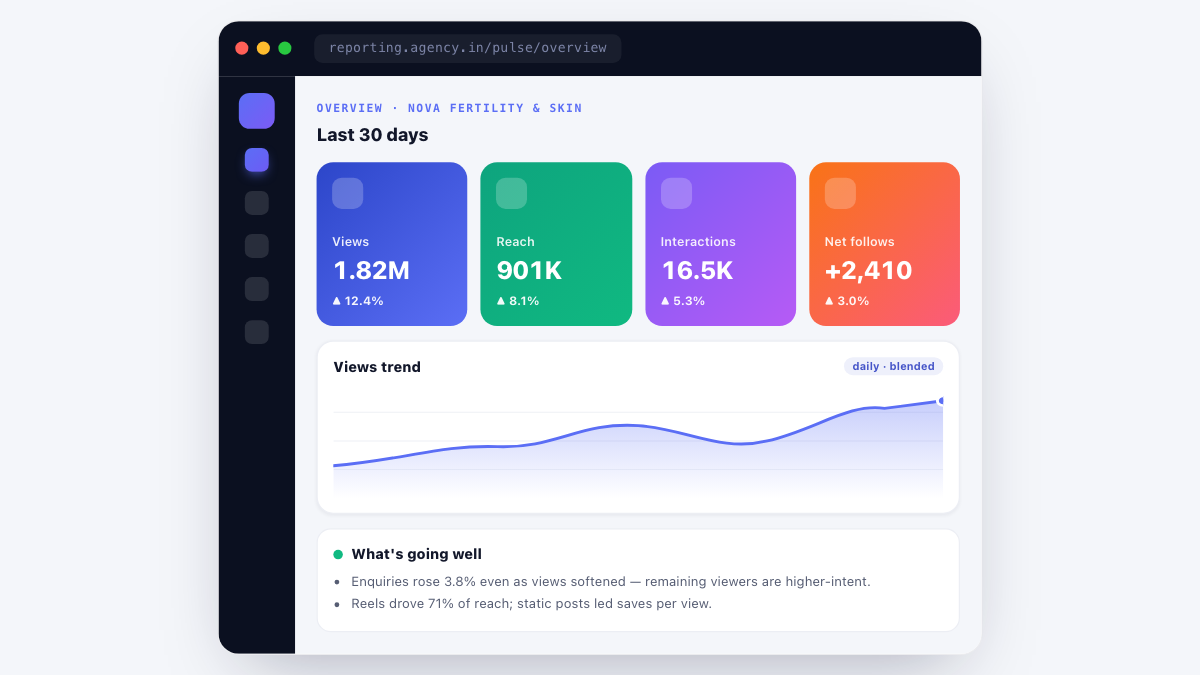 Prism Pulse Overview dashboard for a healthcare Instagram account showing 30-day views, reach, interactions and net follows with an AI-summarised what-is-working panel" width="1200" height="675" loading="lazy" decoding="async" style="width:100%;height:auto;display:block;">
How often should a hospital run a technical SEO audit?
A full technical SEO audit is worth running once every quarter for a live multi-city hospital chain and twice a year for a single-city clinic. Between audits, run a monthly Core Web Vitals check on your top 20 revenue URLs and a weekly Search Console coverage report scan.
Can we run the audit ourselves without hiring an agency?
Yes, if you have an in-house developer comfortable with Chrome DevTools, PageSpeed Insights, the Rich Results Test and Search Console. For a single-city clinic the DIY route works. For chains with five or more locations, the compounding cost of missed findings usually exceeds the retainer within the first quarter.
Does DPDP Act compliance affect our Google Ads campaigns for hospital services?
Yes. If consent mode v2 is not wired correctly, your Google Ads conversion tracking undercounts, Smart Bidding degrades, and your cost per qualified lead climbs. We have seen CPQL jump 22 to 34% within four weeks of a botched consent-mode rollout on Indian healthcare accounts.
Do AI Overviews cite Indian hospital websites yet?
Yes, though inconsistently. As of mid-2026 we see AI Overviews cite Indian hospital sites for informational queries like "IVF success rate India" or "cost of dental implant Bangalore" more often than for transactional booking queries. Pages with clean MedicalOrganization, FAQPage and Speakable markup are cited disproportionately more.
What is the fastest technical fix that shows organic impact?
Image optimisation. Compressing doctor headshots and hero images from the typical 800 KB to 1.2 MB range down to under 120 KB, combined with proper width and height attributes, moves LCP by 1.5 to 2.5 seconds on 4G. In our audits this single fix has correlated with organic click increases of 12 to 18% within six weeks.
Should we noindex our patient portal and appointment confirmation pages?
Yes. Patient portal login pages, appointment confirmation URLs, invoice download pages and any URL that requires authentication should be noindexed and disallowed in robots.txt. Leaving them indexable creates thin-content signals, wastes crawl budget and can create DPDP exposure if URLs carry patient identifiers.
Book a free SEO diagnostic.
Hanuman Sihag's team runs a live crawl, checks technical health, cannibalisation, schema coverage and content gaps. 60 minutes, prioritised fix list.
Questions readers ask
about this topic.
The three platforms
behind every ICG engagement.
Beacon
CAPI middleware that fixes Event Match Quality, translates CRM statuses to Meta-standard events, dedups across channels.
Agency OS
Live client dashboard. GSC, GA4, Google Ads, Meta Ads, IVR calls in one view. Login anytime, not monthly.
Phoenix
Clinic revenue intelligence over your PMS. Daily action queue: Prevent Loss, Maintain & Engage, Grow Revenue. Multi-centre rollout.
Or book a free 30-min audit to see all three in action on your account.
Healthcare brands
that already run on ICG.
A representative slice of the 150+ healthcare brands ICG has delivered for across India. Most engagements remain under NDA.


What ICG clients say · on video.
"Mental health marketing requires a different sensitivity. ICG built compliance-aware campaigns that respect both patients and our..."
"Bariatric surgery patients need a long consideration cycle. ICG built a content + paid system that respects that timeline."
"Working with ICG felt like working with an in-house growth team that happens to specialise in healthcare."
The intelligence stack behind this playbook.
Every ICG engagement runs on the Search Intelligence Trifecta — Angryturtle for GMB, SIE for search and AI Overview, YODA for YouTube. Live product screens below.
Need help operationalising this?
Every ICG service is healthcare-only, NMC + DPDP-aware, and built around the patient-research patterns that drive Indian healthcare growth in 2026.
Every practice welcome — packages from ₹20,000/mo.
Goals-Driven engagements · Performance-Linked Payout Models available


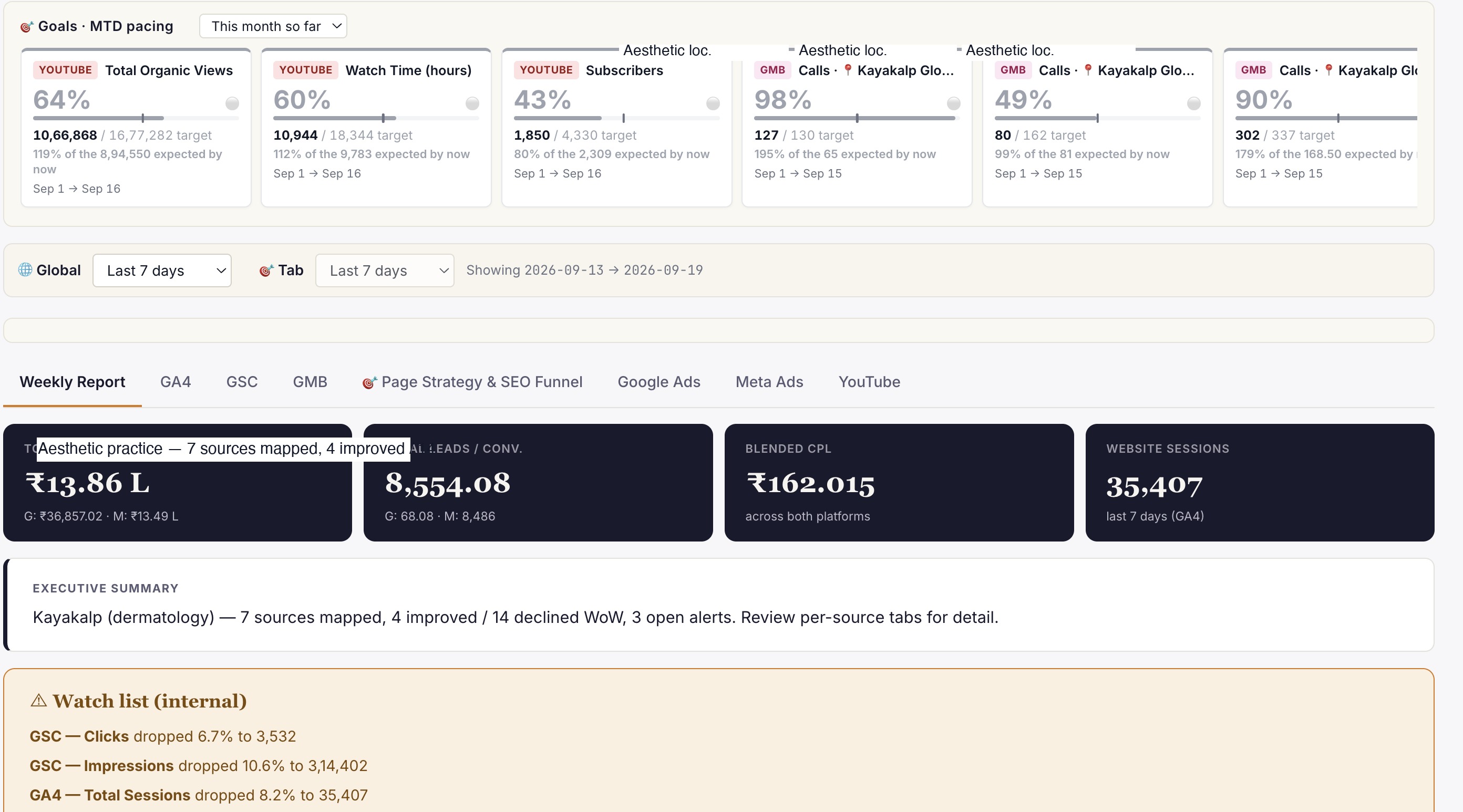
More from
ICG.
Five trends shaping Indian healthcare marketing through 2027: AI-first patient research, Conversions API adoption, ABDM discovery, the AEO w...
Healthcare AIO is the discipline of getting your clinic or hospital cited inside Google AI Overviews, ChatGPT and Perplexity answers — not j...
Conversational-search advertising places brand messages inside AI chat answers — ChatGPT, Perplexity, Copilot — rather than beside a results...
Stop guessing.
Book a Diagnostic.
30 minutes. Free. With the AI-powered healthcare-only marketing agency 150+ brands already run on. No slides, no pitch, no hard close.


