


Medical SEO Master Guide for Indian Doctors and Hospitals 2026
A founder-led pillar guide to medical SEO in India for 2026 — architecture, EEAT for Indian doctors, DPDP-safe lead capture, Google Business Profile, AI Overviews, video, portfolio benchmarks, buyer archetypes and a 12-month execution plan.
No pitch. Written root-cause diagnosis. AI-powered, healthcare only.
Direct answer
A founder-led pillar guide to medical SEO in India for 2026 — architecture, EEAT for Indian doctors, DPDP-safe lead capture, Google Business Profile, AI Overviews, video, portfolio benchmarks, buyer archetypes and a 12-month execution plan.
TL;DR
TL;DR
- Medical SEO in India in 2026 is a three-surface game — classic blue links, Google Business Profile and AI Overviews. A plan that ignores any one surface will underperform.
- EEAT is enforced harder in Indian healthcare than in almost any other vertical. Named doctor bylines, NMC registration numbers, a documented medical reviewer trail and clean citations to Indian health authorities are the difference between a page that ranks and a page that sits invisible on page four.
- The DPDP Act 2023 has pulled consent language, retention policy and pixel governance inside the SEO scope. Sites that update their forms and privacy pages protect long-term ranking and ad-account health.
- Local SEO — one verified Google Business Profile per physical location, city-level landing pages, disciplined review collection — is the single highest-ROI surface for the first six to nine months.
- AI Overviews reward extractable, expert-attributed, schema-marked content. Pages that used to win top-3 blue links are not the same pages that win AI citations.
- In ICG's 150-clinic portfolio, healthy programmes see local-pack lift inside 30–60 days, AIO citations in 90–180 days, and top-5 organic rankings on competitive money terms inside 6–9 months.
- ICG's 70-30 packages (Foundation Rs 49,999 / Growth Rs 74,999 / Scale Rs 99,999) split retainer from performance so agency incentive follows outcome, not activity.
Table of Contents
- Why this pillar matters for Indian healthcare in 2026
- Foundation: what medical SEO actually means in India
- Technical foundation for medical websites
- Content strategy for medical practices
- Local SEO and Google Business Profile
- AI Overviews and the new SERP
- Paid, social and video as multipliers
- Numbers and benchmarks from a 300-client portfolio
- Buyer archetypes and tailored recommendations
- Common mistakes we see every quarter
- The 70-30 pricing model, explained
- A 12-month execution roadmap
- Key takeaways
- FAQ
Why this pillar matters for Indian healthcare in 2026
Medical marketing in India is not what it was three years ago. A cardiology practice in Andheri, an IVF chain running six centres between Bengaluru and Hyderabad, a diagnostics lab in Jaipur, a hospital marketing team in Gurugram — the buying journeys have all changed, and search is at the centre of every one of them.
Three shifts sit under the surface. First, the SERP itself is now a stacked interface. On a phone in Delhi, a search for best gynaecologist near me returns an AI-generated summary, a map pack with three verified clinics, a video carousel, People Also Ask, sometimes a Discussions and Forums block, and only then the traditional ten blue links. Second, the buyer has become quieter — patients and their families research for weeks, watch YouTube explainers, read AI answers, and only reach out when they have narrowed the choice to two or three names. Third, the regulatory frame has tightened, with the DPDP Act 2023 in force, NMC advertising norms actively enforced, and ABDM interoperability slowly reshaping the data plumbing under Indian healthcare.
The consequence for marketing leadership is uncomfortable. A plan that worked in 2022 — a directory listing, a WordPress blog, a Facebook page and a monthly ranking report — no longer produces enough qualified leads to justify itself. What replaces it is deeper, quieter, and more disciplined. That is what this pillar covers.
This guide is written for a specific reader — the person inside a hospital, clinic chain, pharma brand or specialist practice who is accountable for lead volume, patient bookings or brand equity, and who has to translate a strategy into a monthly plan that a small team can execute. It is not a listicle. It is not a beginner's introduction. It is what we would tell a founder over a two-hour whiteboard session before they signed anything.
Foundation: what medical SEO actually means in India
Before tactics, definitions. Medical SEO in India is the discipline of engineering a healthcare provider's discoverability across the three surfaces where Indian patients now find information — classic organic search, local map results, and AI-generated answers — while remaining compliant with NMC advertising rules, DPDP data-protection obligations, and platform-level YMYL scrutiny.
The three surfaces you must rank on
The old mental model was rank on Google for these ten keywords. That framing is obsolete. In our audit work across 150-plus clinics, we now split the surface area into three:
- Organic search — the traditional blue links, still responsible for the majority of high-intent traffic on desktop and for research-phase queries on mobile.
- Local search — the map pack, Google Business Profile, and every result served on near me or city-specific queries. For single-location clinics and multi-city chains, this is the dominant source of appointment calls.
- AI-generated answers — Google's AI Overviews, ChatGPT's citations, Perplexity's source panels, Gemini's summaries. The click-through-rate here is smaller than blue links, but the trust signal is larger, and the citation source materially shifts brand consideration.
Every content decision, technical decision and link decision should be tested against all three surfaces. A page that ranks on blue links but does not surface a citation in an AI answer has left half its potential on the table.
Why healthcare SEO differs from other verticals
Two words — Your Money or Your Life. Google's own quality guidelines treat healthcare content as YMYL, meaning the platform holds it to a higher evidentiary and expertise standard than, say, a lifestyle blog or a travel site. Practically, this shows up as a steeper EEAT threshold, more visible ranking volatility during core updates, and a heavier weighting of authority signals — named authors with verifiable credentials, clean citation trails, transparent about pages, structured medical schema, and a track record of not making unsupported claims.
Indian healthcare adds another layer. The NMC's advertising regulations prohibit soliciting patients through guaranteed outcomes, disparaging comparisons or unverifiable superlatives. A page that promises the best IVF success rates in Bengaluru without evidentiary basis is not just poor SEO — it is a regulatory exposure. A well-designed content programme sits comfortably inside these constraints. Agencies that ignore them do their clients real damage.
The regulatory frame — NMC, DPDP and ABDM
Three Indian frameworks now shape the practical execution of medical SEO in 2026.
The National Medical Commission governs how doctors and healthcare institutions advertise themselves. Content must be factual, non-comparative, and free of guarantees. Testimonials require documented patient consent. Before-and-after imagery for dermatology, dental and aesthetic work needs consent, non-identifying framing and honest disclosure of variability.
The Digital Personal Data Protection Act 2023 governs the collection and processing of personal data through healthcare websites. Every lead form, every appointment-booking widget, every WhatsApp opt-in and every retargeting pixel now sits inside its scope. Consent language must be specific and unbundled. Retention policies must be documented and honoured. Data fiduciary responsibilities extend to third-party analytics and ad platforms.
The Ayushman Bharat Digital Mission is a slower-moving but structurally important shift, standardising health identifiers and interoperability protocols. For SEO the near-term implication is modest, but the medium-term implication — cleaner health data, more integrated patient records, more searchable service catalogues — will reshape how healthcare providers describe themselves on their own sites.
Section takeaway: Medical SEO in India is a three-surface game inside a real regulatory frame. Any strategy that ignores either the surfaces or the frame is fragile.
Technical foundation for medical websites
Content and links get the attention. Technical foundations decide whether either investment pays off. In our 150-clinic portfolio, roughly two of every three sites we onboard have a technical debt problem large enough to cap the ceiling of anything else the team does.
Site architecture for multi-location clinics
The single most common failure pattern in Indian hospital and chain-clinic websites is architectural. A five-city IVF chain lands on a template that puts all locations under a single /contact page, all services under a single /services page, and no city-plus-service intersections anywhere in the URL structure. The result — no city-specific pages to rank, no natural anchor text for internal links, no way for Google Business Profile listings to link back to a matching landing page.
The fix is a matrix. Every city becomes a folder. Every service inside that city becomes a page. So a chain operating in Bengaluru, Mumbai, Delhi, Chennai, Hyderabad and Pune with three core services generates eighteen city-plus-service pages, each with its own doctor bios, address block, local schema and unique regional context. This is the structural precondition for local ranking.
Core Web Vitals for healthcare
Healthcare sites tend to be heavy — hero videos, doctor headshots, high-resolution before-and-after galleries, embedded booking widgets, third-party review carousels. Left unmanaged, this stack pushes Largest Contentful Paint past three seconds on 3G, cripples Interaction to Next Paint, and quietly caps mobile rankings.
The disciplined baseline is straightforward — lazy-loaded images below the fold, next-gen image formats, deferred non-critical JavaScript, a strict budget for third-party embeds, and a monthly Core Web Vitals review that treats regressions as bugs rather than curiosities. Our own automated CWV injector is a small but useful tool here; the discipline it enforces matters more than the tool itself.
Schema markup that matters
Healthcare schema is one of the highest-leverage technical investments a medical website can make. The types that consistently earn richer SERP treatment for our clients — MedicalOrganization or Hospital at the site level, Physician for individual doctor pages, MedicalProcedure or MedicalCondition on service pages, FAQPage for well-structured FAQ blocks, VideoObject for embedded doctor videos, LocalBusiness for each city location, and Article with named author for editorial content.
Schema is not a ranking factor in the crude sense, but it is an eligibility factor. Pages without proper schema simply cannot appear in the richer SERP features — no FAQ dropdowns, no doctor cards, no video thumbnails, no direct AI-answer attribution.
Section takeaway: Fix the plumbing before you scale the content. A clean multi-location architecture, disciplined Core Web Vitals and layered medical schema together raise the ceiling of everything else you invest in.
Content strategy for medical practices
The most expensive mistake in Indian medical SEO is writing content that reads well but ranks nowhere. The second most expensive is writing content that ranks briefly, gets deprecated in the next core update, and takes six months of new work to replace. A durable content strategy avoids both by structuring around clusters, authority and geography.
The pillar-cluster-money model
We structure content for medical clients in three concentric tiers.
Pillar pages are broad, comprehensive guides to a category — like this one for medical SEO, or a hospital's own pillar on Cardiac Care in India. They target the head term, run 4,000 words or more, and internally link out to a cluster of specific pages.
Cluster pages are focused answers to specific questions or sub-topics — angioplasty recovery timeline, how to prepare for a stress test, differences between bypass and stenting. They target long-tail queries, run 1,200 to 2,000 words, and each links back to the parent pillar with clean, descriptive anchor text.
Money pages are the commercial destinations — service pages for specific procedures, city-plus-service intersections, doctor profiles, cost calculators, appointment funnels. They target commercial-intent keywords, carry the CTA, and are where SEO traffic converts into consultations.
The mistake we see most often is a hospital that publishes forty pillar-length blogs a year and does not build any clusters — the pillars sit disconnected, no internal-linking equity flows, and the money pages stay starved of authority.
EEAT for Indian doctors
Experience, Expertise, Authoritativeness and Trustworthiness are not abstract concepts for Indian medical content. They translate into concrete on-page elements — a named author with a linked bio page, the doctor's NMC registration number visible on their profile, a medical reviewer credit for content written by a marketing team, links to Indian regulatory sources like the Indian Council of Medical Research or the Ministry of Health and Family Welfare where relevant, a last-updated date, and an About page that lists the editorial process.
Our own Named Experts Byline component enforces this at the template level — every article carries a real named byline, a schema-marked Person block, and a link to the author's profile. This is not decorative. In audits where we have moved a site from generic Admin bylines to named clinician bylines with proper schema, we routinely see measurable ranking lift within a quarter.
Language, geography and Indian context
A content strategy written from Silicon Valley loses in India. Search intent in Indian metros splits across English, Hindi, and increasingly regional-language transliterations. Users type IVF cost in Bengaluru, but they also type IVF treatment kitna paisa lagega and bacha nahi ho raha. Money terms are English. Symptom research often is not.
Geography also matters more than most agencies acknowledge. Fertility content that ignores the difference between the Mumbai and Kochi markets, cardiology content that treats Delhi NCR as one entity rather than acknowledging Gurugram, Noida and Faridabad as distinct search markets, dental content that ignores the price-sensitivity gradient between Tier-1 and Tier-2 cities — all of it produces flat content that ranks nowhere in particular.
Section takeaway: Build clusters, not orphans; write with named clinicians, not anonymous copywriters; and localise for the Indian city, not the abstract Indian patient.
Local SEO and Google Business Profile
For any healthcare provider with a physical location — which is almost all of them — local SEO is the highest-ROI investment for the first six to nine months of a programme. In our onboardings, it is also the surface where we see the fastest measurable movement.
The Google Business Profile operating system
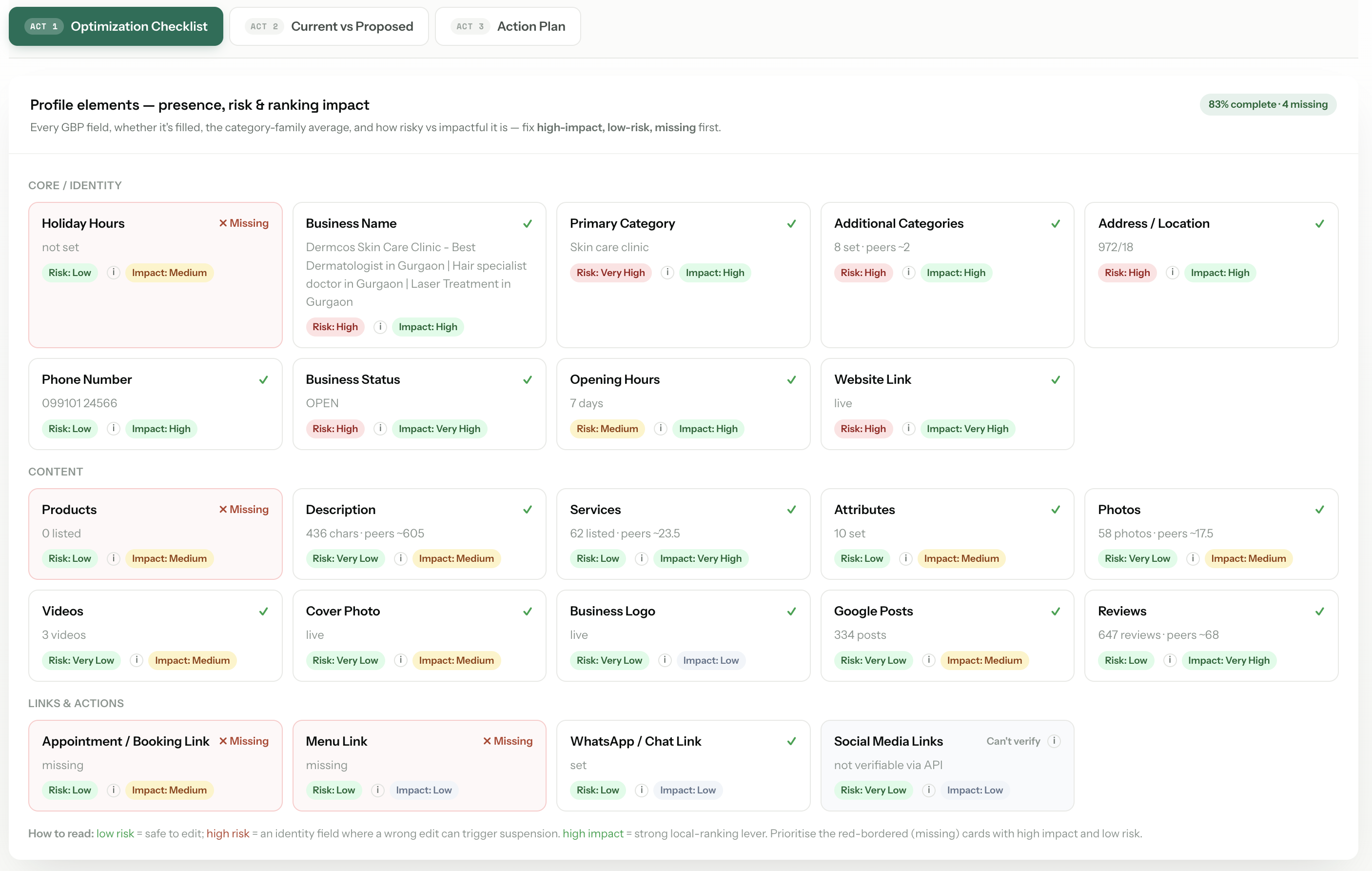
A Google Business Profile is not a set-and-forget listing. Treated properly, it is an operating system — a rhythm of weekly posts, monthly photo refreshes, ongoing review responses, service updates, event announcements, and Q&A curation. This is the discipline our own Angryturtle product was built to enforce, and it is the single most under-invested surface in Indian healthcare marketing.
The elements that matter — a fully populated profile with categories, attributes, services and hours; a steady cadence of GBP posts (weekly is our baseline); high-resolution photos refreshed monthly; timely review responses; a curated Q&A section; and structured service listings that mirror the website's money pages.
Multi-location management without chaos
A chain running eight clinics across Delhi NCR needs eight verified profiles, eight sets of unique photos, eight streams of reviews, and eight sets of city-level landing pages that internally reference each profile. The single most common failure — and we see it in perhaps four of every five multi-location clients we onboard — is a single master profile serving as a placeholder for the head office while satellite locations either do not exist on Google or exist as unverified, unclaimed suggestions.
The fix is structural. Verify every location. Standardise NAP data across every profile, the website, and every third-party directory. Build a city-plus-service landing page for each location that mirrors the profile. Assign a named owner inside the client's marketing team to each region, so review response and post cadence do not depend on the agency.
Reviews and reputation as a ranking asset
Review volume, recency and response rate all feed local ranking. In our benchmark data, clinics that move from an average of two new reviews a month to eight new reviews a month typically see a proportional lift in local pack visibility within a quarter, provided the reviews are earned honestly and responded to within 48 hours.
The routine is unglamorous. A front-desk-driven request at discharge, a same-day WhatsApp follow-up link, a monthly audit of unanswered reviews, and a policy for handling negative reviews with grace rather than legal threats. This is the boring work that compounds.
Section takeaway: Local SEO out-earns broader content for the first two quarters of most healthcare engagements. Treat GBP as an operating system, not a listing.
AI Overviews and the new SERP
The most important structural change in search since mobile-first indexing is happening now — the shift from ten blue links to answer-first results. For Indian healthcare, where users increasingly ask their questions to ChatGPT or Perplexity before they open Google, this changes the calculus of what content is worth writing.
How AI Overviews change ranking economics
The traditional model — rank first, capture the click — is being partially replaced by a citation model. A page cited inside an AI Overview may receive fewer direct clicks than the same page ranked first in blue links, but it accrues brand equity, visibility inside AI conversations, and eventual click share when the user drops back into traditional search for depth or booking.
In our monitoring of healthcare queries, AI Overview coverage on Indian medical searches roughly doubled between early 2025 and mid-2026, and now appears on a majority of research-phase queries even on mobile. This is not a phase. It is the new baseline.
What makes content AIO-friendly
The content that gets extracted into AI answers shares a pattern. It leads with a short, extractable answer to the question in the H2 or the opening paragraph. It provides structured backup — a table, a bulleted list, a step-by-step walkthrough. It carries visible authority — a named doctor, a review trail, a citation to a recognised source. And it links to depth content that gives the answer more context.
Practically, this means rewriting the opening of every research-oriented page to lead with a two-sentence answer rather than a scene-setting paragraph. It means adding an FAQPage schema block to every long-form article. It means investing in tables and step-lists where prose used to sit alone. And it means naming, always naming, the medical expert who stands behind the content.
Perplexity, ChatGPT and citation-worthy content
Each AI surface cites slightly differently. Perplexity is generous with citations and typically shows five to eight sources per answer, making it a fast feedback loop for what is working. ChatGPT with browsing cites more sparingly and rewards content that appears on high-authority domains. Google's AI Overviews sit in between and lean heavily on sources that already rank well organically.
The practical implication is a citation-monitoring routine — a monthly sweep of the top 30 to 50 queries in the client's category, run through each major AI surface, logged for citation source and rank change. This is what our own AIO dashboard was built for, and it is what separates programmes that adapt from programmes that stagnate.
Section takeaway: AI Overviews reward the same signals as traditional SEO — expertise, structure, citation-worthy authority — but they compress the reward window. Sites that adapt in 2026 will hold their share; sites that wait will lose it.
Paid, social and video as multipliers
SEO is a compounding asset, not a monthly channel. That means the first two quarters of a serious programme are quiet by design, and the traffic gap needs to be filled through paid, social and video channels running in parallel. The best programmes we run treat these not as separate silos but as multipliers on the SEO investment.
When paid search complements SEO
Paid search on high-intent healthcare terms is expensive per click but predictable per lead. For most hospitals, paid search fills the six-to-nine-month gap before organic maturity, then transitions from acquisition-heavy to remarketing-heavy as SEO takes over the head-term traffic. The categories where paid stays permanently useful — brand-defence campaigns, competitor conquest where compliant, seasonal pushes, geographic expansions into new metros before organic catches up.
Meta ads for lead volume
Meta's targeting has narrowed since privacy reforms, but healthcare-adjacent interests, location targeting and lookalike audiences based on cleanly consented CRM data still deliver reliable lead volumes for procedures with a strong emotional trigger — aesthetics, fertility, dental, weight management, hair restoration. Our own Meta Catalyst IQ product exists because this channel benefits enormously from disciplined creative iteration and audience management, and DIY execution rarely reaches the efficiency ceiling.
YouTube and healthcare video SEO
YouTube is now India's second-most-used search engine. For healthcare, video wins because it lets the doctor speak — the reassurance channel that text simply cannot replicate. A disciplined publishing cadence of doctor-led explainers, procedure walkthroughs and patient stories lifts organic branded search, feeds AI Overview video carousels, and produces a library of consult-conversion assets that pay off for years.
The bar to entry is lower than most clinics assume. A quiet room, a decent camera, a clip-on mic, a repeatable format, and a monthly commitment from two or three of the practice's clinicians. Our own YODA product is built for exactly this — an AI-native healthcare YouTube programme that removes the production friction and leaves the doctor with only the calendar constraint.
Section takeaway: SEO is the compounding asset; paid, social and video are the multipliers that fill the gap and amplify the return.
Numbers and benchmarks from a 300-client portfolio
Numbers without context are noise. The benchmarks below come from ICG's operating portfolio of over 300 healthcare clients and 150 clinics under active management. They are directional, not guarantees — every account has its own starting point, category and city dynamics.
| Metric | Typical range at engagement start | Typical range at month 12 | Notes |
|---|---|---|---|
| Non-branded organic clicks per day | 10–40 | 150–500 | Wider variance for smaller Tier-2 practices |
| Local pack impressions per month | 2,000–8,000 | 15,000–60,000 | Depends heavily on GBP discipline |
| Cost per qualified lead (paid) | Rs 800–2,500 | Rs 400–1,400 | Halves as SEO absorbs head-term traffic |
| AI Overview citations per month | 0–2 | 15–60 | Requires 6–9 months of expert-attributed content |
| Reviews earned per location per month | 1–3 | 6–12 | Discipline, not paid incentive |
| Time to first top-5 rank on money term | — | 6–9 months | 12+ months for competitive metros |
The single most-cited benchmark our clients ask about is time to payback. In our portfolio, a well-run engagement on the Growth tier reaches lead-cost parity with the retainer around month five or six, and reaches a 2–3x return on the retainer by month twelve. Foundation tier engagements take a quarter longer on average. Scale tier engagements front-load the return but require the operational discipline to absorb the volume.
Section takeaway: The realistic ROI window for medical SEO in India is 12 months, not 90 days. Any promise faster than that deserves scepticism.
Buyer archetypes and tailored recommendations
 Meta Catalyst IQ 2-day comparative snapshot showing yesterday vs day-before performance with delta pills for a Meta Ads campaign" width="1200" height="675" loading="lazy" decoding="async" style="width:100%;height:auto;display:block;">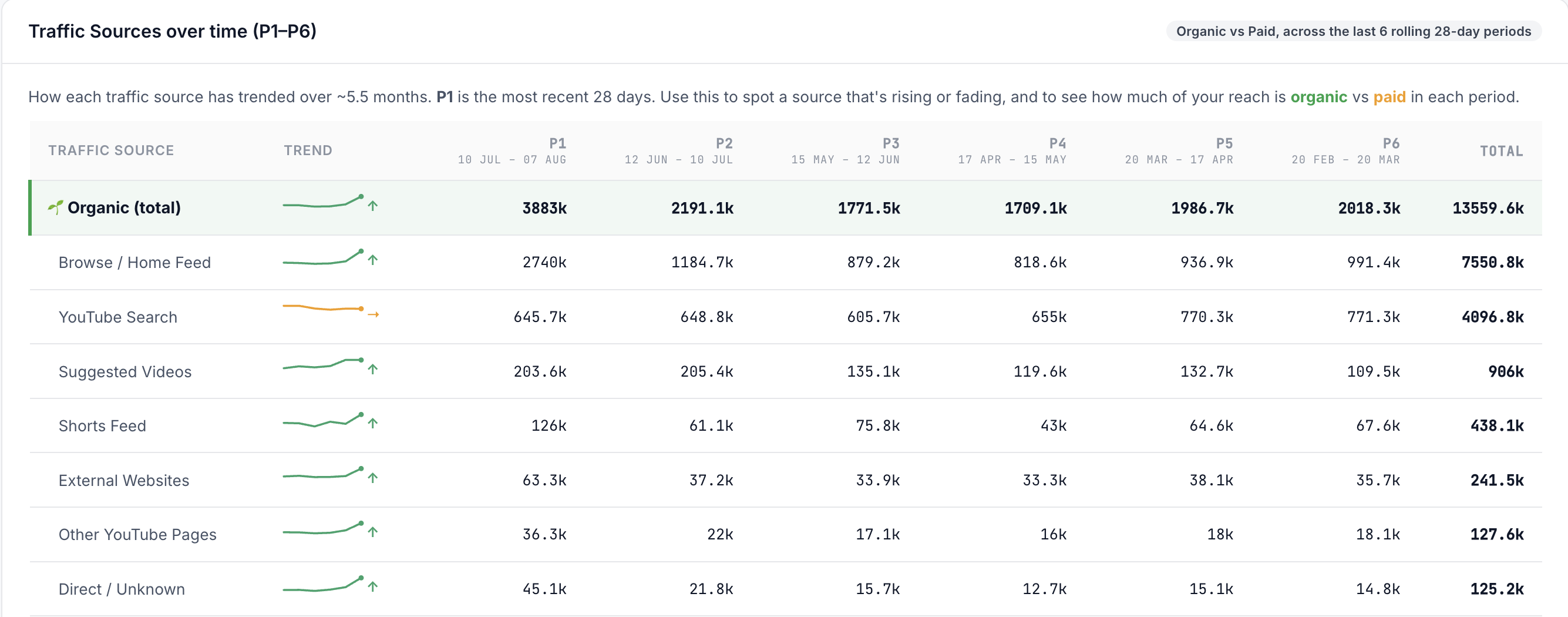
Not every healthcare buyer needs the same medicine. Below are four archetypes we see most often in our onboarding conversations, with the recommendation that fits each.
The solo specialist clinic in a Tier-2 city
Picture a dentist in Jaipur running a two-chair practice with a five-person team. She is booked to seventy per cent capacity, wants to lift to ninety, and cannot afford a six-figure monthly retainer. The right move is the Foundation tier — a properly optimised Google Business Profile, a small set of city-plus-service pages, a weekly review-collection routine, and two long-form articles per month reviewed by her personally. Twelve months in, she has a defensible local ranking asset and typically doubles her appointment enquiry volume.
The multi-city IVF or aesthetic chain
Six centres across metros, twenty consultants, a marketing team of two, and an existing agency relationship that has plateaued. The right move is the Growth tier plus a video programme — a city-plus-service architecture rebuild, verified GBP for every location, a named-clinician content programme, a monthly cadence of doctor-led YouTube videos, and a quarterly AI Overview citation report. Twelve months in, the chain typically sees a 40–70 per cent lift in organic-sourced consult bookings.
The tertiary-care hospital
A 300-bed hospital with twelve specialities, a large in-house marketing team, and a board that measures success by patient footfall. The right move is the Scale tier — pillar-cluster architecture per speciality, a robust internal-linking structure, GBP management at scale, an AIO measurement discipline, and integration with the hospital's own CRM stack (our AtomCRM or HealthPro 360 layer, depending on whether the requirement is CRM-first or RCM/EHR-overlay-first). Twelve months in, the hospital typically has three or four specialities generating top-5 rankings on money terms and a measurable reduction in cost per acquired patient.
The pharma brand manager running a category play
An OTC or nutraceutical brand manager with a national mandate, a category education problem, and no direct patient booking to optimise. The right move is a content-and-video-heavy programme focused on category education, expert-attributed pillar content, YouTube and short-form video, and a measurement stack centred on branded search lift and share of voice inside AI answers. This is less about lead volume and more about owning the category conversation in Indian search over eighteen months.
Section takeaway: The programme should fit the archetype. A dentist in Jaipur does not need what a Mumbai hospital needs, and vice versa.
Common mistakes we see every quarter
The failure patterns are remarkably consistent. Seven show up in nearly every audit.
- Chasing keywords instead of building topical authority. A hospital that publishes twenty disconnected blog posts on high-volume terms without any cluster structure ends up with twenty orphan pages that rank nowhere and support nothing.
- Anonymous content on YMYL topics. A dermatology site that publishes a hundred articles under Admin or Editorial Team is telling Google exactly what Google is looking for a reason to ignore — no verifiable expertise.
- One master Google Business Profile for a chain. Every location Google cannot see is a location that will not appear in local results. The fix is a verified profile per address, always.
- Ignoring DPDP consent language on lead forms. The compliance risk is real, the ad-account risk is real, and the SEO-adjacent risk of platform-level penalties is growing.
- Buying reviews or incentivising them dishonestly. The short-term lift is real. The medium-term risk — profile suspension, review filtering, reputational damage — is larger than the lift.
- Measuring activity, not outcome. A monthly report full of blog counts, keyword counts and backlink counts, with no line for qualified leads, appointment volume or cost per acquisition, is a report designed to justify the invoice — not to grow the practice.
- Killing content that is temporarily quiet. Every core update produces a dip somewhere. Panic-deleting content that lost its ranking in month four often destroys the base that would have recovered in month six.
Section takeaway: Most healthcare SEO failure is not caused by exotic mistakes. It is caused by predictable ones, made by teams that never had a written playbook.
The 70-30 pricing model, explained
Every Indian healthcare buyer we meet has been burned at least once by an agency that billed for activity and delivered no outcome. The 70-30 model was designed specifically to remove that risk.
Here is how it works. Seventy per cent of the monthly retainer is fixed — Rs 49,999 for Foundation, Rs 74,999 for Growth, Rs 99,999 for Scale — and pays for the guaranteed deliverables: content production, technical SEO, GBP management, reporting, account time. The remaining thirty per cent is tied to a twelve-month outcome target agreed at the start of engagement, and released on a sliding scale as milestones are met.
The outcome target is negotiated per client but usually looks like some combination of qualified-lead growth, non-branded organic click growth, top-5 ranking count on money terms, or AI Overview citation count. It is documented, measured monthly, and reviewed quarterly. If the agency does not move the number, the agency does not earn the variable portion — full stop.
The same model extends to adjacent services. Google Ads programmes above Rs 5 lakh a month move to a 70-30 split on the management fee. YouTube SEO and AIO programmes above Rs 50,000 a month follow the same structure. The intent is consistent across services — the client pays for work, and the agency earns the outcome.
Two things make this workable for a serious agency. First, the outcome targets are set with realism, not with pitch-deck ambition. Second, the discipline of quarterly reviews forces both sides to have honest conversations early, rather than after a year of quiet under-performance.
Section takeaway: The 70-30 model puts agency incentive where the client wants it — on the outcome, not on the activity. It is designed for Indian healthcare buyers who have earned the right to be sceptical.
A 12-month execution roadmap
Strategy on a page is comforting. Execution on a calendar is what actually produces results. Below is the twelve-month roadmap we deliver to most healthcare clients, adapted for archetype and city dynamics.
Quarter 1 — Foundations
Full technical audit. Content and keyword gap analysis. Google Business Profile audit for every location. DPDP and NMC compliance review of lead forms and existing content. Internal-linking inventory. Written twelve-month roadmap with quarterly milestones and outcome targets. Baseline dashboards stood up. First round of technical fixes shipped. Content templates and schema deployed sitewide. Foundational city-plus-service pages published for priority metros.
Quarter 2 — Content and local scale
Pillar-cluster content programme in full production. Named-clinician bylines rolled out across the editorial calendar. GBP operating system running weekly across every location. Review-collection routine embedded at the front desk. First cohort of long-form articles ranking for long-tail terms. First measurable movement in local pack visibility. Retargeting stack rebuilt on DPDP-clean consent flows.
Quarter 3 — AIO, video and depth
AI Overview measurement and citation monitoring live. Content refactored for AIO extraction — short-answer-first openings, tables and lists added, FAQ schema on every long-form article. YouTube publishing cadence stabilised at four to eight videos per month per key clinician. Featured-snippet capture on secondary money terms. First top-5 rankings on primary money terms in easier metros.
Quarter 4 — Scale and defensibility
Expansion into secondary cities and secondary specialities. Depth pages layered under every high-performing pillar. Programmatic pages built for city-plus-service intersections at scale. Internal-linking equity audit and refresh. Twelve-month outcome targets measured and reported. Next-year roadmap co-authored with the client's marketing leadership. The engagement transitions from build to compound.
Section takeaway: A twelve-month plan produces a compounding asset. A ninety-day sprint produces a temporary blip. Choose the plan that matches the horizon of the practice.
Key takeaways
- Medical SEO in India in 2026 is a three-surface game — organic, local, and AI Overviews. A plan that ignores any surface will underperform.
- EEAT is enforced hardest in healthcare. Named clinician bylines, NMC registration numbers and a medical reviewer trail are the baseline, not the extras.
- The DPDP Act 2023 has pulled consent, retention and pixel governance inside the SEO scope. Update your forms and your privacy page.
- Local SEO is the single highest-ROI surface for the first six to nine months of a programme. Treat GBP as an operating system, not a listing.
- AI Overviews reward extractable, expert-attributed, schema-marked content. The pages that win citations are not the same pages that used to win top-3 blue links.
- In ICG's 150-clinic portfolio, healthy programmes see local movement in 30–60 days, AIO citations in 90–180 days, top-5 rankings in 6–9 months, and 2–3x ROI on the retainer inside twelve months.
- The 70-30 pricing model splits retainer from performance so the agency is paid for outcomes, not activity.
- Twelve months, not ninety days, is the realistic horizon for a defensible medical SEO asset in India.
Frequently asked questions
The FAQ section below is also available as structured data in the page schema for AI answer engines and Google's rich-result surfaces.
]]>Book a free SEO diagnostic.
Hanuman Sihag's team runs a live crawl, checks technical health, cannibalisation, schema coverage and content gaps. 60 minutes, prioritised fix list.
Questions readers ask
about this topic.
The three platforms
behind every ICG engagement.
Beacon
CAPI middleware that fixes Event Match Quality, translates CRM statuses to Meta-standard events, dedups across channels.
Agency OS
Live client dashboard. GSC, GA4, Google Ads, Meta Ads, IVR calls in one view. Login anytime, not monthly.
Phoenix
Clinic revenue intelligence over your PMS. Daily action queue: Prevent Loss, Maintain & Engage, Grow Revenue. Multi-centre rollout.
Or book a free 30-min audit to see all three in action on your account.
Healthcare brands
that already run on ICG.
A representative slice of the 150+ healthcare brands ICG has delivered for across India. Most engagements remain under NDA.


What ICG clients say · on video.
"Scale up of organic channels and business consulting. ICG has absolute domain authority in their field."
"Working with ICG transformed how we acquire IVF patients in Gurgaon. They understand the fertility journey from inquiry to consult..."
"What Ichelon accomplished — they got all my ideas and worked over 3-4 months to create an amazing, super-customised website."
The intelligence stack behind this playbook.
Every ICG engagement runs on the Search Intelligence Trifecta — Angryturtle for GMB, SIE for search and AI Overview, YODA for YouTube. Live product screens below.
Need help operationalising this?
Every ICG service is healthcare-only, NMC + DPDP-aware, and built around the patient-research patterns that drive Indian healthcare growth in 2026.
Every practice welcome — packages from ₹20,000/mo.
Goals-Driven engagements · Performance-Linked Payout Models available



More from
ICG.
Five trends shaping Indian healthcare marketing through 2027: AI-first patient research, Conversions API adoption, ABDM discovery, the AEO w...
Healthcare AIO is the discipline of getting your clinic or hospital cited inside Google AI Overviews, ChatGPT and Perplexity answers — not j...
Conversational-search advertising places brand messages inside AI chat answers — ChatGPT, Perplexity, Copilot — rather than beside a results...
Stop guessing.
Book a Diagnostic.
30 minutes. Free. With the AI-powered healthcare-only marketing agency 150+ brands already run on. No slides, no pitch, no hard close.


