


Local SEO for physiotherapy centres in India: Physiotherapist plus Physical Therapy Clinic configuration, storefront vs Service Area Business decisions, and cash-heavy pricing display
Local SEO for physiotherapy centres in India is defined by category duality between Physiotherapist and Physical Therapy Clinic, the storefront vs Service Area Business decision for home-visit practices, sub-vertical configuration for sports plus post-surgical plus geriatric care, and pricing display for a cash-heavy specialty where display transparency drives conversion. ICG runs this at scale with Angryturtle.
No pitch. Written root-cause diagnosis. AI-powered, healthcare only.
Direct answer
Local SEO for physiotherapy centres in India is defined by category duality between Physiotherapist and Physical Therapy Clinic, the storefront vs Service Area Business decision for home-visit practices, sub-vertical configuration for sports plus post-surgical plus geriatric care...
TL;DR
Local SEO for physiotherapy centres in India is defined by four specialty-specific decisions that no generic agency setup gets right by default. Category selection between Physiotherapist and Physical Therapy Clinic splits ranking signal in different ways depending on how it is configured. The storefront-versus-Service Area Business decision — critical for practices that combine clinic care with home-visit services — determines what Google shows and hides on the profile. Sub-vertical configuration for sports injury, post-surgical rehabilitation, and geriatric care changes the entire services and content stack. And pricing display strategy in a cash-heavy specialty (where most Indian physiotherapy is out-of-pocket rather than insurance-funded) is a conversion lever that other specialties do not have to think about at the same intensity. ICG runs healthcare local SEO for physiotherapy centres using Angryturtle with physiotherapy-specific configuration for each of these decisions.
Why physiotherapy local SEO is distinct in Indian healthcare
Physiotherapy is unusual in Indian healthcare local SEO for four reasons that interact.
The specialty operates as both a storefront clinic and a home-visit service simultaneously in many practices. The same physiotherapist may see morning appointments at the clinic and afternoon home visits across a 10-km radius. Google Business Profile allows either configuration but not both cleanly, which forces a strategic choice.
The specialty splits into distinct sub-verticals with very different demand patterns. Sports-injury physiotherapy skews younger, faster-decision, higher session frequency. Post-surgical rehabilitation is referral-driven, insurance-adjacent, session-course oriented. Geriatric physiotherapy is often home-visit dominant, family-decision driven, longer engagement. Neurological and paediatric physiotherapy are narrower sub-specialties with their own referral networks.
Pricing is unusually transparent by category norm. Patients directly ask about per-session cost and package cost across the consideration cycle. Practices that display pricing on the profile or on the linked website consistently out-perform practices that hide pricing behind an enquiry form.
Insurance dynamics are shifting but still cash-heavy. Group health insurance policies increasingly include physiotherapy as an OPD benefit, and TPA empanelment is a meaningful signal — the WHO rehabilitation framework that many corporate health insurance schemes reference explicitly includes physiotherapy in the covered rehabilitation scope. Most patient visits, however, remain cash-paid, which changes both content strategy and review-request framing.
GBP category configuration: Physiotherapist vs Physical Therapy Clinic
Google's category tree carries "Physiotherapist" and "Physical Therapy Clinic" as separate entries. The choice matters because it changes how the profile is surfaced.
"Physiotherapist" reads as a practitioner-level category and often surfaces better in queries that pattern as "physiotherapist near me" or "best physiotherapist in [area]." It is the appropriate primary for a solo practitioner brand, or for a practice whose ranking narrative is built around a named specialist.
"Physical Therapy Clinic" reads as a facility-level category and surfaces better in "physiotherapy clinic in [city]," "physio centre near me," and package-oriented searches. It is the appropriate primary for multi-therapist facilities, chain locations, and centres whose ranking narrative is facility-focused rather than practitioner-focused.
Secondary categories worth considering: Sports Medicine Clinic (for sports-injury-focused practices), Rehabilitation Center (for post-surgical or neuro-rehabilitation-focused practices), Occupational Therapist (where combined OT/PT services are delivered), Chiropractor (only if the practice includes a documented chiropractor, otherwise it splits Relevance signal noisily).
Services list — physiotherapy has an unusually long service surface: sports injury rehabilitation, post-surgical rehabilitation, orthopaedic physiotherapy, neuro physiotherapy, paediatric physiotherapy, geriatric physiotherapy, women's health physiotherapy (post-natal, pelvic floor), cardiopulmonary rehabilitation, dry needling, manual therapy, electrotherapy, cupping therapy, home-visit physiotherapy, sports-performance rehabilitation, chronic pain management. Every service listed is a query surface.
Storefront vs Service Area Business — the home-visit duality
Google Business Profile forces a structural choice on physiotherapy practices that offer both clinic care and home-visit services.
Storefront configuration shows the clinic address publicly and lets patients see the location on Google Maps. It is the right choice for practices whose primary business runs from a physical clinic, even if they also offer home visits as a secondary service. Home-visit availability is documented in the services list and description but does not change the primary configuration.
Service Area Business (SAB) configuration hides the physical address and shows a service-area radius instead. It is designed for businesses that operate from a base without walk-in patients. Some home-visit-only physiotherapy operations legitimately fit this pattern.
The mis-configuration we see most often: a hybrid practice registered as SAB when it should be storefront (which hides the clinic address and loses local-pack visibility for storefront queries), or a home-visit-only practice registered as storefront (which sends patients to an address that is really just the practitioner's residence).
The rule we apply: if the practice sees patients at a physical location at least 3-4 half-days per week, storefront is the correct configuration and home visits are documented as a service. If the practice is purely home-visit with no walk-in patients, SAB is the correct configuration and the service radius reflects the actual travel range.
Angryturtle's sie" style="color:inherit;text-decoration:underline;text-decoration-color:rgba(42,126,200,.5);text-underline-offset:2px">Rank OS flags configuration mismatch as a top-priority action because the wrong choice permanently ceilings the profile's ranking upside.
 angryturtle/02-rank-os.png" alt="Angryturtle Rank OS — 5-dimension health scoring (Completeness · Consistency · Authority · Activity · Sentiment) across the portfolio" loading="lazy" decoding="async" style="width:100%;height:auto;display:block;">
Sports, post-surgical, and geriatric sub-vertical configuration
Each sub-vertical changes the entire services and content stack.
Sports-injury physiotherapy configuration adds Sports Medicine Clinic as a secondary category, listed services around ACL rehabilitation, meniscus rehabilitation, shoulder rehabilitation, running-injury rehabilitation, cricket-injury rehabilitation, tennis-injury rehabilitation. Content skews toward sports-injury education, athlete case discussions (compliance-safe), and partnership signalling with sports clubs and academies.
Post-surgical rehabilitation configuration adds Rehabilitation Center as a secondary category, listed services around post-TKR (total knee replacement) rehabilitation, post-THR (total hip replacement) rehabilitation, post-spine-surgery rehabilitation, post-stroke rehabilitation, ICU-step-down rehabilitation. Content skews toward orthopaedic-surgeon referral integration, insurance-panel signalling, and hospital-partnership disclosure.
Geriatric physiotherapy configuration emphasises home-visit service listings, fall-prevention protocols, chronic-condition management (arthritis, Parkinson's, post-stroke), family-caregiver-focused content. The catchment often extends further than for other sub-verticals because home visits define the service area.
A single centre offering all three sub-verticals needs each represented in services and content, with Ask Maps question banks configured for each cluster separately.
 AI Overview readiness scoring on every healthcare query for the listing's specialty × city" loading="lazy" decoding="async" style="width:100%;height:auto;display:block;">
Review dynamics for physiotherapy practices
Physiotherapy reviews concentrate around functional improvement — the patient regained knee mobility, returned to running, resumed daily activities without pain, walked without a cane after post-stroke rehabilitation. Positive reviews often describe specific functional outcomes over a course of sessions rather than a single visit.
Review-request framing has to avoid soliciting specific outcome claims that violate NMC or ASCI. The Angryturtle default for physiotherapy is "we would appreciate feedback on your experience with our team over the course of your visits." It captures the session-course reality without asking the patient to publish a specific-outcome testimonial.
Volume target for competitive metros: 150-350 reviews for a solo physiotherapist or single-location clinic. 400-800 for a multi-location chain or hospital rehabilitation department. Recency is important — the specialty produces short-course engagements, and a review base that is more than 6 months stale reads as inactive.
Reply patterns follow the compliance perimeter — no clinical-outcome confirmation in the public reply, offline invitation for any clinical dispute, acknowledgement of the patient's described experience without adding claims.
Ask Maps question patterns for physiotherapy patients
Prospective patients ask AI systems very specific questions that reveal the coverage gap on most profiles:
- "Does this clinic offer home-visit physiotherapy?"
- "What is the cost per session at this physiotherapy clinic?"
- "Does this centre have a female physiotherapist available?"
- "Is post-knee-replacement rehabilitation available here?"
- "Does this clinic treat sports injuries like ACL and meniscus?"
- "Is neurological physiotherapy for post-stroke patients offered?"
- "Does this centre accept my insurance for physiotherapy?"
- "Are physiotherapy packages available and what do they include?"
- "Does this clinic offer dry needling or manual therapy?"
Ask Maps scores each pattern for whether the profile is answerable and surfaces the highest-value gaps as Rank OS actions. Pricing-availability questions are unusually important in this specialty because the answer directly affects the patient's decision to book.
Cash-heavy pricing display strategy
Physiotherapy is one of the few Indian healthcare specialties where pricing display on the profile and linked website is a direct conversion lever rather than a compliance risk.
The pattern we recommend and Angryturtle configures for physiotherapy profiles: publish per-session pricing range, publish package pricing for common session courses (10-session package, 20-session package), disclose home-visit surcharge if applicable, disclose insurance-panel acceptance status.
Practices that hide pricing behind an enquiry form leak conversions to competitors that display it openly. The compliance overlay — NMC prohibits specific price advertising for procedural care in some contexts, ASCI restricts misleading pricing claims — is manageable for physiotherapy because the specialty is not covered by the strictest procedural-advertising restrictions and pricing transparency is treated as informational rather than promotional.
Angryturtle's Content Studio for physiotherapy profiles includes pricing-display templates that document ranges without making superiority claims and that stay within the ASCI transparency framework.
Citation targets for physiotherapy practices
Beyond the general Indian healthcare directory list, physiotherapy profiles benefit from:
- Indian Association of Physiotherapists (IAP) member directory — the flagship citation for the specialty
- State chapter IAP directories where the practitioner is a member
- Indian Federation of Sports Medicine listings for sports-medicine-integrated practices
- Insurance-panel directories carrying physiotherapy OPD benefits — Star Health, HDFC ERGO, Bajaj Allianz, Care Health OPD panels
- Corporate group health insurance TPA physiotherapy panel listings
- Practo, Lybrate, Docprime under the correct Physiotherapist or Physical Therapy Clinic sub-category
- Sports club and academy referral partnership listings (documented on the profile description)
Angryturtle's citation engine includes the physiotherapy directory list as a specialty default.
Geographic catchment for physiotherapy practices
Storefront-primary practices see catchment concentrated within 3-5 km because patients need to travel to the clinic multiple times per session-course. Home-visit-integrated practices see catchment extend across a 10-15 km radius depending on the practitioner's travel willingness. Home-visit-only practices operate on service-area radii of 15-25 km in some cases.
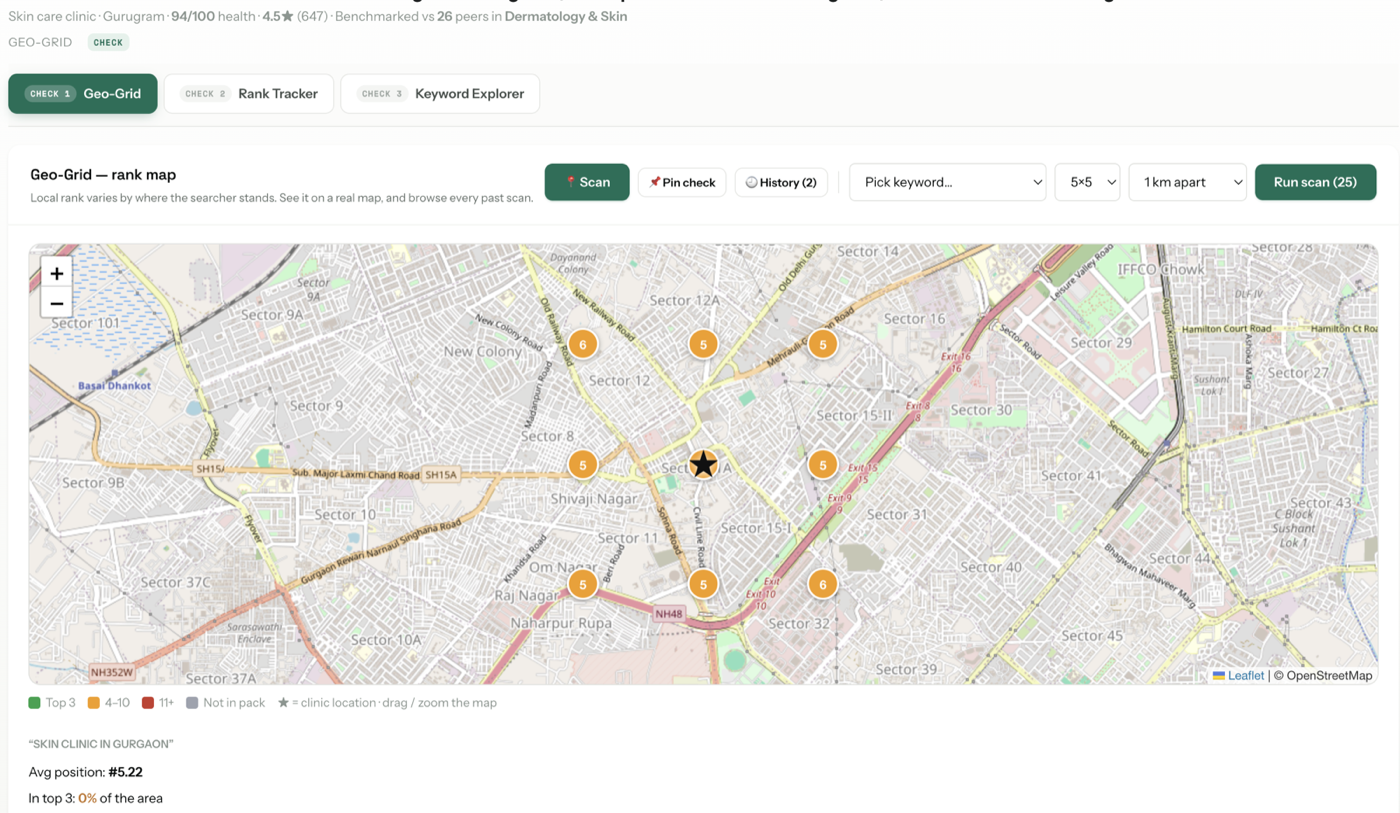
Geo-Grid tracking should reflect this. Storefront practices run on a 5-7 km grid. Hybrid storefront-plus-home-visit practices run on a 10-12 km grid. Home-visit-only practices run on the actual service-area radius. Multi-location chains need per-location grids with catchment overlap analysis.
Pricing tier for physiotherapy practices
Solo physiotherapist or single-location clinic: Boutique tier at ₹25,000/- to ₹60,000/- per month covers profile management, review operations, weekly Post cadence, monthly Geo-Grid, quarterly citation build. Sufficient for a solo or small clinic.
Multi-therapist clinic with home-visit service: Chain tier at ₹60,000/- to ₹1.25L/- per month covers per-therapist plus per-location profile management, higher Post cadence, weekly Geo-Grid, monthly citation build, Ask Maps AIO scoring.
Multi-location physiotherapy chain or hospital rehabilitation department: Hospital tier at ₹1.25L/- to ₹3L/- per month covers per-location profile management, daily Post cadence, review operations with escalation, weekly Geo-Grid per location, custom reporting.
Solo owner with 1-2 profiles running it themselves: Angryturtle self-serve at ₹999/- per month covers Rank OS scoring, Ask Maps, review draft assistance, and Content Studio inside the same platform ICG's managed team uses.
The 30/60/90 day playbook
Days 1-30: primary category correction (Physiotherapist vs Physical Therapy Clinic), storefront-vs-SAB configuration decision, sub-vertical secondary categories aligned to actual services delivered, full services build-out with pricing-display strategy, description rewrite covering full scope, first citation batch across IAP and insurance-panel directories, review-request workflow initiated.
Days 31-60: weekly Google Posts live across educational, sub-vertical, and package-pricing patterns, Geo-Grid baseline captured across the catchment, IAP plus state-chapter citations built and NAP-verified, first Ask Maps gap-closure pass targeting the highest-volume patient queries including pricing-availability queries, review velocity compounding.

Days 61-90: Rank OS score improvement of 15-25 points typical, first measurable ranking movement on primary "physiotherapist in [city]" and sub-vertical queries, insurance-panel citation set completed, AIO Readiness improved as Ask Maps question coverage closes. Compound gains visible from months 4-6 onward.
The tool ICG uses to run this at scale: Angryturtle
ICG runs local SEO and GBP intelligence for 150+ Indian healthcare brands using Angryturtle — our own AI-native GBP intelligence and management OS. The platform scores every profile 0-100 via a proprietary Rank OS model with five weighted dimensions (Relevance, Review Health, Freshness, Entity Authority, AIO Readiness), publishes edits, Posts, media, and review replies directly to Google, and includes Ask Maps AIO Readiness scoring for Google AI Overviews and ChatGPT visibility.
Available in two shapes: self-serve at ₹999/- per month for solo owners with 1-2 profiles, and ICG's managed service from ₹25,000/- per month where our healthcare specialists execute inside the same platform. Both are anchored in the Healthcare Local SEO Agency India pillar page which has full scope, methodology and pricing.
Book a demo on WhatsApp → or start a free trial at angryturtle.ai →
Related reading

- Healthcare local SEO agency India — the pillar service page
- Local SEO for orthopaedic practices — companion referral-partner specialty
- Angryturtle Rank OS explained — the five-dimension scoring model
- Angryturtle Ask Maps AIO Readiness — AI-answer visibility scoring
- Local SEO for diagnostic centres — imaging-partner referral context
FAQ
Should a physiotherapy centre pick Physiotherapist or Physical Therapy Clinic as the primary category? Physiotherapist for a solo-practitioner-brand practice or one whose ranking narrative is built around a named specialist. Physical Therapy Clinic for a multi-therapist facility or chain location where the ranking narrative is facility-focused.
Should a hybrid clinic-plus-home-visit practice use storefront or Service Area Business configuration? Storefront if the practice sees patients at a physical location at least 3-4 half-days per week, with home visits documented as a service. SAB only if the practice is purely home-visit with no walk-in patients.
Is publishing per-session pricing on the profile compliant? Yes, for physiotherapy. The specialty is not covered by the strictest procedural-advertising restrictions and pricing transparency reads as informational rather than promotional. ASCI treats transparent pricing as compliant provided no misleading claims accompany it.
How does home-visit service affect Geo-Grid tracking? Home-visit-only practices need Geo-Grid sized to the actual service radius (often 15-25 km). Hybrid practices need a wider grid than storefront-only practices because catchment extends across the home-visit range.
Which physiotherapy-specific citations matter most? Indian Association of Physiotherapists (IAP) directory, state chapter IAP directories, insurance-panel OPD physiotherapy directories, Indian Federation of Sports Medicine for sports-medicine-integrated practices, Practo/Lybrate under the correct sub-category.
How many reviews does a competitive physiotherapy centre need? 150-350 for a solo practitioner or single-location clinic in a metro. 400-800 for a multi-location chain. Recency matters especially in this specialty because short-course engagements produce natural review flow.
How should sub-vertical focus be reflected in the profile configuration? Each sub-vertical (sports, post-surgical, geriatric, neurological) needs corresponding services listed, corresponding secondary category where appropriate, corresponding Ask Maps question coverage, and content patterns that reflect the actual practice focus. Attempting all four without service depth splits Relevance signal.
Can a physiotherapy centre buy Angryturtle self-serve instead of the ICG managed retainer? Yes. Solo practitioners and single-location clinics with 1-2 profiles can run Angryturtle self-serve at ₹999/- per month. Multi-location chains and hospital rehabilitation departments typically prefer ICG's managed tier starting at ₹25,000/- per month.
How long before a physiotherapy profile shows ranking improvement? First measurable movement in 4-6 weeks after category and configuration correction. Substantive ranking improvement in 3-4 months. Compound effect visible from month 6 onward with consistent execution.
Book a free SEO diagnostic.
Hanuman Sihag's team runs a live crawl, checks technical health, cannibalisation, schema coverage and content gaps. 60 minutes, prioritised fix list.
The three platforms
behind every ICG engagement.
Beacon
CAPI middleware that fixes Event Match Quality, translates CRM statuses to Meta-standard events, dedups across channels.
Agency OS
Live client dashboard. GSC, GA4, Google Ads, Meta Ads, IVR calls in one view. Login anytime, not monthly.
Phoenix
Clinic revenue intelligence over your PMS. Daily action queue: Prevent Loss, Maintain & Engage, Grow Revenue. 46-centre rollout.
Or book a free 30-min audit to see all three in action on your account.
Healthcare brands
that already run on ICG.
A representative slice of the 150+ healthcare brands ICG has delivered for across India. Most engagements remain under NDA.


What ICG clients say · on video.
"Scale up of organic channels and business consulting. ICG has absolute domain authority in their field."
"Working with ICG transformed how we acquire IVF patients in Gurgaon. They understand the fertility journey from inquiry to consult..."
"What Ichelon accomplished — they got all my ideas and worked over 3-4 months to create an amazing, super-customised website."
The intelligence stack behind this playbook.
Every ICG engagement runs on the Search Intelligence Trifecta — Angryturtle for GMB, SIE for search and AI Overview, YODA for YouTube. Live product screens below.
Need help operationalising this?
Every ICG service is healthcare-only, NMC + DPDP-aware, and built around the patient-research patterns that drive Indian healthcare growth in 2026.
More from
ICG.
Healthcare AIO is the discipline of getting your clinic or hospital cited inside Google AI Overviews, ChatGPT and Perplexity answers — not j...
Conversational-search advertising places brand messages inside AI chat answers — ChatGPT, Perplexity, Copilot — rather than beside a results...
NABH digital compliance means every claim, image and testimonial your hospital publishes online matches what an accreditation surveyor can v...
Stop guessing.
Book a Diagnostic.
30 minutes. Free. With the AI-powered healthcare-only marketing agency 150+ brands already run on. No slides, no pitch, no hard close.


