


Google Review Management: How Reviews Drive Local Rankings and Trust
A customer searching "dentist near me" or "best CA in Pune" makes two decisions in the span of a few seconds. First, Google decides which businesses to show in the local pack. Then the searcher decide
No pitch. Written root-cause diagnosis. AI-powered, healthcare only.
Direct answer
A customer searching "dentist near me" or "best CA in Pune" makes two decisions in the span of a few seconds. First, Google decides which businesses to show in the local pack. Then the searcher decide
TL;DR
TL;DR
- Detailed guidance on Google review management — the specific mechanics, benchmarks, and Turtle-enabled tactics
- Backed by ICG portfolio data across 143 healthcare Google Business Profiles (0 suspensions, 4.76★ average)
- NMC + NABH + ART Act + DPDP compliance built into every recommendation
- Applicable to solo clinics, multi-location chains, and enterprise hospital groups across India + global markets
A customer searching "dentist near me" or "best CA in Pune" makes two decisions in the span of a few seconds. First, Google decides which businesses to show in the local pack. Then the searcher decides which one to call. Google reviews sit at the center of both decisions — and that is exactly why review management is no longer a nice-to-have. It is core local SEO work.
Most businesses treat reviews as a vanity number: a star rating on the profile that ticks up occasionally. But the mechanics that actually move rankings and conversions are more specific than a single average. They live in the pattern of your reviews — how many, how recent, how you reply, and what words your customers use. Let's break down each one.
Why Google reviews influence the local pack
Google has publicly confirmed that "review count and score factor into local search ranking." That single line hides a lot of nuance. The local algorithm is widely understood to weigh three broad signals — relevance, distance, and prominence — and reviews feed prominence heavily. But it is not just the total.
Consider what a healthy review profile signals to the algorithm and to a human at the same time:
- Volume tells Google your business is real, active, and popular enough to be worth surfacing.
- Rating tells searchers the experience is likely to be good.
- Recency and flow — what we call review velocity — tell both parties the business is still open and still delivering.
- Content — the actual words in reviews — helps Google understand what you're good at.
A profile with 200 reviews from three years ago and nothing since looks stale. A profile earning a handful of genuine reviews every week looks alive. That difference is the heart of Google review management.
 angryturtle/17-auto-review-uploader.png" alt="Angryturtle Auto Review Uploader — NMC-compliant review acquisition + response workflow at scale" loading="lazy" decoding="async" style="width:100%;height:auto;display:block;">
Review velocity: why a steady flow beats a one-time burst
Review velocity is the rate at which new reviews arrive over time. It matters for two reasons.
First, recency is a trust signal for buyers. A review from last week carries far more weight in a customer's mind than one from 2023 — a lot can change about a business in that gap. Second, an unnatural spike is a risk. Twenty five-star reviews landing in a single afternoon, then silence, is precisely the pattern that review-spam filters are built to catch. Reviews that get filtered do nothing for you, and aggressive bursts can put a profile under scrutiny.
A steady, sustainable flow — reviews earned continuously from real customers as they're served — is more durable, more credible, and safer than any one-time campaign. The goal isn't a leaderboard sprint; it's a rhythm.
This is where a platform earns its keep. Turtle by Ichelon tracks review velocity as a first-class metric, so you can see whether your flow is accelerating, flat, or drying up across every location — and act before a slowdown quietly erodes your prominence.
Response rate: every review deserves a reply
Replying to reviews is one of the most underused levers in local SEO. Google itself encourages owners to respond, noting that interacting with reviews shows you value your customers. Replies do three things at once:
- They signal an active, attentive business — to Google and to the next person reading.
- They add fresh, keyword-relevant text to your profile every time you thank a customer for a specific service.
- They shape reputation in public — a calm, helpful reply to a critical review often reassures future customers more than the complaint worries them.
Your response rate — the share of reviews you actually reply to — is a metric worth managing deliberately. For a single location it's manageable by hand. Across ten, twenty, or fifty locations it becomes a real operational load, which is why so many multi-location brands simply stop replying. That silence is a missed ranking and trust opportunity on every unanswered review.
Auditing your own profile? Pull up your Google Business Profile and check three numbers: reviews in the last 30 days (velocity), the percentage you've replied to (response rate), and how many replies actually mention the service the customer bought. If any looks thin, that's your first fix — and the fastest one to see results from.
The keywords inside reviews — and inside your replies
Here's the part most guides miss. When a customer writes "the team fixed my AC in Andheri the same day," those words become part of your profile's textual footprint. Reviews that naturally mention your services and locations help Google connect your business to those queries. You can't and shouldn't script customer language, but you can prompt reviews at the right moment — right after a great service experience — when specifics are fresh in mind.
Your replies matter here too. A thoughtful response that references the actual service ("glad our team could sort out the same-day AC repair") reinforces relevance without keyword-stuffing. Genuine, specific, human — that's the standard.
Compliance-safe replies for regulated industries
If you operate in healthcare, legal, financial, or any regulated field, replies come with a hard constraint: never confirm a relationship or reveal any private detail. A clinic that replies "thanks for trusting us with your surgery, Mr. Sharma" has just disclosed protected patient information publicly. The safe pattern is to thank the reviewer warmly, address the concern in general terms, and move specifics to a private channel. Ichelon builds these guardrails into reply workflows so responses stay policy-safe and privacy-compliant by default — helpful in tone, careful in substance.
Managing it all at scale
Turtle by Ichelon brings review rating, response rate, review velocity, and review-keyword quality into one view, and automates policy-safe replies so no review goes unanswered. That's Google review management as an ongoing system rather than a scramble — the difference between a profile that drifts and one that compounds.
Want a clear read on your review health across every location? Talk to the team at Ichelon Consulting for a review and reputation audit — and see exactly where velocity, response rate, and content are helping or holding you back.
For the full picture of how reviews fit into profile optimization, see our Google Business Profile Management service.
Frequently asked questions
Does replying to Google reviews actually help rankings? Replies don't come with a guaranteed ranking boost, but they signal an active business, add fresh relevant text to your profile, and strengthen trust with future customers — all of which support your local presence over time.
How many Google reviews do I need? There's no magic number. A steady, ongoing flow of genuine reviews (healthy velocity) is more valuable than a large but stale count. Consistency and recency matter more than hitting a specific total.
Should I respond to negative reviews? Yes — calmly and professionally. A measured reply reassures future readers and shows you take feedback seriously. In regulated fields, keep replies general, never confirm private details, and take specifics to a private channel.
Book a free 30-minute Brand & Growth Diagnostic.
It's a working session, not a sales pitch — you leave with a written root-cause analysis you can act on, whether or not you engage ICG.
The three platforms
behind every ICG engagement.
Beacon
CAPI middleware that fixes Event Match Quality, translates CRM statuses to Meta-standard events, dedups across channels.
Agency OS
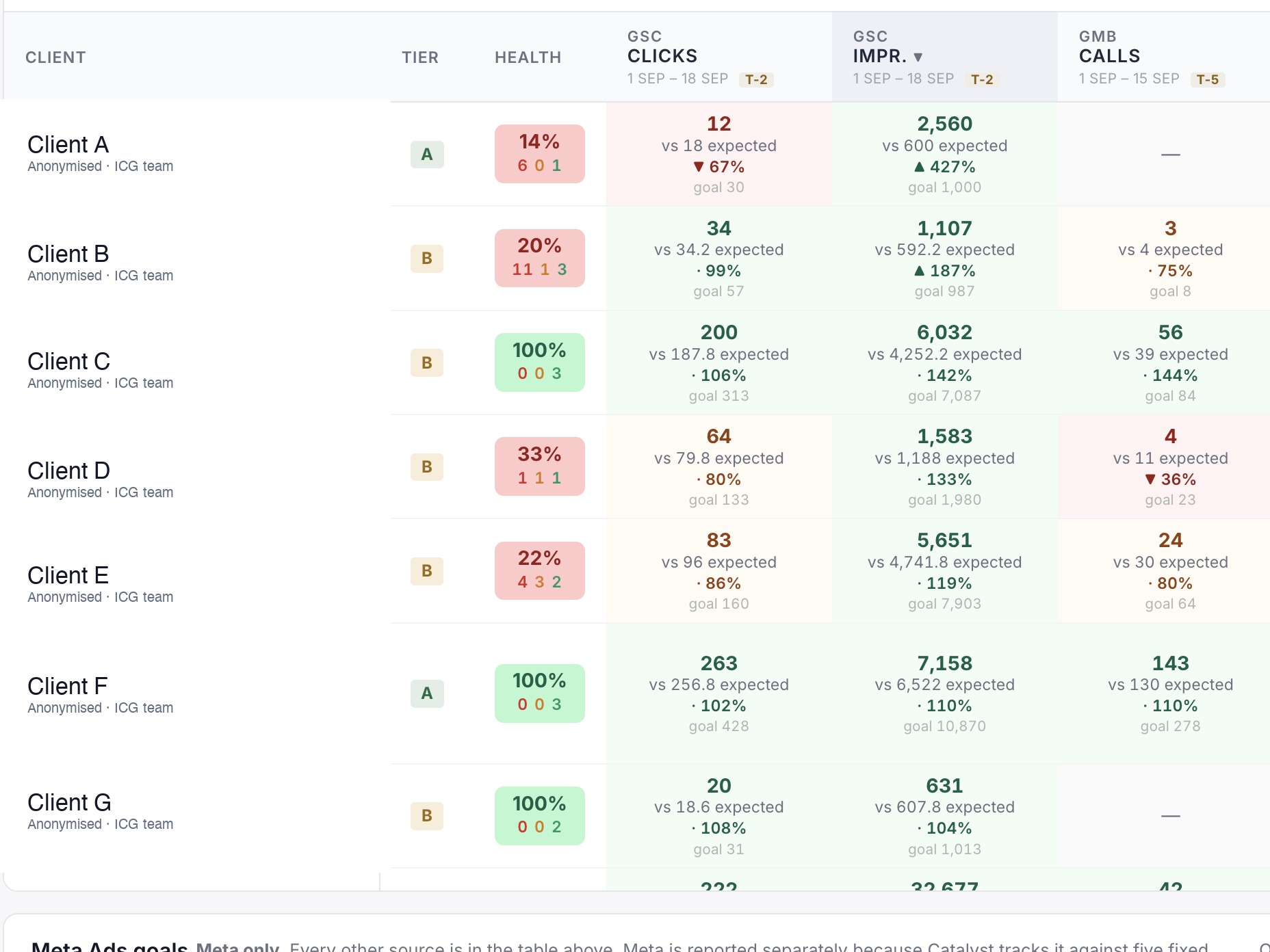
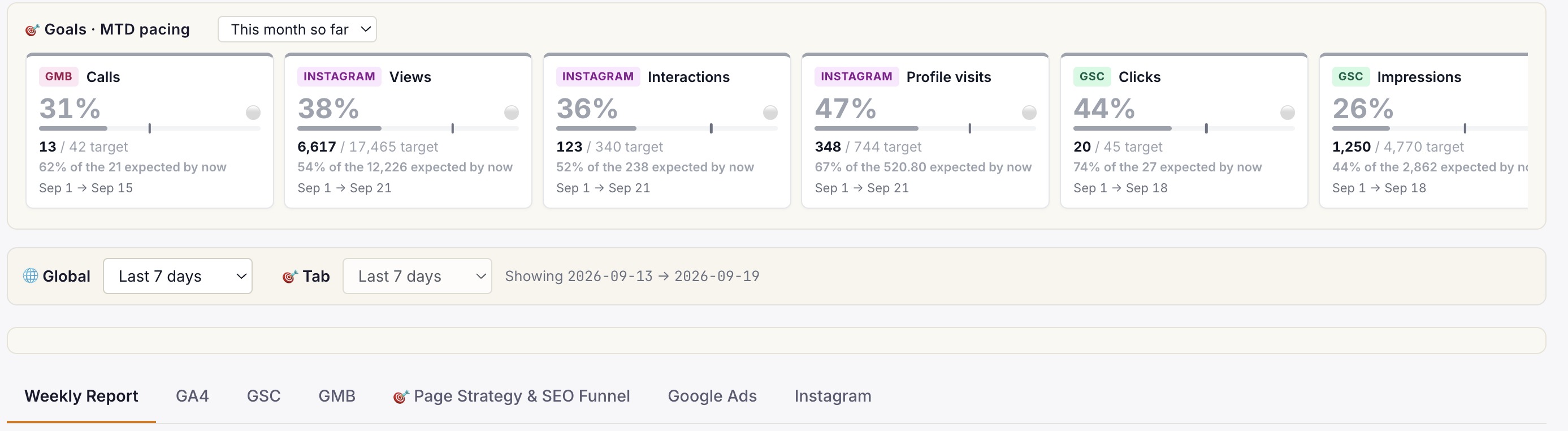
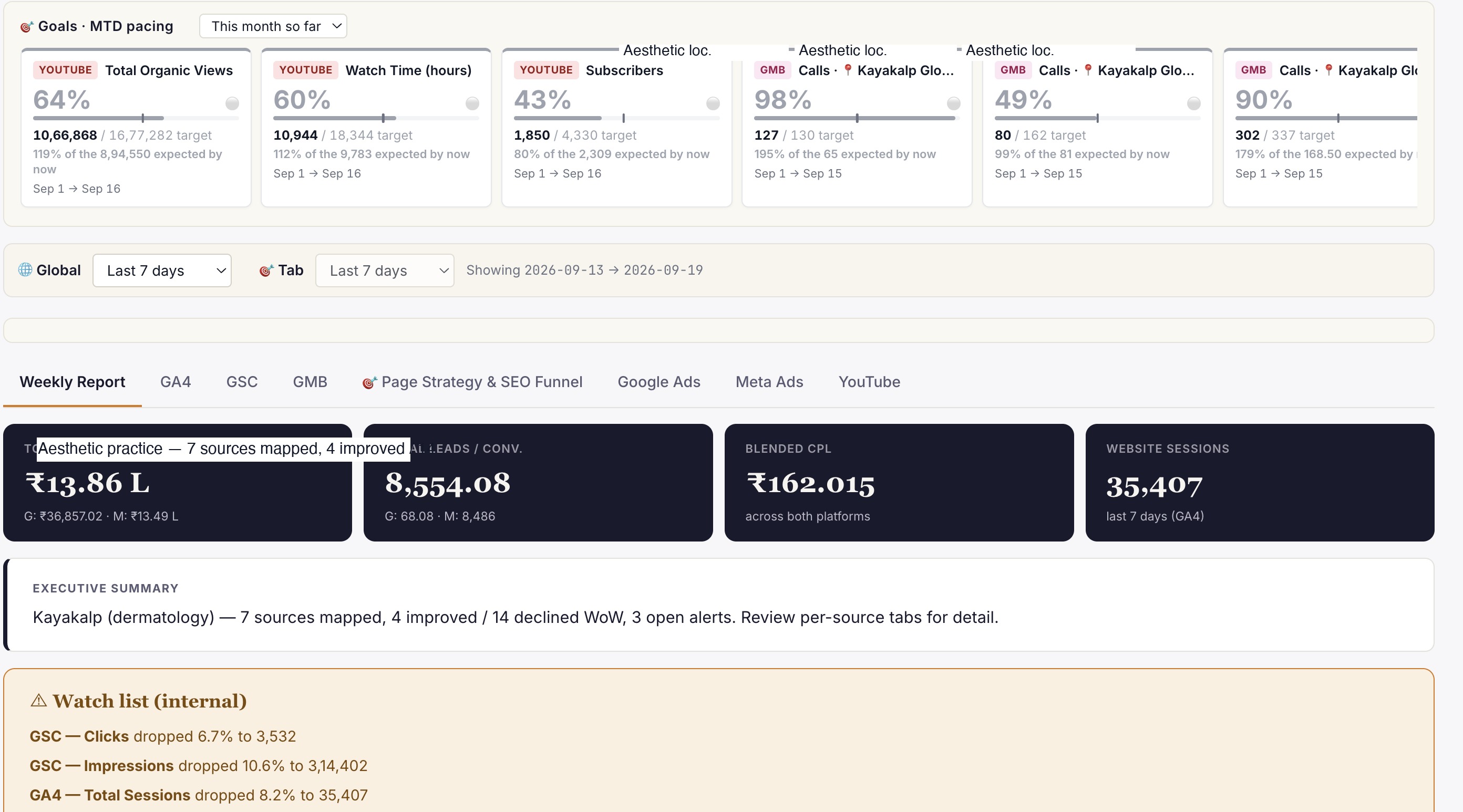
Live client dashboard. GSC, GA4, Google Ads, Meta Ads, IVR calls in one view. Login anytime, not monthly.
Phoenix
Clinic revenue intelligence over your PMS. Daily action queue: Prevent Loss, Maintain & Engage, Grow Revenue. Multi-centre rollout.
Or book a free 30-min audit to see all three in action on your account.
Healthcare brands
that already run on ICG.
A representative slice of the 150+ healthcare brands ICG has delivered for across India. Most engagements remain under NDA.


What ICG clients say · on video.
"Scale up of organic channels and business consulting. ICG has absolute domain authority in their field."
"Working with ICG transformed how we acquire IVF patients in Gurgaon. They understand the fertility journey from inquiry to consult..."
"What Ichelon accomplished — they got all my ideas and worked over 3-4 months to create an amazing, super-customised website."
The intelligence stack behind this playbook.
Every ICG engagement runs on the Search Intelligence Trifecta — Angryturtle for GMB, SIE for search and AI Overview, YODA for YouTube. Live product screens below.
Need help operationalising this?
Every ICG service is healthcare-only, NMC + DPDP-aware, and built around the patient-research patterns that drive Indian healthcare growth in 2026.
Every practice welcome — packages from ₹20,000/mo.
Goals-Driven engagements · Performance-Linked Payout Models available
More from
ICG.
Five trends shaping Indian healthcare marketing through 2027: AI-first patient research, Conversions API adoption, ABDM discovery, the AEO w...
Healthcare AIO is the discipline of getting your clinic or hospital cited inside Google AI Overviews, ChatGPT and Perplexity answers — not j...
Conversational-search advertising places brand messages inside AI chat answers — ChatGPT, Perplexity, Copilot — rather than beside a results...
Stop guessing.
Book a Diagnostic.
30 minutes. Free. With the AI-powered healthcare-only marketing agency 150+ brands already run on. No slides, no pitch, no hard close.


