


Google Ads vs Meta Ads for Healthcare: Buyer Framework India
A neutral, feature-based comparison of Google Ads and Meta Ads for Indian hospitals and clinics: eight decision axes, 2026 CPQL benchmarks by specialty, NMC and DPDP compliance guardrails, five buyer archetypes, and the ICG 70-30 pricing model for paid media.
No pitch. Written root-cause diagnosis. AI-powered, healthcare only.
Direct answer
A neutral, feature-based comparison of Google Ads and Meta Ads for Indian hospitals and clinics: eight decision axes, 2026 CPQL benchmarks by specialty, NMC and DPDP compliance guardrails, five buyer archetypes, and the ICG 70-30 pricing model for paid media.
TL;DR
Last updated 16 August 2026 · reading time 12 minutes
TL;DR
- Google Ads wins on intent. If a patient is typing "hair transplant cost near me" at 11 pm, that click is closer to a booking than any interest-based impression can be. For most Indian clinics, this is the demand-capture layer that keeps the calendar full next Tuesday.
- Meta Ads wins on demand creation. Reels, carousel before/after (where NMC permits), and lookalike audiences fill the top of the funnel for procedures patients did not know they wanted, or did not know were affordable.
- Compliance is not a footnote. The NMC advertising code (2022 amendment), platform-level healthcare restrictions, and the DPDP Act 2023 consent regime shape what you can say, how you can target, and how long you can hold lead data.
- Neither channel is "better" in isolation. A working Indian healthcare mix usually runs 55 to 70 percent Google, 25 to 40 percent Meta, and a thin sliver on YouTube or programmatic depending on the specialty.
- Budget floor matters. Under Rs 60,000 a month of ad spend, split-testing both channels dilutes learning signal. Pick one, prove it, then layer.
Table of contents
- Why this comparison matters for Indian healthcare buyers
- The eight axes to compare on
- Main comparison table
- Per-axis deep dives
- Which fits which buyer
- How ICG helps you choose
- The 70-30 pricing model for paid media services
- FAQ
Why this comparison matters for Indian healthcare buyers
In the last three years the buying question at Indian hospitals and clinics has quietly shifted. It used to be "should we do digital ads at all?" Now it is "we have a Rs 3 lakh monthly ad budget, OPD footfall dipped 11 percent last quarter, the clinic down the road is running Reels every day, and the CMO wants a paper on Monday — Google or Meta?"
A generic export from a platform certification course does not answer that. Indian healthcare has three constraints that most Western playbooks skip:
- The NMC advertising regulation restricts before-and-after imagery, guarantees of outcome, and superlative claims for registered medical practitioners. Meta creative that would fly in the US often fails an Indian doctor's compliance review.
- The DPDP Act 2023 made lead forms with vague consent language legally risky. Both Google Lead Form extensions and Meta Lead Ads require rethinking the notice, purpose and retention layers.
- ABDM and Ayushman Bharat shifted a chunk of patient journeys into digital-first discovery via ABHA-linked apps. Ad platforms sit adjacent to this ecosystem, not inside it, which changes attribution logic.
The cost gap makes this expensive to get wrong. A qualified cardiology consult lead in Bengaluru now runs Rs 900 to Rs 1,700 on Google Search, and Rs 380 to Rs 750 on Meta but with a lower show-up rate. Treating the two as interchangeable burns Rs 15 to 20 lakh a year in a mid-sized hospital before finance notices.
The eight axes to compare on
Before the table, here are the eight axes that actually matter for an Indian healthcare buyer. Skip the vanity axes (impressions, reach, "engagement rate") — they do not correlate with booked appointments for any specialty we have worked in over 300 clients.
- Intent depth — how close is the click to a booking decision?
- NMC and platform compliance fit — how much creative and copy survives review?
- DPDP consent capture — how cleanly does the lead form meet the 2023 Act?
- Cost per qualified lead (CPQL) economics — not CPL, CPQL: leads the front desk can actually convert.
- Creative production load — how many assets a month, and what does that cost in-house or via agency?
- Attribution and measurement clarity — can you defend the number to a hospital board?
- Scale ceiling — at what monthly spend does the channel stop giving you incremental leads?
- Retargeting mechanics — how does the channel handle the 21 to 45 day consideration window that defines most elective care?
Main comparison table
The table below compares Google Ads and Meta Ads across the eight axes, using a third column for a Hybrid approach because in real hospital budgets the answer is almost always a mix. All figures are 2026 India averages across the ICG portfolio (150 plus clinics live at time of writing).
| Axis | Google Ads (Search + PMax) | Meta Ads (Instagram + Facebook) | Hybrid / blended approach |
|---|---|---|---|
| Intent depth | Very high — the search query is the intent. Bottom-funnel by default. | Low to medium — interest, behaviour and lookalike signals, not stated need. | High at the base, medium at the top — funnel-shaped. |
| NMC + platform compliance fit | Text-heavy, easier to keep within NMC advertising code. Callouts and sitelinks pass review readily. | Visual-heavy. Before-after, procedural photography, and testimonial reels need aggressive legal filter. | Sound if creative governance is centralised in one workflow. |
| DPDP consent capture | Native Lead Form extensions accept custom consent text. Server-side conversion is mature. | Instant Forms allow custom questions and privacy notice URL, but consent granularity is thinner. | Central CRM (with explicit purpose-limitation flags) makes both compliant. |
| CPQL (Indian metros, 2026) | Rs 700 to Rs 2,400 depending on specialty; higher for oncology, IVF, cardiology. | Rs 250 to Rs 900 but 15 to 40 percent lower qualified-to-total ratio. | Blended CPQL 25 to 35 percent lower than either channel alone at maturity. |
| Creative production load | Low. 6 to 12 responsive search ads, refreshed monthly. PMax adds 8 to 15 assets. | High. 20 to 40 fresh creatives a month to fight fatigue. | High, but reused across surfaces if governed well. |
| Attribution clarity | Strong — GA4 + Search Console + offline conversion imports. Board-friendly. | Moderate — view-through and modelled conversions require narrative to defend. | Requires a single measurement stack; otherwise numbers double-count. |
| Scale ceiling | Capped by search volume in your catchment. A tier-2 IVF clinic often saturates at Rs 3 to 5 lakh a month. | Very high ceiling — audience is nearly infinite; CPQL degrades slowly, not sharply. | Extends useful spend range by roughly 2x before diminishing returns. |
| Retargeting mechanics | Display + YouTube + RLSA. Works but audience sizes are small for local clinics. | Best-in-class for warm-audience nurture over 21 to 45 day windows. | Google captures demand, Meta warms and closes hesitant patients. |
Per-axis deep dives
1. Intent depth: the search query is the pre-qualification
When a patient types "best knee replacement surgeon in Pune" they have already crossed three internal thresholds — they have accepted they need the procedure, they have decided to explore private care, and they are actively comparing options. Google Ads meets them at that moment. Meta interrupts a person scrolling Reels about a school reunion and asks them to consider that their occasional knee pain might need attention. Both can produce a booking, but the Google click is worth two to four Meta clicks in orthopaedic and cardiac verticals because the intent work is done before the ad loads.
The counterpoint matters. For aesthetic dermatology, hair transplant, weight-loss surgery and cosmetic dentistry, Meta creates demand where the patient did not know a solution existed at their price point. A Reel featuring a Rs 25,000 down-payment hair-transplant finance option can outperform six months of Google Search bidding in a tier-2 city because the search volume simply is not there yet.
2. NMC and platform compliance fit
The National Medical Commission's advertising code, particularly after the 2022 amendments, restricts guarantees, superlative claims, before-after imagery for RMPs, and solicitation. Google Search ads are largely textual — a headline like "Board-certified cardiologist, Sector 34" clears review comfortably. Meta creative is visual, and the pressure to show a smiling patient outcome is constant. We have watched Meta budgets get frozen by risk committees when a state medical council flagged a Reel. A compliance-approved asset library — reviewed once, reused across formats — is the price of running Meta at scale in Indian healthcare.
3. DPDP consent capture
The Digital Personal Data Protection Act 2023 does not distinguish between a paper OPD registration and a Google Lead Form submission. Both are personal data collected for a stated purpose, with retention, deletion and grievance obligations. Practically:
- Consent text must state the specific purpose (for example, "to schedule an appointment for orthopaedic consultation at our Andheri clinic").
- Marketing communication consent must be separately captured and be as easy to withdraw as it was to give.
- Retention beyond the stated purpose requires either fresh consent or a lawful basis under Section 7.
Google Lead Form extensions accept longer custom disclaimers and support server-side conversion via the Enhanced Conversions API, which lets you send hashed patient identifiers back to the platform without violating the Act. Meta Instant Forms are catching up but historically prioritise conversion friction over consent granularity. Either channel can be made compliant; neither is compliant out of the box.
4. CPQL, not CPL
Cost per lead is the wrong metric for healthcare and always has been. A dental clinic that pays Rs 200 per Meta lead but only 12 percent show up for consultation has an effective CPQL of Rs 1,667. Compare that to Rs 900 per Google lead at 42 percent show-up, which lands at Rs 2,142. The Google lead looks worse on the media invoice and better on the P&L. Our benchmark across the ICG portfolio in 2026:
- General dentistry — Google CPQL Rs 550 to Rs 1,100, Meta CPQL Rs 800 to Rs 1,800.
- IVF (first consultation) — Google CPQL Rs 1,800 to Rs 3,600, Meta CPQL Rs 2,100 to Rs 4,500.
- Hair transplant — Google CPQL Rs 1,200 to Rs 2,400, Meta CPQL Rs 900 to Rs 1,900 (this is one of the few categories where Meta wins on CPQL).
- Cardiology second opinion — Google CPQL Rs 900 to Rs 1,700, Meta CPQL rarely justifies at any scale.
5. Creative production load
Meta is a creative treadmill. Fatigue sets in within 10 to 14 days on most healthcare audiences because the addressable pool for a specialty like paediatric neurology in a metropolitan catchment is small — 40,000 to 90,000 relevant adults — and they see your ad multiple times a week. You need 20 to 40 net-new creative units a month to keep frequency healthy. Google Search needs six to twelve responsive search ads across a couple of ad groups, refreshed monthly. Budget Rs 40,000 to Rs 90,000 for creative production if Meta is primary, Rs 8,000 to Rs 20,000 if Google is.
6. Attribution clarity
Hospital finance committees are unforgiving on this axis. A modelled conversion that Meta reports is technically defensible, but explaining view-through attribution to a promoter who ran a manufacturing business for 30 years is not fun. Google's chain — Search Console for organic, GA4 for on-site, offline conversion import from your CRM for booked and shown appointments — reads like an audit trail. Meta's chain, particularly with iOS 14.5-plus opt-outs still eroding signal, requires more narrative. This does not mean Meta is worse. It means Meta needs a measurement architecture (a proper server-side tag, deduplicated events, a first-party data lake) that costs Rs 60,000 to Rs 1.5 lakh to build once.
7. Scale ceiling
Google saturates. In a catchment of eight lakh people, the total monthly search volume for "orthopaedic surgeon" plus long-tail variants might be 3,200. Even at 100 percent impression share you cannot spend Rs 8 lakh a month on Search meaningfully — the auction runs out of hands. Meta does not saturate that fast; the interest and lookalike audiences run into the millions. If your growth ambition is opening three new units in the next 18 months, Meta is the scaling lever. If your job is filling next month's OPD slots, Google is the demand-capture lever.
8. Retargeting for the elective-care consideration window
The average IVF patient in India considers for 4 to 9 months. The average cosmetic surgery patient, 2 to 6 weeks. The average dental crown patient, 10 to 21 days. Meta owns the middle of this window. A three-touch retargeting sequence — day 3 (education), day 10 (testimonial), day 21 (offer) — is trivial to build on Meta and clunky on Google. This is the strongest tactical argument for keeping a Meta line item even when Google is doing the heavy lifting on acquisition.
Which fits which buyer
Buyer archetype A — single dental or aesthetic clinic (Rs 8 to 25 lakh monthly revenue, Rs 40,000 to Rs 1.2 lakh ad budget)
Start with Google Search only. The catchment is small, intent volume is enough to move next month's chair utilisation, and Meta's creative production load will kill your margins. Layer Meta at Rs 60,000-plus monthly ad spend, and only for procedures with a price-visible offer (aligner packages, whitening, cosmetic consults). A single doctor-owner cannot review 30 creatives a month; do not pretend otherwise.
Buyer archetype B — 100-bed multispecialty hospital, cardiology and orthopaedics heavy
Blended: 65 percent Google Search, 25 percent Meta, 10 percent YouTube for reputation and doctor-personality content. Budget floor Rs 2.5 to 4 lakh a month. Google fills the second-opinion and elective-surgery pipelines. Meta warms the diabetic-care and preventive-cardiology audiences. YouTube handles the "who are these doctors" trust question that shows up in every CRM call. A proper measurement stack — server-side tagging, offline conversion imports, a single CRM view — pays back within three quarters.
Buyer archetype C — mid-tier IVF chain, 3 to 8 clinics across two states
60 percent Google (Search + a lightweight PMax layer for branded and long-tail non-brand), 35 percent Meta (heavy on lookalike audiences seeded from converted patients), 5 percent YouTube. IVF is a category where Meta demand-creation actually earns its keep because the patient often does not know that IVF is affordable at Rs 1.6 to 2.4 lakh a cycle in her city. The 4 to 9 month consideration window means retargeting is non-negotiable. Budget floor Rs 4.5 lakh a month; below that, focus everything on the flagship clinic and let organic momentum carry the satellite units.
Buyer archetype D — cosmetic surgery or hair transplant chain, national footprint
Invert the ratio. 55 percent Meta, 35 percent Google, 10 percent YouTube. These are the categories where Meta CPQL beats Google CPQL and where visual demonstration (within NMC bounds) is the primary conversion driver. Financing offers, EMI calculators on the landing page, and WhatsApp-first lead capture matter more than the platform mix. Budget floor Rs 6 lakh a month to sustain the creative pipeline this needs.
Buyer archetype E — diagnostic lab chain
Almost pure Google, with 15 percent on Meta for preventive-health package pushes around World Diabetes Day, Heart Month and similar calendar hooks. Diagnostic buying is transactional and price-comparison heavy; Search Ads with location extensions and price callouts convert. Meta works only as a seasonal amplifier.
How ICG helps you choose
Ichelon Consulting Group has run paid media for 150-plus clinics and 300-plus healthcare clients across India since 2019. Our position on Google-versus-Meta is deliberately neutral — no platform kickbacks, no ideological preference, and the recommendation we give a 100-bed hospital in Coimbatore will not match the one we give a solo cosmetic dermatologist in Gurgaon. What we bring is the eight-axis decision framework above, a compliance workflow tuned to the NMC code and the DPDP Act, and a measurement stack that survives a board meeting.
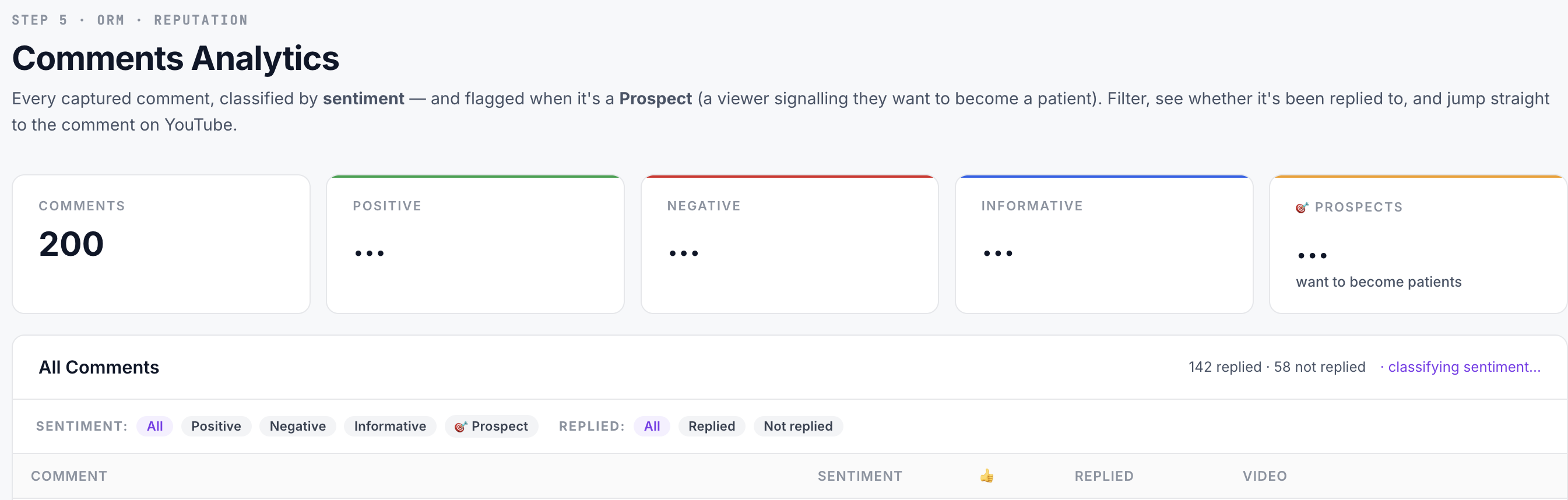
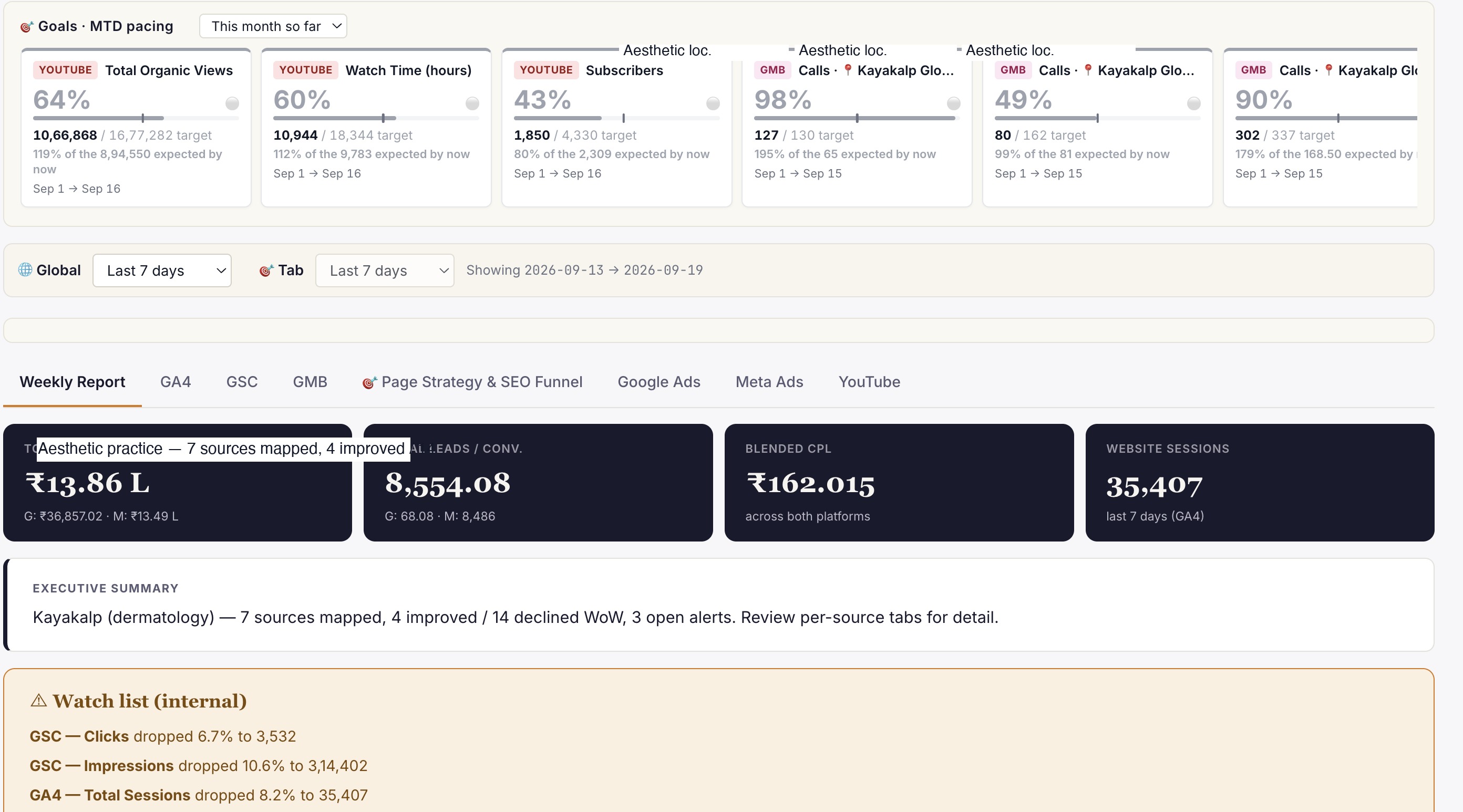
Our product set plugs in where each helps: Meta Catalyst IQ (our Meta Ads engine), Prism Spy (competitor Meta Ads intel and creative-fatigue monitor), Prism Pulse (Instagram analytics for founder and doctor personal accounts), Angryturtle (our GBP operating system that lifts the map-pack conversion rate your ads land into), and YODA (our AI-native YouTube engine for doctor-led content). But the recommendation on where to spend the rupee always comes from the buyer's constraints, not the product menu.
The 70-30 pricing model for paid media services
ICG's paid media engagements use a 70-30 fee structure that mirrors our SEO retainers. Seventy percent of the fee is fixed — covering strategy, creative direction, media buying, compliance review, weekly reporting and account management. Thirty percent is tied to a 12-month qualified-lead target on a sliding scale, so if we overshoot the target the fee expands proportionally, and if we miss, it contracts. For Google Ads engagements this model activates at Rs 5 lakh per month of media spend and above. For YouTube and AIO (AI Overview) engagements it activates at Rs 50,000 per month. The reasoning is simple: below those thresholds the noise-to-signal ratio does not let us commit to targets honestly.
For clients still discovering their fit, our three SEO tiers — Foundation (Rs 49,999 per month), Growth (Rs 74,999 per month) and Scale (Rs 99,999 per month) — often run alongside a starter Google Ads scope, because organic search intent and paid search intent share the same query set and the same landing pages. Bundling avoids the common trap of two separate agencies bidding on your brand keyword and inflating your CPC.
FAQ
 Meta Catalyst IQ Creative Scoring Matrix ranking every Meta ad creative by hook strength, proof density, offer clarity and CTA — with money-wastage column in rupees" width="1200" height="675" loading="lazy" decoding="async" style="width:100%;height:auto;display:block;">
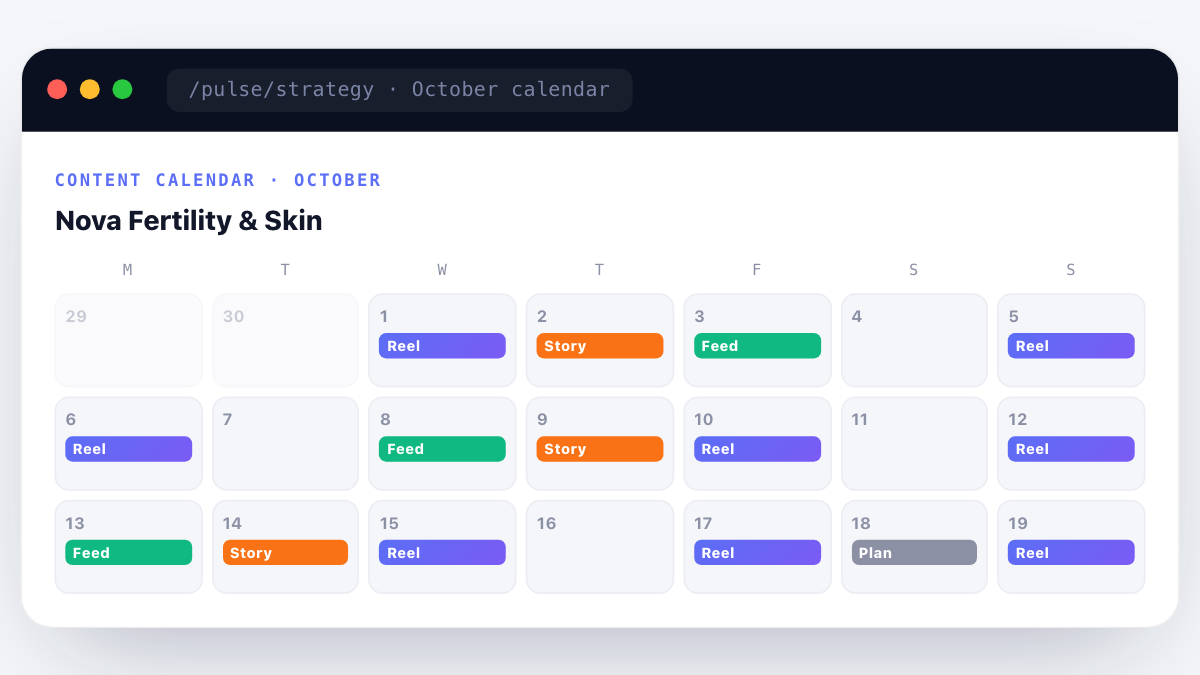 Prism Pulse content calendar showing the month ahead with Reel, Feed and Story slots colour-coded per day for a healthcare Instagram account" width="1200" height="675" loading="lazy" decoding="async" style="width:100%;height:auto;display:block;">
Can a small dental clinic run only Meta Ads and skip Google?
Technically yes, structurally no. Meta will produce leads, but the CPQL will drift up as your creative fatigues, and you will not have a demand-capture safety net for patients actively searching your specialty. The right sequence for a solo clinic is Google Search first, Meta second once the base is proven.
Is it true that Meta Ads are cheaper than Google Ads for healthcare in India?
On CPL — cost per raw lead — yes, usually. On CPQL — cost per lead who actually shows up and converts — the two channels are within 20 percent of each other in most categories, with Google ahead on high-intent verticals like cardiology and orthopaedics, and Meta ahead on cosmetic categories.
How does the DPDP Act 2023 change the way we run lead-gen ads?
Three practical changes. First, the consent text on every lead form must specify purpose, retention period and grievance officer contact. Second, marketing consent must be separated from consultation-booking consent. Third, any offshore data processor (which most ad platforms are) needs to be listed in your privacy notice with the categories of data shared. None of this stops you from running ads; it changes the form fields and the notice URL.
Do Google's Enhanced Conversions and Meta's Conversions API do the same thing?
Similar goal, different plumbing. Both send server-side signals back to the platform so that reporting and optimisation survive browser-level privacy restrictions. Google's Enhanced Conversions layer works with hashed first-party identifiers; Meta's CAPI supports event-level data with deduplication against the pixel. In practice you need both if you run both channels, and they need to be wired to a single event source of truth in your CRM.
What is the minimum monthly ad budget where a hybrid Google-plus-Meta mix starts working?
Around Rs 1.5 lakh a month of media, in our experience. Below that, each channel is starved of learning signal and the algorithm never stabilises. Between Rs 60,000 and Rs 1.5 lakh, pick one channel and run it well. Below Rs 60,000, focus on organic — Google Business Profile, reviews, local content — and defer paid.
How does ABDM affect our paid-media strategy?
Indirectly but meaningfully. ABDM-linked patient journeys are pulling discovery into ABHA-connected apps and government portals, which reduces some open-web search volume for basic OPD queries. It does not touch elective-care and specialty search, which is where most paid healthcare rupees actually go. Long term, expect ABDM-native ad surfaces to emerge; short term, plan as if ABDM is invisible to your ad accounts.
Can we run Google Ads compliantly for procedures the NMC restricts advertising for?
Sometimes. The NMC code restricts solicitation, guarantees and superlatives — it does not ban all category-level information. An honest, education-first ad ("Understand the options for lumbar disc treatment. Free 15-minute consultation with a spine specialist.") usually clears both NMC and Google's own healthcare policy. Ads promising outcomes or comparing your doctor to others do not.
Should we hire a specialist healthcare agency or a generalist performance agency?
The compliance overhead of Indian healthcare — NMC, DPDP, state medical council variations, platform-level healthcare policies — is heavy enough that a generalist agency will make you spend six months teaching them. If your monthly ad budget is under Rs 1 lakh, that cost of education is fatal. Above Rs 5 lakh it is survivable but still not efficient. A healthcare-native team with published case studies in your specialty is the safer bet.
Does YouTube belong in the Google or Meta bucket for this decision?
Neither, strictly. YouTube is a third leg — high-trust, doctor-personality-driven, and increasingly cited in AI Overviews for medical queries. Budget it separately at 5 to 15 percent of paid media, treat it as brand and consideration rather than direct-response, and measure it on assisted conversions plus organic branded search lift, not last-click.
What does a healthy paid-media report look like for a hospital board?
One page. Three numbers at the top — qualified leads, cost per qualified lead, revenue attributable. A channel split table underneath. A 13-week rolling CPQL trend. A short paragraph on what changed and what we are testing next. Anything longer is agency theatre.
Book a free Meta ads account audit.
Raman Soni's team pulls your account, checks CAPI/EMQ, reviews creative for NMC compliance, and shows where CPQL is leaking. 45 minutes, actionable output.
Questions readers ask
about this topic.
The three platforms
behind every ICG engagement.
Beacon
CAPI middleware that fixes Event Match Quality, translates CRM statuses to Meta-standard events, dedups across channels.
Agency OS
Live client dashboard. GSC, GA4, Google Ads, Meta Ads, IVR calls in one view. Login anytime, not monthly.
Phoenix
Clinic revenue intelligence over your PMS. Daily action queue: Prevent Loss, Maintain & Engage, Grow Revenue. Multi-centre rollout.
Or book a free 30-min audit to see all three in action on your account.
Healthcare brands
that already run on ICG.
A representative slice of the 150+ healthcare brands ICG has delivered for across India. Most engagements remain under NDA.


What ICG clients say · on video.
"Scale up of organic channels and business consulting. ICG has absolute domain authority in their field."
"Working with ICG transformed how we acquire IVF patients in Gurgaon. They understand the fertility journey from inquiry to consult..."
"What Ichelon accomplished — they got all my ideas and worked over 3-4 months to create an amazing, super-customised website."
Need help operationalising this?
Every ICG service is healthcare-only, NMC + DPDP-aware, and built around the patient-research patterns that drive Indian healthcare growth in 2026.
Every practice welcome — packages from ₹20,000/mo.
Goals-Driven engagements · Performance-Linked Payout Models available


More from
ICG.
Five trends shaping Indian healthcare marketing through 2027: AI-first patient research, Conversions API adoption, ABDM discovery, the AEO w...
Healthcare AIO is the discipline of getting your clinic or hospital cited inside Google AI Overviews, ChatGPT and Perplexity answers — not j...
Conversational-search advertising places brand messages inside AI chat answers — ChatGPT, Perplexity, Copilot — rather than beside a results...
Stop guessing.
Book a Diagnostic.
30 minutes. Free. With the AI-powered healthcare-only marketing agency 150+ brands already run on. No slides, no pitch, no hard close.


