


GMB Review Management Agency Selection for India: A Buyer's Guide for Healthcare Brands
A working buyer's guide for hospital marketing directors, healthcare agency owners, and doctors running clinics as businesses in India. Covers what a serious GMB review agency should deliver, fair pricing bands, NMC and DPDP compliance traps, and seven red flags to spot.
No pitch. Written root-cause diagnosis. AI-powered, healthcare only.
Direct answer
A working buyer's guide for hospital marketing directors, healthcare agency owners, and doctors running clinics as businesses in India. Covers what a serious GMB review agency should deliver, fair pricing bands, NMC and DPDP compliance traps, and seven red flags to spot.
TL;DR
TL;DR
- A serious GMB review management agency for Indian healthcare does four things well: seeds compliant review requests, responds inside 24 hours, defends against fake or medico-legal attack reviews, and reports monthly on rating movement tied to enquiry volume — not vanity impressions.
- Budget range for GMB-only mandates in India: Rs 15,000 to Rs 75,000 per month. Anything under Rs 10,000 usually means bulk-template outreach that breaks NMC advertising norms and DPDP consent rules.
- Before signing, insist on named reviewer flows (not paid or incentivised campaigns), a written takedown SOP for medico-legal complaints, and DPDP-aligned patient consent copy inside your intake form.
- Ichelon Consulting Group runs GMB review management through Angryturtle, its Google Business Profile operating system, on a 70-30 fixed-variable model where the Foundation tier at Rs 49,999 already includes GMB plus three other growth surfaces.
Table of contents
- Why does GMB review management matter for Indian healthcare brands?
- What does a GMB review management agency actually deliver?
- How do you evaluate a GMB review agency for a hospital or clinic in India?
- Which compliance rules apply to GMB reviews in Indian healthcare?
- How much should you pay a GMB review agency in India?
- What red flags should you spot before signing the contract?
- How does ICG structure GMB review management differently?
- FAQ
Why does GMB review management matter for Indian healthcare brands?
Google Business Profile is the first surface most Indian patients touch before booking a hospital consult, a dental appointment, or an IVF discovery call. Roughly 46 percent of all Google searches carry local intent, and in tier-1 metros like Mumbai, Bengaluru, and Delhi NCR, the map pack is often the first thing a patient sees on mobile before your website ever loads. If your rating sits below 4.3 or you have fewer than 40 reviews, you lose the click before the SEO conversation even starts.
The stakes are sharper for healthcare than for most verticals. A negative review on a fertility clinic in Gurugram can cost that clinic three or four Rs 2.5 lakh IVF cycles in a single week. A pharma brand manager running a chain of hearing aid stores in Chennai will tell you that one unanswered complaint about a specific audiologist becomes the top-cited concern in 60 percent of subsequent enquiry calls. Reviews are not marketing decoration in Indian healthcare — they are the pre-consultation trust score.
That is why the choice of GMB review management agency matters more than the choice of website vendor. A weak website loses you a share of traffic. A weak review strategy loses you the whole enquiry.
What does a GMB review management agency actually deliver?
A serious GMB review management agency delivers four outcomes: a steady inflow of authentic patient reviews, response coverage within 24 hours on every review, active defence against fake or vendetta reviews, and monthly reporting that ties rating trajectory to enquiry volume. Everything else is either upsell or padding you are paying for without knowing it.
Review generation
Good agencies do not blast a generic "please review us" WhatsApp broadcast. They build a request flow that fires only after a service event — discharge, follow-up call, prescription refill, second consultation — and lands as a personalised message with the doctor's name and the treatment context. The best flows sit inside a CRM so a patient who left a poor NPS never receives a review invitation in the first place.
Response management
Every review, positive or negative, gets a response drafted in the clinic's voice, checked against DPDP and NMC advertising rules, and published within 24 hours. Positive reviews get a warm, specific reply that reinforces the treating doctor. Negative reviews get an empathetic acknowledgement plus a private channel — a phone number or WhatsApp handle — for resolution offline.
Reputation defence
Fake reviews, competitor-planted reviews, and reviews from people who were never patients are a real problem in Indian healthcare. A good agency runs a weekly sweep, files removal requests through Google's Business Profile Help flow with the right policy citation, and escalates through a legal channel if a review names a doctor with defamatory content.
Reporting
Monthly reporting should show: new reviews added, average rating movement, response coverage percentage, review-to-enquiry correlation, and the top three themes in negative reviews with a remediation plan. Anything shorter than this is a screenshot dump dressed up as insight.
How do you evaluate a GMB review agency for a hospital or clinic in India?
Evaluate a GMB review agency on five criteria: healthcare specialisation, response SLA, review generation ethics, takedown track record, and reporting depth. Ask for named client examples in your specialty, request a live review response inside 30 minutes as a trial, and read a written escalation SOP for medico-legal reviews before you sign anything.
Healthcare specialisation
General ORM agencies write responses that read fine for a restaurant but land badly for a hospital. A response to a review that mentions a treatment outcome, a specific drug, or a doctor's advice needs to be worded so it does not violate NMC's prohibition on solicitation and does not confirm or deny protected health information. Only agencies that have handled healthcare reviews at volume know how to word this properly.
Response SLA
Ask for a written SLA. The number to insist on: 90 percent of reviews responded to within 24 hours, 100 percent within 48 hours. Anything looser than this means your negative reviews will sit unanswered while the next enquiry reads them and reconsiders.
Review generation ethics
Any agency that offers to buy reviews, gift patients for reviews, or write reviews on behalf of patients should be walked out of the room. Beyond the ethical issue, Google's algorithms now catch pattern-driven fake reviews and can suspend the entire Business Profile. A suspended profile in Kolkata for a six-branch dental chain will cost you a full quarter of new patient flow.
Takedown track record
Ask for the last five fake reviews they removed, the timeline, and the specific policy grounds cited. If they cannot show you five concrete examples with dates, they have not actually done the work at scale.
Reporting depth
Reporting should tie back to enquiries in AtomCRM or your existing patient management system — new appointments, form fills, phone calls that reference the profile. If the report stops at "we posted 12 responses this month", the agency is charging you for typing rather than outcomes.
Which compliance rules apply to GMB reviews in Indian healthcare?
Three Indian frameworks apply to GMB reviews for healthcare brands: the NMC Registered Medical Practitioner Regulations 2023 on solicitation, the Digital Personal Data Protection Act 2023 on patient consent, and the Ayushman Bharat Digital Mission consent architecture where the review is tied to an ABHA-linked interaction.
The NMC rules are the trap most agencies fall into. Registered medical practitioners are prohibited from soliciting patients directly. That means a review request that reads "please help Dr Sharma reach more patients" is a violation. A compliant request instead reads "Dr Sharma would appreciate your feedback on your recent consultation to help us improve care" — no solicitation, purely a feedback framing.
The DPDP Act adds a second layer. Any communication that references a patient's specific treatment, drug, or consultation date requires explicit consent to process that personal data for a marketing purpose. Most consent forms Indian hospitals use today do not cover this. A serious agency will rewrite the intake consent so the review request itself is DPDP-clean, not just the marketing emails downstream.
ABDM's consent framework is optional for many practices for now, but is becoming the default for hospitals accepting Ayushman Bharat cases. If your review request references an ABHA-linked encounter, you need a fresh consent artefact through the Consent Manager before the request goes out.
How much should you pay a GMB review agency in India?
Fair market pricing for a GMB review management agency in India ranges from Rs 15,000 per month for a single-location clinic to Rs 75,000 per month for a multi-city hospital chain with 20-plus profiles. Below Rs 10,000 you are almost certainly buying template automation, and above Rs 1 lakh for GMB alone means the agency is bundling services you may not actually need.
| Practice size | Locations | Fair monthly range | What it should cover |
|---|---|---|---|
| Solo clinic | 1 | Rs 15,000 - Rs 22,000 | Profile hygiene, weekly posts, 100% response, 15-25 new reviews/month |
| Multi-doctor clinic | 1-3 | Rs 25,000 - Rs 40,000 | Above plus takedown SOP, doctor-level review routing, quarterly audit |
| Regional hospital | 3-8 | Rs 45,000 - Rs 75,000 | Above plus dedicated account manager, CRM integration, weekly reporting |
| Multi-city chain | 10+ | Rs 75,000 - Rs 1,50,000 | Above plus API integration, per-branch dashboards, legal escalation lane |
Two pricing patterns to watch for. The first is per-review pricing — agencies that charge Rs 200 per review generated. This creates an incentive to fake reviews. The second is per-response pricing — Rs 50 per reply. This creates an incentive to write shallow one-line responses that add nothing. Both structures work against the outcome you actually want, which is a sustainably higher rating tied to more enquiries.
What red flags should you spot before signing the contract?
Seven red flags should make you walk away from a GMB review management agency: guaranteed 5-star ratings, promises of specific review counts per month, refusal to share client references in healthcare, unclear ownership of the Google Business Profile, no written response SLA, lock-in contracts beyond six months, and off-shore response teams with no healthcare training.
The GMB ownership question is the one Indian founders miss most often. If the agency creates or claims your Google Business Profile under their own Google account, they own the asset. When you switch agencies — and eventually you will — you may find the new agency has to rebuild the profile from scratch, losing years of review equity in the process. Always insist that your profile sits under your own Google account with the agency added as a manager, not the owner.
Lock-in contracts beyond six months in the review management category are almost always a sign the agency knows results will be slow or that churn is high. A confident GMB review agency in India will offer a rolling monthly retainer or a three-month initial term with monthly extensions after that.
Off-shore response teams are a subtle red flag. A dental practice in Jaipur cannot afford a review response written by someone who has never seen a Jaipur landmark or heard a Marwari surname pronounced correctly. Responses that feel geographically off destroy the credibility signal reviews are supposed to build. Ask where the writers sit before you sign.
How does ICG structure GMB review management differently?
Ichelon Consulting Group runs GMB review management as one lane inside a broader Google Business Profile operating system called Angryturtle, not as a standalone service. Every review response is written by a healthcare-trained content operator in India, checked against NMC and DPDP rules, and published inside 24 hours. Rating trajectory is tied back to enquiry volume through AtomCRM so the monthly report shows revenue impact, not activity counts.
ICG has worked with 150-plus clinics and 300-plus live healthcare clients across dental, IVF, orthopaedics, oncology, and hospital chains. That volume is what lets the team spot patterns — a specific type of negative review that keeps appearing in Bengaluru dental chains, a particular kind of malicious review targeting IVF clinics in Delhi NCR after a competitor launch, a review-response wording that consistently converts a 2-star into a 4-star update after resolution. General agencies rebuild this pattern library every time; ICG applies it from day one.
The other structural difference: ICG's GMB review lane never sits alone. It plugs into HealthPro 360 for the patient management overlay, into Meta Catalyst IQ so the review theme insight informs ad creative, into Prism Pulse for Instagram trust signals, and into YODA when a review theme suggests a video answer would help. A stand-alone GMB agency cannot make those connections because it does not run the other surfaces.
The 70-30 fixed-variable model
ICG's engagement pricing follows a 70-30 model. 70 percent of the retainer is fixed monthly work — profile hygiene, review generation, response management, reporting. 30 percent is a variable pool that flexes to whatever the account needs that month — a takedown push after a review attack, a review-request sprint before a new branch launch, a doctor-level reputation build for a newly joined consultant.
The three anchor tiers:
- Foundation — Rs 49,999/month: GMB review management plus three other growth surfaces (typically SEO, content, and one paid channel). Right-sized for a single-city clinic or a small chain.
- Growth — Rs 74,999/month: Adds Meta Catalyst IQ for ads, deeper CRM integration through AtomCRM, and per-branch review dashboards. Right for a 3-8 branch practice or a regional hospital brand.
- Scale — Rs 99,999/month: Adds YODA for video, competitive intelligence through Prism Spy, and a dedicated account director. Right for multi-city chains and established hospital groups.
Below Rs 49,999 the 70-30 model does not hold — there is not enough variable pool to defend against a real attack week. Founders looking for cheaper GMB-only work are better served by the standalone Angryturtle subscription starting at Rs 999 per month, understanding it is a DIY tool rather than a managed service.
FAQ


 AI Overview citation share versus named competitors on the same healthcare query set" width="1200" height="675" loading="lazy" decoding="async" style="width:100%;height:auto;display:block;">
How long does it take a GMB review management agency to move the needle for an Indian hospital?
Expect 60-90 days to see rating trajectory shift and around six months for meaningful ranking improvement in the local map pack. Anything sooner is either luck or the profile was severely under-managed before the engagement began.
Can a GMB review agency in India remove fake or defamatory reviews?
Yes, if the review violates Google's policies. A good agency documents the violation, submits it through the Business Profile Help flow with evidence, and follows up. Removal rates in Indian healthcare hover around 40-55 percent because Google is conservative about deletions and requires clear policy grounds.
Is it legal to ask patients for GMB reviews under NMC rules?
Yes, provided the request is framed as feedback rather than solicitation, does not offer any incentive, and does not reference a specific doctor as the beneficiary of the review. Consent to receive the request should sit inside your patient intake form and be DPDP-compliant in its wording.
What is the minimum GMB review count and rating for a healthcare business to compete in Indian metros?
A 4.3-plus rating with 40-plus reviews is the baseline in tier-1 metros. For competitive specialties like IVF, cosmetic dentistry, and dermatology in Mumbai or Delhi NCR, a 4.5-plus rating with 100-plus reviews is closer to the real threshold for map pack visibility.
Should we combine GMB review management with our SEO retainer or keep them separate?
Combine them if the agency has genuine capability in both. Local SEO and GMB review management share the same target — map pack visibility — so splitting them across two vendors usually creates coordination overhead without a quality gain.
What happens to our reviews if we change GMB review management agencies?
Nothing, if your Google Business Profile is under your own Google account with the agency added as a manager. The reviews belong to the profile, not the agency. Always confirm ownership before signing any contract or transferring access.
Do we need a separate GMB review agency for each city we operate in?
No. Multi-city chains are better served by a single agency with pan-India response coverage and city-level content operators who know local naming conventions and landmarks. A single agency spots cross-branch patterns faster and negotiates review takedowns from a stronger evidence base.
Book a free 30-minute Brand & Growth Diagnostic.
It's a working session, not a sales pitch — you leave with a written root-cause analysis you can act on, whether or not you engage ICG.
Questions readers ask
about this topic.
The three platforms
behind every ICG engagement.
Beacon
CAPI middleware that fixes Event Match Quality, translates CRM statuses to Meta-standard events, dedups across channels.
Agency OS
Live client dashboard. GSC, GA4, Google Ads, Meta Ads, IVR calls in one view. Login anytime, not monthly.
Phoenix
Clinic revenue intelligence over your PMS. Daily action queue: Prevent Loss, Maintain & Engage, Grow Revenue. Multi-centre rollout.
Or book a free 30-min audit to see all three in action on your account.
Healthcare brands
that already run on ICG.
A representative slice of the 150+ healthcare brands ICG has delivered for across India. Most engagements remain under NDA.


What ICG clients say · on video.
"Scale up of organic channels and business consulting. ICG has absolute domain authority in their field."
"Working with ICG transformed how we acquire IVF patients in Gurgaon. They understand the fertility journey from inquiry to consult..."
"What Ichelon accomplished — they got all my ideas and worked over 3-4 months to create an amazing, super-customised website."
The intelligence stack behind this playbook.
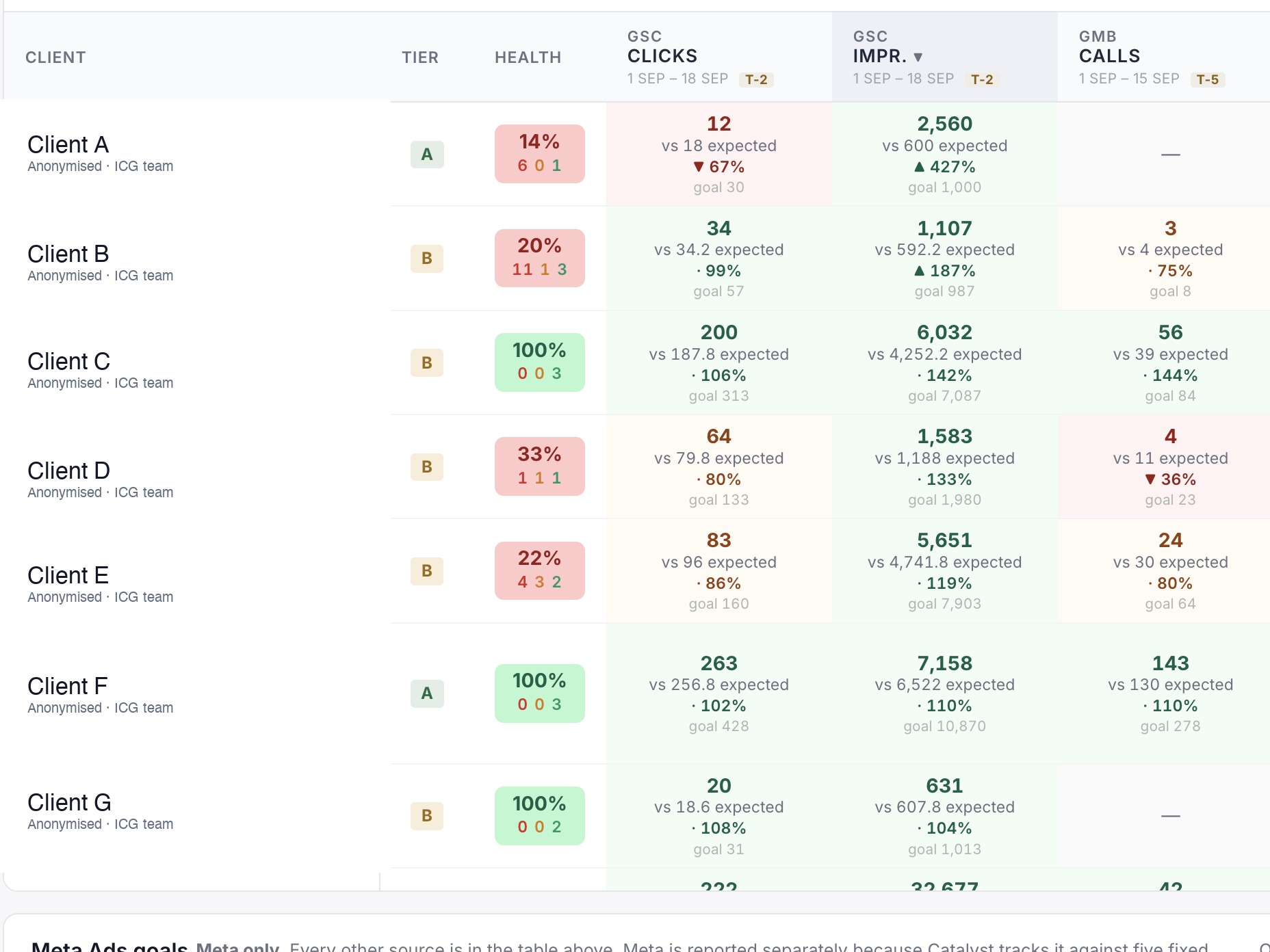
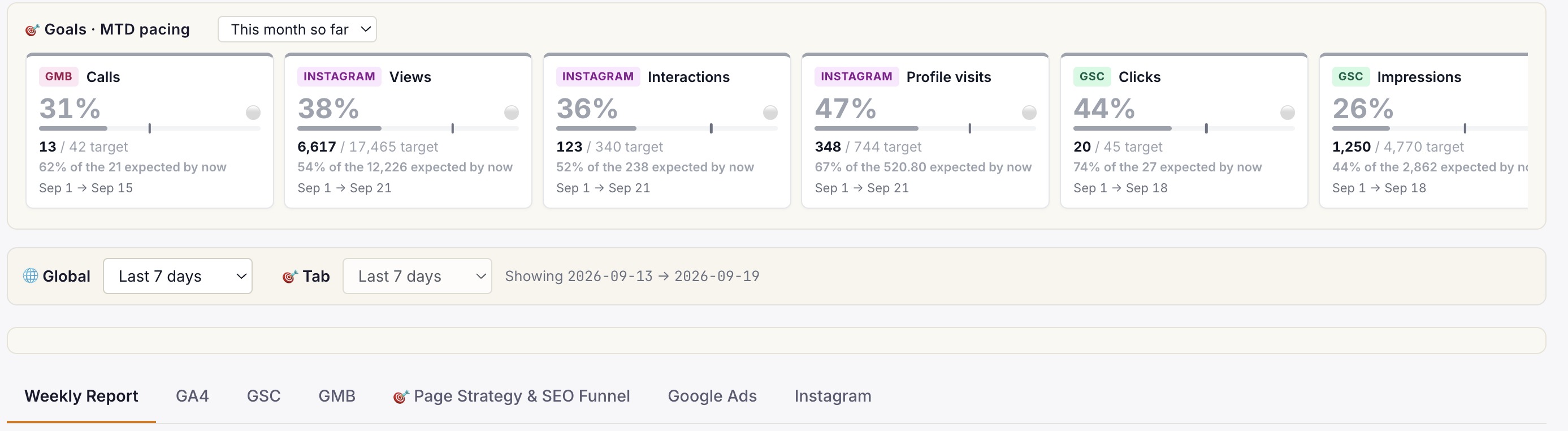
Every ICG engagement runs on the Search Intelligence Trifecta — Angryturtle for GMB, SIE for search and AI Overview, YODA for YouTube. Live product screens below.
Need help operationalising this?
Every ICG service is healthcare-only, NMC + DPDP-aware, and built around the patient-research patterns that drive Indian healthcare growth in 2026.
Every practice welcome — packages from ₹20,000/mo.
Goals-Driven engagements · Performance-Linked Payout Models available
More from
ICG.
Five trends shaping Indian healthcare marketing through 2027: AI-first patient research, Conversions API adoption, ABDM discovery, the AEO w...
Healthcare AIO is the discipline of getting your clinic or hospital cited inside Google AI Overviews, ChatGPT and Perplexity answers — not j...
Conversational-search advertising places brand messages inside AI chat answers — ChatGPT, Perplexity, Copilot — rather than beside a results...
Stop guessing.
Book a Diagnostic.
30 minutes. Free. With the AI-powered healthcare-only marketing agency 150+ brands already run on. No slides, no pitch, no hard close.


