


AEO and LLM Optimisation for Healthcare — The 2026 Pillar Guide
Pillar guide for healthcare AEO and LLM optimisation: what AEO is and why it matters in 2026, how LLMs cite sources, the AIO Intel Tool, structured content discipline, named-author E-E-A-T compounding, citation reinforcement, measurement, and the 90-day deployment playbook.
No pitch. Written root-cause diagnosis. AI-powered, healthcare only.
Direct answer
Pillar guide for healthcare AEO and LLM optimisation: what AEO is and why it matters in 2026, how LLMs cite sources, the AIO Intel Tool, structured content discipline, named-author E-E-A-T compounding, citation reinforcement, measurement, and the 90-day deployment playbook.
TL;DR
2026-06 update — the GEO measurement maturity
When this guide was first published, GEO (Generative Engine Optimization) measurement was experimental. The 2026 update reflects measurement maturity across three LLM surfaces:
ChatGPT. Brand mentions in ChatGPT responses to healthcare queries are now trackable via systematic query rotation, response capture, and brand-mention extraction. ICG monitors ~100 healthcare query patterns weekly per client to track brand mention frequency, citation context, and competitive positioning.
Perplexity. Perplexity displays its source citations, making GEO measurement more straightforward. ICG tracks which ICG-client-domain pages are cited in Perplexity responses to which queries — and what content patterns drive citation frequency.
Claude and Gemini. Both surfaces are tracked through similar query-rotation methodology. The measurement reveals which content patterns produce brand mentions on which surface — and how to engineer content for cross-LLM citation.
The GEO measurement output is reported alongside Google ranking data in ICG's monthly client reporting.
AEO — Answer Engine Optimisation — is the discipline of optimising content to be cited by Large Language Models when those models answer user queries. AEO is to LLM search what SEO was to Google search in 2005 — an emerging discipline that the early movers will dominate.
What AEO Is and Why It Matters in 2026
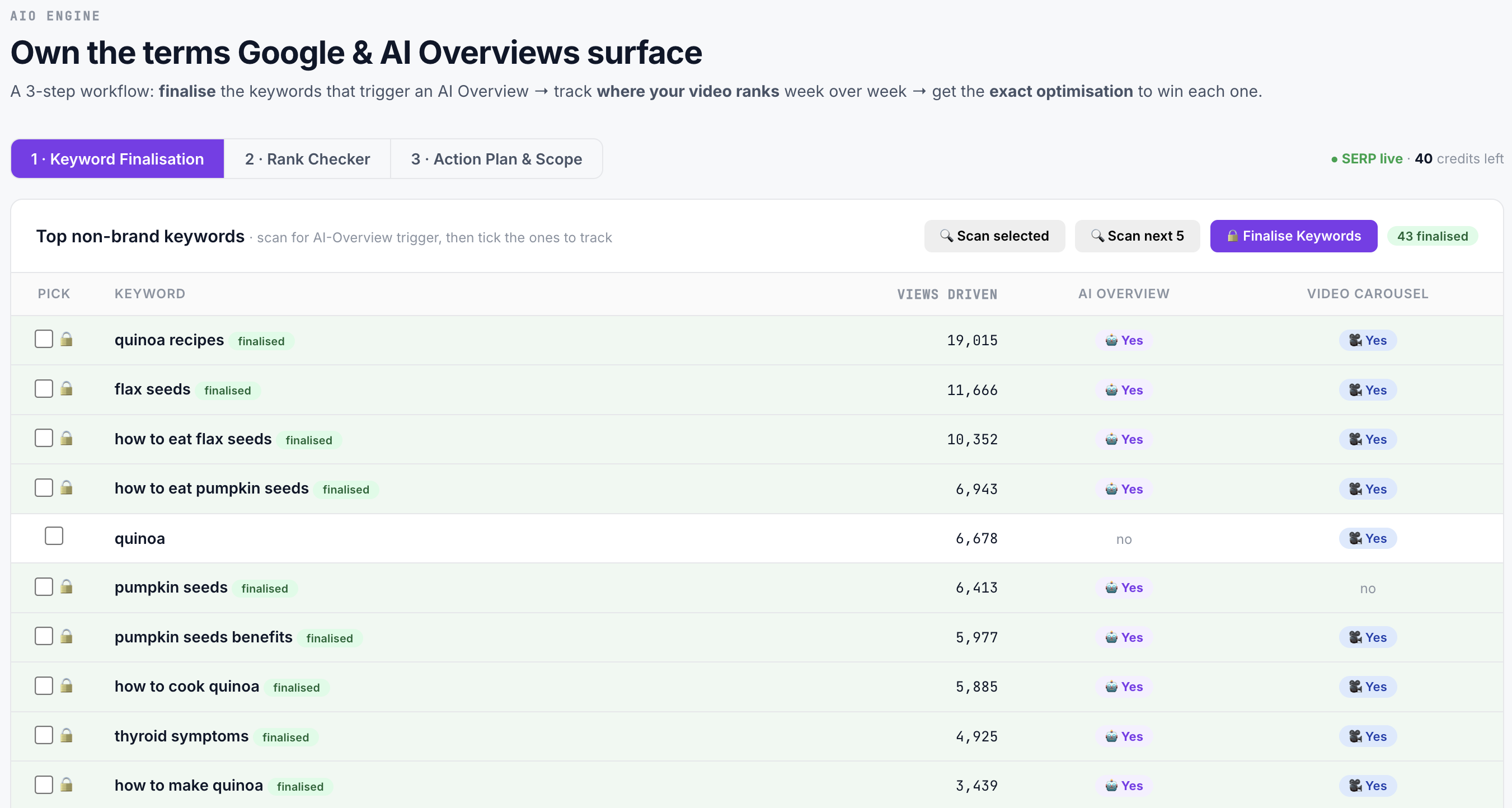 AI Overview opportunity across YouTube search, Google web and Google AI Overview" width="1200" height="675" loading="lazy" decoding="async" style="width:100%;height:auto;display:block;">
The LLM-search share of healthcare research queries in India in 2026 is approximately 8-14% (specialty-dependent) and rising. ChatGPT, Perplexity, Gemini, Claude, and Google AI Overviews collectively are becoming the first-touch research channel for an increasing share of healthcare patients — particularly the urban professional, tech-corporate, and English-comfortable demographics that drive demand for high-value procedures.
The clinic that ranks well in Google's blue links but is not cited by LLMs is invisible to this growing audience. The LLM cites a small number of sources in each generated answer — typically 3-7. The competition is not for the top-10 position in a list of results; it is for the top-3 position in the LLM's source attribution. AEO is materially more concentrated than traditional SEO.
How LLMs Cite Sources
LLM citation decision-making is informed by several signals that are distinct from traditional SEO ranking factors:
Source quality signals. Author credentials, named-author bylines with Person schema and sameAs references to verifiable external entities, publication date, last-updated date, citation discipline within the content.
Structural cues. Explicit FAQ blocks with FAQPage schema, DefinedTermSet for technical terminology, Question schema with Answer pairing, sourceable factual claims with dated citations.
Topical relevance. The content addresses the specific query with substantial depth, not generic coverage of the topic. The LLM rewards specificity.
E-E-A-T signals. Experience, Expertise, Authoritativeness, Trustworthiness — the same signals Google's quality-rater framework uses are relevant for LLM citation.
Citation reinforcement. Content that is itself cited by other authoritative sources accumulates citation authority. Reference to other authoritative work compounds.
The AIO Intel Tool Deployment
ICG's AIO Intel Tool is the measurement and optimisation platform for AEO programmes. The four capabilities:
Citation rate measurement. Scheduled queries against ChatGPT, Perplexity, Gemini, Claude, and Google AI Overviews using representative query sets. Citation rate (was the source cited / total query runs) and citation position (which sources are cited and in which order) are logged.
Competitive analysis. Maps which competitor sources are being cited for the client's target query clusters. Identifies where the client is under-represented vs competitors.
Content gap analysis. Identifies query clusters where the LLM has limited or no quality source content — these are the highest-priority content opportunities.
Optimisation recommendations. For each content piece, AIO Intel suggests structural improvements likely to lift citation rate — schema additions, FAQ expansion, citation reinforcement, author attribution.
Structured-Content Discipline
The structural cues that LLMs use to evaluate citation candidates require specific content production discipline:
FAQPage schema. Every content piece should include an FAQ block addressing the most likely follow-up questions. The FAQ block is wrapped in FAQPage schema. The questions are written in patient-natural-language. The answers are 80-180 words each, sourceable, and self-contained.
DefinedTermSet for technical terminology. Medical terms are defined explicitly with DefinedTerm schema. Definitions are 50-150 words. The terms link to authoritative reference sources.
Question schema with Answer pairing. Beyond FAQ, individual question-answer pairs throughout content can carry Question and Answer schema. The pattern is the structural backbone of AEO citation.
Named-author bylines with Person schema. Every content piece authored by a named individual with Person schema rendering the author's credentials, alumni, hospital affiliations, sameAs references. The author entity becomes the citation anchor.
Citation reinforcement. Every quantitative claim, every comparative claim, every regulatory claim cited to a verifiable source with dated reference. The citation discipline is foundational to LLM trust signals.
Named-Author E-E-A-T Compounding
The named-author content programme is the highest-leverage AEO investment. The mechanics:
Author entity building. Each clinic doctor receives a Person schema deployment with full credentials, alumni, hospital affiliations, sameAs references to LinkedIn, conference speaker pages, university alumni databases, hospital affiliation pages. The author entity is reinforced across every content piece they author.
Content portfolio. Each author has a portfolio of content addressing their specialty — pillar content, FAQ content, procedure-specific content, patient-question content. The portfolio reinforces the author's expertise signal.
Cross-author reinforcement. Multiple authors at the same clinic with overlapping but distinct expertise areas reinforce the clinic's collective authority. The clinic-level entity benefits from the author-level entity reinforcement.
External reinforcement. Author appearances at conferences, podcasts, published research, media commentary, LinkedIn thought-leadership — these external signals reinforce the entity. LLMs detect the entity reinforcement across modalities.
Citation Reinforcement
Citation reinforcement operates bidirectionally. Outbound citations (the content references authoritative sources) build the content's credibility. Inbound citations (other sources reference the content) build the content's authority over time.
Outbound citation discipline. Every quantitative claim cited to a dated, accessible source. Healthcare-specific authoritative sources (peer-reviewed journals, NMC, ICMR, NABH, IBEF, NATHEALTH) carry highest weight. The citation density target is one citation per 200-300 words of content.
Inbound citation building. Third-party reference to the content increases citation authority. Strategies include: outreach to healthcare publications, expert commentary opportunities, conference speaking, research collaboration, and digital PR programmes. The compounding is multi-year.
Measurement
AEO measurement operates across three layers:
Citation rate. Direct measurement via AIO Intel Tool's scheduled queries. Citation rate by query cluster, citation position when cited, citation trend over time.
Inbound referral traffic. Referral traffic from ChatGPT (perplexity.ai, chat.openai.com, gemini.google.com, claude.ai, copilot.microsoft.com) in Google Analytics 4. This traffic is materially smaller than Google organic but qualitatively different — these visitors have been pre-qualified by the LLM answer and arrive with substantial context.
Brand-search lift. LLM citations drive brand awareness even when the LLM-cited visit does not convert directly. Brand-search query volume lift is a leading indicator of LLM-citation impact.
AEO vs SEO — What's Same, What's Different
Same. Content quality, topical depth, author credibility, schema markup, page experience, mobile-first indexing.
Different. AEO rewards structural discipline (explicit Q-and-A, defined terms, citation density) more than SEO. AEO rewards named-author E-E-A-T more directly than SEO. AEO competition is more concentrated (3-7 cited sources vs top-10 in SEO). AEO measurement is different (citation rate via sampling vs ranking via direct measurement).
In 2026, the two disciplines overlap substantially but the optimisation strategies diverge. The clinic that has built a strong SEO programme has a foundation for AEO but needs to add AEO-specific structural discipline.
The Regulatory Considerations for AI-Search Content
LLM-citable healthcare content operates under the same regulatory framework as other healthcare content — NMC Section 6, Schedule J, ART Act, DCI, DPDP. The compliance discipline applies regardless of channel.
The specific AEO consideration: LLM answers may be presented to users without the context that SEO-driven website visits provide. Content that is NMC-compliant in its original context may be cited by LLM in a context that strips compliance disclaimers. The discipline: the content itself must be compliant standalone, without relying on context that the LLM may not preserve.
The 90-Day Healthcare AEO Deployment Playbook
Days 1-14 — Audit and foundation. AEO audit of existing content. AIO Intel Tool deployment. Baseline citation rate measurement. Priority query cluster identification.
Days 14-45 — Schema deployment. FAQPage schema across priority pages. DefinedTermSet for technical terminology. Person schema for named authors. Question/Answer schema for in-content Q&A patterns. Citation discipline audit and gaps closed.
Days 45-90 — Content production and measurement. Content production for priority query clusters identified in the AEO audit. Citation rate re-measurement. Optimisation cycles on the highest-performing content.
The 90-day deployment typically delivers measurable improvements in citation rate for priority queries by Week 8. The compounding continues over months 4-12 as the content portfolio deepens and named-author entity signals strengthen.
Book a free SEO diagnostic.
Hanuman Sihag's team runs a live crawl, checks technical health, cannibalisation, schema coverage and content gaps. 60 minutes, prioritised fix list.
Questions readers ask
about this topic.
The three platforms
behind every ICG engagement.
Beacon
CAPI middleware that fixes Event Match Quality, translates CRM statuses to Meta-standard events, dedups across channels.
Agency OS
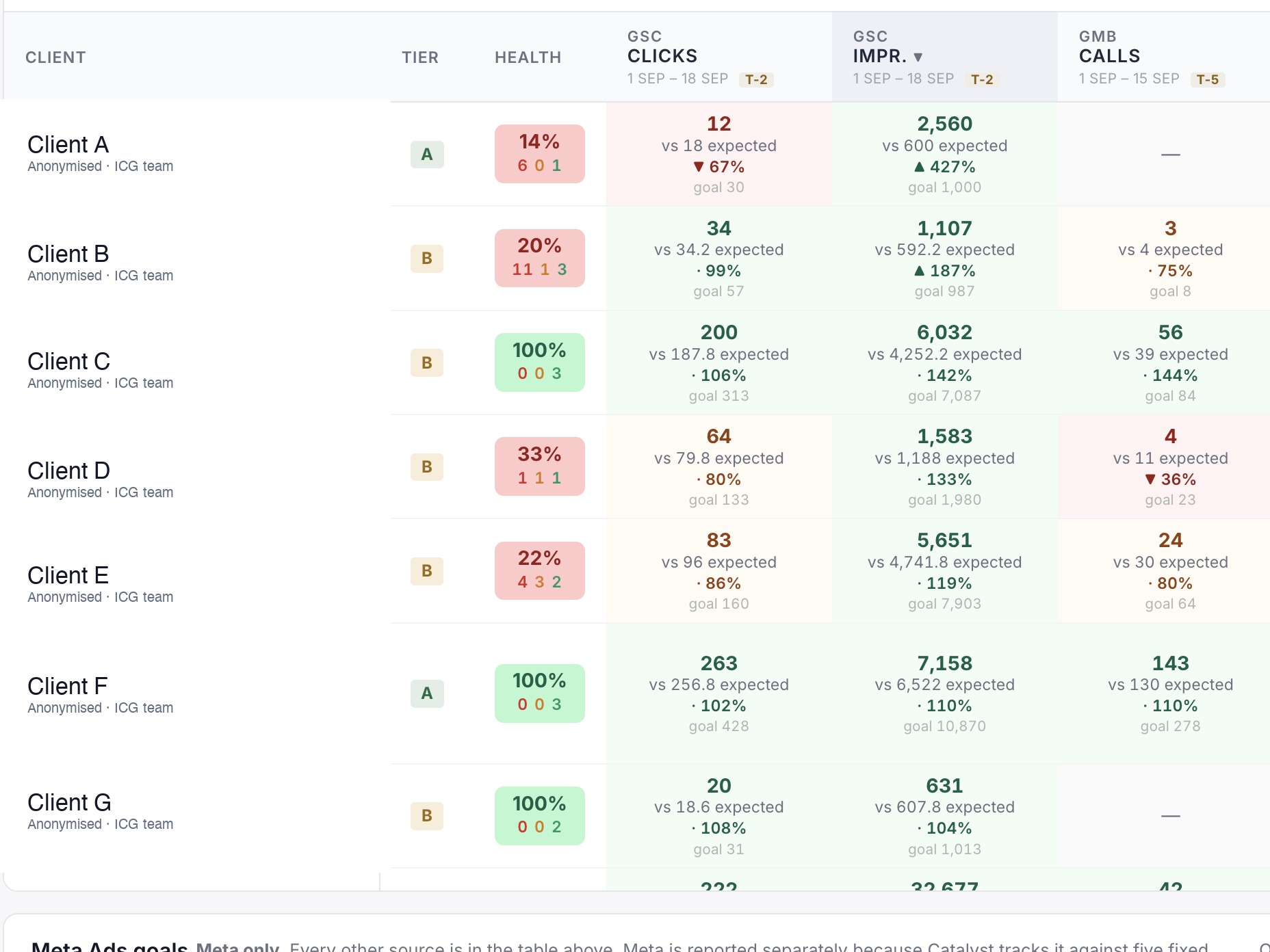
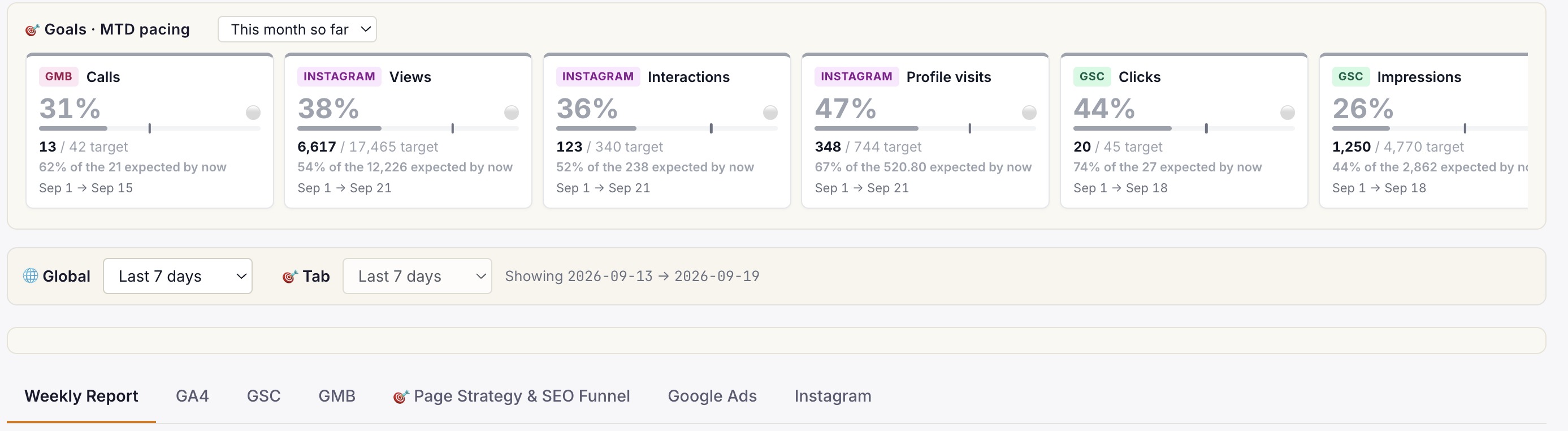
Live client dashboard. GSC, GA4, Google Ads, Meta Ads, IVR calls in one view. Login anytime, not monthly.
Phoenix
Clinic revenue intelligence over your PMS. Daily action queue: Prevent Loss, Maintain & Engage, Grow Revenue. Multi-centre rollout.
Or book a free 30-min audit to see all three in action on your account.
Healthcare brands
that already run on ICG.
A representative slice of the 150+ healthcare brands ICG has delivered for across India. Most engagements remain under NDA.


What ICG clients say · on video.
"Scale up of organic channels and business consulting. ICG has absolute domain authority in their field."
"Working with ICG transformed how we acquire IVF patients in Gurgaon. They understand the fertility journey from inquiry to consult..."
"What Ichelon accomplished — they got all my ideas and worked over 3-4 months to create an amazing, super-customised website."
The intelligence stack behind this playbook.
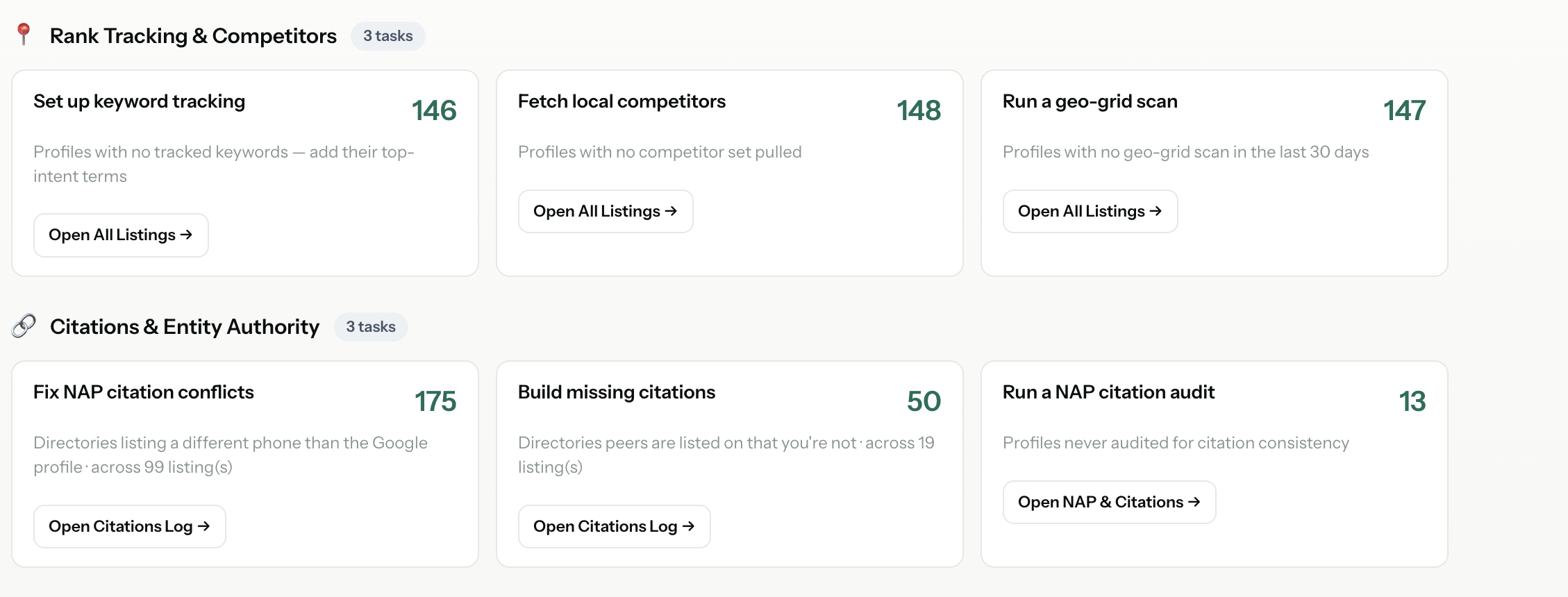
Every ICG engagement runs on the Search Intelligence Trifecta — Angryturtle for GMB, SIE for search and AI Overview, YODA for YouTube. Live product screens below.
Need help operationalising this?
Every ICG service is healthcare-only, NMC + DPDP-aware, and built around the patient-research patterns that drive Indian healthcare growth in 2026.
Every practice welcome — packages from ₹20,000/mo.
Goals-Driven engagements · Performance-Linked Payout Models available
More from
ICG.
Five trends shaping Indian healthcare marketing through 2027: AI-first patient research, Conversions API adoption, ABDM discovery, the AEO w...
Healthcare AIO is the discipline of getting your clinic or hospital cited inside Google AI Overviews, ChatGPT and Perplexity answers — not j...
Conversational-search advertising places brand messages inside AI chat answers — ChatGPT, Perplexity, Copilot — rather than beside a results...
Stop guessing.
Book a Diagnostic.
30 minutes. Free. With the AI-powered healthcare-only marketing agency 150+ brands already run on. No slides, no pitch, no hard close.


