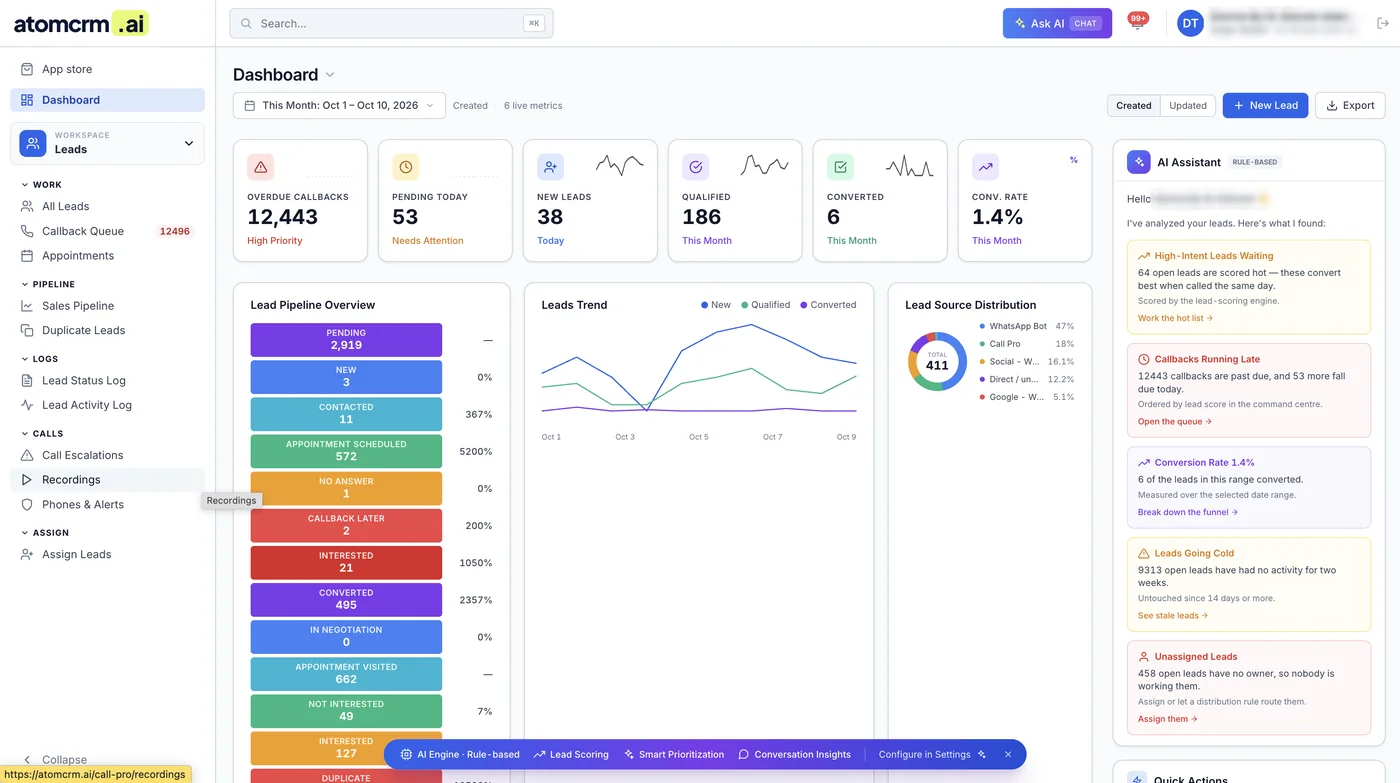
What is speed to lead?
Speed to lead is the time between a prospective patient's enquiry and the practice's first meaningful response. An enquiry can be a web form, a missed call, a chat or a social message. A meaningful response is a real reply that moves toward booking, not an automatic receipt. Faster responses usually mean more booked appointments, because people contact several practices at once.

- Measured from enquiry timestamp to first human or useful response.
- Track it by channel and time of day; nights and weekends are usually the weak spot.
- Missed calls count as leads; call back them, don't wait for voicemail.
- Fast follow-up must still respect TCPA consent and HIPAA.
- Every practice welcome — retainers from $499/mo, Goals-Driven engagements, Performance-Linked Payout Models available.
- Dallas, Texas LLC
- US client team · Central Time (CST)
- 25+ US healthcare clients
- BAA signed with every client
- HIPAA compliance training across client and delivery teams
- Contracts and invoices in USD
-
 Primary Care · North Dallas, TXCase study →
-
 MedSpa · North Dallas, TX
-
 Skin Care · Beverly Hills, CA
-
 Dental · Christiansburg, VACase study →
-
 Pediatrics · Blacksburg, VACase study →
-
 Pediatric Dentistry · Blacksburg, VACase study →
-
 Dental · Roanoke, VACase study →
-
 Functional Medicine · Telehealth · USACase study →
“They were able to get all my ideas and work with me over a period of three to four months and create this amazing website. It's super customized, very modern, and it incorporates all the elements that I had wanted — the patient portal, nice pictures, a very interactive website, patient reviews. I would highly recommend their company to anyone who wants to make an excellent website.”
What speed to lead measures
Speed to lead is a response-time metric. The clock starts when the enquiry arrives: the form submission time, the missed call time, or the message time. It stops at the first response that a person would consider useful. That usually means a call from staff, a text that offers times, or a booking link with a real reply, not a generic "we received your message" email.
Practices typically report it as a median, plus the share of leads answered within a set window that the practice chooses. Averages hide problems, because a few leads answered the next morning can drag the figure in ways that a median shows more clearly.
The reason it matters is simple. A person searching for care often fills in more than one form or calls more than one practice. The first practice that answers clearly and offers a time has an advantage. Speed also signals how the patient will be treated later.
How practices improve it
- Route leads instantly: send form and chat leads to the people who can act, not a shared inbox checked twice a day.
- Fix missed calls: use call tracking to see missed calls and call them back quickly.
- Cover off-hours: set expectations on the form, offer online booking, or use an answering service under a BAA.
- Script the first touch: give staff a short, friendly opener that moves toward a booking.
- Report weekly: by channel, staff member and hour.
See our lead conversion guide for call handling ideas, the front desk HIPAA checklist and the KPI dashboard guide.
Common mistakes and limits
Speed without quality backfires. A fast but rushed call that does not answer questions or offer times will not book. Measure booking rate together with speed. Another mistake is counting an auto-reply as the response, which makes the metric look good while patients wait.
Compliance applies to fast follow-up. Automated texts and calls need the right TCPA consent, and messages should not include sensitive health details in insecure channels. Any tool that stores enquiry details with health information should be covered by a BAA. Faster is better only when the response is lawful, accurate and helpful.
Finally, avoid comparing your number to claims you read online about ideal response times. Use your own data: compare booking rates for leads answered quickly versus slowly, and set the target from that.
Related pages from the US team
Lead conversion guide
Calls, leakage and front-desk fixes.
HIPAA for front desk staff
Compliant call and message handling.
KPI dashboard guide
Track response time with other weekly metrics.
US healthcare marketing glossary
Every term, defined in plain English.
Every practice welcome — Goals-Driven engagements from $499/mo
We benchmark your last 90 days, agree monthly goals with you, and track them live on Ichelon Agency OS with a report every Monday. Performance-Linked Payout Models are available. Our US leadership is based in Dallas, and strategy calls run in US business hours.
Common questions
What is speed to lead in healthcare?
It is the time between a prospective patient's enquiry, such as a form, call or message, and the practice's first meaningful response. Practices track it because people often contact several providers, and the one that responds clearly first is more likely to book them.
How do practices measure speed to lead?
They record the time each enquiry arrives and the time of the first real response, then report the median and the share of leads answered within a target window. Breaking it down by channel, staff member and time of day shows where delays happen.
Does an automatic email reply count for speed to lead?
Not usually. An auto-reply confirms receipt but does not move the person toward booking. Most practices measure the first human response or useful reply, such as a call or text that offers appointment times.
Are there compliance limits on fast follow-up texts?
Yes. Automated texts and calls need appropriate consent under the TCPA, and marketing messages need prior express written consent. Messages should avoid unnecessary health details, and tools storing enquiry data with health information should be covered by a HIPAA BAA.
A note on this guide: it explains marketing practice, not legal advice. Rules on privacy, advertising and insurance change and vary by state, so confirm anything compliance-related with your own counsel.
Leads waiting too long for a reply?
Book a 30-minute call. We'll review how enquiries reach your team and where response time slips.
Lead quality and management in the nine-stage patient journey
- 0Foundations
- 1Demand gen
- 2Capture
- 3Lead quality
- 4Lead mgmt
- 5Scheduling
- 6Show-up
- 7Conversion
- 8Retention
It works after the enquiry, where most growth leaks: screening every lead and making sure each one is followed up. Our own software runs the work, and every stage is reported against a monthly target on Ichelon Agency OS.
See all nine stages and the tool behind each one →