Hospital ORM service India — chain-scale reputation infrastructure, not a review-reply subscription.
A hospital chain's reputation is not one number on one Google Business Profile. It is dozens of branches, hundreds of doctors, thousands of monthly reviews, and one bad week at any single location that can drag trust down for a brand patients associate as a whole. ICG builds the infrastructure — review governance, crisis response protocol, and a media relations overlay where needed — that lets a chain manage reputation at the scale it actually operates at, not the scale a single-location ORM tool was built for.
TL;DR
- Hospital ORM is built for multi-location, multi-department, multi-doctor reputation — branch-level review routing, escalation, and reporting, not one dashboard for one address.
- Runs on ICG's Search Intelligence Trifecta — Angryturtle owns the multi-location GBP layer, SIE tracks AI-search and branded visibility, YODA monitors video mentions.
- Crisis response infrastructure is built before an incident happens, not during one — named escalation chain, response-time targets, and pre-approved holding statements.
- Every public response is checked against NMC Section 6 and ASCI Chapter III before it posts — no outcome claims, no individual patient details, no misleading comparisons.
- Retainers from Rs 20,000/month · Custom-scoped per engagement, based on branch count, review volume, and whether crisis response and media relations overlays are included.
What hospital ORM actually is, and why it matters more in 2026 than it did three years ago.
Hospital ORM is the discipline of managing how a multi-location healthcare brand is perceived across every place a patient, referring doctor, or family member forms a judgment about it — Google reviews at each branch, aggregate ratings that roll up to the parent brand, press mentions, social chatter, and increasingly what AI Overviews and chatbots say when someone asks "is [hospital] good." It is not the same job as replying to reviews at a single clinic. A ten-branch chain generates review volume, complaint variety, and reputational exposure that no single person can track by hand, and a crisis at one branch reads to the market as a statement about the whole brand within hours, not weeks.
The stakes changed in 2026 for three reasons. First, patients now research a hospital the way they research anything else — reviews first, website second — and a 3.6-star aggregate rating with unanswered 1-star reviews from eight months ago reads as institutional neglect, whether or not it's accurate. Second, AI Overviews and chatbot answers increasingly summarise sentiment ("patients report long wait times at X") pulled straight from review text, so unmanaged reviews are no longer just a rating problem — they're becoming the source material for what an AI system tells a prospective patient before they ever visit the website. Third, hospital chains scaling into new cities face a specific risk: a strong flagship location can carry a weak new branch's rating on paper, until review platforms and search engines start surfacing branch-specific ratings separately, which many now do.
The operational reality inside most hospital marketing teams is that ORM gets handled reactively — someone notices a bad review, someone drafts a reply, nobody has a system for the next one. That works at one location. It breaks completely past three or four, because review volume, department variety (a maternity-ward complaint needs different handling than a billing complaint), and doctor-specific mentions all multiply faster than a small internal team can track manually. What a chain needs instead is infrastructure: a routing system that gets each review to the right person, response templates pre-approved for common scenarios, an escalation path for anything sensitive, and a crisis protocol that's already written before the crisis happens.
This is also where reputation intersects with quality accreditation. NABH-accredited hospitals are assessed on infection control, patient safety, staff competency, and documented processes — but a patient reading Google reviews doesn't see an accreditation certificate, they see "the nurses were rude" or "billing took three hours." ICG's ORM reporting deliberately maps public sentiment themes back to the categories NABH assessors actually evaluate, so hospital leadership can see where public perception and internal quality metrics agree — and, more usefully, where they diverge and something operational needs fixing before it shows up as a pattern of reviews.
Hospital ORM doesn't run standalone — it runs on the same Search Intelligence Trifecta as every ICG engagement.
Reputation management done in isolation from search visibility misses half the picture. A chain can fix every review response and still lose ground if the underlying Google Business Profiles aren't being monitored for risk factors, or if nobody's tracking whether AI Overviews are surfacing the chain favourably when someone searches a specialty in a given city. ICG runs hospital ORM through three connected platforms rather than a standalone review-reply tool.
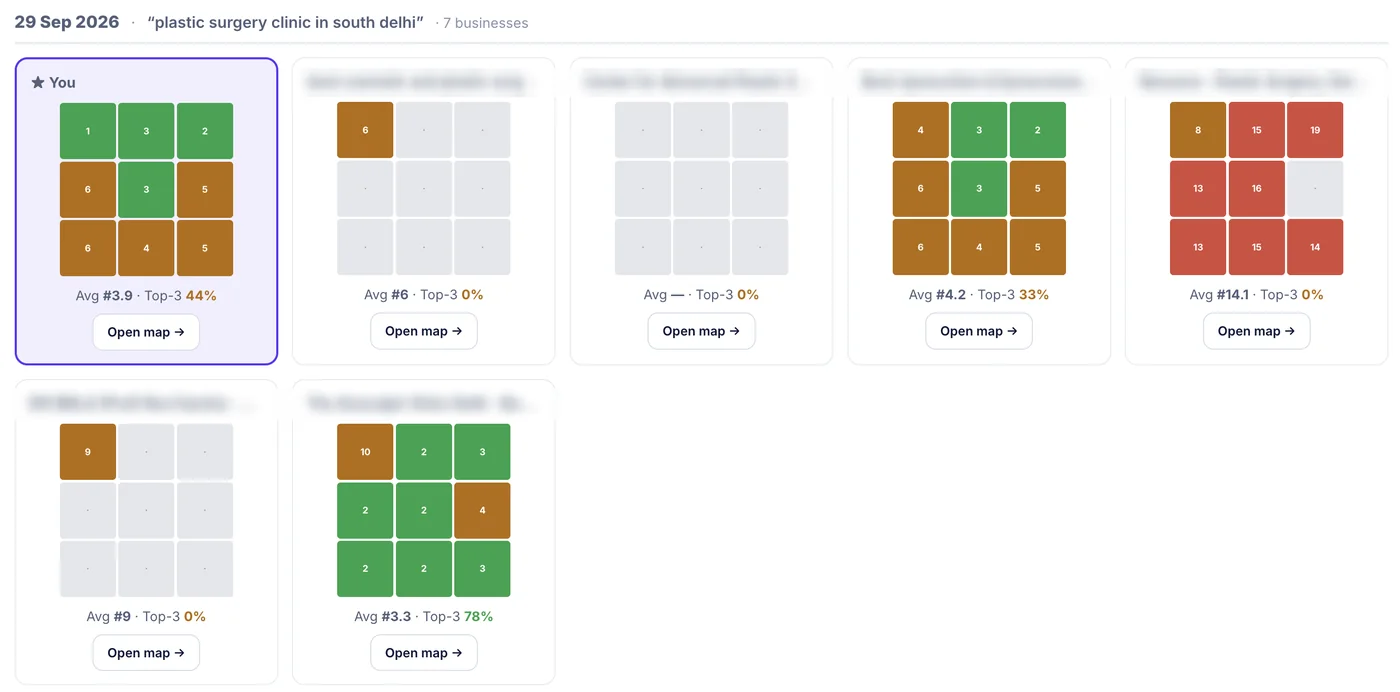
Illustrative dashboard — layout reference, not client data
Illustrative dashboard — layout reference, not client data
Angryturtle
Multi-location Google Business Profile intelligence — per-branch review velocity, risk-factor scoring, and response-rate alerts across the whole chain.
See Angryturtle →SIE
Tracks whether the hospital brand is being cited favourably in AI Overviews and branded search results as reputation content publishes.
See SIE →YODA
Monitors YouTube and video mentions of the hospital brand — patient testimonial content, third-party reviews, and press video pickups.
See YODA →Service-specific deliverables built for chain scale.
Every hospital ORM engagement is scoped to the chain's branch count and risk profile, but the core deliverable set is consistent:
- Multi-location review monitoring — every Google Business Profile, third-party directory listing, and relevant review platform tracked per branch, with alerts routed to the right internal owner within hours of a new review, not days.
- Branch-level response governance — a tone-and-claims playbook approved once by hospital leadership, then applied consistently across every location so responses don't vary wildly depending on who happens to write them.
- Escalation matrix — a named chain of who gets notified for what: routine complaints to branch ops, billing disputes to finance, clinical concerns to the medical superintendent, anything with legal exposure straight to leadership.
- Crisis response protocol — pre-written holding statements, response-time targets, and an incident classification system built before an incident happens, so nobody is drafting a first response from scratch during a live situation.
- Media relations overlay (where scoped) — press and trade-media monitoring, statement drafting, and coordination with the hospital's legal and communications leads for reputational exposure beyond reviews.
- Doctor-level mention tracking — flagging when reviews or press name individual doctors, so both the doctor and hospital administration see the same picture rather than doctors discovering mentions independently.
- Monthly and board-level reporting — a rollup showing chain-wide rating trend, branch comparison, response-time compliance, and sentiment-theme analysis mapped to NABH-relevant categories.
- Review solicitation guidance — a compliant, non-gated process for encouraging patient feedback, without incentivising or filtering which reviews reach public platforms.
Every response passes through the same compliance filter, every time.
Hospital reputation content sits closer to regulatory risk than most marketing output because it responds directly to patient experience, and a careless reply can create exposure that outlasts the original review. Three frameworks govern everything ICG drafts on a hospital's behalf.
NMC Section 6 restricts how medical practitioners and institutions can present outcomes and solicit patients. A review response never claims a treatment "cured" or "guaranteed" an outcome, never uses a reply to solicit new patients directly, and never names or describes an individual patient's clinical case — even to correct a factual error in a negative review, because doing so risks a patient-confidentiality breach worse than the original complaint.
ASCI Chapter III governs comparative and superiority claims. Responses and any reputation-related content avoid "best," "No. 1," or comparative language against other providers — even when a reviewer's own comment invites a superlative reply, the response stays factual and specific rather than promotional.
DPDP 2023 governs how patient-adjacent data is handled anywhere in the ORM pipeline — review text referencing patient details, internal escalation notes, and any data captured through a feedback-solicitation flow. Nothing that could identify a specific patient's visit or condition is logged, forwarded, or referenced in a public response.
Every response drafted against these three frameworks goes through the escalation matrix before anything sensitive posts — routine, low-risk replies can be pre-approved for direct posting once the playbook is validated with hospital leadership, but nothing clinical, legal, or reputationally sensitive skips human sign-off.
The 90-day engagement plan.
Weeks 1-2 — Audit and infrastructure setup
Full audit of every branch's review presence, current response rate, and historical rating trend. Escalation matrix built and named with real hospital-side contacts. Tone-and-claims playbook drafted and approved by leadership.
Weeks 3-4 — Backlog clearance
Every unanswered legacy review across all branches gets a response, oldest first, prioritising branches with the lowest response rates. Crisis response protocol finalised and rehearsed with a mock scenario against the named escalation chain.
Weeks 5-8 — Steady-state monitoring live
Daily monitoring across every branch, responses drafted within the agreed SLA, doctor-level mention tracking active. First monthly chain-wide report delivered showing branch comparison and sentiment themes.
Weeks 9-12 — Trifecta integration and reporting cadence
Angryturtle, SIE, and YODA signals fully feeding the unified dashboard. Board-level reporting format finalised with hospital leadership. Review-solicitation process launched at branches with response rates now above target.
Media relations overlay, where scoped, runs in parallel from week 1 — press monitoring doesn't wait for the review-management backlog to clear, since press exposure can happen at any point in the engagement.
What the hospital owns after the engagement.
Every asset ICG builds belongs to the hospital, not to ICG. The tone-and-claims playbook, the escalation matrix, the crisis response protocol, and every response template are handed over as living documents the hospital's own team can use with or without ICG continuing the retainer. The Google Business Profiles, review platform accounts, and any social or press contact lists built during the engagement remain under the hospital's ownership at all times — ICG never holds admin access a hospital can't reclaim on request.
If a chain chooses to bring reputation management in-house after building the infrastructure with ICG, the handover includes the full response history, the sentiment-theme reporting format, and a documented version of the escalation matrix — so continuity doesn't depend on any one person's memory of how the system was supposed to work.
Custom-scoped to branch count and risk profile.
Hospital ORM pricing is never a fixed tier structure, because a 3-branch chain in one city and a 40-branch national network need fundamentally different infrastructure. Retainers are scoped against branch count, total review volume, whether a crisis response protocol and media relations overlay are included, and the reporting cadence hospital leadership or the board requires.
Custom-scoped per engagement — final pricing depends on the number of branches, monthly review volume, whether crisis response retainer and media relations overlay are included, and reporting frequency.
The starting point — Retainers from Rs 20,000/month · Custom-scoped per engagement — covers a small chain's core review monitoring and response governance. Chains adding a dedicated crisis response retainer, media relations overlay, or board-level reporting cadence scope up from there. There is no published tier list because no two hospital chains carry the same branch count, review volume, or risk exposure; every quote starts with the audit in weeks 1-2 above.
Three hypothetical engagements, and how the infrastructure would respond.
Scenario 1 — A 6-branch chain with one severely underperforming location
A hospital group's flagship branch carries a 4.7 rating, but a newer branch sits at 3.4 with a 20% response rate, dragging the aggregate down and showing up in local search as the weakest option in that city. The escalation matrix routes every new review at that branch to the branch ops lead directly, the response backlog clears within the first month, and the sentiment-theme report identifies a recurring complaint pattern (long OPD wait times) that hospital operations can act on independently of anything ICG controls — the reputation fix and the operational fix happen in parallel.
Scenario 2 — A viral social post naming a doctor spreads within hours
A patient's family posts a complaint that gets picked up by a local news account and starts circulating on social platforms, naming a specific doctor. Because the crisis response protocol and escalation matrix already exist, a holding statement goes out within the target window, the named doctor and hospital legal are looped in immediately rather than discovering the situation independently, and daily monitoring tracks whether the story is spreading or settling — the infrastructure existing before the incident is what makes a fast, coordinated response possible.
Scenario 3 — A chain preparing for NABH re-accreditation wants reputation alignment
A hospital group approaching a NABH re-assessment wants to understand where public review sentiment might raise questions during the audit. The sentiment-theme report maps recurring review themes (billing transparency, staff conduct, cleanliness) against NABH-relevant categories, giving hospital leadership a heads-up on operational areas worth addressing before assessors visit — reputation data functioning as an early-warning signal for quality gaps, not just a marketing metric.
Who this is for, and who it isn't.
This service is built for hospital chains and multi-branch healthcare groups with at least three active locations, an aggregate review volume that's outgrown manual reply management, and leadership that wants a reputation system with named accountability rather than an ad-hoc response process. It's the right fit for a chain preparing for expansion into new cities, one recovering from a reputation incident, or one heading into a NABH re-accreditation cycle who wants public sentiment and internal quality metrics read together.
It is not the right fit for a single-location clinic — that's a lighter, cheaper ORM scope, not chain infrastructure. It's also not a fit for a hospital that wants reviews filtered or gated so only positive ones reach Google, or one that wants outcome claims or comparative superiority language in responses — ICG won't build either, regardless of budget, because both create compliance exposure that outweighs any reputational upside.

Frequently asked questions.
What is hospital ORM, and how is it different from clinic-level ORM?
Hospital ORM manages reputation across every location, department, and doctor a chain operates under one brand — a single 1-star review at one branch can drag down search trust for branches that had nothing to do with it. Clinic-level ORM handles one address. Hospital ORM needs branch-level review routing, department-level escalation, and a crisis protocol that can respond within hours across every property, because a single incident at one branch is read by the market as a statement about the whole chain.
How many locations does this service support?
Engagements are custom-scoped to the number of branches, departments, and Google Business Profiles a chain operates — from a 3-city chain to a 40+ branch network. The infrastructure (dashboard, escalation matrix, response templates) is built once and scales per location added.
Does ICG respond to reviews on the hospital's behalf?
ICG drafts every response against an approved tone-and-claims playbook and routes anything clinical, legal, or reputationally sensitive to a named hospital contact for sign-off before it posts. Routine, low-risk responses can be pre-approved for direct posting once the playbook is established — the split is agreed with the hospital, not assumed.
What counts as a reputation crisis for a hospital chain?
A cluster of negative reviews referencing the same incident, a viral social post or news pickup naming the hospital, a regulatory notice becoming public, a doctor-specific allegation spreading across platforms, or a sudden spike in 1-star volume at one branch that risks bleeding into the chain's aggregate rating. Each has its own response protocol and internal escalation chain.
How fast can ICG respond during a live incident?
The crisis response protocol targets an initial holding response within 2-4 hours of an incident being flagged, a drafted public statement within 24 hours for review by hospital leadership and legal, and daily monitoring reports until the situation is contained. Speed depends on having a named hospital-side approver reachable during the window — this is set up before any incident, not during one.
How does media relations fit into an ORM engagement?
For chains where reputation exposure runs beyond reviews — press pickup, local news, healthcare trade press — ICG layers a media relations track on top of the ORM base: monitoring for press mentions, drafting statements, and coordinating with the hospital's legal and communications leads before anything goes out publicly. This overlay is scoped separately from day-to-day review management.
How does NABH accreditation connect to reputation management?
NABH accreditation signals verified quality — and ICG's ORM reporting surfaces where a hospital's public review sentiment (cleanliness, wait times, staff conduct, billing transparency) lines up with or diverges from the standards NABH assessors actually check. That alignment strengthens both the accreditation renewal narrative and the public trust signal, without ICG providing NABH consulting itself.
What compliance rules govern hospital reputation content?
Every public-facing response, statement, or review-solicitation message is checked against NMC Section 6 (no outcome claims, no doctor solicitation language), ASCI Chapter III (no misleading comparative or superiority claims), and DPDP 2023 for any patient-adjacent data referenced in a response. Nothing goes out that names an individual patient's case or clinical outcome.
Can hospitals solicit reviews from patients?
Yes, within limits — a neutral request to share feedback is fine, but ICG never drafts messaging that incentivises positive reviews, filters out negative feedback before it reaches Google, or implies any clinical outcome. Review-gating (routing only happy patients to public platforms) is avoided; it violates platform policy and creates exposure if discovered.
What does the Search Intelligence Trifecta add to hospital ORM?
Angryturtle runs the multi-location Google Business Profile layer (review velocity, risk-factor scoring, per-branch rating trends). SIE tracks whether reputation content and press mentions are being picked up in AI Overviews and branded search results. YODA monitors YouTube and video mentions of the hospital brand. All three roll into one dashboard so reputation isn't managed blind to search visibility.
How is this priced for a hospital chain?
Retainers start from Rs 20,000/month and are custom-scoped per engagement based on branch count, review volume, whether a crisis response retainer and media relations overlay are included, and reporting cadence required by hospital leadership or the board.
How long before a hospital chain sees rating improvement?
The first 30 days build the response infrastructure and clear the response backlog across every branch. Aggregate rating movement at the chain level typically becomes visible in the 60-90 day window as new reviews get timely responses and legacy unanswered reviews are cleared, though a chain starting from a severely damaged rating may take two to three quarters to fully recover.
Does ICG work with hospitals that already have an in-house PR or marketing team?
Yes — most chain engagements run alongside an in-house team. ICG typically owns the platform infrastructure, monitoring, response drafting, and crisis protocol, while the in-house team retains final sign-off on anything sensitive and owns the relationship with hospital leadership. The split is agreed during onboarding.
Reviews and reputation in the nine-stage patient journey
- 0Foundations
- 1Demand gen
- 2Capture
- 3Lead quality
- 4Lead mgmt
- 5Scheduling
- 6Show-up
- 7Conversion
- 8Retention
It works in conversion: the reviews a patient reads decide which practice they call, and they feed local rankings too. Our own software runs the work, and every stage is reported against a monthly target on Ichelon Agency OS.
See all nine stages and the tool behind each one →