TL;DR
- YouTube channel management built specifically for individual doctors in India — not a general video agency.
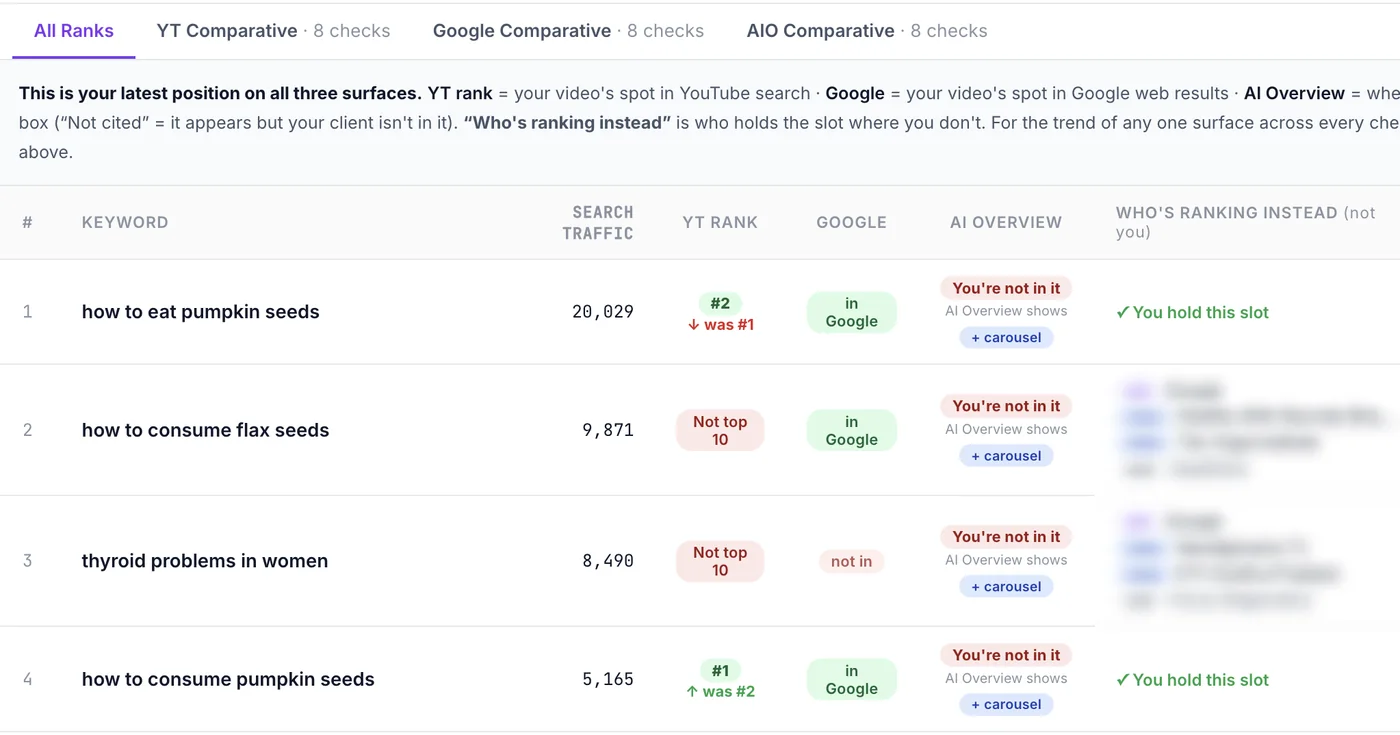
- Powered by YODA: AIO Engine, Search Demand Clusters, Brand Search Trend, YouTube SEO Lab, and Reporting.
- Every script clears an NMC Section 6 compliance check before filming — no soliciting, no comparative claims, no self-praise.
- Standard cadence: 4 long-form videos + 8-12 Shorts/month from one monthly shoot block.
- Retainers from ₹20,000/month. Custom-scoped per engagement. Channel stays in the doctor's own Google account, always.
Doctor YouTube Channel Management India — YODA-Powered Growth

YouTube channel management built for individual doctors, not brands. Scripts written to what patients actually search, thumbnails held to a discipline that earns clicks without gimmicks, and every upload run through YODA — ICG's proprietary YouTube growth engine for healthcare. Retainers from ₹20,000/month.



Why doctor authority matters in 2026.
The way a patient chooses a doctor has quietly inverted. It used to start with a referral slip and end at the clinic reception. Now it starts with a search — a symptom, a procedure name, or the doctor's own name — and a meaningful share of that search happens on YouTube, not Google. Patients do not read a paragraph about a root canal any more; they watch a two-minute video of a dentist explaining it, decide the dentist seems trustworthy, and book. If that video does not exist, or if it exists for a different doctor in the same city, the patient books the other doctor.
This is not a marginal channel. YouTube is the second-largest search engine used in India, and health queries are among the fastest-growing categories on it. A doctor who has never uploaded a video is invisible to an entire generation of patients who default to video before text. Worse, the absence compounds — every month a competing doctor uploads and a doctor without a channel does not, the gap in Search visibility, in AI Overview citations, and in raw patient trust widens.
The opportunity side is just as real. A well-run doctor channel does three things a website alone cannot: it builds parasocial trust before the first consult (patients feel like they already know the doctor), it captures long-tail procedure and symptom searches that a static page struggles to rank for, and it feeds a brand-search flywheel where every video watched increases the odds the viewer later searches the doctor's name directly — a signal that then earns the channel more organic distribution. None of this requires the doctor to become an influencer. It requires a disciplined, compliant, consistently-run channel, which is precisely what most solo and small-group practices in India do not have the internal bandwidth to build themselves.
2026 specifically is the inflection point because two forces are converging. First, Google's AI Overviews now surface YouTube videos directly inside health-query answers far more often than they did two years ago — a channel optimised for this surfaces a doctor's face and voice inside an AI answer, not just a blue link. Second, patient trust in generic clinic marketing has eroded; patients increasingly discount stock-photo websites and gravitate to doctors who show up on camera and explain things plainly. Doctors who start building channel authority now are building a moat competitors will not be able to close in six months.
There is also a quieter, structural reason this matters more for doctors specifically than for most other professionals building a personal brand. A lawyer or a consultant can build authority through written case studies and speaking engagements without ever appearing on video. A doctor cannot, because the underlying anxiety a patient carries into a medical decision is resolved primarily by seeing a calm, competent human explain the situation — tone of voice, pacing, and visible confidence do work that text cannot replicate. This is precisely why doctor channels convert disproportionately well relative to their subscriber count: a channel with a few thousand subscribers, watched by the right local audience at the right moment of decision, regularly outperforms a text-only website with ten times the monthly visitors on the metric that actually matters, which is booked consults.
The cost of waiting compounds in a specific, measurable way. YouTube's ranking systems reward channel history — upload consistency, watch-time patterns, and subscriber engagement built over months, not single viral hits. A doctor who starts today with a disciplined, twelve-month cadence will, by the time a hesitant competitor finally begins, already own the search results for the highest-value procedure and symptom queries in their specialty and city. That head start is difficult to unwind once it exists, which is the entire logic behind treating channel authority as infrastructure to build now rather than a project to revisit later.
What ICG delivers.
Doctor YouTube channel management is a full-stack service — we do not hand a doctor a content calendar and disappear. It covers channel launch, ongoing production, on-page YouTube SEO, and monthly reporting, all run through YODA so every decision is backed by demand data rather than guesswork.
The starting point for every engagement is the same question: what are patients in this doctor's specialty and city actually typing into YouTube's search bar and into Google right before an AI Overview surfaces a video answer? We do not begin with a content calendar template borrowed from a general marketing playbook. We begin with YODA's Search Demand Cluster data for the specific specialty, cross-reference it against what the doctor is already known for clinically, and build the first three months of topics from that overlap. A dermatologist and an orthopaedic surgeon will end up with almost entirely different topic maps even in the same city, because the underlying demand data is different — and that is the point.
Channel architecture
Channel art, handle, playlist structure mapped to the doctor's procedure list, About tab written for both patients and Google's entity understanding, hero video, and a thumbnail template the editor reuses for consistency and instant recognisability.
Script, shoot, edit
Scripts written from YODA's demand data, not from what sounds interesting to us. One monthly shoot block (2-3 hours) with a director on the call, professional edit, captions, and end-screens driving to the next video or to a booking link.
Titles, tags, thumbnails
Every upload runs through the YouTube SEO Lab — title tested against real search phrasing, description built for both viewers and AI Overview extraction, tags mapped to the Search Demand Clusters, thumbnail tested against a click discipline specific to medical content.
NMC Section 6 gate
Every script is checked against NMC Section 6 before filming, not after — no soliciting language, no comparative superiority, no unverified success-rate claims, no before-after content without consent and medical-education framing.
Monthly rank + brand-search report
A monthly report showing which videos are ranking, which are earning AI Overview citations, and — the metric that matters most long-term — whether branded search volume for the doctor's name is climbing.
Doctor-owned, always
The channel lives in the doctor's own Google account from day one. ICG never uploads to or operates a doctor channel from an agency-owned login. If the engagement ends, nothing needs to be handed back — it was never held.
The Trifecta backing this service.
Doctor YouTube channel management is not a standalone content service — it runs on YODA, one leg of ICG's three-platform Search Intelligence Trifecta (Angryturtle for Google Business Profile intelligence, SIE for site-wide Rank OS diagnostics, and YODA for YouTube). Two of YODA's five capabilities do the heaviest lifting for a doctor channel specifically: the Authority Cluster Momentum view and the Brand Search Trend tracker.
The second view is YODA's Brand Search Trend — the direct evidence that the flywheel is turning. As branded views (viewers who searched the doctor's name or channel directly, rather than arriving via suggested content) climb month over month, it confirms the channel is converting anonymous audience into named-recall audience — the exact signal that predicts consult growth six to twelve weeks later.
NMC Section 6 compliance overlay.
Personal-brand video content carries more regulatory exposure than a static website, because a script committed to camera is harder to walk back than a paragraph of text. Section 6 of the National Medical Commission's Code of Ethics Regulations governs advertisement and solicitation by registered medical practitioners, and it is the single most important compliance frame for a doctor YouTube channel operating in India.
Section 6 prohibits, and every ICG-written script is checked against:
- Soliciting patients directly — no "book with me" phrasing framed as advertisement rather than education.
- Comparative superiority claims — no "best," "top," or "leading" language relative to other doctors.
- Self-praise and unverified success-rate claims — outcomes are described in ranges backed by published literature, never as personal guarantees.
- Before-after imagery without documented, written patient consent and clear medical-education framing.
- Any content that could be read as an inducement, discount, or promotional offer tied to a procedure.
The check happens before filming, not after editing — a script that fails the Section 6 gate is rewritten at the script stage, which is far cheaper than reshooting. ASCI Chapter III guidelines are layered on top wherever a video is boosted or run as an ad, since paid distribution invokes advertising-standards rules on top of the base medical-ethics frame. For dental channels, the same discipline is applied through a DCI-aware lens; for AYUSH practitioners, AYUSH guideline language replaces the NMC frame. DPDP Act 2023 governs any patient story or identifiable footage used in a video — written consent is collected and archived before a single frame with a patient in it is published.
This overlay is not a checklist bolted onto content already written. It is the frame every script starts inside — the writer knows the boundaries before the first line is drafted, which is why compliance review rarely produces a rewrite at the review stage rather than at the concept stage.
There is a practical reason to take this seriously beyond regulatory risk: content that violates Section 6 tends to underperform even on pure engagement metrics once the flywheel is running, because viewers increasingly recognise and distrust overtly promotional medical content. A script that explains a procedure honestly, with appropriate caveats about individual variation, earns more comments, more saves, and more branded searches than a script that oversells. Compliance and performance point in the same direction here — which is part of why the discipline holds even for doctors initially sceptical of how strict it sounds on paper.
The 90-day engagement plan.
Ninety days is the window in which the brand-search flywheel typically produces its first visible turn — early clusters ranking, thumbnail click-through stabilising, and the first measurable lift in branded search volume. The plan runs in three clear phases.
Days 1-14 — Foundation
Channel audit or green-field launch, YODA Search Demand Cluster mapping for the doctor's specialty and city, playlist architecture, thumbnail template, and the first month's script batch drafted and cleared through the NMC Section 6 gate. First shoot block scheduled.
Days 15-45 — First cadence
First month of uploads goes live: 4 long-form videos and 8-12 Shorts, each optimised through the YouTube SEO Lab before publishing. Early performance data (click-through rate, average view duration, impressions) feeds back into the next month's script priorities.
Days 46-90 — Compound and refine
Second and third month cadence runs, thumbnail discipline tightens around what is actually earning clicks for this specific doctor and specialty, Authority Cluster Momentum is reviewed to double down on rising clusters, and the first full Brand Search Trend read is delivered — the first hard evidence of whether branded search is climbing.
By day 90 a doctor typically has 12 long-form videos and 24-36 Shorts live, a channel with a coherent playlist structure a new visitor can navigate, and a monthly report showing the trend line rather than a single snapshot.
Ninety days is deliberately framed as the first checkpoint, not the finish line. Thumbnail click-through discipline, in particular, only becomes reliable once there is enough upload history to compare like against like — a single video's performance is noise; twelve videos' performance is a pattern. The same is true of the Authority Cluster Momentum view, which needs at least two full months of data before it can distinguish a genuinely rising topic from a one-off spike driven by an unrelated news cycle. Doctors who treat the 90-day mark as a decision point on whether the channel is "working" are usually looking too early — the flywheel's second and third turns, from month four to month nine, are typically where the compounding becomes visible in consult volume rather than just in view counts.
What you own after the engagement.
A doctor channel is a personal asset, and it is treated that way from the first day of the engagement. The channel itself is created and held in the doctor's own Google account — ICG is granted manager-level access to upload and manage, never ownership. If the engagement pauses or ends, nothing needs to be transferred because nothing was ever held by ICG in the first place.
Alongside the channel, the doctor retains every published video, every thumbnail source file, the full script archive for the engagement period, and the complete YODA reporting history — rank positions, AI Overview citation instances, and the Brand Search Trend data showing exactly how branded search moved month over month. None of this is proprietary to ICG; it is the doctor's evidence base for whatever comes next, whether that is continuing the engagement, bringing production in-house, or handing it to another team.
What is proprietary to ICG is the YODA platform itself — the AIO Engine, the Search Demand Cluster methodology, and the SEO Lab tooling that generated the recommendations. A doctor does not receive a copy of the platform, but they receive every output the platform produced for their channel, in full, permanently.
Pricing.
Retainers from ₹20,000/month · Custom-scoped per engagement.
There is no fixed tier table for doctor YouTube channel management, because the variables that actually change cost — video cadence, specialty (a surgical specialty needs longer explainer scripting than a Shorts-first aesthetic practice), Shorts volume, studio versus in-clinic filming, and whether a dedicated editor is needed for a heavier cadence — genuinely change the scope of work month to month. Publishing a single flat number would either overcharge a light-cadence solo practitioner or undercharge a channel running six long-form videos a month.
What ₹20,000/month buys at the entry point: channel management on a lighter cadence, typically 2-3 long-form videos and 4-6 Shorts per month, full NMC Section 6 script review, and monthly reporting through YODA. Heavier cadences, dedicated studio days, multi-language scripting (Hindi and English, or a regional language alongside), and dedicated editor time scale the retainer upward from there, always agreed in writing before the engagement starts — never a surprise invoice.
Media spend, if a doctor chooses to boost specific videos as ads, is billed separately and pass-through at cost, with a monthly transparency report showing exactly what was spent and what it returned.
We deliberately avoid the four-tier "Starter / Growth / Scale / Elite" table common across this category, because a doctor's real cost driver — cadence and production complexity — does not map cleanly onto four fixed boxes. A solo dermatologist running a Shorts-first cadence with in-clinic filming and a light editing load can sit meaningfully below a surgeon running six long-form videos a month with external studio time and bilingual scripting, even though both are technically "doctor YouTube channel management." The written scope after the first call exists precisely to avoid either doctor overpaying for a shape of service they do not need, or underpaying into a cadence that will not move the needle.
Case scenarios.
The following are hypothetical, anonymised composites built from patterns we see across doctor-authority engagements — not a specific practice's results.
Solo dermatologist, tier-1 city
A newly independent dermatologist with zero YouTube presence launches with a Shorts-first cadence (procedure explainers under 60 seconds). Within the first 90 days, three Shorts begin surfacing for procedure-name searches; by month six, branded search volume for the doctor's name has visibly climbed in the monthly YODA report, correlating with a rise in direct-booking consult mentions of "I saw your video."
Orthopaedic surgeon, tier-2 city
An established orthopaedic surgeon with an inactive channel (six old videos, no consistent cadence) restarts with a long-form-first approach — procedure walkthroughs and recovery-timeline explainers. The Authority Cluster Momentum view flags "joint replacement recovery" as a rising cluster within the first two months, and scripting effort shifts to double down on that topic set.
IVF specialist, metro city
An IVF specialist launches a channel addressing common patient-journey questions — every script cleared not only against NMC Section 6 but also framed to avoid any implied success-rate guarantee, given the emotional weight of fertility content. The channel becomes a supporting trust asset that patients watch before their first consultation, reported anecdotally by the front-desk team as a recurring consult-intake comment.
Build the channel that turns views into name recall — and name recall into consults.
Send your specialty and city on WhatsApp. We return a free audit of your current channel (or a green-field launch plan) and a written 90-day scope before you commit to anything.
Doctor YouTube channel management — FAQ.
What does doctor YouTube channel management from ICG include?
Channel launch, ongoing script and production, YouTube SEO Lab optimisation on every upload, and monthly rank and brand-search reporting — all run through YODA, with every script cleared against NMC Section 6.
How much does doctor YouTube channel management cost?
Retainers from ₹20,000/month, custom-scoped per engagement based on cadence, specialty, and production complexity. A written scope follows the first call.
Do I have to appear on camera myself?
Yes — the entire premise of a doctor-authority channel is that patients see and hear the doctor specifically. We keep the on-camera time small: one monthly shoot block covers a month of content.
What is the brand-search flywheel?
The compounding loop where a video builds name recall, recall becomes a direct name search, and that branded-search signal earns the channel more organic distribution. YODA's Brand Search Trend tracks this month over month.
What is YODA and how does it help my channel?
YODA is ICG's proprietary YouTube growth engine for healthcare — AIO Engine, Search Demand Clusters, Brand Search Trend, YouTube SEO Lab and Reporting, all applied to every video we produce.
Is this NMC Section 6 compliant?
Yes. Every script is checked against NMC Section 6 before filming — no soliciting, no comparative claims, no unverified outcomes, no before-after content without consent and education framing.
How often do videos publish?
Standard cadence is 4 long-form videos and 8-12 Shorts per month from a single monthly shoot block, adjustable by specialty.
What do I own if I stop the engagement?
Everything. The channel lives in your own Google account from day one — every video, thumbnail file, script, and the full YODA reporting history stays with you.
How is this different from a general video production agency?
A general agency optimises for production quality. We optimise for the brand-search flywheel — demand-data-driven topics, click-tested thumbnails, and a compliance gate built into scripting from the start.
How do I get started?
WhatsApp ICG with your specialty and city, or book a call. We run a free audit or green-field plan and send a written 90-day scope before you commit.
Go deeper on doctor authority.
This service is powered by Angryturtle — our GBP intelligence platform.
Angryturtle scores every listing across 7 dimensions, tracks your rank on a live geo-grid across your actual service area, audits NAP + citations, and monitors suspension risk continuously. We don't guess — we measure.
YouTube and video in the nine-stage patient journey
- 0Foundations
- 1Demand gen
- 2Capture
- 3Lead quality
- 4Lead mgmt
- 5Scheduling
- 6Show-up
- 7Conversion
- 8Retention
It works in demand generation: videos built on patient questions, tracked on YouTube, Google and AI Overviews. Our own software runs the work, and every stage is reported against a monthly target on Ichelon Agency OS.
See all nine stages and the tool behind each one →