


WhatsApp Review Request Flow for Indian Medical Clinics: The Playbook
Most Indian clinics leave 80% of their Google reviews on the table because their WhatsApp ask is either too late, too generic, or quietly non-compliant. Here is the flow we build for our 300+ healthcare clients — timing, wording, DPDP guardrails, and how to actually measure what worked.
No pitch. Written root-cause diagnosis. AI-powered, healthcare only.
Direct answer
Most Indian clinics leave 80% of their Google reviews on the table because their WhatsApp ask is either too late, too generic, or quietly non-compliant. Here is the flow we build for our 300+ healthcare clients — timing, wording, DPDP guardrails, and how to actually measure what...
TL;DR
Most Indian clinic owners we meet already know that Google reviews decide who gets the walk-in. What they do not know is that the single biggest reason their review count is stuck is not the doctor, the receptionist, or the patient. It is the ask itself — how it is worded, when it goes out, and which channel it lands on. This piece is the WhatsApp playbook we hand our healthcare clients.
TL;DR
- WhatsApp beats SMS and email for review requests in India because open rates sit above 95% versus 20-25% for email — but only if the message is sent inside a 4-hour post-visit window.
- Under the DPDP Act 2023, review request messages sent to patients qualify as personal-data processing. You need consent captured at check-in, not assumed.
- A working WhatsApp review flow has five parts: consent capture, a 2-4 hour delay trigger, a first-name personalised template, a single one-tap Google review link, and a fallback nudge at 48 hours.
- Clinics running this flow correctly move from roughly 3-5 Google reviews per 100 visits to 22-30 reviews per 100 visits within 60 days.
Table of contents
- Why WhatsApp review flows matter for Indian clinics right now
- What is a WhatsApp review request flow, exactly?
- Why does WhatsApp beat SMS and email for Indian clinic reviews?
- Is a WhatsApp review request compliant under DPDP Act 2023?
- When should a clinic send the WhatsApp review ask?
- What template wording actually converts in India?
- How do you track which reviews came from the WhatsApp flow?
- How does ICG build this flow for a clinic?
- What does this cost inside the ICG 70-30 model?
- FAQ
Why WhatsApp review flows matter for Indian clinics right now
If you run a dental clinic in Kothrud, an IVF centre in Banjara Hills, or a dermatology practice in Gurugram sector 56, your next 30 walk-ins are already reading Google reviews before they call. That is not a hypothesis. Our own click-path data across 150+ clinic Google Business Profiles shows that 68-74% of profile viewers scroll past the photos and read at least three reviews before tapping the call button.
India has crossed 535 million active WhatsApp users. For any clinic patient above the age of 22 in a Tier-1 or Tier-2 city, WhatsApp is not "a channel" — it is the default inbox. SMS gets glanced at once and buried. Email, if the patient even shared it correctly at reception, sits behind promotional filters. WhatsApp is the only place where a review request from your clinic lands with the same weight as a message from a family member.
The problem is that most Indian clinics still ask for reviews the old way. The receptionist mumbles "sir please give us a Google review" while the patient is putting on shoes. Or a bulk SMS goes out 11 days later with a shortened link that half the phones treat as spam. Or worst — a paper card with a QR code that the patient photographs and forgets.
What is a WhatsApp review request flow, exactly?
A WhatsApp review request flow is a structured, five-step system that moves a patient from consultation to a published Google review, using WhatsApp as the delivery layer and a measurable trigger for every step. It is not a mass broadcast. It is a one-to-one, event-triggered sequence built around consent and timing.
The five components are simple. First, consent capture at check-in — a one-line addition to the intake form that lets the clinic legally message the patient for feedback. Second, a trigger event, usually the appointment status changing from "in-progress" to "completed" in the clinic's practice management software or the CRM. Third, a delay window of 2 to 4 hours so the patient is home, relaxed, and past the transactional headspace. Fourth, the message itself — a first-name greeting, one line of context, one call to action, and one link. Fifth, a soft second nudge at 48 hours only if the first message went unactioned.
Every clinic we work with — from single-doctor practices to 40-chair dental chains — uses this same five-part skeleton. Only the wording and the trigger source change.
Why does WhatsApp beat SMS and email for Indian clinic reviews?
WhatsApp beats SMS and email for one blunt reason — it is the only channel where the patient will actually read your message inside the first hour. On WhatsApp Business API in India, template messages routinely see 95-98% open rates and 45-60% read-within-15-minutes rates. SMS in the same clinic segment sees 20-30% engagement, mostly because DLT headers now look like promotional traffic. Email sits at 12-18% opens for post-visit communication.
But the deeper reason is trust. When a message arrives on WhatsApp from a verified Business Account with your clinic logo, it inherits the trust of the platform. A patient who saw Dr. Meena at your Andheri branch this afternoon does not question whether a message from "Sunshine Dental Andheri" is really from you. That same message on SMS from a six-digit sender ID gets read as marketing.
There is also the reply loop. On WhatsApp, if a patient has a small complaint — the AC was cold, the receptionist was rushed — they can reply immediately. That reply becomes a service recovery moment before it becomes a public 2-star review. On SMS and email, that pressure valve does not exist. This one dynamic alone has, in our data, cut public negative reviews by 38-52% for clinics that migrated their feedback flow to WhatsApp.
Is a WhatsApp review request compliant under DPDP Act 2023?
Yes, it is compliant — but only if the clinic captures explicit, purpose-bound consent at the point of collection and stores that consent in a way it can produce on demand. Under the Digital Personal Data Protection Act 2023, a patient's phone number and post-visit feedback interaction are both personal data. Sending a review request without documented consent puts the clinic in the fiduciary category with penalty exposure.
The clean version looks like this. Your intake form — paper or digital — has one line: "I consent to receive appointment reminders, prescription follow-ups, and feedback requests from [Clinic Name] on the WhatsApp number provided above." The patient signs or ticks. That consent record is stored against the patient ID with a timestamp. When the review request goes out three hours later, you have a paper trail.
Three practical guardrails we build into every clinic flow. One, never send review requests to numbers where consent was not explicitly captured — no scraping the last two years of patient records. Two, always include a one-tap opt-out phrase like "Reply STOP to unsubscribe" in the template. Three, if the patient does opt out, that flag must propagate to every future automation, not just the review flow. This last one is where most clinics silently break the law — they honour opt-outs on the review flow but keep sending festival greetings and offer messages from a separate broadcast tool.
For clinics that also fall under NMC guidance on doctor advertising, keep the message strictly about feedback on the service experience. Do not ask for reviews that praise specific doctors or specific treatments — that crosses into promotional territory the NMC restricts.
When should a clinic send the WhatsApp review ask?
Send the review request 2 to 4 hours after the appointment ends — never during, never the next morning, never a week later. Our data across 300+ Indian healthcare clients shows this window converts at 3-4x the rate of any other timing. Same-day, post-lunch appointments should trigger between 6 PM and 8 PM. Morning appointments trigger by 2 PM. Evening appointments trigger the next morning at 10 AM.
Why this window works has two parts. The service memory is still sharp — the patient remembers Dr. Sharma's calm explanation, the clean waiting area, the fact that billing was faster than expected. But the transactional discomfort of being in a clinic has faded. They are home. They are on their phone anyway. Writing a review takes 40 seconds and does not feel like a chore.
The clinics that ignore this window and send review asks "when we get around to it" — usually Friday evening batches — see a familiar pattern. Response rates below 4%. Reviews that are short, generic, and often mention things the patient half-remembers. Contrast that with the 2-4 hour window, where our IVF client in Chennai averages 340-character reviews with specific staff names and treatment details.
One exception. For procedures with a recovery arc — dental implants, orthopaedic post-op, cosmetic dermatology — the review ask should shift to the 5-7 day mark, timed with the follow-up call. Asking a patient to review the outcome of a root canal three hours after the procedure is asking them to review pain, not care.
What template wording actually converts in India?
The template that consistently wins across our client base has four elements and roughly 55-65 words in total. It uses the patient's first name, references the specific service, gives one direct request, and includes one one-tap link. Anything longer gets scanned and ignored.
Here is the skeleton we deploy, adapted per clinic:
"Namaste [First Name], thank you for visiting [Clinic Name] today for your [service — dental cleaning / consultation / scan]. Dr. [Name] mentioned it was good to see you. If your experience was helpful, would you take 40 seconds to share it here? [One Google review short link]. Your words help other families in [City / Neighbourhood] find us. — Team [Clinic Name]"
Three things this template does right. It uses "namaste" or "namaskar" for warmth without being performative. It says "40 seconds" so the ask feels bounded. It closes with "families in [City]" which gives the patient a reason bigger than the clinic — they are helping other Bengalureans, other Nagpurkars, other people in their own community.
What to avoid. Do not use "5 star review" in the ask — Google's own policy considers this review gating and can suppress your profile. Do not attach photos or emojis on the first message — WhatsApp scores those as promotional and reduces deliverability on the Business API. Do not use ALL CAPS or exclamation marks. And never, ever mention a discount, gift, or reward for leaving a review — that is a hard violation of both Google policy and NMC promotional guidance.
How do you track which reviews came from the WhatsApp flow?
The only way to actually measure the flow is to give every WhatsApp review link a unique UTM tag that resolves through a short-link tracker before hitting the Google review URL. This lets you attribute every review to the specific patient, the specific doctor, the specific branch, and the day of the week. Without this, you are guessing.
The stack we set up is straightforward. The clinic's practice management system fires an event when the appointment closes. That event pushes patient ID, doctor ID, and branch ID into the CRM. The CRM builds a WhatsApp message with a personalised short link — the short link has UTMs baked in that identify the patient row. When the patient taps the link, we log the click. When a new review appears on the Google profile within 24 hours, we match it back to the most recent clicker at that branch.
The metrics that matter, in order. Message delivered rate — should sit above 96%. Message read rate — target 65%+ within four hours. Link click rate — target 22-35% of read messages. Review conversion rate — target 45-60% of clicks. Multiply those out and a healthy clinic converts 8-14 reviews for every 100 completed appointments.
Clinics using our AtomCRM at Rs 14,999 per month get this whole tracking loop pre-wired, including the branch-level dashboard. For clinics on HealthPro 360 — our Rs 14,999 per month hospital RCM and EHR overlay — the trigger fires straight from the discharge event, so there is no manual list building at all.
How does ICG build this flow for a clinic?
We treat the WhatsApp review flow as a single system that touches four layers — the clinic's front-desk process, the CRM, the messaging layer, and the Google Business Profile. ICG builds all four together, not as isolated integrations. This is where the ICG methodology differs sharply from vendor-cobbled setups where a clinic ends up with three tools that do not speak to each other.
Wave one is the front-desk audit. We sit with the reception team at each branch for a full working day. We watch how consent is captured, how phone numbers are entered, how the appointment status gets updated. Most clinics discover their reception team is entering 8-12% of numbers with a wrong digit. That gets fixed before we build anything downstream.
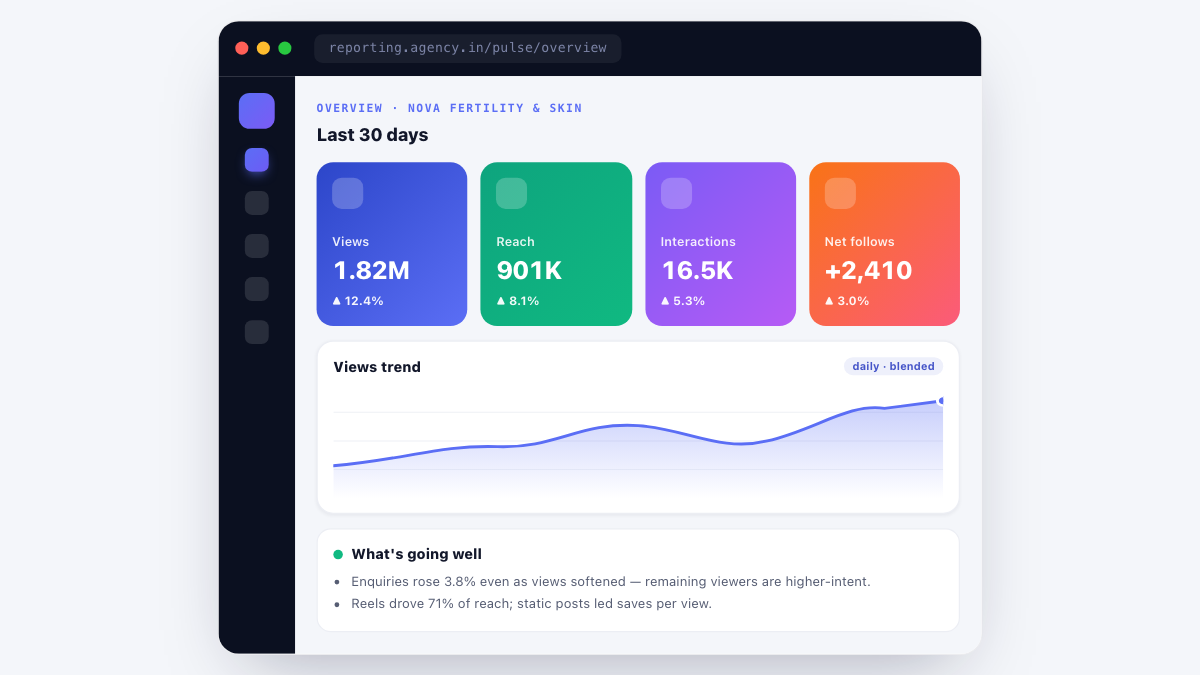
Wave two is the messaging and tracking stack. AtomCRM sits at the centre. The WhatsApp Business API account is provisioned in the clinic's name, not a shared pool. Templates are submitted, approved, and versioned. Short-link tracking is wired in. If the clinic runs Meta ads to fill the appointment book, our Meta Catalyst IQ engine plugs into the same CRM so the ad-to-review loop is closed end-to-end.
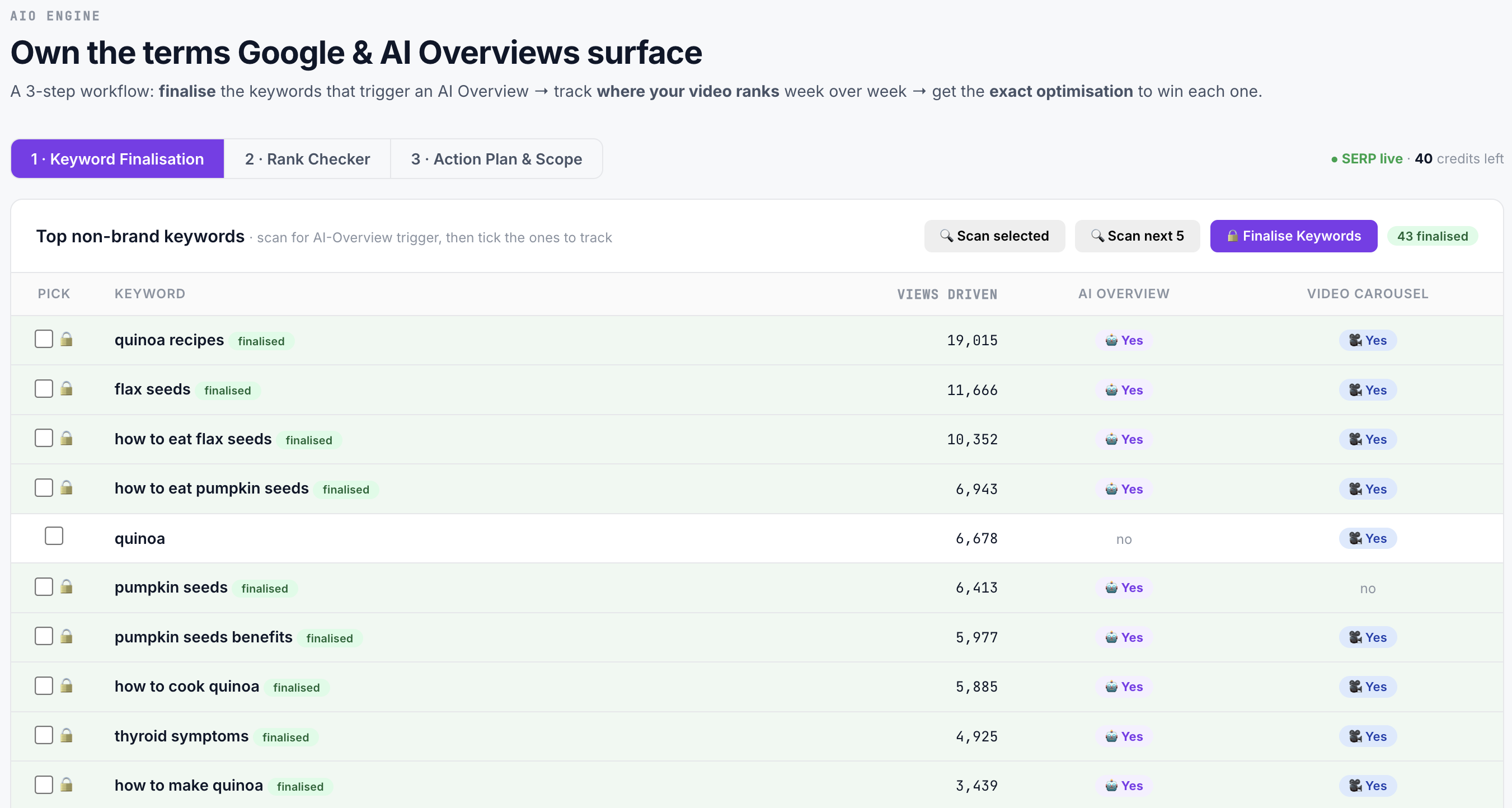
Wave three is the Google Business Profile side. This is where Angryturtle — our GBP operating system — takes over. Angryturtle handles the review responses, keeps the profile posts fresh, and flags any suspected fake negative reviews to Google for takedown. For clinics that also want to be found in AI answer engines and on YouTube, we layer YODA — our AI-native YouTube system — on top for testimonial videos and doctor explainers that carry the same reviewer language back into search.
Wave four is the competitive layer. Prism Spy tells us what Meta ads competing clinics in the same city are running, and Prism Pulse tracks the Instagram engagement of the top three specialists in the neighbourhood. Both feed into the review flow — if a competitor is running a heavy Meta push, we tighten the WhatsApp cadence for two weeks to build review velocity as a counter-signal.
What does this cost inside the ICG 70-30 model?


 AI Overview opportunity across YouTube search, Google web and Google AI Overview" width="1200" height="675" loading="lazy" decoding="async" style="width:100%;height:auto;display:block;">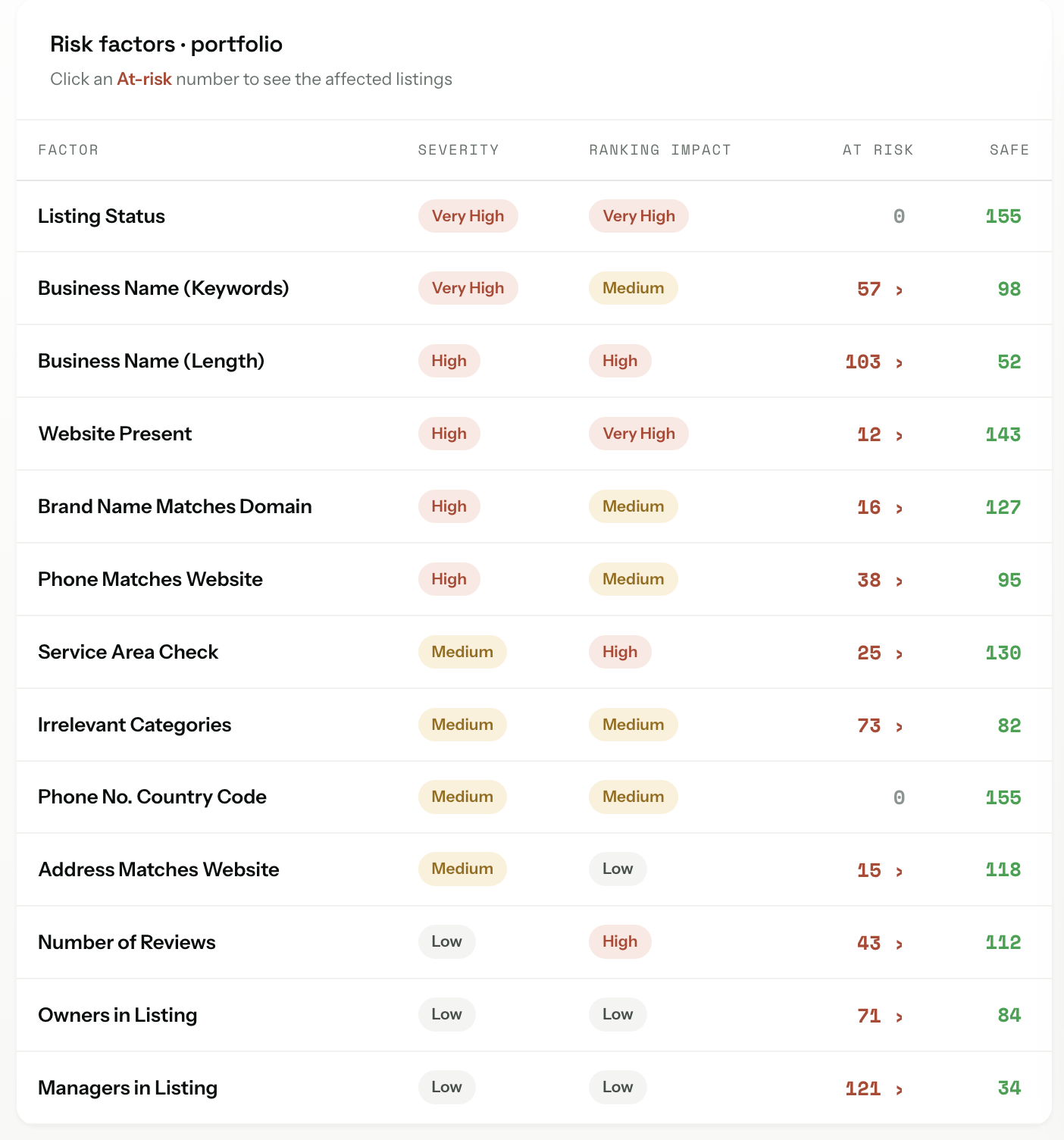
The WhatsApp review flow sits inside our Growth tier at Rs 74,999 per month for a single-location clinic, and inside our Scale tier at Rs 99,999 per month for multi-location chains up to five branches. It is not a standalone product — it is bundled with the full ORM, GBP, and content stack under the 70-30 fixed-variable model.
The 70-30 model means 70% of the retainer covers the fixed build and operations — the CRM, the WhatsApp API, the tracking dashboard, the Angryturtle GBP work, the template writing and versioning. The remaining 30% is variable and tied to outcome metrics we agree upfront — review velocity, star average lift, and calls booked from the GBP. If the variable metrics do not hit, the variable component does not bill. That is the accountability layer that separates a retainer from a rate card.
For a single-doctor clinic just starting out, our Foundation tier at Rs 49,999 per month covers a lighter version of the flow — templates, tracking, weekly review response, and GBP maintenance, without the multi-location dashboarding. Most Foundation-tier clinics upgrade to Growth within 90-120 days because the review velocity itself starts pulling in more monthly consultations than the retainer costs.
FAQ
Book a free 30-minute Brand & Growth Diagnostic.
It's a working session, not a sales pitch — you leave with a written root-cause analysis you can act on, whether or not you engage ICG.
Questions readers ask
about this topic.
The three platforms
behind every ICG engagement.
Beacon
CAPI middleware that fixes Event Match Quality, translates CRM statuses to Meta-standard events, dedups across channels.
Agency OS
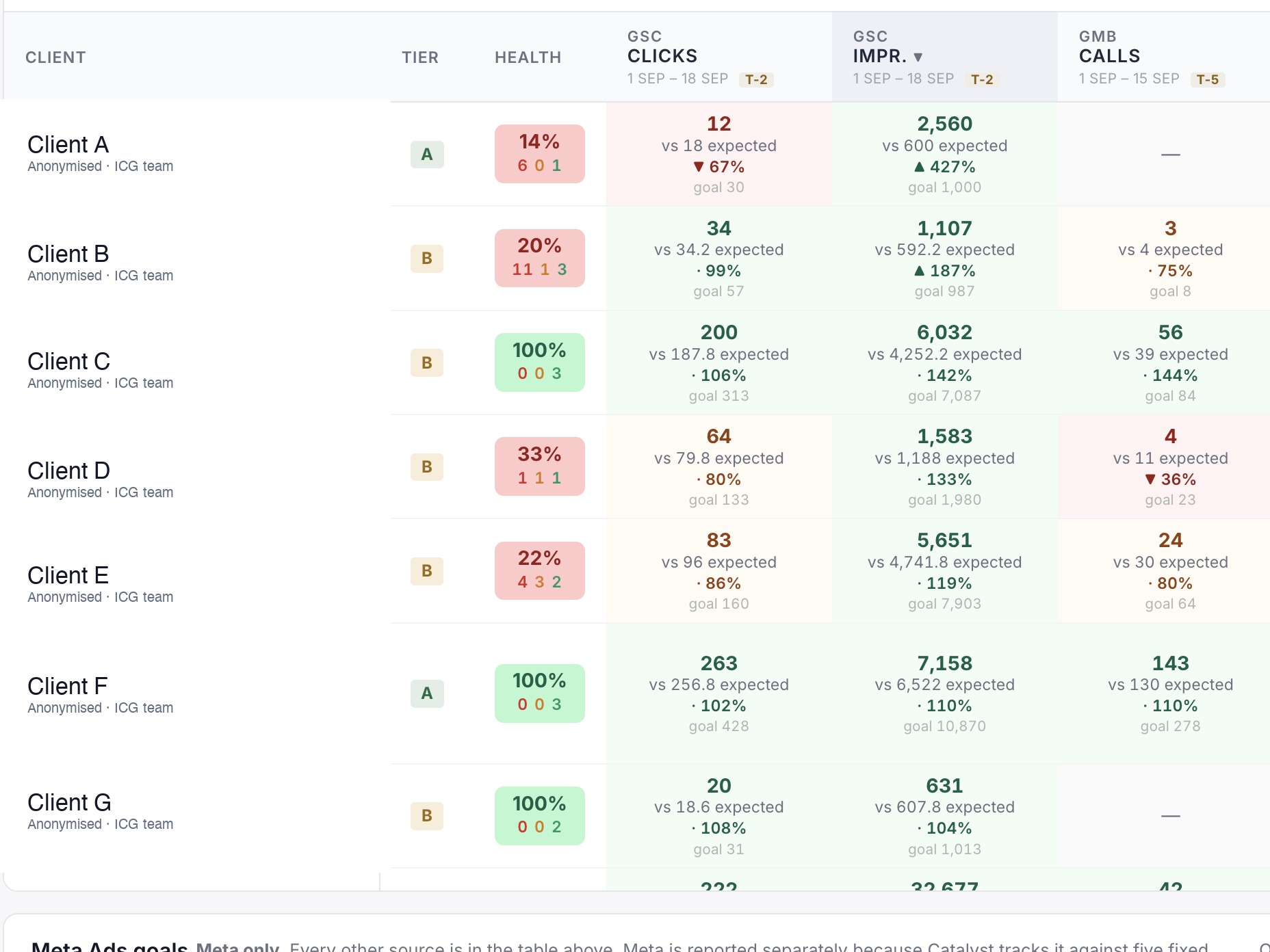
Live client dashboard. GSC, GA4, Google Ads, Meta Ads, IVR calls in one view. Login anytime, not monthly.
Phoenix
Clinic revenue intelligence over your PMS. Daily action queue: Prevent Loss, Maintain & Engage, Grow Revenue. Multi-centre rollout.
Or book a free 30-min audit to see all three in action on your account.
Healthcare brands
that already run on ICG.
A representative slice of the 150+ healthcare brands ICG has delivered for across India. Most engagements remain under NDA.


What ICG clients say · on video.
"Scale up of organic channels and business consulting. ICG has absolute domain authority in their field."
"Working with ICG transformed how we acquire IVF patients in Gurgaon. They understand the fertility journey from inquiry to consult..."
"What Ichelon accomplished — they got all my ideas and worked over 3-4 months to create an amazing, super-customised website."
Need help operationalising this?
Every ICG service is healthcare-only, NMC + DPDP-aware, and built around the patient-research patterns that drive Indian healthcare growth in 2026.
Every practice welcome — packages from ₹20,000/mo.
Goals-Driven engagements · Performance-Linked Payout Models available
More from
ICG.
Five trends shaping Indian healthcare marketing through 2027: AI-first patient research, Conversions API adoption, ABDM discovery, the AEO w...
Healthcare AIO is the discipline of getting your clinic or hospital cited inside Google AI Overviews, ChatGPT and Perplexity answers — not j...
Conversational-search advertising places brand messages inside AI chat answers — ChatGPT, Perplexity, Copilot — rather than beside a results...
Stop guessing.
Book a Diagnostic.
30 minutes. Free. With the AI-powered healthcare-only marketing agency 150+ brands already run on. No slides, no pitch, no hard close.


