


Practice Management System (PMS) India 2026: Buyer's Guide
Practice Management System (PMS) for Indian clinics in 2026: what it does, PMS vs EMR/HMS/CRM, honest cost ranges, vendor shortlist, and a 12-point buying checklist.
No pitch. Written root-cause diagnosis. AI-powered, healthcare only.
Direct answer
Practice Management System (PMS) for Indian clinics in 2026: what it does, PMS vs EMR/HMS/CRM, honest cost ranges, vendor shortlist, and a 12-point buying checklist.
TL;DR
A Practice Management System (PMS) is the software backbone of a modern medical clinic. It manages patient registration, appointment scheduling, consultation documentation, prescription generation, billing, inventory, and reporting — replacing manual registers, fragmented Excel sheets, and disconnected single-purpose tools with a unified, intelligent platform. For Indian clinics in 2026, a well-implemented PMS typically delivers 15-30% revenue improvement within 12 months — through reduced no-shows, faster billing cycles, improved patient retention, and the data infrastructure that enables every other digital transformation initiative.
This guide covers what a PMS is, what to look for in 2026, pricing benchmarks, and deployment timelines for Indian clinic owners considering the move from paper/Excel to PMS.
PMS vs HMS vs EMR vs EHR — the acronyms decoded
The healthcare technology acronym landscape confuses most buyers. Here's the clear distinction:
- PMS (Practice Management System) — Manages the day-to-day operations of a medical practice: scheduling, billing, basic clinical notes. Designed for outpatient practices (clinics).
- HMS (Hospital Management System) — Includes everything in PMS plus inpatient management: admissions, IPD, OT scheduling, pharmacy at scale, lab integration, complex insurance billing.
- EMR (Electronic Medical Record) — The digital clinical record system. Structured consultation notes, prescriptions, investigations, clinical history. Often a module within PMS/HMS.
- EHR (Electronic Health Record) — Patient-controlled cross-provider health records. In India, this is the ABDM (Ayushman Bharat Digital Mission) framework.
For a single clinic, PMS is the typical starting point. For a multi-specialty hospital, HMS is required. Both should include EMR functionality. EHR integration is roadmap territory.
What a good PMS does
Patient management
- Patient registration with structured demographics
- Patient ID generation (unique identifier across the practice)
- Demographic search and patient history retrieval
- Insurance and TPA information capture
- Patient portal for self-service (booking, records, prescriptions)
Appointment scheduling
- Doctor-wise slot management with calendar views
- Multi-channel booking (web portal, WhatsApp, phone, walk-in)
- Automated reminder sequences (WhatsApp + SMS + voice)
- Waitlist management for full slots
- No-show tracking and re-engagement workflows
Clinical documentation
- Structured consultation notes (SOAP format with specialty templates)
- Digital prescription with drug database and interaction alerts
- Investigation ordering linked to lab/imaging
- Clinical history timeline (all visits, diagnoses, medications)
- ICD-10 coding support
- Referral letter and discharge summary generation
Billing and finance
- Single-window billing (consultation + procedures + pharmacy + labs)
- Package billing for procedure bundles
- Insurance and TPA claim preparation
- GST-compliant billing
- Receipt management and daily collection reports
- Outstanding dues tracking with ageing analysis
Reporting and intelligence
- Revenue dashboards (daily, monthly, yearly)
- Doctor productivity reports
- Specialty contribution analysis
- Patient demographic insights
- Marketing channel attribution (which sources drive which patients)
What to look for in a 2026 PMS
Cloud vs on-premise
In 2026, cloud-based PMS is almost always the right choice. Cloud advantages:
- No server infrastructure to maintain
- Automatic updates and security patches
- Multi-location access without VPN
- Predictable monthly cost vs upfront capital
- Disaster recovery built in
On-premise PMS may still make sense for hospitals with strict data residency requirements, but for the vast majority of Indian clinics, cloud is the right choice.
Security architecture — non-negotiable
This is where most PMS solutions fall short. Demand:
- AES-256 encryption for data at rest and in transit
- Role-Based Access Control (RBAC) — granular permissions per role
- Audit trails on every record access and modification
- Session management with automatic timeouts
- India data residency (servers in India for DPDP Act compliance)
- Regular security audits with documentation
Most generic PMS solutions sold in India today lack proper audit trails and RBAC — making them inadequate for NABH accreditation and DPDP Act compliance.
Integration capabilities
A modern PMS must integrate with:
- WhatsApp Business API (appointment reminders, communications)
- Voice bot / IVR (for reminder calls and IVR booking)
- Payment gateways (UPI, cards, net banking)
- Insurance / TPA APIs (where available)
- Marketing platforms (for attribution from ad to consultation)
- Lab equipment (HL7 protocol — increasingly important)
Mobile-friendly patient portal
The patient portal should work in a mobile browser without requiring an app installation. App-based portals see 70-80% lower patient adoption than mobile-web portals because patients don't install apps for occasional clinic visits.
Pricing benchmarks for Indian clinics in 2026
Basic SaaS PMS (off-the-shelf, generic):
- ₹2,000-8,000 per user per month
- Lower customisation, faster deployment
- Best for solo practitioner clinics
Healthcare-specialised PMS (industry-built):
- ₹15,000-50,000 per location per month (multi-user)
- Higher customisation, healthcare workflow native
- Best for multi-doctor clinics and small hospitals
Enterprise HMS (full hospital management):
- ₹50,000-3,00,000 per month per location
- Full IPD, OT, pharmacy at scale, complex billing
- Best for mid-size to large hospitals
Implementation costs (one-time):
- Solo clinic: ₹50,000-2,00,000 (basic deployment + training)
- Multi-doctor clinic: ₹2,00,000-8,00,000 (with data migration)
- Hospital: ₹5,00,000-25,00,000 (full HMS deployment)
Deployment timeline expectations
Solo practitioner clinic: 3-4 weeks from contract signing to go-live for basic deployment (OPD + Billing + Scheduler).
Multi-doctor clinic: 6-10 weeks including data migration from existing system (Excel, paper records, legacy software).
Full hospital HMS: 8-12 weeks for HMS deployment with all modules (OPD + IPD + Pharmacy + Labs + Billing + Inventory + MIS).
Clinics that try to deploy PMS in 2 weeks typically fail at training and adoption. Clinics that wait 6+ months for "the perfect deployment" rarely launch at all. The 6-10 week window balances deployment quality with momentum.
How ICG implements PMS
ICG's HealthPro 360 PMS is deployed as part of a structured 4-week to 12-week engagement depending on clinic size. The deployment includes:
- Workflow audit and clinic-specific configuration
- Data migration from existing systems (paper, Excel, legacy software)
- Staff training (reception, doctors, billing, management)
- Patient portal customisation and branding
- WhatsApp Business API setup and template approvals
- Go-live support with onsite team for first 2 weeks
- 30-day post-launch optimisation and adoption monitoring
See HealthPro 360 PMS · Practice Management System · Book a free Digital Health Audit
How Practice Management System differs from CRM, EMR, and HMS
| System | Primary user | Primary purpose | Indian context |
|---|---|---|---|
| Practice Management Software (PMS) | Front-desk + practitioner | Daily operations: schedules, billing, basic records, inventory | Single-clinic to mid-size multi-doctor — most common starting point |
| Healthcare CRM | Marketing + sales + telecaller team | Lead capture, lead-to-patient conversion, retention | Becoming standard as patient acquisition gets sophisticated |
| Electronic Medical Records (EMR) | Doctors + clinicians | Patient clinical records, prescriptions, medical history | NMC + ABDM compliance increasingly important |
| Patient Management System | Patient-facing operations team | Patient journey, communications, treatment plan tracking | Often built into PMS or CRM in India |
| Hospital Management System (HMS) | Hospital admin + multi-department | IPD-OPD-Lab-Pharmacy integrated workflow | For tertiary care; NABH-aligned |
| Bundled platform | All of the above | Single platform covering 80%+ workflow | Emerging category; HealthApex OS, similar Indian SaaS |
For deeper category understanding, see CRM vs PMS vs HMS vs EMR taxonomy.
The 12 core features every Indian PMS should have
- Multi-doctor appointment scheduling with conflict detection — Must handle multi-clinic doctor schedules + walk-ins + emergency slots
- Patient registration with ABHA ID integration — ABDM-compliant from day one (mandatory through 2027 rollout)
- Treatment-specific EMR templates — Pre-built templates for common specialties (IVF, dental, derm, ortho)
- Prescription generation with e-signature — NMC Section 6 telemedicine compliant
- Billing with Indian GST + cashless insurance integration — Multi-payer reality of Indian healthcare
- WhatsApp Business API native integration — Without this, manual workflows kill productivity
- Lab and radiology integration — Patient labs flow to EMR automatically
- Pharmacy + inventory module — Stock alerts, expiry tracking, batch management
- Reports + analytics dashboards — Per-doctor, per-specialty, per-location revenue + utilization
- Audit trail logging — DPDP Act 2023 compliance
- Hindi + regional language support — Tier-2 / tier-3 reality
- Mobile + tablet UI — Front-desk teams work across devices
The 8 advanced features that separate top-tier PMS from basic
- Server-side analytics with custom event tracking — Beyond Google Analytics; healthcare-specific event taxonomy
- Multi-location consolidation reporting — Chain-wide patient flow, doctor utilization, revenue concentration
- Treatment-plan tracking with conversion funnels — Patient stages from consultation to treatment completion
- Cross-specialty referral suggestions — AI-powered cross-sell recommendations
- Patient lifetime value scoring — Identify high-LTV patients for retention
- Lost-to-follow-up recovery automation — Phoenix-style revenue intelligence
- Telemedicine module with session logging — NMC Section 6 compliant video consults
- Marketing attribution integration — Connect campaign data to patient outcomes
The Indian PMS vendor landscape
Bottom tier (₹500-2,000/month per location)
Basic appointment + minimal billing. Vendors: entry plans of doctor-listing platforms and clinic-software products built for single clinics. Limitation: cannot handle multi-doctor or chain workflows.
Lower-mid tier (₹2,000-15,000/month)
Clinic-software products built for single clinics. Appointment + EMR + billing. No real CRM or revenue intelligence. Most common Indian clinic choice but capped scale.
Mid tier (₹14,999-50,000/month)
HealthApex OS bundled (₹14,999 for full 8-tool stack), healthcare editions of general-purpose sales CRMs, premium EMR suites. Includes CRM + PMS + analytics + WhatsApp BAPI. Sweet spot for serious clinics + chains.
Upper-mid tier (₹50K-2L/month)
Healthcare editions of global CRM and practice-management suites. Enterprise features but compliance gaps for India-specific use cases.
Enterprise tier (₹3-10L/month)
Enterprise CRM suites and global EHR vendors. Built for US healthcare. 6-9 month implementation. Most Indian deployments use <20% of capacity. ICG's HealthPro 360 vs enterprise CRM suites comparison covers when this tier is justified.
PMS implementation timeline (realistic)
| Phase | Timeline | Activities |
|---|---|---|
| Discovery + scoping | 1-2 weeks | Audit existing workflows, identify must-have features, plan data migration |
| Configuration | 1-3 weeks | Customize templates, configure forms, set up user roles + permissions |
| Data migration | 1-2 weeks | Patient records from existing system (Excel, paper, legacy SaaS) |
| Integration setup | 1-3 weeks | WhatsApp BAPI, payment gateways, lab APIs, GMB, Google Calendar |
| Training | 1-2 weeks | Front desk, doctors, support team training |
| Pilot + iteration | 2-4 weeks | Live with selected workflows, refine, expand |
| Full rollout + stabilization | 4-8 weeks | All workflows live, monitor + optimize |
Total: 11-24 weeks for productized platforms. Enterprise platforms (enterprise CRM suites, global EHR vendors): 6-18 months.
The PMS buying decision framework
The framework that predicts deployment success (based on ICG-tracked deployments):
- Define your 3 highest-priority workflows (consume 80% of operational time)
- Match category to workflows (don't buy HMS for clinic-scale problems)
- Verify ABDM data model fit ("Show me ABHA integration in your data architecture")
- Confirm WhatsApp BAPI native integration (no middleware adapter)
- Demand 3-year TCO data (include implementation, training, integration, customization)
- Test with 30-day pilot before full commitment
- Verify compliance baseline (DPDP, NMC, ART Act for IVF, Schedule J for pharma)
The hidden costs of PMS that vendors don't advertise
- Implementation cost — typically 30-100% of annual license. Enterprise: 100-300%.
- Training cost — ₹50K-2L; varies with team size.
- Integration cost — ₹50K-3L for WhatsApp BAPI, payment gateways, third-party APIs.
- Annual customization — ₹2-10L typical for enterprise; near zero for productized Indian platforms.
- Trained admin / IT salary — enterprise CRM suites typically need ₹1-2L/month admin; productized platforms don't.
- Annual upgrade / migration — Some vendors charge for major version upgrades.
- Data export — Some vendors restrict patient data portability or charge for it.
Related reading
- Once the basics are clear, our practice management software comparison for India shows how the main product categories differ on capability and cost.
- Comparing record systems? See our guide to EMR software in India.
- To compare real options side by side, read our clinic management software comparison for India, covering ten product types and a trial checklist.
- If your practice software sends reminders on WhatsApp, the healthcare WhatsApp Business API guide explains approval and DPDP consent.
15 FAQs on Practice Management Systems for Indian clinics
- What's the minimum-viable PMS for a single-doctor clinic?
- An entry-level Indian clinic-software product at ₹2,000-7,000/month. Covers appointment + basic EMR + billing.
- When should a clinic upgrade from basic PMS to a bundled platform?
- When marketing spend exceeds ₹50K/month, or when CRM + WhatsApp + analytics needs emerge, or when multi-doctor / multi-location operations start.
- What's the difference between PMS and EMR?
- PMS focuses on operations (appointments, billing, inventory). EMR focuses on clinical records (medical history, prescriptions, lab results). Most Indian solutions bundle both.
- Is ABDM integration mandatory in a PMS?
- For ABHA-registered clinics (most by 2027), yes. ABHA token field, HPR integration, Consent Manager hooks should be in the data model — not bolt-on.
- Can I switch PMS vendors after deployment?
- Yes, but data migration is complex. Plan for 4-12 weeks downtime + data audit + patient communication. ICG has handled enterprise CRM → AtomCRM migrations.
- What's the typical PMS deployment timeline in India?
- Productized platforms: 11-24 weeks. Enterprise platforms (enterprise CRM suites, global EHR vendors): 6-18 months.
- How does PMS pricing change with multi-location?
- Most vendors charge per-location. Some offer chain-wide pricing at 30-50% per-location discount. HealthApex OS bundled is ₹14,999/month covering all locations.
- Is open-source PMS viable for Indian clinics?
- Generally no for established clinics. Maintenance + customization + compliance work exceeds commercial subscription cost. Open-source viable for tech-led startups building proprietary stack.
- What's the role of WhatsApp Business API in PMS?
- Critical — should be native integration, not middleware. 50-70% of patient interactions happen via WhatsApp. PMS without WhatsApp BAPI requires costly middleware adapters.
- How does telemedicine fit into PMS?
- Modern PMS includes video consultation module with NMC Section 6 compliant session logging, prescription e-signature, and post-consult prescription delivery via WhatsApp.
- What reports should I expect from a good PMS?
- Per-doctor utilization, per-specialty revenue, appointment vs walk-in mix, OPD-IPD-Lab integration revenue, patient retention cohorts, marketing source attribution, treatment-plan completion rates.
- Does PMS replace the clinic's accounting software?
- Usually no. PMS handles patient-level billing; accounting software (Tally, QuickBooks and similar) handles statutory + tax. PMS exports to accounting software via integration.
- How does pricing transparency vary across Indian PMS vendors?
- Indian-built productized platforms publish public pricing. Enterprise vendors (enterprise CRM suites, global EHR vendors) require sales conversation. Mid-tier vendors (single-clinic software, general-purpose sales CRMs) publish "starting from" with higher real cost.
- What's the role of Indian language support in PMS?
- Important for tier-2/3 deployments. Front-desk teams and patients prefer regional language. Top Indian platforms support Hindi + 4-8 regional languages.
- How does HealthApex OS compare to standalone PMS?
- HealthApex OS bundles PMS (HealthPro 360) + CRM (AtomCRM) + revenue intelligence (Phoenix) + attribution (Beacon) + 4 more tools at ₹50,000/- setup + ₹799/- per telecaller. A standalone single-clinic PMS covers only the PMS portion at ₹2-15K/month. Use case driven choice — see our HealthPro 360 vs single-clinic PMS comparison.
For a free 48-hour PMS evaluation audit, book the ICG audit. We map your current workflow, evaluate 3-5 vendor candidates, and document the 5-year TCO before any pitch.
DPDP Act 2023 and PMS: the compliance layer most vendors skip
The Digital Personal Data Protection Act 2023 is now in force, and by 2026 most Indian clinics are quietly non-compliant because the PMS they picked in 2019 was never built for the new rules. If you are shortlisting a Practice Management System this year, compliance is no longer a nice-to-have. It sits alongside billing and appointments as a core evaluation axis.
Here is what a DPDP-ready PMS should demonstrate before you sign a three-year contract:
- Consent capture on record. Every patient must have an explicit, timestamped consent for data processing, marketing communication, and third-party sharing. Blanket ticks on a paper form no longer count.
- Purpose limitation. The PMS should tag why a data point was collected (appointment vs. lab vs. insurance) and restrict downstream use.
- Right to erasure workflows. A patient can now demand deletion. Your PMS must support it without breaking billing audit trails.
- Data localisation posture. If your PMS runs on international cloud regions, confirm where patient data physically sits and whether the vendor can move it to an Indian region on request.
- Breach notification hooks. The Data Protection Board expects a 72-hour clock. Your PMS should log access, flag anomalies, and export an incident report on demand.
The clinics we work with through the Client Elevation Programme are increasingly running a two-column shortlist: features on the left, DPDP posture on the right. A brilliant scheduling engine that cannot honour an erasure request is a legal liability, not an asset. If your existing PMS fails this audit, budget for a migration inside the next 18 months rather than a renewal.
For clinics evaluating the ICG-built stack, our clinical operating layer HealthPro360 and the fertility-specific IVF PMS ship with consent capture, granular access logs, and India-region data residency by default. If you would rather stress-test your current vendor first, our team can run a 45-minute DPDP readiness review before you commit to any long-term contract.
How do Indian clinics drive staff adoption of a new PMS?
Staff adoption decides whether a PMS pays back in 6 months or dies in 6 months. Most Indian clinics that switch systems lose 30-45% of feature value inside the first 90 days because front desk, doctors and billing teams keep parallel paper logs "just in case". A structured adoption plan closes that gap.
The three roles that make or break PMS adoption
- Front desk: Highest daily usage. If receptionists don't book every appointment through the PMS, walk-in data leaks and your CPQL math breaks. Resistance is usually speed — if a PMS takes 45 seconds per booking versus 15 on a paper register, staff revert inside a week.
- Doctors: The biggest blocker in Indian OPD settings. Voice-to-text in Hindi, Tamil, Telugu and Marathi has changed this in 2026 — but only when it's configured on day one, not retrofitted in month three.
- Billing team: Easiest cohort because billing wants the audit trail. GST edge cases (composite supply, TDS on doctor payouts, HSN codes for imaging) still need config validation before go-live.
Training cadence and language considerations
The rollout pattern that works across Bangalore, Mumbai, Hyderabad and Kochi: 2 hours role-based training pre-launch, 30 minutes daily standup for the first 2 weeks, then fortnightly refreshers for 90 days. Multilingual UI is not optional — DPDP Act 2023 requires privacy notices in a language the data principal understands, and it's your front-desk staff who trigger those consent flows on the PMS screen.
Adoption metrics that predict long-term ROI
- Appointment-through-PMS rate: Target 95%+ by day 60. Below 80% signals a front-desk workaround.
- ABHA linking rate: Target 30-40% by day 90. Signals ABDM integration is actually being used, not just installed.
- Digital prescription rate: NMC Registered Medical Practitioner Regulations require doctors to maintain digital records; below 70% signals doctor-side resistance.
- Feature depth: % of paid features actively used. Below 40% means you're overpaying for the tier.
ICG's 70-30 marketing engagement model (70% recurring execution, 30% strategic sprints) mirrors PMS adoption oversight — sustained weekly reviews for 90 days, not one-shot training. Clinics hitting these benchmarks typically see CPQL between ₹450-900 across dental, IVF and ortho verticals, versus ₹1,400+ when PMS data stays fragmented across paper and screen.
Mini-FAQ
Q: How long does full PMS adoption take in a 20-doctor multi-specialty clinic?
A: 90-120 days for 90%+ staff usage in Tier-1 metros; 150-180 days in Tier-2 cities. The lag is training bandwidth and doctor calendar availability, not the software itself.
Q: Can you force PMS adoption with a policy mandate alone?
A: No. Indian clinics that tried "no paper register" mandates in month one saw 25-40% temporary appointment volume drops as receptionists slowed down. A 2-week parallel run followed by hard cutover in week 3 works far better than day-one enforcement.
Book a free 30-minute Brand & Growth Diagnostic.
It's a working session, not a sales pitch — you leave with a written root-cause analysis you can act on, whether or not you engage ICG.
The three platforms
behind every ICG engagement.
Beacon
CAPI middleware that fixes Event Match Quality, translates CRM statuses to Meta-standard events, dedups across channels.
Agency OS
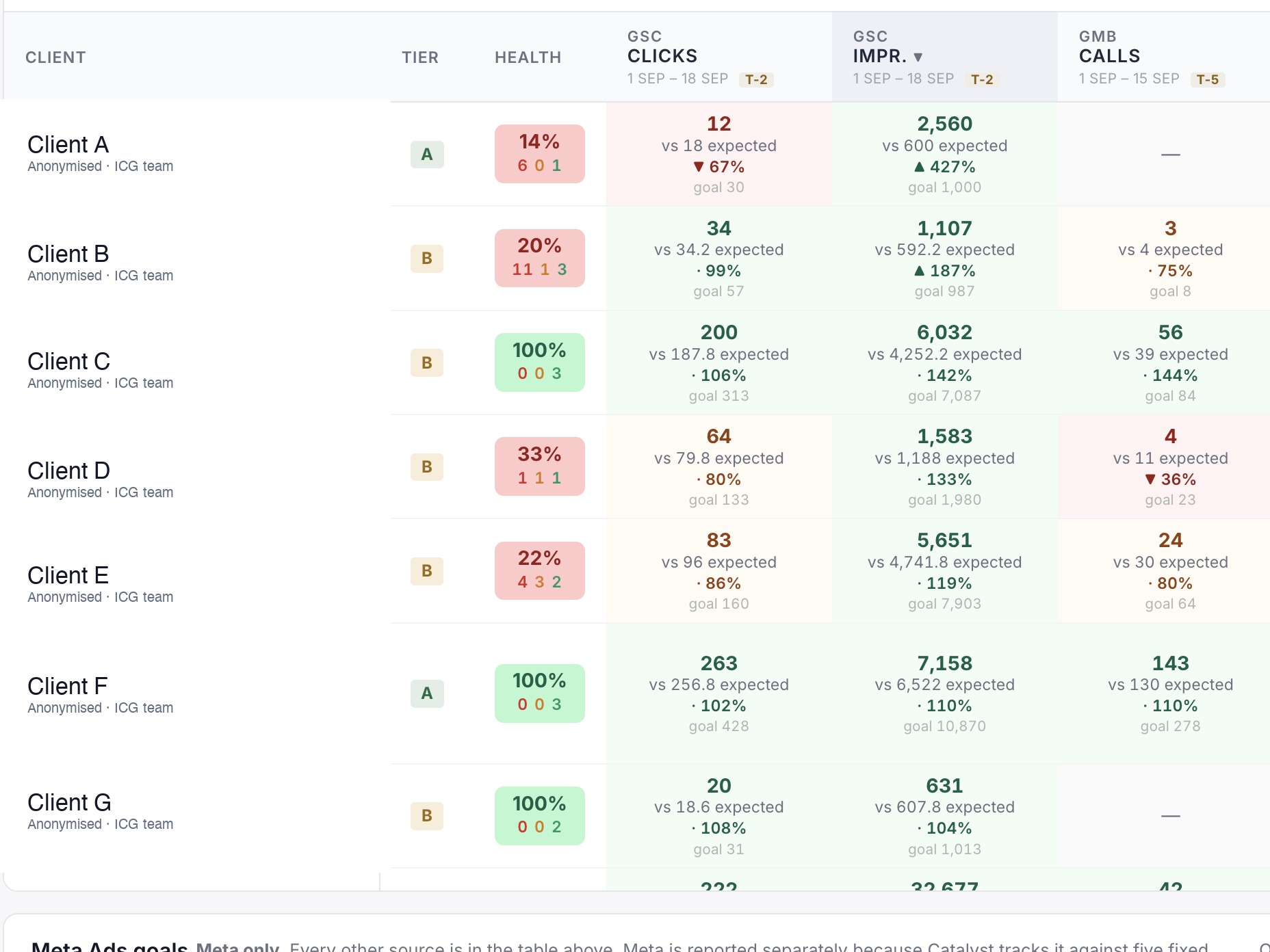
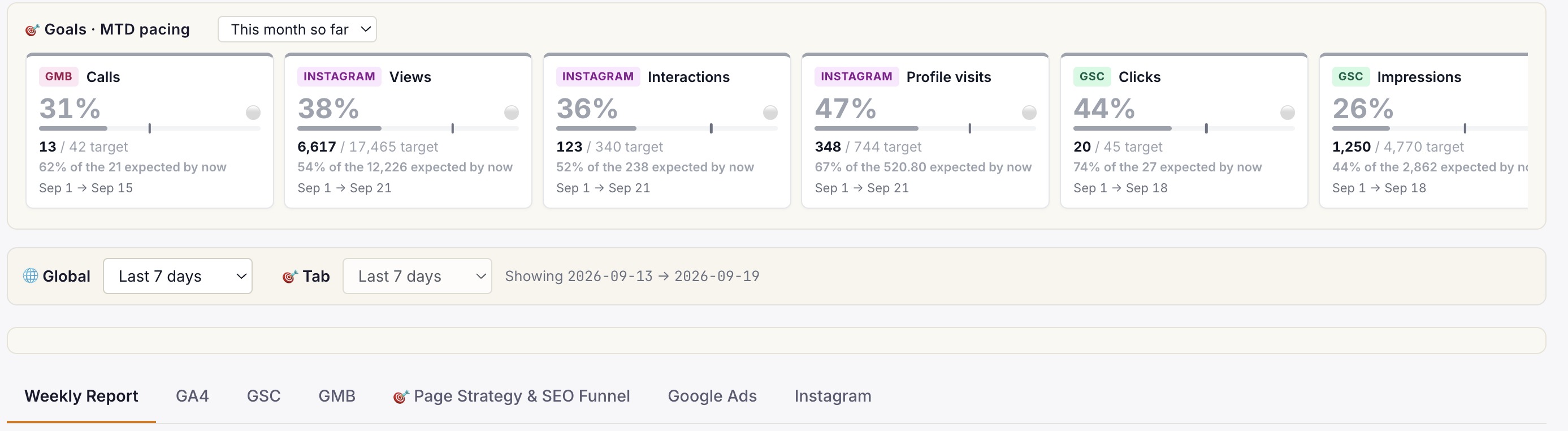
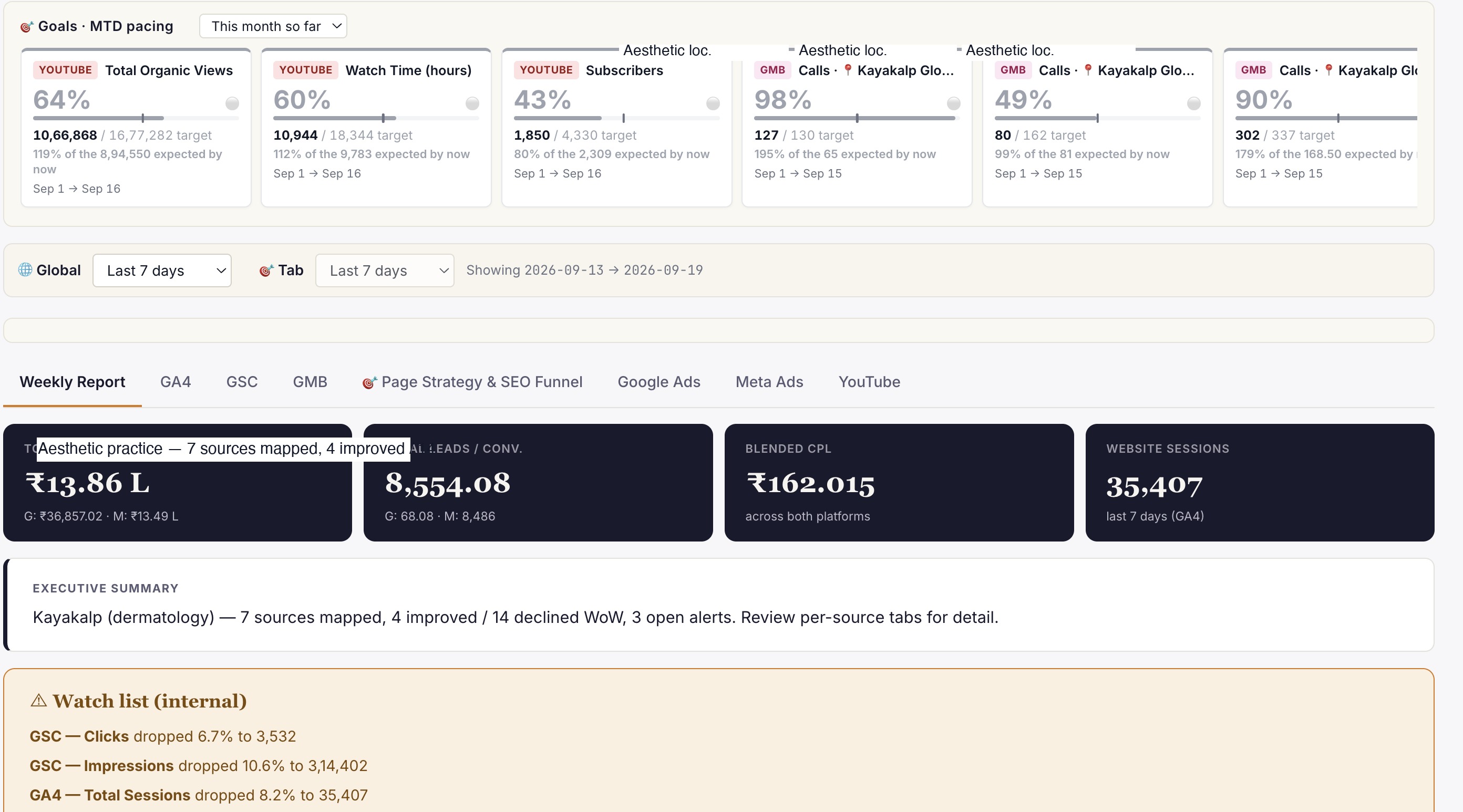
Live client dashboard. GSC, GA4, Google Ads, Meta Ads, IVR calls in one view. Login anytime, not monthly.
Phoenix
Clinic revenue intelligence over your PMS. Daily action queue: Prevent Loss, Maintain & Engage, Grow Revenue. Multi-centre rollout.
Or book a free 30-min audit to see all three in action on your account.
Healthcare brands
that already run on ICG.
A representative slice of the 150+ healthcare brands ICG has delivered for across India. Most engagements remain under NDA.


What ICG clients say · on video.
"Scale up of organic channels and business consulting. ICG has absolute domain authority in their field."
"Working with ICG transformed how we acquire IVF patients in Gurgaon. They understand the fertility journey from inquiry to consult..."
"What Ichelon accomplished — they got all my ideas and worked over 3-4 months to create an amazing, super-customised website."
Need help operationalising this?
Every ICG service is healthcare-only, NMC + DPDP-aware, and built around the patient-research patterns that drive Indian healthcare growth in 2026.
Every practice welcome — packages from ₹20,000/mo.
Goals-Driven engagements · Performance-Linked Payout Models available
More from
ICG.
Five trends shaping Indian healthcare marketing through 2027: AI-first patient research, Conversions API adoption, ABDM discovery, the AEO w...
Healthcare AIO is the discipline of getting your clinic or hospital cited inside Google AI Overviews, ChatGPT and Perplexity answers — not j...
Conversational-search advertising places brand messages inside AI chat answers — ChatGPT, Perplexity, Copilot — rather than beside a results...
Stop guessing.
Book a Diagnostic.
30 minutes. Free. With the AI-powered healthcare-only marketing agency 150+ brands already run on. No slides, no pitch, no hard close.


