The reputation a doctor spent 15 years building — defended, compounded, kept clean.

NMC-compliant online reputation management built for Indian healthcare — Angryturtle-powered Google Business Profile reviews, Reddit monitoring, YouTube comment management, Instagram and LinkedIn signal shaping. 143 healthcare GBPs managed. 4.76 star portfolio average. Zero suspensions since 2018.



What is healthcare reputation management, and why does it need to be different from generic ORM?
Healthcare reputation management is the practice of shaping how a doctor, clinic, hospital or pharma brand is seen across search, Maps, review platforms, Reddit, YouTube and social — inside the tighter rules that medicine operates under. Where a restaurant can chase five-star reviews aggressively, a registered medical practitioner in India cannot. NMC Code of Ethics, 2002 (amended 2023) Section 6 restricts solicited testimonials that suggest cure or superiority. The DPDP Act 2023 restricts what patient data can appear in a public response. The ART Act 2021 restricts what an IVF centre can say publicly about outcomes. Generic ORM advice — buy reviews, blast follow-ups, respond aggressively, name the patient — will get a doctor flagged, delisted, or in front of a state medical council. ICG runs healthcare ORM as a four-pillar system: Angryturtle GMB review acquisition, Reddit monitoring plus response, YouTube comment layer, and social signal shaping across Instagram, LinkedIn and YouTube. 143 healthcare Google Business Profiles are currently under management. Portfolio-wide average rating is 4.76. Zero suspensions since 2018. Retainers start from ₹20,000/month, custom-scoped, with Performance-Linked Payout Models available.
Why a doctor's reputation is more fragile than any other brand's.
A restaurant losing a star gets over it. Someone will still book the table. A hotel with one bad Google review can offset it with two new campaigns and a discount. A doctor cannot.
When a patient searches for "best gynaecologist in Noida" and the first non-ad result carries a 3.4 star average and a top review that reads "avoid — she does not listen", the enquiry does not just drop. It ends. The searcher moves to result number two. The doctor never learns about the lost patient, never sees the enquiry that did not happen, has no way to measure the loss. This is what makes healthcare reputation different — the failure is invisible.
The four things that make healthcare uniquely exposed.
First — the trust threshold is higher. A patient handing over their body is not comparing pasta. They are looking for reasons to say no. One bad review carries the weight of five good ones. That is not opinion. It is what click-through data on Google's local pack shows.
Second — the doctor cannot fight back the way other businesses can. NMC Section 6 restricts what a medical practitioner can say about themselves in public. No superiority claim. No testimonial of cure. No naming the patient in a response. Even a well-intended reply to a bad review can be a complaint waiting to be filed. We have seen a state medical council notice arrive because a dentist replied to a 1-star with "the patient had unrealistic expectations". True or not, it named a treatment context — and that was enough.
Third — the review-bomb is a competitor move now. Three years ago it was rare. Now a mid-sized city dental clinic in Faridabad sees a coordinated cluster of one-star reviews from accounts that never visited, roughly once every 8 to 14 months. The pattern is always the same. Three to eight profiles with generic Indian names, no photos, one prior review each (for a random Mumbai chai shop), all inside a 36-hour window. It is the online equivalent of paying somebody to slash your signboard.
Fourth — forums drift and Google indexes the drift. Once a thread on Reddit or Quora starts with "does anyone have experience with Dr Sharma at [chain]?", the answers can go anywhere. Even honest responses from ex-patients can be phrased in ways that show up on Google's brand-SERP for years. If nobody is monitoring, nobody notices — until the day the thread ranks position three on the doctor's name search.
What ICG does about it.
We treat healthcare reputation as a four-surface problem — Google (Maps and search), Reddit / forums, YouTube (video plus comments) and social (Instagram and LinkedIn). We run one workflow per surface, connected to a single dashboard, with response SLAs that a lawyer can defend if a state medical council ever asks. That is the entire proposition. Nothing exotic. Just the discipline that healthcare deserves and rarely gets.
The ICG 4-pillar ORM system.
Every reputation engagement — solo dentist to 40-hospital chain — runs on the same four pillars. What changes is the volume per pillar, not the discipline.
Angryturtle GMB Reviews
NMC-compliant review acquisition, response workflow, review-bomb detection, competitor rank on the local map, geo-grid tracking. Powered by Angryturtle Rank OS — our proprietary GBP intelligence platform.
Reddit Monitoring + Engagement
Brand mention tracking on r/india, r/AskDocs, r/IndiaSpeaks, city subs and specialty communities. Disclosed engagement where the sub allows. Authority content where it does not.
YouTube Comment Layer
Triage matrix on every published video — support, sales, safety, brand-risk, spam. Doctor-approved reply templates. SLA by category. Comment sentiment fed back into content programming.
Social Signal Shaping
Instagram, LinkedIn and YouTube programmed for a positive story arc. Earned mentions, doctor-authored posts, thought leadership. Prism Pulse for measurement.
Why four, not one.
Most "ORM agencies" in India sell a single thing — usually GMB review acquisition — and call it reputation management. It is not. A doctor with a 4.9 rating on Google whose name search shows a scathing Reddit thread on page one still loses the patient. A hospital with immaculate Instagram whose top YouTube video has an unanswered comment about a botched procedure still loses the enquiry. Reputation is what a searcher sees across the entire first screen — Maps, organic, video, forum thread, social profile. Four pillars because four surfaces.
And the four are not additive — they are multiplicative. A strong LinkedIn presence makes a bad Google review less believable. A well-programmed YouTube channel makes a Reddit thread look outdated. A clean Reddit reduces the weight a patient gives to a single low Maps rating. Each pillar buys the others credibility.
Angryturtle — the NMC-compliant review workflow that keeps 143 GBPs clean.
Angryturtle is our proprietary Google Business Profile intelligence platform. Every listing we manage — 143 of them, across dental chains, IVF centres, dermatology practices, hospital groups and standalone specialists — runs on it. It is not a review scraper with a dashboard. It is the command surface for the entire local-reputation motion.
Seven things Angryturtle does that a manual workflow cannot.
7-dimension profile health score
Every listing gets a score across NAP consistency, primary category correctness, service coverage, photo cadence, review velocity, response rate, and Q&A hygiene. Falls below 78 and the account team sees it before Monday standup.
Geo-grid rank tracking on a real map
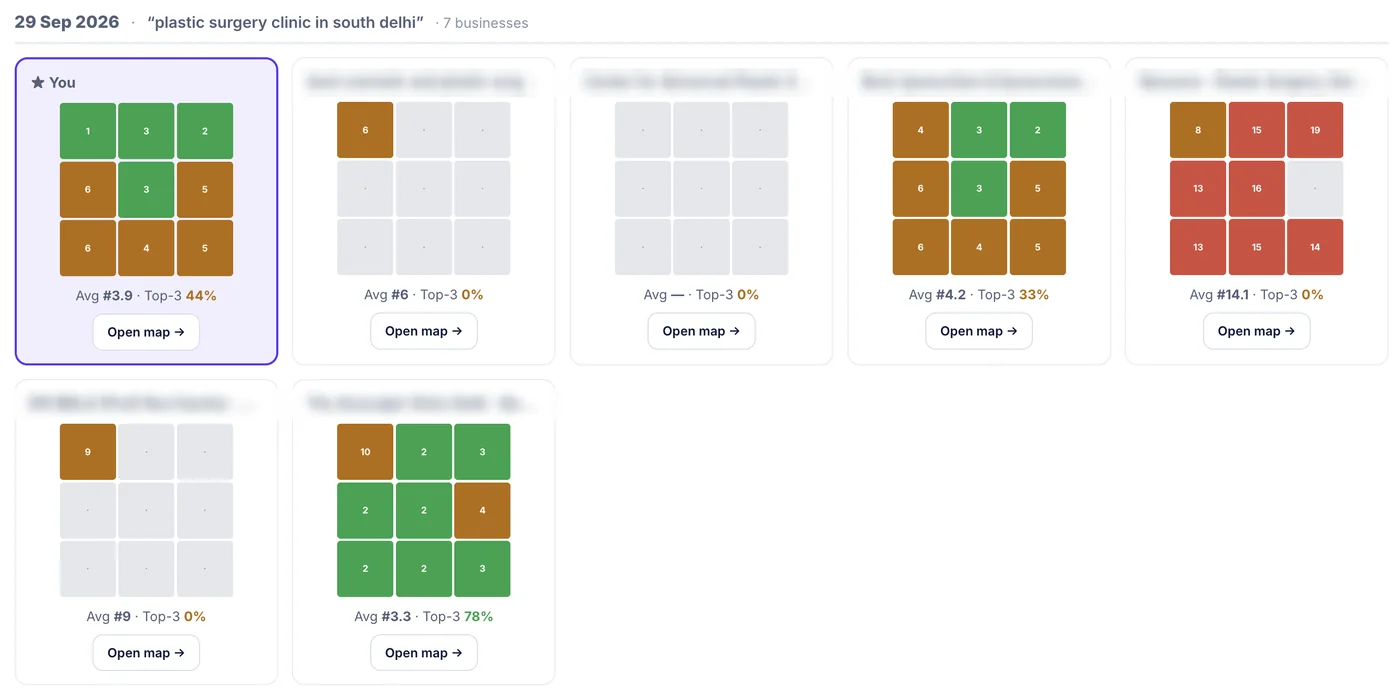
Rank for the target keyword shown on a 7x7 grid across a 5km radius from the listing. We can see which pin position ranks first, which drops off at 2km, and why.
NAP + citation conflict audit
Angryturtle crawls 40+ Indian and global directories monthly — doctor-listing platforms, local business listings, health-specific citations — flags any address or phone drift, and queues fixes.
Suspension-risk monitor
Runs every profile against the current Google policy vector daily. Detects duplicate listing risk, keyword-stuffed business name, service-area misuse, or forbidden category use — before a suspension.
Review anomaly detection
Baseline velocity is set per profile. Any spike above 2.4x normal, or any cluster of low-star reviews from unverified accounts inside 48 hours, triggers an alert.
One-tap response workflow
Draft reply, doctor approval, publish. Response templates pre-vetted for NMC Section 6, DPDP and ART Act — no patient names, no procedure specifics, no cure implications.
Auto-uploader for real service moments
Post-discharge, post-consultation, post-procedure SMS with plain review-request link. No incentive text. No "if you liked us please leave 5 stars". Just the request, timed to the moment the experience is freshest.
Why this compounds.
A single clean review adds one point to your average. A steady drumbeat of 12-18 clean reviews a month over 14 months adds something bigger — a review recency signal that Google's local pack rewards. Listings with fresh review flow rank above listings with a higher star average but stale reviews. This is verified in our own portfolio data. A dermatology chain we manage in Bangalore holds position 1 on "skin clinic HSR layout" with a 4.7 average, above a competitor sitting at 4.9 whose last review was 11 months ago.

Angryturtle → The command surface for 143 healthcare listings — one prioritised action queue per profile, updated daily.
The 7-dimension profile health score — what it actually measures, and why it matters.
You cannot manage reputation without measuring it, and you cannot measure it usefully without breaking it into components. The single number most agencies quote — star average — hides more than it reveals. A listing with a 4.9 star average that has not received a fresh review in nine months is in worse local-pack shape than a listing with 4.5 stars that receives five new reviews a week. Averages lie. Vectors tell the truth.
The seven dimensions Angryturtle scores every listing on.
1. NAP consistency
Name, address and phone number across the citation universe. Angryturtle crawls 40+ Indian and global directories monthly, compares each hit to the canonical Google Business Profile record, and flags any drift. A single phone-number mismatch across three high-authority directories can shave 4 to 7% off local-pack visibility.
2. Primary category accuracy
A dermatology clinic listed under "Skin Care Clinic" ranks for different keyword clusters than one listed under "Dermatologist". Google's category taxonomy shifts twice a year without notice — the daily audit catches when a category has been silently renamed or when a secondary category has been dropped.
3. Service coverage completeness
Every service the clinic actually offers, correctly mapped to Google's service taxonomy, with plain-language descriptions that respect NMC restrictions. Missing services are missed queries. Over-claimed services are policy-violation queues.
4. Photo cadence and geo-metadata
Fresh photos with correct EXIF geolocation data feed Google's local relevance model. A listing that has not received a new photo in six months is being penalised for it. Angryturtle tracks upload cadence per listing and flags stale profiles.
5. Review velocity vs baseline
Not just review count — review flow. A profile earning 8 to 15 new reviews a month for eight consecutive months carries a completely different rank-authority signal than one that got 300 reviews in a single quarter three years ago. Velocity is what compounds.
6. Response rate and response SLA
What percentage of reviews received a response, and how fast. Below 60% response rate correlates with slower local-pack rank recovery after a negative event. Below 24-hour median response SLA on new reviews correlates with higher review volume the following month.
7. Q&A hygiene
The Questions and Answers section on Google Business Profile is publicly editable — anyone can ask, anyone can answer. If nobody from the clinic is monitoring, the answers to "does this clinic accept my insurance?" can come from strangers, competitors, or bots. Angryturtle tracks every Q&A item and routes unanswered ones to the response layer.
How the composite score is used.
Each dimension carries its own weight, adjusted per specialty. Dental listings weight photo cadence and review velocity higher because those two levers move fastest for dental local-pack. IVF listings weight Q&A hygiene higher because IVF searchers ask more questions before booking. The final score sits between 0 and 100. Above 90 is a well-managed listing. Between 78 and 90 is functional but with visible gaps. Below 78 triggers a full account-team review before the Monday standup — no exceptions.
The score is transparent to the client. Every monthly report opens with it. Every quarterly review discusses which dimensions moved, which stayed flat, and what the next 30-day plan does about the flat ones. Reputation cannot be managed on gut feel — not at 143 listings, not at any number.
What a review-bomb looks like from inside — and how the response goes.
Names withheld. Case is real. A single-branch dental clinic in south Delhi, roughly 900 total reviews at 4.7 stars, went from a 4.72 average on Monday to 4.31 on Wednesday. The drop was seven one-star reviews inside 41 hours.
The Angryturtle anomaly monitor pinged the account team at 06:04 IST on Tuesday morning. By that point, five of the seven reviews were already live. Each carried a 40-to-90-word complaint. Each was from an account with fewer than three prior reviews. Two of those accounts had reviewed the same random restaurant in Pune the previous week. None had visited the clinic — we checked the appointment ledger for the phone numbers, cross-checked the names, and confirmed no matching patient existed in the prior 18 months.
The response over the next 96 hours.
- Hour 6 · triage. Every review classified — bomb candidate vs genuine grievance vs ambiguous. Five went into bomb bucket. Two into ambiguous — we treated those as genuine until proved otherwise.
- Hour 8 · response drafts. Each of the five bomb-bucket reviews got a public reply drafted inside NMC constraints — no naming, no procedure specifics, an invitation to reach the practice manager offline. Reviews were not attacked publicly. The clinic did not accuse. That would have triggered a defamation exposure of its own.
- Hour 12 · doctor approval. The clinical owner reviewed and signed off. Five responses published on the same day.
- Hour 14 · Google Redressal + Business Profile Appeal. We filed two separate reports through the review-removal channel and the Business Profile support flow. Attached: screenshots of the reviewer accounts, the shared restaurant review pattern, the ledger-check evidence, the anomaly velocity report from Angryturtle.
- Hour 20 · fresh review flow. The Angryturtle auto-uploader picked up the day's genuine service moments — 22 completed appointments — and pushed personalised, unincentivised review requests. Fourteen responded over the next four days. Twelve were 5-star. Two were 4-star. All were real patients with matched appointment records.
- Day 4 · outcome. Three of the five bomb reviews were removed by Google. Two stayed up. The 14 new genuine reviews pulled the average back to 4.66 by Sunday.
Sunday morning average: 4.66. Monday's starting average had been 4.72. Net loss over an attempted attack: 0.06 stars. Enquiries for the following week were within 4% of the four-week average. The competitor, we later learned from a supplier relationship, had briefed a freelance operator on Fiverr who had done this to three other clinics in the neighbourhood over the previous eight weeks.
The point is not that we win every one. Sometimes Google does not remove the bomb reviews. Sometimes the response is slower because the doctor is travelling. What compounds is the process — the fact that a workflow existed, that the alert fired at hour 6 instead of week 3, that the response was NMC-safe, that fresh flow diluted the impact. Without that, the same attack would have taken the listing to 4.31 permanently, and the local-pack rank would have followed.
143 healthcare Google Business Profiles. Zero suspensions. Here is why that number matters.
Ask any healthcare ORM agency in India one question — how many listings have you got suspended, and how many stayed clean? Watch the answer.
Google's suspension policy has become sharper over the last three years. The old workflow — mass-uploading reviews through fake accounts, keyword-stuffing the business name, marking every profile as service-area — no longer survives. Listings suspended in 2026 for these violations are hard to reinstate. Many stay suspended. The lifetime rank equity built over years disappears in one policy sweep.
What we do differently.
We never buy or incentivise reviews.
Every review that lands on a listing we manage is either from a genuine patient who received a plain unincentivised request through Angryturtle, or an organic walk-in review. That is it. No agency-side review uploaders. No promises of five stars. No discount coupons in exchange for reviews.
We never stuff the business name.
A dental clinic is registered on Google as "Dr Rajesh Sharma's Dental Clinic" — not as "Best Dentist Delhi | Root Canal | Braces | Dr Rajesh Sharma Dental Clinic". The second one is a suspension in waiting. The first one ranks better because it matches the citation universe.
We never misuse service-area.
A physical clinic gets a physical address listing. Service-area is reserved for genuinely mobile services — like a home-care physiotherapy operation. Misusing it to hide the address triggers Google's duplicate-listing detection almost immediately.
We never respond to reviews with patient specifics.
Not a single response on a listing we manage names the patient, their condition, their procedure or their outcome. DPDP Act 2023 makes this dangerous. NMC Section 6 makes it a professional conduct issue. Our template library respects both.
We audit every listing weekly.
Angryturtle runs the profile against Google's current policy vector daily. If anything drifts — a new photo without geo-metadata, a category that Google rewrote, an owner-response with a name in it — the account team sees it before it becomes a problem.
Zero suspensions across 143 listings over eight years is not luck. It is the by-product of refusing to do the fast thing. The agencies who use the fast thing have portfolios in the low single digits of suspensions per hundred profiles per year. Some are much higher. Ask before you sign.
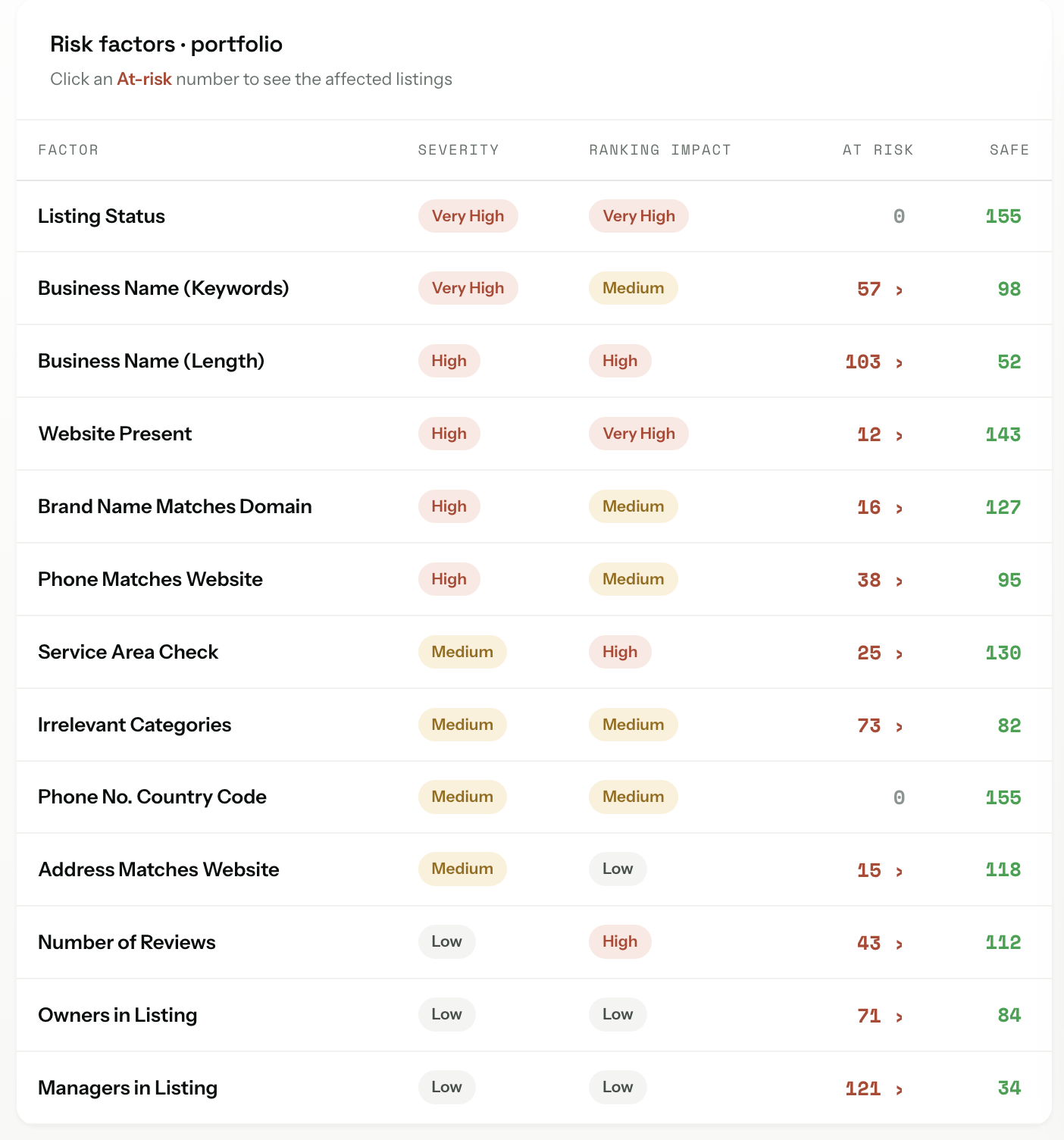
Angryturtle → Daily risk-factor scoring per listing — the workflow that turned 143 healthcare GBPs into zero suspensions since 2018.
Reddit reputation for Indian doctors — the forum most agencies pretend does not exist.
Reddit is the second-most influential English-language discussion platform in India for anything health-related. That is not something we are guessing at. It is what our GSC clickstream data across the healthcare cluster shows — the Reddit URL that ranks on a doctor's name typically pulls a 6 to 12 percent click-through rate, often higher than a stale doctor-listing profile.
Where the mentions actually happen.
The English-language subs that drive Indian healthcare conversation are more predictable than most doctors think. We monitor a specific list, weekly. The main ones — r/india, r/AskDocs, r/IndiaSpeaks, r/india_masala_free, r/AskIndia — and the city subs — r/bangalore, r/delhi, r/mumbai, r/hyderabad, r/chennai, r/pune, r/kolkata, r/gurgaon, r/noida. On top of those, specialty communities like r/infertility, r/dermatology, r/dental, r/HairTransplants, r/PlasticSurgery. Then the two aggregators — r/AsianBeauty and r/SkincareAddictionIndia — which shape derm conversation.
Three response modes. Three different playbooks.
Mode 1 · Disclosed engagement
On subs where transparent affiliation is acceptable — city subs, most specialty communities — we respond with disclosed identity. Flair reads "Marketing team for [Clinic]". Response never promotes. It answers the question, links to the doctor-authored article that has the full answer, and ends the thread cleanly. This preserves trust in the sub and reduces the odds of the post being removed by moderators.
Mode 2 · Outrank the thread
On subs where any promotional signal will get the account banned — r/AskDocs, r/india — we do not post. Instead, we publish a doctor-authored, deep-answer piece on the clinic's own site, engineer it for the exact query language the Reddit thread ranks on, and use internal-linking to push it into a top-3 organic position. Google then serves both. The searcher clicks the article first.
Mode 3 · Do nothing
Some threads deserve to exist. A patient who had a genuinely bad experience, wrote a balanced account, and moderators left it up — engaging with that will only amplify it and looks defensive. We flag it in the monthly report, log it as an operational feedback item for the clinic, and let it sit. Reddit threads decay faster than most people assume.
The mistakes we watch other agencies make.
Creating undisclosed sockpuppet accounts to promote a clinic on Reddit is the single fastest way to a permanent domain ban. Once identified — and Reddit's mod tools identify these quickly — the ban extends to any mention of the clinic across the platform. The clinic loses the ability to be discussed at all, in either direction. We have seen this happen to two well-known IVF chains whose previous agencies used the sockpuppet playbook. The recovery cost is enormous.
Downvoting negative threads through bot accounts is the second-fastest. Reddit's algorithm is tuned to detect coordinated voting. Once flagged, the sub's mods remove the entire thread — including any positive responses — and the clinic ends up in the sub's blocklist. Our answer to a negative thread is a better piece of authority content ranking above it on Google. Slower. Cleaner. Actually works.
YouTube comments — the reputation surface Google indexes and AI Overviews cite.
The comment section of a doctor's YouTube video is not social media chatter. It is public, searchable, indexed by Google, and — since mid 2025 — pulled into AI Overview citations when the video is credible. It is also the single most read piece of "third-party opinion" a prospective patient will look at before booking. More than reviews. More than Reddit. More than the clinic's own website.
Why comments outweigh video views for reputation.
A viewer who watches a doctor's video and finds a comment that reads "Went for consultation, was disappointed, doctor did not explain the risks properly" will not book — regardless of what the video itself demonstrated. Prospective patients trust other patients more than they trust the source. This has always been true. What is different now is that the comment is public, searchable and lasts.
YouTube comments are also a two-way ranking signal. Videos with high comment volume, high response rate from the creator, and high positive sentiment rank higher on YouTube search and appear more often on "People Also Watched" carousels. A neglected comment section suppresses reach on the videos that follow.
The five-category triage matrix we run on every video.
Why the SLAs are what they are.
Sales-intent comments — "how do I book?", "is this available in Bangalore?", "what does this cost?" — are dropped bookings if left unanswered for a day. A four-hour SLA closes most of them inside the browsing window the viewer is in. Safety-related comments — anyone describing an adverse experience with the treatment discussed in the video — get a two-hour response window and mandatory doctor sign-off because that comment thread is the one AI Overview is most likely to cite. Getting the response right, publicly, before the AI Overview crawls it, is the entire point.
Comment sentiment as content-programming input.
Every month we run a sentiment sweep across the last 60 days of comments on a doctor's channel. If a particular procedure video is consistently drawing "what about after-care?" questions in comments, the next video is programmed to answer exactly that. This closes the search-intent gap and turns the channel into a conversation the doctor is actually leading. It is also what makes the difference between a channel that grows and one that plateaus at 4,000 subscribers.
Instagram, LinkedIn and YouTube — building a positive first-screen story arc.
The last surface. And the one most doctors underestimate. When a prospective patient searches for a doctor's name on Google, they see roughly ten organic results in the first screen. What appears there — and in what order — is what the search reads as the doctor's reputation.
What the first screen should look like.
The clinic's own website in position one. The Google Business Profile knowledge panel on the right. The doctor's LinkedIn profile in the top five. A YouTube channel link. An Instagram profile. Maybe a legitimate press mention. That is the version we work toward. What we work against is the version where positions three, four and five are a Reddit thread, an old doctor-listing profile with a 3.2 average, and a random news mention from 2019 about something the doctor no longer does.
Signal shaping is the discipline of building enough owned, controlled, positive surface to push everything else off the first screen. Not through censorship — that does not work — through supply.
Instagram — patient-safe reels, not viral pandering.
Every reel we publish for a healthcare client is filtered through three tests. Would a patient want to see this? Does it respect NMC Section 6? Would it look defensible if a state medical council pulled it up in three years? A reel showing the doctor explaining what to expect before a root canal passes. A reel showing before/after photos of a nose job to trending audio does not. Signal shaping is a slow, disciplined content motion — the doctor's expertise on show, the patient's dignity intact, the compliance floor unbroken.
LinkedIn — where the referring physician looks.
For specialist consultants especially, LinkedIn is where other doctors quietly look before referring. A well-maintained LinkedIn presence — real content, sensible cadence, no self-promotional grandstanding — is a reputation moat that no bad Google review can overcome. Fellow doctors trust the LinkedIn signal above almost every other online source.
YouTube — the reputation asset that appreciates.
A YouTube video that has run for 18 months, gathered a few hundred comments, and been steadily maintained becomes the strongest single reputation asset in a doctor's digital footprint. It appears on YouTube search, on Google video results, in AI Overview citations. And unlike a paid ad, it does not stop working when the invoice ends.
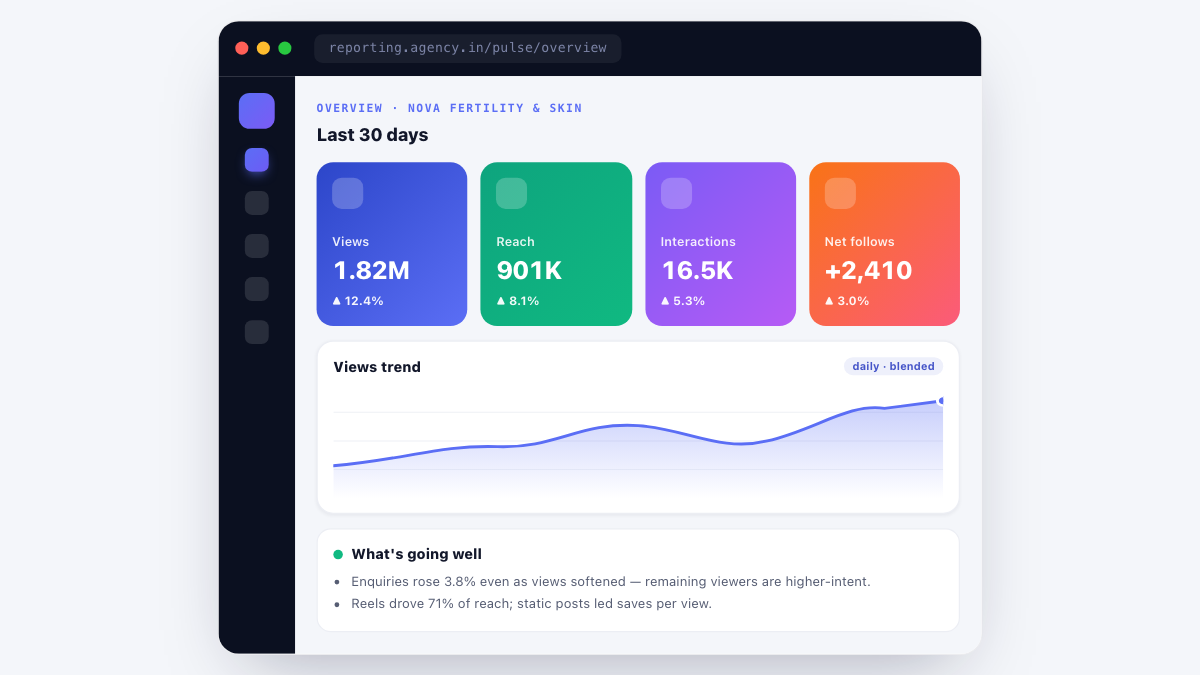
Prism Pulse → Instagram, LinkedIn and YouTube reach, sentiment and comment temperature — one monthly dashboard per doctor or brand.
LinkedIn thought leadership — the reputation moat that outranks every review site.
Every specialist consultant knows this instinctively. Referrals move through peer networks. A cardiologist in Chandigarh who wants to send a patient to a Delhi electrophysiologist does not check Google reviews. They check LinkedIn.
That single fact reshapes how a doctor should think about reputation. The patient-facing surface — Google reviews, Instagram reels, brand-SERP — matters. But the peer-facing surface, hosted almost entirely on LinkedIn, decides where 30 to 60 percent of high-value cases come from in specialty medicine. It is invisible to most agencies and invisible in most reputation reports.
What a strong specialist LinkedIn actually looks like.
- Profile positioning that reads as a peer, not as a promoter — credentials, fellowships, current appointment, focus areas.
- One long-form post every two to three weeks, discussing a real clinical decision or case pattern (anonymised).
- Engagement on other doctors' posts — the mutuality that keeps the algorithm delivering the doctor's own posts.
- Occasional evidence of professional activity — conference talk, guest lecture, published paper, board appointment.
- Zero patient marketing. Zero discount-driven content. Zero cross-promotion of the clinic's Instagram.
The LinkedIn signal is patient-visible too — a searcher who Googles a doctor and finds a serious, well-maintained LinkedIn presence in the first screen reads the whole footprint differently. The Google review average matters less. The Reddit thread matters less. The doctor looks like a professional whose peers respect them, which is what a patient actually wants to see.
The ICG workflow for doctor LinkedIn.
We do not ghost-write posts that the doctor did not say. What we do is interview the doctor once a month for 30 to 40 minutes on cases, decisions, and clinical pattern observations, then convert that into two to three posts written in the doctor's own voice, approved by them before publishing. The result reads authentic because it is authentic. The doctor is on the record for what they said. The agency is invisible.
The reputation risks nobody warns Indian doctors about.
Most doctors have a rough idea that NMC has rules about advertising. Beyond that, the landscape is murky. Some of the biggest reputation risks are the ones that come from things doctors do believing they are safe.
Naming a patient in a review response.
The most common one. A patient writes a negative Google review — vague, unfair, sometimes not even about a real visit. The doctor, feeling defensive, replies with "Mrs Sharma, you came on the 14th of March for a scaling and were charged our standard fee". Fair reply on the surface. It just publicly disclosed a patient's identity, visit date, and treatment. That is a DPDP Act 2023 breach and, depending on the language, an NMC conduct issue. Our template library does not allow it, ever.
Using patient photos on Instagram without written consent.
Before/after photos, procedure clips, delivery-room celebration posts — all common on healthcare Instagram accounts. Almost none have documented written consent from the patient. If challenged, that is a DPDP violation and, for IVF-specific content, an ART Act violation. Our workflow requires a signed consent form scanned into the client folder before any patient-recognisable content is scheduled.
Testimonials of cure.
"Dr Verma cured my back pain in three sessions" — the kind of quote a happy patient writes voluntarily on Google. If the doctor's website reproduces it in a testimonials section, NMC Section 6 has been breached by the doctor, regardless of who wrote the original words. The rule sits on the doctor, not the patient. Our compliance layer scrubs any testimonial that claims cure or superiority before it lands on a client's site.
Discount coupons in exchange for reviews.
The most common Google Business Profile suspension trigger in India. A well-meaning receptionist hands out a card saying "leave us a 5-star review, get 10% off next visit". Google detects the coincident review pattern within weeks. Suspension follows. Reinstatement is difficult and sometimes impossible. Our workflow explicitly forbids this and briefs client staff on why.
Comparative claims on paid ads.
"Better than the leading dental chain" — a phrase that reads harmless if the client is used to consumer marketing. ASCI (Advertising Standards Council of India) will pull it inside a fortnight. NMC will note it. The result is a formal complaint on record. Our copy workflow does not permit superlatives ("best", "leading", "number one") or comparatives that name or imply a competitor.
How to reply to a 1-star review — the NMC-compliant playbook.
The single most common request from doctors starting on ORM: "what do I say to this review?". Here is the actual playbook.
Rule 1 · Never name, never confirm, never deny.
No patient name. No visit date. No confirmation of the treatment mentioned. No denial of the treatment mentioned. Nothing that could be read as public disclosure of a doctor-patient relationship. The response acknowledges concern, invites offline resolution, ends. That is the shape.
Rule 2 · Response within 48 hours.
A negative review with no response reads as unresolved. A response inside 48 hours reads as attention. The 48-hour window matters more than the exact wording.
Rule 3 · One response, not a thread.
Never argue in the review comments. If the reviewer responds to your response, do not respond again. The thread stops. Doing otherwise invites the situation to escalate publicly.
Rule 4 · Personal-sounding, not template-sounding.
"We are sorry to hear about your experience. Please contact our practice manager on [number]." — reads generic and lowers trust. "We take every concern like this seriously. Would you reach out to our practice manager, [name], on [number]? We want to understand what happened." — reads considered, human, and does not name the reviewer or confirm anything about the visit.
A worked example.
Review (1 star): "Waited 2 hours despite appointment. Doctor spent 5 minutes and prescribed medicines that did not work. Charging too much for this level of service."
Response (correct): "We are genuinely sorry that this was your experience. A long wait when you have booked in advance is not the standard we hold ourselves to, and neither is a consultation you did not feel was thorough. Would you please reach our practice manager, Priya, on 011-XXX-XXXX or write to feedback@[clinic].in? We would like to understand exactly what happened so we can address it properly."
Response (wrong): "Mrs [name], as per our records you were seen on the 12th at 3:40pm and Dr Rao spent 22 minutes with you. The prescription was as per your presentation and standard for this clinic. Please review our fee schedule which is displayed at reception."
The second response feels satisfying to write. It is also a DPDP disclosure, an NMC-adjacent argument on a public forum, and a piece of evidence the reviewer's lawyer would love if it ever came to that. Our response layer never writes it, regardless of how tempting the moment.
Managed ORM vs DIY — the honest comparison.
A perfectly reasonable question from any solo doctor: can we do this in-house? Sometimes yes. Sometimes no. Here is the honest math.
When DIY is genuinely the right answer.
Solo practitioner. Single location. Genuinely small patient volume (under 40 visits a month). Somebody on staff — usually the doctor's spouse or a part-time practice manager — who understands NMC constraints and has 8 to 10 hours a week to give this. In this shape, DIY works, and we will happily point you at the free Angryturtle onboarding checklist rather than sell you a retainer you do not need.
When managed is the right answer.
More than one location. Any level of paid marketing running. Any signal of competitive review-bomb activity in the specialty. Any patient volume above 100 visits a month. Any hospital chain, IVF group, dermatology chain or pharma brand. In this shape, the DIY workflow will collapse inside three months — usually because the doctor gets busy, the staff member who was doing it leaves, or a bomb hits during a week when everyone is distracted. Managed is not more expensive than DIY. Done properly, DIY costs more once you count the staff time.
The Angryturtle review-acquisition workflow, step by step.
Everyone claims to do ethical review acquisition. Very few can describe exactly how, without hand-waving. Here is the ICG workflow from patient arrival to review publication, in plain sequence.
-
Step 1 · The service momentThe trigger is not an appointment booking. It is not a payment. It is the completion of the service — discharge, follow-up closure, procedure completion. Angryturtle syncs with the clinic's appointment system (or receives a manual daily upload) to detect these moments.
-
Step 2 · The delayA review request goes out roughly 6 to 24 hours after the service moment — long enough that the patient has had the experience settle, short enough that they still remember specifics. Sending immediately reads as a sales ask. Sending three days later gets ignored.
-
Step 3 · The messageOne SMS or WhatsApp message. Written in the patient's preferred language where known (English, Hindi, or one of six regional languages). No incentive. No mention of 5 stars. Plain: "Thank you for choosing [clinic name]. If you have a moment, we would appreciate your honest review — [short link]."
-
Step 4 · The linkThe short link goes directly to the Google Business Profile review page. Nothing in between. No survey gate that filters low ratings away (Google's policy explicitly prohibits this). Every patient sees the same review interface, regardless of what they intend to write.
-
Step 5 · The response layerEvery published review triggers an internal alert. Reviews above 4 stars get a warm, non-templated thank-you response inside 24 hours. Reviews below 4 stars get a considered, NMC-compliant response inside 48 hours — drafted by ICG, approved by the doctor, published through Angryturtle.
-
Step 6 · The follow-throughEvery low-star reviewer who left contact information (or is identifiable through internal records) gets an offline outreach from the practice manager — genuine attempt to understand the concern, resolve it if possible. Sometimes reviewers voluntarily revise or remove a review after the offline resolution. Never asked, occasionally happens.
-
Step 7 · The reportingEvery month, the client receives an Angryturtle report — new reviews by star band, response rate, response SLA compliance, average star trend, anomaly alerts fired, citation health delta, competitor rank movement. One page. Actionable. Not a data dump.
Boring. Deliberately. This workflow is what turns "we want more Google reviews" into a compounding asset without triggering any of the policy violations that catch other agencies. We do it RIGHT — right process, right systems, right ecosystem — because the fast way permanently damages the underlying listing.

Angryturtle → The plain, unincentivised review request pipeline — timed to genuine service moments, sent in the patient's preferred language.
Where reputation matters at each stage of the patient's decision.
Patients do not decide on a doctor in one step. They pass through four rough stages, and reputation surfaces different assets at each stage. Understanding this is the difference between spending ORM budget in the right place and the wrong place.
Stage 1 · Awareness
Symptom or need surfaces. Patient searches on Google for the condition or the treatment. What matters: does your doctor / clinic show up in the AI Overview citation or the top organic block? Reputation asset: authoritative content, YouTube video, media mention.
Stage 2 · Shortlist
Patient searches for the type of practitioner + city. Google Maps local pack, top organic results. What matters: rating, review recency, response rate, photos, business hours accuracy. Reputation asset: Angryturtle-managed GBP.
Stage 3 · Verification
Patient searches for the specific doctor's name. Brand-SERP appears — the ten organic results plus the knowledge panel. What matters: clean first screen, controlled links, no rogue Reddit thread on page one. Reputation asset: LinkedIn, YouTube, Instagram, controlled first-screen.
Stage 4 · Booking
Patient makes contact — call, WhatsApp, form. What matters: how the front desk handles first interaction, how quickly a confirmation goes out, how the follow-up feels. Reputation asset: operational, but ORM begins the moment they book because the next review is now being written in their head.
Most agencies concentrate spend on stage two. It is the most measurable. It is also where the fastest wins sit. But an ORM engagement that ignores stages one and three leaves the patient exposed to a competitor's content at stage one and to an ugly brand-SERP surprise at stage three. We work all four in parallel because that is where reputation actually decides the enquiry.
The 12-hour incident-response playbook for hospital chains and specialty groups.
A hospital chain will, at some point, face an event that hits the news. A patient outcome that reaches a regional paper. A staff-side allegation on Twitter. A viral video from a distraught family member. A regulator notice covered by a health-beat journalist. When it happens, the reputation surface can go from stable to critical inside a single news cycle.
The difference between a hospital that comes out the other side with its brand intact and one that spends 18 months rebuilding is not the severity of the underlying event. It is the coordination of the response inside the first 12 hours. Beyond 12 hours, the narrative has settled. What is on Google, what is on Twitter, what is in the WhatsApp forwards — that becomes the story, regardless of what the internal facts turn out to be.
The pre-briefed playbook, in six phases.
-
Phase 0 · Before anything happensEvery Scale-tier engagement includes a two-hour pre-briefing with the chain's CEO or CMO, the head of communications, the legal counsel, and — where relevant — the medical director. We document who signs off on public statements, who owns the CEO's LinkedIn account during a crisis, what the standard holding statement looks like, and what the escalation matrix is. This meeting is dull. It saves you six hours when the event hits.
-
Phase 1 · Hour 0 to 2 · Situation assessmentWe activate the incident channel — a dedicated WhatsApp group plus a shared Notion war-room. Every platform gets a sweep: Google reviews, YouTube comments, Twitter/X, Instagram DMs, Reddit, Quora, news mentions, staff-side WhatsApp forwards where visible. A one-page situation summary lands with the CEO inside two hours.
-
Phase 2 · Hour 2 to 4 · Holding statementA holding statement — 60 to 120 words, human, non-defensive, factually cautious — goes out through the official channels the pre-brief agreed on. Usually the chain's Twitter, the head office LinkedIn, and a pinned entry on the affected branch's Google Business Profile. Nothing that pre-empts investigation. Nothing that admits liability. Nothing that names patients or staff.
-
Phase 3 · Hour 4 to 8 · Response layer activationEvery incoming comment, review, and forum post gets triaged and responded to inside the response layer. The pre-briefed reply templates get customised in real time by the account lead. Emotional replies from families are handled with a specific, softer template that acknowledges the human weight without confirming clinical detail.
-
Phase 4 · Hour 8 to 12 · Media routingJournalists reaching out for comment get routed to the pre-designated media contact — never to individual doctors, never to branch staff. If a specific journalist has picked up the story, we brief the media contact on that journalist's prior coverage patterns and typical angle.
-
Phase 5 · Day 2 onwards · Narrative rebuildOnce the immediate cycle passes, the rebuild starts. New authority content published on the affected topic. Reviews carefully seeded from the current week's genuine visits (never touching the affected patient thread). LinkedIn thought-leadership from the chain's named consultants. The goal: within 60 days, the first-screen brand-SERP no longer surfaces the incident above the chain's own controlled surface.
Nothing about this is heroic. The heroism is in the pre-brief nobody wanted to attend. A hospital chain that has run the pre-brief will move through phases 1 to 5 without visible fumbling. A hospital chain that has not will still be arguing about who signs off on the holding statement at hour 6 while the story finds its shape on WhatsApp.
What the monthly reputation report actually shows.
One thing to name upfront. Most agency ORM reports are unreadable. Screenshots of dashboards. Five decimal places on numbers nobody asked for. No narrative. No decision surfaced. The report exists to justify the retainer, not to run the account.
The ICG report is designed the opposite way. One page. Written in plain language. Every number tied to a decision. Numbers we cannot explain are removed, not added.
Sections of the standard monthly.
The headline
Two sentences. What moved this month, what needs the doctor's attention next month. Nothing else.
GBP portfolio (Angryturtle export)
Per-listing star trend, review volume by star band, response rate, response SLA compliance, local-pack rank on the target keyword, geo-grid coverage.
Anomalies + resolutions
Any review-bomb detected, any suspension risk flagged, any citation drift, any competitor listing change worth noting. What we did about each.
Reddit + forum monitoring
Any new threads mentioning the brand. Sentiment. Response we took (mode 1, 2, or 3 per the playbook). Outcome, where measurable.
YouTube comment layer
Comments received by triage category. Response SLA compliance. Sentiment sweep. Any content-programming implications for next month's videos.
Social signal snapshot
Prism Pulse export — Instagram, LinkedIn, YouTube reach, engagement rate, sentiment, cross-platform mention volume. Comparison to previous 30 days.
Brand-SERP inventory
The top 10 Google results on the doctor's or clinic's name search. Any change from last month. Any position now occupied by rogue content — with the plan to displace it.
Next month's asks
What we need from the doctor / clinic to keep the flywheel spinning. Interview slot for LinkedIn, one video approval, one review-response batch. Nothing more than 90 minutes total.
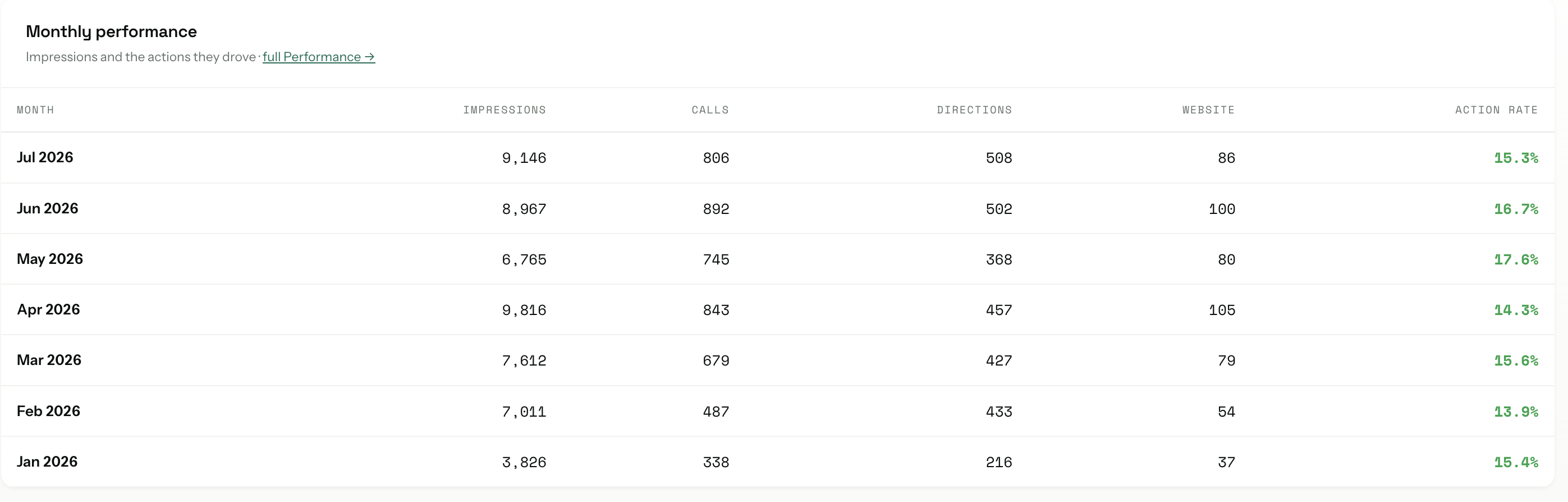
Angryturtle → One page per listing — rank trend, review velocity, anomaly log, and the one decision that needs the doctor's attention this month.
Reputation management, by specialty.
Every specialty carries a different reputation surface. IVF and cosmetic surgery live under the ART Act plus tight NMC scrutiny. Dental sees the highest review-bomb frequency of any Indian healthcare category. Dermatology is disproportionately affected by Instagram signal. Hospital chains carry incident-response weight. We adapt per specialty.
IVF + Fertility
ART Act 2021 forbids any public claim about success rates without formal registry data. Every response, every social post, every YouTube comment is filtered for cure-implication language.
Dental clinics
Highest review-bomb frequency of any specialty we monitor. Also the most sensitive to review recency for local-pack rank. Weekly Angryturtle audit is mandatory in this specialty.
Dermatology + aesthetic
Instagram-heavy. Before/after content is the biggest DPDP exposure. Strict written-consent workflow before any recognisable patient content is scheduled.
Plastic surgery
Reddit-heavy. r/PlasticSurgery, r/HairTransplants and specialty subs drive a disproportionate share of enquiries. Reddit monitoring intensity is higher than for other specialties.
Cardiology + specialty consult
LinkedIn-heavy. Referring-physician network drives 40 to 60% of high-value cases. Thought-leadership cadence takes priority over Instagram.
Ophthalmology
YouTube-heavy. Procedure explainers drive a large share of consultation bookings. Comment-layer discipline is critical.
Hospital chains
Incident-response weight is dominant. A single adverse event that hits news requires a coordinated response across every platform inside 12 hours. Retainers include an incident-response playbook, pre-briefed.
Diagnostic labs
Local-pack rank and price transparency dominate. Review velocity beats star average — patients trust recency in the diagnostic category.
Pharma + life sciences
UCPMP 2024 restricts almost every consumer-facing claim. Reputation work focuses on doctor-facing platforms — LinkedIn, medical forums, congress coverage — plus brand-safety monitoring.
Where reputation management meets AI Overviews.
Something changed in the middle of 2025 that most Indian doctors are still catching up with. Google's AI Overview started pulling review snippets, YouTube comments, Reddit threads and forum posts as citation sources for medical-adjacent queries. The reputation surface stopped being just what a searcher sees below the AIO block. It became what the AIO block itself was written from.
Practically, this means a Reddit thread that describes a bad experience with a specific clinic can now surface inside the AI Overview response to "best dental clinic in [city]", woven into the AIO's own summary. Even if the searcher never clicks through to the thread itself, the sentiment has been absorbed into the AI response and shaped the searcher's read.
What we do about it.
Three things. First, we ensure the doctor's own site publishes AIO-ready content on every commercial and clinical query in the specialty — direct-answer blocks, source attribution, schema — so Google's citation engine has a good, controlled source to pull from. Second, we work through the Reddit / YouTube / forum layer to ensure any negative content is either responded to inside the same thread (moving sentiment) or outranked by better authority content. Third, we track AI Overview citations through our own AIO dashboard so we see when a competitor's citation replaces ours or vice versa.
The 2026 rule for reputation.
Do not think of reputation as "what shows on my brand-SERP". Think of it as "what an AI Overview would confidently say about me if asked". The distinction matters. A doctor whose brand-SERP looks clean but whose AIO response leans on a five-year-old negative news mention is not reputation-safe. A doctor whose AIO response cites their own thought-leadership content, their fresh reviews, and their video answers is.
Every workflow, mapped to the compliance stack.
A one-line summary of the rules ICG's reputation workflows are engineered around. If your current agency cannot articulate this map, ask why.
What 12 months of managed ORM actually looks like.
Client names withheld per signed NDA. The rank, review, and rating data is real and verifiable on call.
Rating recovery · dental chain · 5 branches · 11 months
Suspensions across 143 managed GBPs · 8 years
Review-bomb attacks resolved · IVF chain · 24 months · net rating loss: 0.03
Local-pack rank · dermatology · Bangalore HSR Layout · 6 months from position 8
Rogue Reddit thread displaced from pos 3 to pos beyond-first-page on doctor\'s name · 5 months
Total patient reviews on managed portfolio · genuine · unincentivised
What a reputation audit actually surfaces — and why most doctors are surprised.
Every engagement starts with a diagnostic. Free. Ninety minutes of our time, no obligation on the doctor. Here is what we look at, what we typically find, and the order in which we present it back.
The 10-item audit checklist.
Brand-SERP inventory
We Google the doctor's name in an incognito window from a Delhi and a Bangalore IP. Every result on page one and page two gets logged — position, source domain, sentiment, editable or not, aged or fresh.
Knowledge panel completeness
Whether Google shows a knowledge panel on the doctor's name search, what it contains, whether the doctor has claimed and verified it, whether the profile photo is professional.
Google Business Profile audit
Angryturtle runs the full 7-dimension score. Rating, review count, response rate, response SLA, photo cadence, service coverage, category correctness, NAP consistency, Q&A hygiene.
Geo-grid rank on the target keyword
Where the listing ranks on a 7x7 grid across a 5km radius from the clinic, on the primary target keyword. Shows exactly where the visibility drops off.
Citation universe scan
Every mention of the clinic name across 40+ directories. Flags any address, phone number or hours drift that is bleeding local-pack authority.
Reddit sweep
90-day search across every relevant sub. Every mention logged with sentiment, response status, and moderator disposition.
YouTube presence
Every video that surfaces when the doctor's name is searched on YouTube. Views, comment volume, comment sentiment, response rate.
Instagram + LinkedIn audit
Follower count is the least interesting number. Recency of posts, engagement rate, comment temperature, whether the doctor has actually posted anything themselves versus agency-generated content.
Competitor benchmark
Same audit run on the doctor's top 3 to 5 competitors. Shows exactly where the gaps sit and where the wins are.
Compliance red flags
Any live content — testimonials on the website, patient photos on Instagram, comparative claims on ads — that would fail a strict NMC / DPDP / ART audit. These get raised first, because they are the fastest way to make the reputation worse.
Three things we almost always find.
First — the brand-SERP has at least one surprise. A rogue Reddit thread nobody knew about. An old doctor-listing review page ranking in position four with a 3.1 average. A news mention from 2018 about an unrelated legal matter that the doctor forgot existed. Roughly 90% of first-time audits surface at least one item the doctor did not know was there.
Second — the Google Business Profile is under-managed. Response rate below 40%. Response SLA in weeks not hours. Categories set incorrectly at some point in the past and never revisited. Photos that have not been refreshed in over a year. This is the fastest-fix category — measurable improvement inside 60 days.
Third — there is compliance exposure on the doctor\'s own website. Testimonials that use words like "cured" or "life-changing". Before/after patient photos without documented written consent. Comparative claims on service pages. This category rarely surprises us. It always surprises the doctor. And it is the first thing we fix — not because it changes rank overnight, but because it removes the risk that a regulator conversation could open on the doctor\'s own home page.
Who runs healthcare ORM at ICG.
Reputation work is judgment work. It cannot be automated end-to-end. What follows is the actual team that touches your account — no ghost consultants, no borrowed bios.
Abhash Kumar
Compliance-first product thinking. Owns the ORM system architecture, workflow design and NMC-adjacent policy calls. Where the "we do not do that" line gets drawn.
Deep Verma
Engineering. Owns Angryturtle — the platform under every managed listing. Where the anomaly monitor, geo-grid tracker and suspension-risk audit are built.
Rohit Gupta
Owns commercial and strategic conversations. Every hospital-group and pharma engagement runs through his desk. IIT BHU (Pharmaceutical Engineering) + IIM Rohtak.
Hanuman Sihag
Runs the day-to-day Angryturtle operations across the 143-listing portfolio. Owns the response layer, the anomaly response protocol, and the weekly compliance audits.
Raman Soni
Runs the Reddit monitoring workflow, thread response calls, and the authority-content programme that outranks rogue threads on brand-SERPs.
Sabhyaa
Instagram signal shaping, LinkedIn cadence for specialist consultants, YouTube comment triage. Where the patient-safe, NMC-compliant content actually gets built.
The first 90 days of an ICG reputation engagement — week by week.
Anyone can promise "we will get you results". What matters is whether the sequence between contract signature and month three has a defensible shape. Ours does. Here it is, in the actual order things happen.
Week 1 — Diagnostic and access handover.
We run the full 10-item audit. In parallel, the clinic hands over access — Google Business Profile ownership transfer (or manager permission), YouTube channel access, Instagram admin, LinkedIn company page admin, and the appointment system read access needed for the Angryturtle review workflow. This week is unglamorous but the whole engagement runs faster or slower based on how cleanly it happens.
Week 2 — Compliance triage and quick fixes.
Every red flag surfaced by the audit gets categorised — immediate (scrub inside 48 hours), short-term (fix inside 30 days), long-term (structural, addressed via next quarter\'s plan). Testimonials that violate Section 6 come down first. Patient photos without consent come down second. Comparative ad claims get paused. This week protects the doctor. It does not yet grow anything.
Week 3 — Angryturtle workflow live.
The review-acquisition pipeline goes live. First test batch sent to the previous week\'s completed appointments. Response layer active — every new review, positive or negative, gets a drafted reply inside the SLA, doctor approval, publish. The daily suspension-risk audit begins. NAP consistency fixes kick off across the citation universe.
Week 4 — First monthly report.
One-page report lands with the doctor. Baseline vs current on every relevant metric. The two headline decisions for month two are surfaced. In most cases, the first month\'s star average will already have ticked up by 0.05 to 0.15 points — not because of magic, but because response rate went from 20% to 100% and review flow started.
Weeks 5 to 8 — Reddit and social layers on.
Growth and Scale tiers activate the Reddit monitoring workflow in week 5 — every relevant sub gets swept, every open mention gets a response call. YouTube comment triage begins if the clinic has an existing channel. Instagram and LinkedIn signal shaping starts with the first doctor interview for LinkedIn content programming and the first content sprint for Instagram.
Weeks 9 to 12 — First real rank movement.
Local-pack rank on the target keyword typically moves inside this window. Sometimes 3 to 6 positions. Sometimes into the top-3. Depends on the specialty, the city competition, and how bad the starting position was. If it does not move by end of week 12, the account gets a full second-pass audit — no charge — and we surface exactly what is holding the listing back. Second-pass audit rarely fires. When it does, it is usually because of an underlying citation issue we spotted in week 2 but that took longer than expected to correct.
Day 90 review.
Ninety-minute call with the doctor or the chain\'s executive team. What moved. What did not. What the next quarter\'s plan looks like. Whether the tier is still the right fit — solo clinics sometimes graduate from Foundation to Growth as their reputation surface expands, hospital chains sometimes discover they need more incident-response bandwidth than Scale-standard covers and we build a custom retainer. Honest conversation. Any adjustments take effect from month four.
Nothing about this ordering is aggressive. It is the same sequence we have run 60+ times on healthcare accounts. Compressing it — moving Reddit ahead of the Angryturtle workflow, or skipping the compliance triage to get to social media faster — reliably breaks something later. We run it in this order because we have already made the mistakes.
Three tiers. No setup fee. No lock-in.
All tiers include Angryturtle Rank OS, review workflows and monthly governance. What changes across tiers is the number of listings covered, the depth of Reddit / YouTube / social work, and the intensity of incident response.
Solo doctor · single-location clinic · single specialty. Full Angryturtle-managed GBP review workflow, response layer, monthly report, quarterly Reddit sweep, basic social signal cadence.
- 1 Google Business Profile managed
- Weekly compliance audit + suspension-risk monitor
- NMC-safe response layer, 48hr SLA
- Monthly Angryturtle governance report
- Quarterly Reddit + brand-SERP sweep
Multi-location chain up to 5 listings. Full four-pillar ORM — Angryturtle, Reddit, YouTube, social signal shaping. Suspension reinstatement included.
- Up to 5 Google Business Profiles managed
- Weekly Reddit monitoring + response layer
- Full YouTube comment triage matrix
- Instagram + LinkedIn signal shaping
- Prism Pulse monthly social report
- Suspension reinstatement included
Hospital chains, IVF groups, dermatology chains, pharma brands. Full stack across every surface, cross-platform incident-response playbook, dedicated account lead.
- Unlimited Google Business Profiles under management
- Dedicated account lead + response team
- Incident-response playbook, 12hr activation
- Executive LinkedIn programme for named consultants
- Cross-platform sentiment sweep, weekly
- Custom compliance audit for pharma / IVF / hospital chain scenarios
All tiers on 90-day rolling terms. Cancel with 30-day written notice. Standard SEO, PPC, YouTube and website engagements can be bundled — talk to us about combined retainers where the ORM pillar sits alongside them.
Six things that separate ICG's ORM from the category default.
We spend a lot of these pillar pages saying what we do. This section says what we do not do — the shortcuts other agencies still take.
-
1
We do not use freelance review-farm networks.
The category has been quietly running this for years. Fake accounts, staged reviews, agencies with a "connection". We do not touch it. It is a suspension in slow motion.
-
2
We do not sell downvote-brigading of negative Reddit threads.
Some ORM agencies still offer this. It works for four weeks. Then Reddit bans the domain. Then the clinic has no discussion presence at all. We do not offer it.
-
3
We do not name patients in review responses.
Even when asked to. Even when the reviewer has publicly identified themselves. DPDP is not optional. Our template library will not accept it.
-
4
We do not respond to review threads more than once.
A single response demonstrates care. A back-and-forth publicly amplifies a bad review. We publish once, invite offline resolution, stop.
-
5
We do not use generic ORM templates.
The "we take your feedback seriously" boilerplate reduces trust. Every response is drafted for the specific review, in language the doctor can defend, inside NMC constraints. Slower. Necessary.
-
6
We do not sell reputation without SEO context.
Reputation lives inside search results. A reputation report that ignores where the brand actually ranks is unfinished work. Every ORM engagement includes brand-SERP mapping and the plan to shape it.
Related reading
- What the NMC guidelines say about reviews: Google reviews for doctors and clinics under the NMC guidelines.
Healthcare reputation management · frequently asked.
What does healthcare reputation management actually cover in India? +
ICG runs healthcare ORM across four pillars — Angryturtle-powered Google Business Profile review acquisition and response, Reddit monitoring plus strategic engagement, YouTube comment management, and Instagram / LinkedIn / YouTube signal shaping. Every workflow respects NMC Code of Ethics Section 6, the DPDP Act 2023 and, where relevant, the ART Act 2021.
How much does ORM cost for a clinic or hospital? +
Every tier is custom-scoped: retainers start from ₹20,000/month, with Goals-Driven engagements and Performance-Linked Payout Models available. Foundation suits a single-location clinic, Growth covers multi-location chains up to five listings, and Scale covers hospital chains, groups and pharma brands with cross-platform reputation surface. All tiers include Angryturtle Rank OS, review workflows and monthly governance.
Is Google review incentivisation allowed for doctors under NMC? +
No. NMC Section 6 prohibits solicited testimonials that imply cure, superiority or endorsement, and Google's own terms ban paid or incentivised reviews. ICG's Angryturtle workflow triggers a review request only after a genuine service moment — discharge, follow-up, closure — with plain, unincentivised language. That is the reason our 143-listing portfolio carries zero suspensions.
How many Google Business Profiles does ICG manage without suspension? +
143 healthcare Google Business Profiles are managed on Angryturtle right now. Portfolio average rating sits at 4.76 stars. Zero suspensions since we started the compliance-first workflow in 2018. That is the single most important reputation metric a doctor should ask any agency to disclose.
What is a review-bomb attack and how does ICG respond? +
A review-bomb is a coordinated cluster of one-star reviews — usually 4 to 20 inside a 48-hour window — from accounts that never visited the clinic. Angryturtle flags anomaly velocity within 6 hours, we file a Google Redressal and Business Profile appeal with device-fingerprint evidence, seed authentic follow-up reviews from the same week's legitimate visits, and open a response layer that neutralises the swarm without violating Section 6.
Do you handle Reddit reputation for Indian doctors? +
Yes. We track r/india, r/AskDocs, r/IndiaSpeaks, city subs and specialty communities for brand mentions, then respond with disclosed engagement only where the community allows it. Where a thread cannot be answered honestly under the sub's rules, we build competing authority content that outranks it inside Google's core web results.
How is YouTube comment management different from social media moderation? +
YouTube comments are indexed by Google, surface inside AI Overviews and directly influence video watch time — which then decides whether the video reaches the People Also Watched carousel. ICG's YODA layer routes every comment through a triage matrix of five categories — support, sales, safety, spam, brand-risk — with SLAs by category and doctor-approved reply templates for the medical ones.
What is included in social signal shaping? +
Instagram, LinkedIn and YouTube get a positive story arc — earned mentions, doctor-authored posts, patient-safe reels, thought leadership on LinkedIn, and monthly Prism Pulse reporting on reach, sentiment, and comment temperature. The idea is to make the first fifteen results a searcher sees — once they Google the doctor's name — tell a coherent professional story.
How long does ORM take to show measurable results? +
Star rating moves inside 30 days once the review workflow is stable. Local-pack rank shifts inside 60 to 90 days. Reddit and YouTube comment sentiment turns inside 90 days. First-page brand-SERP cleanup — the ten links that show up on the doctor's name search — takes 120 to 180 days.
Do you write the review responses or does the doctor? +
Both. Every response ships through a shared inbox. Our writers draft under Section 6 constraints, the doctor or their designated staff approves inside a 24-hour window, and Angryturtle publishes. Doctors keep editorial control. We keep the compliance floor.
What happens if Google suspends the profile anyway? +
We restore it. Reinstatement work is included in Growth and Scale tiers. The process needs documentation of NMC registration, clinic premises evidence, and a written appeal — we assemble the pack, file it, and follow through until the listing returns. Zero suspensions across 143 managed listings is the norm; when a suspension does hit an inherited profile at onboarding, average reinstatement is 11 days.
Can ICG help with reputation for hospital chains and pharma brands? +
Yes. Hospital chain work covers multi-city listing governance, review routing per department, incident response for adverse-event coverage, and executive LinkedIn presence for named consultants. Pharma work respects UCPMP 2024 restrictions — no promotional claims, no patient testimonials, brand safety monitoring across health forums and Reddit.
Can we start with just GBP and add the other pillars later? +
Yes. Foundation covers Google Business Profile alone and is the sensible entry point for a solo clinic. Most clinics add Reddit and YouTube layers between month 3 and month 6, once the GBP flywheel is stable. Some never add them and that is fine too — we do not upsell where the volume does not warrant it.
Does ORM overlap with SEO? +
Yes, and deliberately. Every brand-SERP result on a doctor's name is an SEO ranking. Every negative review that outranks the clinic on Google is an SEO defeat as much as a reputation one. Where an SEO retainer is already running with ICG, the ORM engagement plugs into the same content, technical, and internal-linking layer — reducing overlap and cost.
What is the minimum engagement term? +
Ninety-day rolling. If ORM is not moving the needle on measurable metrics by month three, we would rather part ways cleanly than hold you to a longer term. In practice, retention past month six sits at over 90% across the current portfolio.
Reputation, in context — the wider ICG stack.
A reputation audit is the honest place to start.
Forty-five minutes on WhatsApp or a call. We look at your current Google Business Profile against the Angryturtle 7-dimension score, run your brand-SERP for the top ten results a patient sees on your name, sweep Reddit and YouTube for open mentions, and tell you what the picture actually looks like. No pitch deck. No hard sell. If ORM is not the right answer, we will say so.
Find your root cause in 30 minutes.
Free Brand & Growth Diagnostic. Written findings. No commitment.
The team behind this engagement
at ICG.
Named leaders involved in every account. Not delegated to junior account managers.

This service is powered by Angryturtle — our GBP intelligence platform.
Angryturtle scores every listing across 7 dimensions, tracks your rank on a live geo-grid across your actual service area, audits NAP + citations, and monitors suspension risk continuously. We don't guess — we measure.
Reviews and reputation in the nine-stage patient journey
- 0Foundations
- 1Demand gen
- 2Capture
- 3Lead quality
- 4Lead mgmt
- 5Scheduling
- 6Show-up
- 7Conversion
- 8Retention
It works in conversion: the reviews a patient reads decide which practice they call, and they feed local rankings too. Our own software runs the work, and every stage is reported against a monthly target on Ichelon Agency OS.
See all nine stages and the tool behind each one →