


Practice Management Software India: 10 Platform Types Compared (2026)
Compare 10 types of practice management software used across Indian clinics and hospitals in 2026 — pricing tiers, workflows, migration risk, real deployment notes.
No pitch. Written root-cause diagnosis. AI-powered, healthcare only.
Quick answer
How do you compare clinic management software in India?
Compare clinic management software in India on five points, in this order: fit with your specialty workflow, total yearly cost including set-up and messaging, data ownership and export terms, compliance (ABDM, GST invoicing, DPDP Act 2023 consent), and the quality of local support. Run every shortlisted product through the same test script with your own staff before deciding.
Direct answer
Compare 10 types of practice management software used across Indian clinics and hospitals in 2026 — pricing tiers, workflows, migration risk, real deployment notes.
TL;DR
Indian healthcare PMS comparison content online is mostly sales material disguised as comparison: a vendor's own blog ranking themselves first, or a directory listing comparing 30 vendors superficially. Neither is useful when you actually need to pick or replace your PMS.
This article is the honest take from ICG deployments — what the main categories of Indian practice management software (EMR-first clinic software, regional HMS suites, booking-platform-linked clinic software, aesthetic management platforms, budget clinic software and open-source hospital systems) are genuinely good at, where each leaves gaps in 2026, and the migration path that fits your clinic.
The decision framework
Before comparing vendors, define your operating context:
-
Single doctor or multi-doctor? Single-doctor practices need less sophisticated workflows; multi-doctor clinics need calendar arbitration, role-based access, and revenue-share calculations.
-
Single location or multi-location? Single-location PMS is significantly cheaper but creates data silos if you scale. Multi-location PMS costs 3–5× more but unifies the patient record.
-
Marketing-driven or referral-driven? Marketing-driven clinics need CRM + attribution integration. Referral-driven clinics need referrer attribution + thank-you workflows.
-
High-volume short-cycle (dental, LASIK, OPD) or low-volume long-cycle (IVF, oncology, cosmetic surgery)? Determines funnel architecture, follow-up cadence, and CLTV tracking needs.
-
Specialty-specific workflow needs? Photo annotation for aesthetic/dermatology, Norwood scale for hair transplant, AMH/sperm count for IVF, joint scoring for orthopaedic, MDT review for oncology.
Category-by-category honest assessment
EMR-first clinic software
Best for: Single-doctor practices, small specialty clinics, primary-care GPs in tier-2 cities.
Strengths: Clean EMR-first interface, good prescription writing, established footprint in tier-2 cities, integrates with diagnostic labs.
Gaps in 2026: No native CRM (patient enquiries before consultation live elsewhere). No native attribution to Meta/Google ad accounts. Limited multi-location billing. No revenue intelligence — no patient action queues for retention or cross-sell. No native YouTube intelligence or LLM citation tracking.
Right path: Stay on your EMR-first software if you're a single-doctor practice without significant ad spend. Add Phoenix overlay + AtomCRM + Beacon if you have meaningful patient acquisition operations. See full HealthPro 360 vs EMR-first clinic software comparison.
Regional hospital and clinic HMS suites
Best for: Mid-size hospitals, multi-specialty clinic chains, diagnostic centres — especially in South India.
Strengths: Comprehensive HMS coverage including OPD + IPD + pharmacy + lab modules. Strong south India footprint. Mature billing for complex scenarios.
Gaps in 2026: Generic CRM module — not specialty-configured for IVF, aesthetic, dental workflows. No native CAPI/GCLID attribution. No telecaller intelligence (caller leaderboard, adherence). No revenue intelligence — patient action queues for retention not surfaced. No LLM citation tracking.
Right path: Keep your existing HMS as the HMS of record. Add Phoenix above it (reads via API), add AtomCRM in front (lead capture + telecaller workflow), add Beacon (attribution). See full HealthPro 360 vs regional HMS suites comparison.
Clinic software tied to a doctor-listing and booking platform
Best for: Solo practitioners and small clinics listed on a national doctor-listing and booking platform.
Strengths: Tight integration with the platform's patient discovery surface. Simple onboarding. Established brand recognition.
Gaps in 2026: Designed around platform-sourced leads — externally acquired leads are second-class citizens. Limited customisation for specialty-specific workflows. Add-on for multi-location billing. No attribution outside platform discovery. No revenue intelligence layer.
Right path: For clinics actively building independent multi-channel marketing, full migration to HealthPro 360 + AtomCRM + Beacon + Phoenix. Migration typically 4–6 weeks with parallel running. See full HealthPro 360 vs booking-platform clinic software comparison.
Aesthetic and wellness management platforms
Best for: High-end aesthetic clinics, dermatology chains, wellness + spa businesses.
Strengths: Strong package + membership management. Mature appointment scheduling. Multi-location. Established in India's premium aesthetic segment.
Gaps in 2026: No native CAPI/GCLID attribution. WhatsApp Business API integration is add-on, not native. No telecaller performance intelligence. No LLM citation tracking. Reporting designed for operations, not for marketing attribution.
Right path: Stay on your aesthetic platform for aesthetic operations + package management. Add Phoenix overlay + AtomCRM + Beacon for marketing attribution + telecaller intelligence + revenue ops. See full HealthPro 360 vs aesthetic management platforms comparison.
Budget clinic software
Best for: Small to mid-size clinics, single-doctor practices in tier-2/tier-3 cities (cost-sensitive).
Strengths: Affordable pricing. Simple UI. Decent regional support. Basic CRM included.
Gaps in 2026: Basic CRM only — not specialty-configured. No native CAPI/GCLID attribution. Limited multi-location consolidation. No revenue intelligence or predictive action queues. No telecaller leaderboard. No LLM citation tracking.
Right path: Two routes. (a) Keep your current software, add AtomCRM + Beacon + Phoenix overlay if its API access permits. (b) Migrate to HealthPro 360 if it has scaling pains. ICG audit identifies which fits. See full HealthPro 360 vs budget clinic software comparison.
Open-source hospital systems
Best for: Mission hospitals, NGO-run healthcare networks, tertiary teaching hospitals.
Strengths: Open-source flexibility. OpenMRS-based clinical depth. Strong for resource-constrained settings. Customisable.
Gaps in 2026: No CRM module for paid-acquisition lead capture. No native attribution or CAPI integration. Custom implementation required for any marketing workflow. No telecaller performance intelligence. Steep learning curve for non-clinical staff.
Right path: For mission hospitals adding paid acquisition: keep the open-source system for clinical records; add AtomCRM + Beacon + Phoenix as the marketing-and-revenue-ops layer. ICG's open-source-aware integration extracts patient + visit data via OpenMRS API. See full HealthPro 360 vs open-source hospital systems comparison.
The honest takeaway
No single PMS is best for every clinic. The right choice depends on:
- Clinic size and complexity
- Specialty workflow needs
- Marketing operations sophistication
- Compliance posture (DPDP architecture)
In most cases, ICG's recommendation is overlay, not replacement: keep what works (your existing PMS for clinical records and billing) and add the marketing-and-revenue-ops layer (AtomCRM + Beacon + Phoenix) above it. Full migration to HealthPro 360 is the right choice only when the existing system is genuinely failing — not as a knee-jerk to consolidate.
Related reads
- Practice Management Software India pillar
- HealthApex OS — the full ecosystem
- All 6 category comparisons: EMR-first software, regional HMS suites, booking-platform software, aesthetic platforms, budget clinic software, open-source hospital systems
- AtomCRM for the marketing-ops layer
- Phoenix for the revenue-intelligence overlay
Category-by-category deep dive — 10 types of practice management software in India 2026
This comparison covers the 10 most commonly evaluated types of practice management software for Indian healthcare facilities. The framing: appropriate use case, key strengths and known limitations. No vendor has sponsored this comparison.
1. Booking-platform-linked clinic software
Best for: Multi-doctor specialty clinics and solo practices with primarily OPD workflow. High adoption in dental, dermatology, and general practice. Key strengths: Appointment scheduling interface is the cleanest in the category. Patient notification via SMS and app is built in. Integration with the platform's patient-facing app enables online booking directly into the calendar. Known limitations: EMR capabilities are basic — not appropriate for complex clinical documentation needs. No robust ABDM integration as of mid-2026. Limited customisation for specialty-specific workflows (IVF stimulation protocols, aesthetic treatment plans). CRM integration is not native — requires third-party connection.2. Open-source hospital systems
Best for: Hospitals and larger facilities that have dedicated IT teams and want maximum configurability without licensing cost. Key strengths: Open-source with strong ABDM integration. Configured for IPD and OPD workflows. Active community with regular updates. Used by several government-funded and NGO hospital programmes across India. Known limitations: Implementation complexity is high — requires a skilled technical team for setup, configuration, and ongoing maintenance. Not appropriate for facilities without IT staff. User interface is functional but not as polished as commercial alternatives. Pricing: Zero licensing cost; implementation and ongoing support are paid separately.3. Cloud-native commercial HMS
Best for: Mid-size to large hospitals (50–500 beds) seeking a commercial HMS with cloud-native architecture. Key strengths: Cloud-native deployment with good multi-location support. Billing and pharmacy modules are well-developed. ABDM integration in active development. Known limitations: Implementation timeline for complex hospital configurations is 4–8 months. ABDM integration completeness should be verified against NHA certification status. Support responsiveness varies by account size.4. Legacy on-premise hospital HMS
Best for: Established hospitals and medical college hospitals that prioritise comprehensive clinical workflow coverage over cloud-native architecture. Key strengths: Long track record in Indian hospital deployments. Deep clinical workflow coverage across specialties. Strong in teaching hospital and multi-department configurations. Known limitations: On-premise focus means cloud deployment is secondary. ABDM integration pace is slower than cloud-native competitors. UI is dated compared to newer entrants.5. Mid-size hospital HMS
Best for: Hospitals of 50–200 beds seeking a balance between feature completeness and implementation speed. Key strengths: Faster implementation than some larger HMS vendors. Good OPD scheduling and billing module. WhatsApp integration available. Known limitations: Some specialty-specific modules (ICU, OT) are less developed than the OPD workflow. ABDM integration status should be verified.6. Global low-cost cloud clinic software
Best for: Small clinics and solo practitioners seeking a low-cost, cloud-based option with appointment management. Key strengths: Low cost. Easy setup. Multi-country support (useful for clinics with international patient base). GDPR-friendly for international patients. Known limitations: Limited India-specific features — no ABDM integration, no Indian TPA workflow support, no regional language support. Not appropriate for facilities needing Indian compliance features.7. ICG HealthPro 360
Best for: Specialty clinics (IVF, aesthetic, dental, physiotherapy) that want their PMS integrated with a patient acquisition and retention CRM stack. Key strengths: Built for Indian specialty clinic workflows. Native integration with AtomCRM, Hawk, Beacon, and Phoenix — enabling the full HealthApex OS patient lifecycle management. WhatsApp integration built in. DPDP-compliant architecture. Known limitations: Not designed for hospital-scale IPD management. Best for outpatient and day-care contexts. Pricing: ₹7,999–₹14,999 per month depending on location count and modules. Explore HealthPro 360 →8. Chain-focused hospital HMS
Best for: Multi-specialty hospital chains with 5+ locations seeking a unified HMS across all locations. Key strengths: Multi-location architecture is a core strength, not an add-on. Centralised reporting with per-location drill-down. Known limitations: Minimum viable client size is relatively large — not cost-effective for single-location hospitals or clinics.9. Dental and aesthetic specialty software
Best for: Dental chains and aesthetic clinic chains. Key strengths: Specialty-specific workflow templates for dental (tooth chart, treatment plan documentation) and aesthetic procedures. Good patient photo management for before-and-after documentation. Known limitations: Limited beyond dental and aesthetic. Not appropriate for multi-specialty or general medicine.10. Healthcare modules from general business-software suites (emerging)
Best for: Clinics already using a general business-software suite that want a healthcare-specific PMS within the same product family. Key strengths: Native integration with the suite's CRM, analytics, and other products. Cost-effective for organisations already on the suite. Known limitations: Healthcare specialisation is limited compared to purpose-built PMS platforms. ABDM integration roadmap not confirmed. Not appropriate as a primary PMS for facilities with complex clinical workflow requirements.Feature comparison table
| Platform | ABDM | IPD | Multi-location | CRM integration | |
|---|---|---|---|---|---|
| Booking-platform-linked clinic software | Partial | No (SMS only) | No | Limited | Third-party |
| Open-source hospital systems | Full | Via plugin | Yes | Yes | Via API |
| Cloud-native commercial HMS | In progress | Yes | Yes | Yes | Via API |
| Legacy on-premise hospital HMS | In progress | Limited | Yes | Yes | Via API |
| ICG HealthPro 360 | Partial | Yes (native) | No | Yes | Native (AtomCRM) |
Pricing tiers summary
| Tier | Monthly range | Appropriate for | Typical options |
|---|---|---|---|
| Entry | ₹2,000–₹8,000 | Solo practitioner, small clinic | Booking-platform clinic software, low-cost cloud clinic software, business-suite healthcare modules |
| Mid | ₹8,000–₹50,000 | Multi-doctor clinic, specialty chain | HealthPro 360, mid-size hospital HMS, dental/aesthetic specialty software |
| Hospital | ₹50,000–₹5,00,000+ | 30+ bed hospital | Cloud-native HMS, legacy on-premise HMS, open-source hospital systems |
Migration guide — moving from one PMS to another
PMS migration is one of the most underestimated risks in healthcare software decisions. Three categories of migration risk:
Data migration risk: Patient demographic records, historical appointment data, billing history, and clinical notes are in the old system's proprietary format. Every PMS vendor will claim migration capability; verify specifically which data types are migrated (demographics and appointments are standard; clinical notes, imaging links, and prescription history are not always migrated). Operational continuity risk: A PMS cutover — even a weekend cutover — creates a period where the new system is live and the old system is off. If the new system has configuration errors, the clinic cannot revert easily. Plan a parallel-run period (old and new system both operational, data double-entered) for at minimum 2 weeks for small clinics, 4–8 weeks for larger facilities. Training risk: Staff trained on one PMS will resist the new system and find workarounds that bypass its intended workflows. Budget for structured training (not just "watch this video") — a minimum of 4 hours of hands-on training per role type before go-live.Independent clinic software vs software linked to a booking platform
Many clinics start on software that comes bundled with a doctor-listing or online booking platform, and later look for an independent system. The decision is mostly about control: who owns the patient list, the communication history and the reviews.
Before you move, get written answers to five questions:
- Export. Can you download every patient record, appointment, invoice and prescription in a standard format, without a fee?
- Consent. Under the DPDP Act 2023, was patient consent for messages collected for your clinic or for the platform? You may need fresh consent to keep contacting patients.
- Profile and reviews. What happens to your listing and its reviews if you stop paying for the software?
- Phone numbers. Are calls routed through a platform number you will lose?
- Notice period. How long is the lock-in, and is data deleted on exit?
An independent system usually gives you cleaner data ownership; a linked one may give you more listing visibility. Neither is right for every clinic. Our ranking of practice management software in India compares the categories on cost and capability.
OPD and physician scheduling software for hospitals: what to check
Hospital OPD scheduling is harder than clinic booking because one patient journey crosses several doctors, rooms and departments. The right software handles doctor rosters and appointment slots together, shows token status on screens and WhatsApp, manages walk-ins alongside booked patients, and passes the visit straight to billing without re-entry.
Patients notice when this fails. In ICG’s Google review study, wait time and scheduling were the top complaint theme for eye hospitals and the second most common in most other segments:
| Segment (national data) | Wait time and scheduling share of complaint themes |
|---|---|
| Eye hospitals | 44.0% |
| Multispeciality hospitals | 21.7% |
| All 245 profiles | 18.8% |
| Dermatology clinics | 18.3% |
| Orthopaedic hospitals | 18.0% |
Source: India Healthcare Google Review Study 2026; segment reports for eye hospitals.
For outpatient enquiry handling before the visit, see our hospital OPD CRM page.
A two-week trial script for shortlisted clinic software
Demos show the best path through a product; a trial with your own staff shows the daily one. Give every shortlisted vendor the same script and score each step.
- Import 50 real (anonymised) patient records and check that names, phone numbers and visit history land in the right fields.
- Book, reschedule and cancel appointments for three doctors with different slot lengths.
- Raise a GST invoice for a consultation, a package and a refund.
- Send a reminder and a follow-up recall on WhatsApp, and check the consent record behind each.
- Give the receptionist, a doctor and the owner different access levels, then confirm what each can see.
- Pull a month-end report on collections, no-shows and new versus repeat patients.
- Export everything and open it in a spreadsheet.
A product that cannot complete step 7 cleanly is a product you will find hard to leave.
Frequently asked questions
Which practice management software is best for an IVF clinic in India?
IVF clinics need a PMS that handles the specific workflow: stimulation protocol tracking (day-by-day medication and monitoring), embryology lab result recording (linked to the PMS patient record), and cycle outcome documentation. ICG's HealthPro 360 with IVF configuration handles these workflows and integrates with AtomCRM for the patient counselling and follow-up layer. Booking-platform-linked clinic software typically does not have IVF-specific workflow support. Open-source hospital systems can be configured for IVF with significant customisation work.
How much does PMS migration cost?
Migration cost depends on data volume and complexity. For a small clinic (under 5,000 patient records, OPD-only data): ₹50,000–₹2,00,000 one-time migration cost in addition to new system implementation. For a larger clinic or hospital with IPD history, clinical notes, and imaging links: ₹2,00,000–₹10,00,000 migration cost. ICG recommends requesting a migration feasibility assessment from the new vendor before signing a contract — not after.
Should I choose a single-vendor suite or best-of-breed for each function?
For facilities under 100 beds: single-vendor suite (where the vendor has strong coverage of all required modules) reduces integration complexity significantly. Best-of-breed makes sense when one functional area has a critical requirement the suite vendor cannot meet — for example, a clinic with a complex IVF embryology lab workflow may use a dedicated IVF lab system alongside a general PMS, connected via API.
Explore HealthPro 360 → · Explore AtomCRM → · Read: Healthcare software India → · Read: Patient management system India → · Book a free diagnostic →Related reading on ICG
This piece sits inside ICG's broader work on healthcare growth, AI-first marketing systems, and healthcare operations. If this article was useful, these related pieces from ICG's editorial and platform work will help you build on it:
- Best PMS — India
- EMR vs PMS vs HIS vs HMS — what you actually need
- Best healthcare software — India
- What is healthcare CRM — India 2026 definition and use cases
- Free 30-min PMS selection diagnostic
Or explore the full editorial index at ICG Insights, our healthcare services, or book a free 30-minute diagnostic to discuss your specific context with a Co-Founder.
Six mistakes Indian clinic owners keep making when picking a PMS in 2026
After sitting across the table from practice owners during PMS shortlists, the same avoidable errors show up again and again. If you catch these before you sign, you will save six figures and roughly a year of internal pain.
- Buying the demo, not the deployment. Every vendor demo runs on a sanitised dataset with one specialty, one branch and no legacy migration. The real question is how the platform behaves in month four, once 40,000 old patient rows, three consultant calendars and your existing WhatsApp reminder flow are all inside it.
- Ignoring the front-desk workflow. The person clicking through your PMS 400 times a day is not the founder or the CIO. If the receptionist needs more than three clicks to register a walk-in patient, you will lose an hour a day per chair, forever.
- Underestimating ABDM and DPDP readiness. In 2026, ABDM Milestone-2 compliance and DPDP consent artefacts are non-negotiable for any clinic that wants to bid for CGHS, ECHS or corporate empanelments. Ask vendors to show you the actual consent log, not a marketing slide.
- Confusing EMR depth with PMS depth. Some platforms are excellent electronic medical record engines but weak at billing, GST invoicing and inventory. Others are the reverse. Map your revenue-critical workflows first, then judge modules.
- No exit clause. If your data export is a locked PDF or a paid CSV, you do not own your patient database — the vendor does. Insist on structured JSON/CSV export in the contract before day one.
- Skipping the marketing-stack question. Your PMS needs to talk to your ads, your Google Business Profile and your WhatsApp funnel — otherwise you are counting leads twice and attributing revenue to the wrong campaign. This is the exact gap our Meta Catalyst IQ stack and Angryturtle GBP OS were built to close, and it is why we push every ICG client to pick a PMS with clean webhook or API access.
If you want a second pair of eyes on your shortlist before you sign, our team runs a free 30-minute PMS-fit review as part of the Client Elevation Programme. You can also WhatsApp Rohit with your top three vendors and we will share the honest deployment notes we cannot publish on this page.
Book a free 30-minute Brand & Growth Diagnostic.
It's a working session, not a sales pitch — you leave with a written root-cause analysis you can act on, whether or not you engage ICG.
Questions readers ask
about this topic.
The three platforms
behind every ICG engagement.
Beacon
CAPI middleware that fixes Event Match Quality, translates CRM statuses to Meta-standard events, dedups across channels.
Agency OS
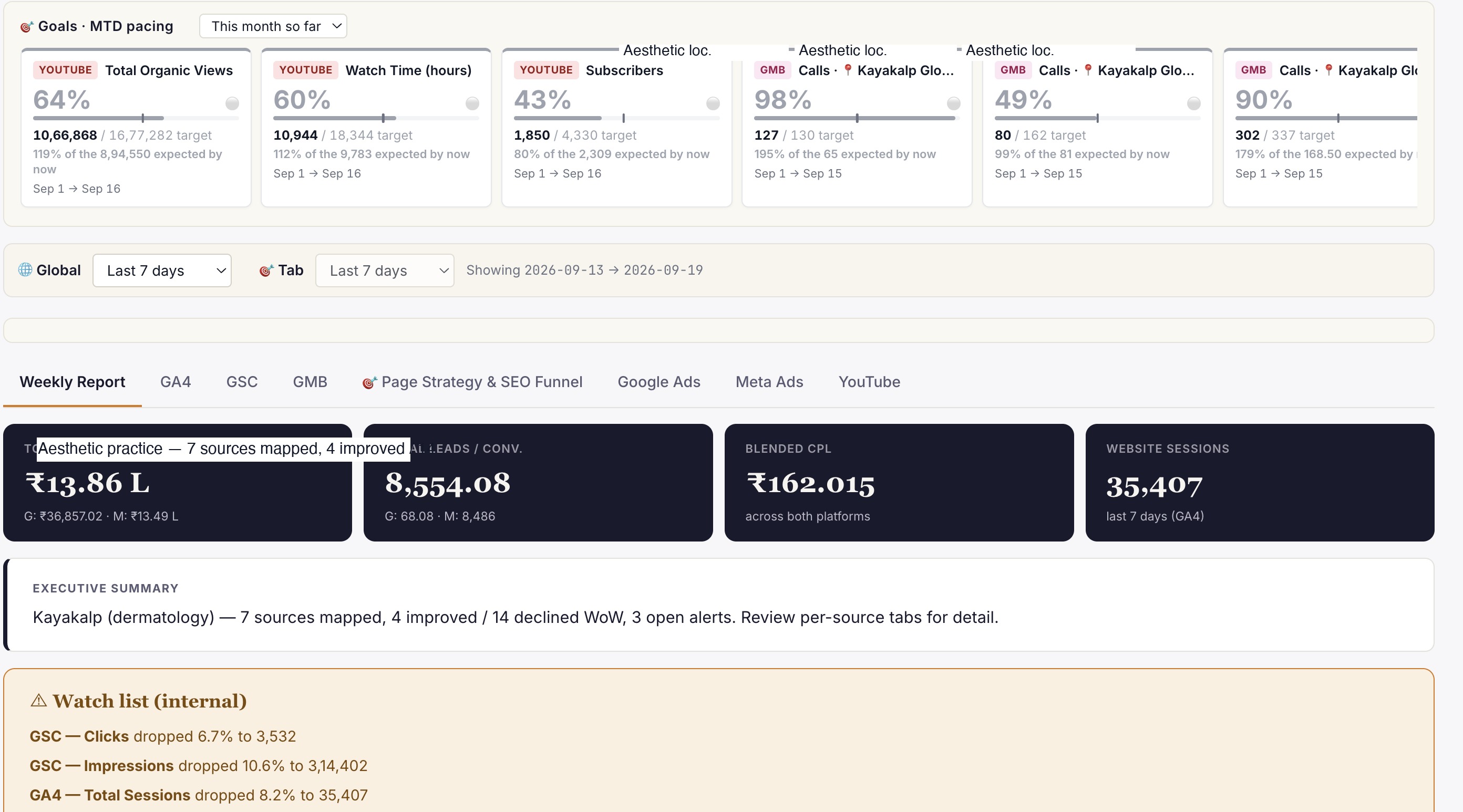
Live client dashboard. GSC, GA4, Google Ads, Meta Ads, IVR calls in one view. Login anytime, not monthly.
Phoenix
Clinic revenue intelligence over your PMS. Daily action queue: Prevent Loss, Maintain & Engage, Grow Revenue. Multi-centre rollout.
Or book a free 30-min audit to see all three in action on your account.
Healthcare brands
that already run on ICG.
A representative slice of the 150+ healthcare brands ICG has delivered for across India. Most engagements remain under NDA.


What ICG clients say · on video.
"Scale up of organic channels and business consulting. ICG has absolute domain authority in their field."
"Working with ICG transformed how we acquire IVF patients in Gurgaon. They understand the fertility journey from inquiry to consult..."
"What Ichelon accomplished — they got all my ideas and worked over 3-4 months to create an amazing, super-customised website."
Need help operationalising this?
Every ICG service is healthcare-only, NMC + DPDP-aware, and built around the patient-research patterns that drive Indian healthcare growth in 2026.
Every practice welcome — packages from ₹20,000/mo.
Goals-Driven engagements · Performance-Linked Payout Models available


More from
ICG.
Five trends shaping Indian healthcare marketing through 2027: AI-first patient research, Conversions API adoption, ABDM discovery, the AEO w...
Healthcare AIO is the discipline of getting your clinic or hospital cited inside Google AI Overviews, ChatGPT and Perplexity answers — not j...
Conversational-search advertising places brand messages inside AI chat answers — ChatGPT, Perplexity, Copilot — rather than beside a results...
Stop guessing.
Book a Diagnostic.
30 minutes. Free. With the AI-powered healthcare-only marketing agency 150+ brands already run on. No slides, no pitch, no hard close.


