


Organic vs Paid YouTube for Medical Brands in India: 2026 Comparison Guide
A feature-based comparison of organic YouTube, paid YouTube ads, and hybrid AI-native approaches for Indian medical brands. Covers 8 axes, CPQL trajectories, NMC/DPDP compliance surface, and category-tier fit for hospitals, IVF chains, dental clinics, and aesthetic groups in 2026.
No pitch. Written root-cause diagnosis. AI-powered, healthcare only.
Direct answer
A feature-based comparison of organic YouTube, paid YouTube ads, and hybrid AI-native approaches for Indian medical brands. Covers 8 axes, CPQL trajectories, NMC/DPDP compliance surface, and category-tier fit for hospitals, IVF chains, dental clinics, and aesthetic groups in 2026...
TL;DR
TL;DR
- Organic YouTube compounds every month; paid YouTube buys immediate reach; the hybrid AI-native tier is what most Indian medical brands actually need in 2026.
- Indian healthcare buyers watch 45-70 minutes of health video per day on mobile YouTube, but paid ad avoidance among treatment researchers is nearly 3x higher than in retail categories.
- The NMC advertising code and the DPDP Act 2023 constrain paid targeting more tightly than organic content, especially for surgical, oncology, IVF, and psychiatry inventories.
- CPQL trajectory: organic-only stacks reach Rs 300-800 per qualified lead by month 9; paid-only stacks tend to sit at Rs 800-1,800 CPQL indefinitely unless creative and landing hygiene are constantly refreshed.
- Category-tier fit: solo clinics start organic-heavy, 100-bed hospitals need hybrid, and multi-city chains need an AI-native organic + paid stack running together with shared creative and shared attribution.
Table of contents
- Why this comparison matters for Indian medical brands in 2026
- The three category tiers we are comparing
- The 8 axes to compare on
- Main comparison table
- Per-axis deep dives
- Which tier fits which Indian healthcare buyer
- How ICG helps as a neutral advisor
- 70-30 pricing model for YouTube and AIO services
- Frequently asked questions
Why this comparison matters for Indian medical brands in 2026
Healthcare marketing directors in India are being pulled in two directions this year. On one side, the CFO wants a paid line item that can be turned up or down each month, tied to inquiries. On the other, the medical director wants trust content that can survive a patient reading three reviews, watching two videos, and asking a WhatsApp question before booking. Both are legitimate. Neither is fully solved by one channel.
YouTube sits at the exact centre of that pull. Indian users on average watch 45-70 minutes of health-adjacent video per day on mobile YouTube, and the platform is now the second most searched health destination in India after generic Google Search. But the shift that most marketers underestimate is that YouTube is now behaving like a decision engine, not just an awareness channel. A patient researching hair transplant, IVF, cardiac stenting, dental implants, or bariatric surgery will watch four to nine videos before shortlisting a clinic. Some of those videos are ads. Most are not.
That behavioural shift is why the organic-versus-paid question needs a real answer, not a slogan. It also needs an India-specific frame. The NMC advertising code, the DPDP Act 2023 consent architecture, ABDM's health ID rails, and the reality that most Indian clinics still book patients over WhatsApp rather than a slick web form all change what "good" looks like on YouTube. A comparison written for a US or European market cannot be lifted and applied.
This guide compares three category tiers on eight axes that matter to Indian healthcare buyers. It is deliberately feature-based, not vendor-based. The point is to help you decide what stack fits your archetype, then choose partners against that decision, not the other way around.
The three category tiers we are comparing
Before we get to the axes, define the tiers clearly. When Indian medical brands say "we should do YouTube", they are almost always pointing at one of three tiers, and confusing the tiers is the single biggest reason budgets get wasted.
Tier A: Organic-first YouTube (SEO + content)
A channel-led approach. The brand publishes doctor explainers, patient education, procedure walk-throughs, and myth-busting videos, all optimised for YouTube search, Suggested, and Shorts distribution. Ranking is earned through watch time, retention, thumbnail click-through, and topical authority. There is no paid spend on the videos themselves. Budget goes into production, thumbnails, editing, SEO metadata, and rank tracking.
Tier B: Paid-first YouTube (in-stream, in-feed, Shorts ads)
A media-buying approach. The brand runs TrueView In-Stream, In-Feed, Bumper, and Shorts ads targeted by intent signals, custom audiences, and geo. Creatives are shorter, benefit-led, and CTA-driven. Budget sits mostly in media spend, with a smaller slice for creative production and landing pages. Reporting is auction-log driven and immediate.
Tier C: Hybrid AI-native stack (organic + paid + retrieval)
An integrated approach where the same content system feeds both organic ranking and paid inventory, and where AI is used inside the workflow, not just at the edges. Scripts are drafted with LLM assistance and reviewed by clinicians. Thumbnails and titles are tested in a structured queue. Retention analytics feed back into next-episode planning. Retrieval-based systems point the same video library at YouTube's organic surface, YouTube Ads, Google AI Overviews, and on-site chat. This is the tier that products like ICG's YODA sit inside, and it is where most mid-market and enterprise healthcare brands are converging in 2026.
The 8 axes to compare on
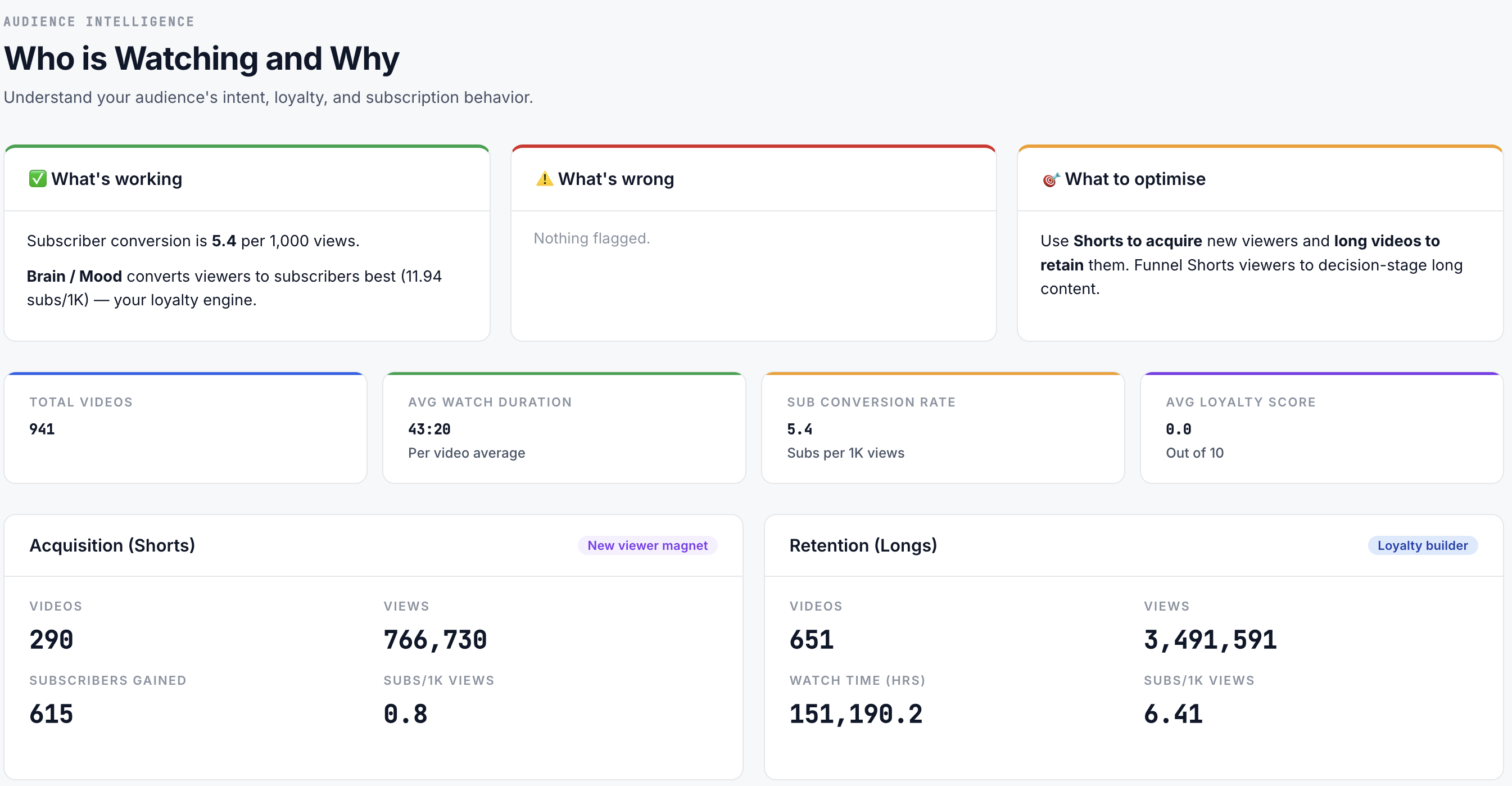
Not every axis matters equally for every buyer. But if a comparison ignores any of these eight, it is not a comparison. It is a pitch.
- Time to first qualified lead
- CPQL trajectory over 12 months
- NMC and DPDP Act compliance surface
- Content asset durability
- Attribution transparency
- Trust signal weight for high-consideration treatments
- Team and talent required to run it
- Scalability across specialties, cities, and languages
Main comparison table
| Axis | Tier A: Organic-first | Tier B: Paid-first | Tier C: Hybrid AI-native |
|---|---|---|---|
| Time to first qualified lead | 60-120 days for the first steady trickle; 6-9 months for reliable pipeline | 7-21 days once creatives and audiences are live | 21-45 days; paid seeds volume, organic locks retention |
| CPQL at month 12 (Indian healthcare benchmark) | Rs 300-800 per qualified lead | Rs 800-1,800 per qualified lead | Rs 400-1,100 blended, with organic pulling the average down each quarter |
| NMC and DPDP Act compliance surface | Low risk when scripts are clinician-reviewed; edits stay under brand control | Higher risk; targeting parameters, promises, and before/after imagery all get audited | Moderate; workflow includes a compliance gate before either surface publishes |
| Content asset durability | 3-5 years of watch time on evergreen clinical explainers | Days to weeks; creative fatigue is the dominant cost driver | Same 3-5 year organic durability plus a paid layer that gets refreshed monthly |
| Attribution transparency | Weak on the last click; strong on assisted and post-view influence | Strong on impression and click; weak on offline WhatsApp and phone conversion | Strongest when UTM discipline, call tracking, and CRM sync are wired end-to-end |
| Trust signal weight for high-consideration treatments | Very high; long-form doctor content is the format Indian patients trust most | Moderate; skip rates on ads are elevated for oncology, IVF, psychiatry, and cardiac categories | Very high; ads act as a discovery layer that hands patients over to organic trust content |
| Team and talent required | In-house or agency editor, scriptwriter, SEO analyst, doctor on-camera coach | Media buyer, creative director, landing page owner, analytics lead | All of the above plus an AI workflow owner, retention analyst, and attribution engineer |
| Scalability across specialties, cities, languages | Excellent once a content system exists; poor if every video is a bespoke shoot | Excellent within the platform; limited by creative production cadence | Highest; the same script and thumbnail system fans out to 8-12 languages and dozens of cities |
Per-axis deep dives
1. Time to first qualified lead
The single question every hospital board asks first. Paid wins on this axis without argument. Once creatives clear the medical review, a well-set up in-stream campaign on YouTube can produce the first inbound WhatsApp inquiry within 7-21 days. Organic-first stacks take longer. Even with strong doctor talent on camera, the first steady trickle of leads from ranked videos typically starts around day 60-90, and reliable, planable pipeline arrives at month 6-9. The hybrid tier is deliberately structured to compress that gap: paid runs first to seed the audience and gather signal, and organic content is engineered to convert that signal into repeat watch time within 21-45 days.
2. CPQL trajectory over 12 months
This is where organic quietly wins the long game. Paid-only YouTube in Indian healthcare tends to stabilise at Rs 800-1,800 per qualified lead depending on specialty, city, and landing page quality. That number does not compound downward on its own. Organic-only stacks start much higher, often north of Rs 3,000 CPQL in months 1-3 because the denominator is small, but they trend toward Rs 300-800 CPQL by month 9-12 as watch time accumulates and Suggested traffic kicks in. The hybrid tier blends the two curves. In our engagements, we typically see a blended Rs 400-1,100 CPQL at month 12, with the organic slice dragging the average down every quarter.
3. NMC and DPDP Act compliance surface
This is where paid-first stacks quietly accumulate risk. The NMC advertising code disallows testimonials that promise cure, misleading before-and-after imagery, and comparative claims against other doctors or hospitals. The DPDP Act 2023 introduces consent obligations around retargeting and audience data. Ad platforms do not enforce these Indian-specific constraints for you. Every targeting set, every creative, and every landing form has to be audited internally. Organic-first stacks carry a lower surface area because scripts are clinician-reviewed, videos are published under the brand's own channel identity, and edits are permanent rather than iterated in an auction. The hybrid tier holds the middle ground when the workflow includes a compliance gate before either surface publishes, which is how the AI-native tier should be operated.
4. Content asset durability
Ask what the asset is worth in year three. A well-produced 8-12 minute doctor explainer on "recovery timeline after knee replacement" or "cost of IVF in India" continues to attract watch time for 3-5 years. It also becomes the URL that AI Overviews cite, that WhatsApp bots retrieve from, and that the sales team sends before a consultation. Paid creatives, by contrast, fatigue within days to weeks in Indian healthcare categories. They are cost, not asset. The hybrid tier is the only one that gives you both: the paid layer is treated as a monthly refresh line, while the organic library keeps compounding underneath it.
5. Attribution transparency
Every tier lies to you a little. Paid gives you strong impression and click data but almost nothing on the WhatsApp message that arrives three days later. Organic gives you excellent post-view influence data inside YouTube Studio but almost no last-click signal. The hybrid tier is the only one that closes the loop, but only if you invest in the plumbing: consistent UTM tagging, call tracking numbers per campaign, a CRM that can accept a "video watched" event as a lead source, and a monthly review cadence that treats attribution as an editorial decision, not just an analytics one. A CRM built for Indian healthcare workflows, such as AtomCRM at Rs 14,999 per month, makes this loop practical for most 20-100 bed hospitals.
6. Trust signal weight for high-consideration treatments
The higher the ticket size and the higher the emotional stakes, the more organic wins. Oncology, IVF, cardiac stenting, spinal surgery, bariatrics, and psychiatric care all show elevated skip rates on paid inventory in India. Patients researching these categories skip ads faster and treat mid-roll interruption more negatively than they do in retail. Long-form organic content, especially with the same doctor appearing across the library, is the format Indian patients trust most before a high-consideration decision. Paid is not useless here. It works as a discovery layer that hands patients over to organic trust content, which is exactly the play the hybrid tier is designed to run.
7. Team and talent required
Do not underestimate this. An organic-only YouTube programme still needs a scriptwriter, a doctor-on-camera coach, an editor, a thumbnail designer, and an SEO analyst tracking retention and Suggested distribution. A paid-only programme needs a media buyer, a creative director, a landing page owner, and an analytics lead. The hybrid tier needs all of the above plus an AI workflow owner who governs the LLM-assisted script drafting and thumbnail testing, a retention analyst, and an attribution engineer. Most 100-bed hospitals cannot hire that whole stack in-house, which is why hybrid is almost always run through an agency partnership rather than built from scratch.
8. Scalability across specialties, cities, and languages
India is not one market. A hospital chain running in Chennai, Ahmedabad, Kochi, and Guwahati needs Tamil, Gujarati, Malayalam, and Assamese cuts of the same script. An IVF chain needs a fertility-specialist library that also branches into endometriosis, PCOS, and male-factor infertility content. Organic-first can scale if the content system is real, meaning shared scripts, shared thumbnails, shared SEO templates. Paid scales easily inside the platform, but not faster than the creative team can produce fresh variants. The hybrid tier scales best because AI-assisted workflows compress the script-to-shoot cycle from four weeks to under one, and the same asset library feeds both surfaces.
Which tier fits which Indian healthcare buyer
Category tiers do not fit buyers evenly. Here is how the four most common Indian healthcare buyer archetypes should think about the choice.
Archetype 1: Single dental clinic in a metro
Monthly marketing budget of Rs 40,000 to Rs 90,000. One or two dentists, no in-house marketing team. The right starting tier is Organic-first, with a small paid experiment in month four once there are 20-30 videos live. Doing paid-first at this budget almost always produces disappointing CPQLs because the campaign never accumulates enough signal to optimise. A single dental clinic should invest in doctor-on-camera confidence, five to seven evergreen procedure explainers, and consistent Shorts cadence before touching paid.
Archetype 2: 100-bed multi-speciality hospital in a Tier-2 city
Monthly marketing budget of Rs 4-8 lakh across channels. The right tier is Hybrid AI-native. A hospital of this size cannot afford to wait 9 months for organic to bear pipeline, but paid-only stacks will hit compliance walls and CPQL ceilings within two quarters. The hybrid tier lets the hospital run three or four flagship specialty pillars, such as cardiology, ortho, oncology, and IVF, on organic while paid buys immediate reach for the campaigns the marketing head has to defend to the board this quarter. Pair this with an EHR overlay such as HealthPro 360 at Rs 14,999 per month so the WhatsApp lead becomes a scheduled OPD and the loop is closed.
Archetype 3: Mid-tier IVF chain, 5-15 centres
Monthly marketing budget of Rs 8-25 lakh. Almost always Hybrid AI-native, and this is where the tier earns its highest ROI. IVF has long research cycles, elevated ad skip rates, high ticket size, and geographic sensitivity. Organic content in five to eight Indian languages, retained on a channel that publishes weekly, becomes the single strongest lead source by month 12. Paid runs underneath as a discovery layer for new centre launches and city expansion. Anything less than hybrid leaves either compounding value or immediate volume on the table.
Archetype 4: Aesthetic or dermatology chain with 10-30 clinics
Monthly marketing budget of Rs 10-30 lakh. Hybrid, but with a paid tilt. Aesthetic categories have shorter research cycles than IVF, higher tolerance for paid inventory, and much sharper seasonality around weddings and festivals. The hybrid tier still wins because organic content protects trust and manages the NMC compliance surface, but the paid layer takes a larger share of budget month to month. Chains at this size should also invest in a competitive intelligence layer such as Prism Spy so paid creative iteration is informed by what is actually working in the category.
How ICG helps as a neutral advisor

Ichelon Consulting Group runs healthcare marketing programmes for 300+ live clients across India, including 150+ clinics, hospitals, and specialty chains. Our position on organic-versus-paid YouTube is not a preference. It is a diagnosis. We map your specialty mix, ticket size, geographic footprint, current channel maturity, and clinician bandwidth against the eight axes above, then recommend a tier and a phased rollout. We build organic through structured content systems, we run paid through Meta Catalyst IQ and YouTube Ads, and we operate the hybrid tier through YODA, our AI-native YouTube stack. Because we own the full stack across organic, paid, and AI surfaces, the recommendation you get is not skewed toward the service that pays us more this month. It is skewed toward the tier that produces the CPQL your board will approve twelve months from now.
70-30 pricing model for YouTube and AIO services

ICG's YouTube and AI Overview optimisation engagements follow the same 70-30 structure as our SEO packages. Seventy percent of the monthly fee is fixed and covers scripting, production support, publishing, SEO metadata, retention analytics, and monthly review. Thirty percent is tied to a twelve-month organic and AIO visibility target on a sliding-scale slab, so upside is shared and downside is limited. YouTube and AIO engagements begin at Rs 50,000 per month for foundation-scale programmes. Google Ads and YouTube Ads media-management engagements follow the same 70-30 structure for media budgets from Rs 5,00,000 per month upward. For services that are almost entirely fixed workflow, such as AtomCRM at Rs 14,999 per month and HealthPro 360 at Rs 14,999 per month, the pricing is flat and independent of media spend so the buyer knows exactly what the operating layer costs before the marketing layer scales.
Frequently asked questions
Is organic YouTube enough on its own for a hospital in India in 2026?
For a 20-40 bed clinic in a single city with patient acquisition targets under 300 inquiries a month, yes. For a 100-bed hospital or any multi-city chain, no. The board will not tolerate a 6-9 month lead time before reliable pipeline. Hybrid is the honest recommendation at that scale.
How much should a mid-tier IVF chain spend on YouTube monthly?
Between Rs 3 lakh and Rs 12 lakh depending on the number of centres and the number of Indian languages the content library covers. Split the budget roughly 55-60 percent organic production and management, 35-40 percent paid media, 5 percent on retention and attribution tooling.
Does the NMC advertising code apply to YouTube content?
Yes. It applies to any promotional communication by a registered medical practitioner or a hospital, and YouTube counts. Organic explainers that are clinician-reviewed and framed as education generally have a much lower compliance surface than paid ads that make outcome claims. This is one of the most important reasons Indian healthcare should not run paid YouTube without a compliance gate.
What does DPDP Act 2023 change for paid YouTube targeting?
Consent obligations around retargeting pools, custom audiences built from patient lists, and remarketing to visitors of clinical URLs all tighten under DPDP. Practically, healthcare advertisers need documented consent for any audience list uploaded to an ad platform, clear opt-out flows, and shorter retention windows. Organic YouTube distribution is unaffected by DPDP because it does not depend on personal data uploads.
How is the hybrid AI-native tier different from just running organic and paid separately?
Two things. First, the same content system feeds both surfaces, so scripts, thumbnails, retention insights, and topical clusters compound instead of running as parallel workstreams. Second, AI is used inside the workflow to compress the script-to-shoot cycle, test thumbnails at scale, and route retention data back into next-episode planning. That is what separates the AI-native tier from a spreadsheet that tracks two channels.
What is a realistic CPQL to plan against in the first six months?
For paid-only, plan against Rs 1,200-2,000 per qualified WhatsApp inquiry in months 1-3, trending toward Rs 800-1,500 by month 6. For organic-only, expect CPQL to be uneconomic in months 1-3 because the denominator is small, then to drop below Rs 1,000 by month 6-7. For the hybrid tier, plan against a blended Rs 900-1,400 CPQL in months 1-3, trending toward Rs 500-900 by month 6.
Do YouTube Shorts count as organic or paid?
Both. Organic Shorts are a distribution surface that compounds separately from long-form and is currently the fastest way to grow a healthcare channel from zero. Paid Shorts are a separate ad inventory inside YouTube Ads. In the hybrid tier the two are planned together because a Shorts hook that performs organically almost always outperforms a bespoke paid Short.
How do we handle Indian-language content across cities without exploding cost?
Anchor on a shared English script for each episode, then produce regional-language cuts through a script-translation-and-reshoot workflow rather than fresh scripting per language. AI-assisted translation of scripts, thumbnails, and metadata brings the marginal cost of the eighth language cut close to the marginal cost of the second. This is one of the specific reasons Indian multi-city healthcare brands cluster around the hybrid AI-native tier.
Should we build a YouTube team in-house or work with an agency?
For organic-only at solo-clinic scale, one in-house content lead plus a freelance editor works. For hybrid at hospital or chain scale, an agency partnership is almost always more efficient in year one and year two because the specialist stack, meaning AI workflow, retention analyst, attribution engineer, compliance reviewer, media buyer, and creative director, is expensive to hire and hard to retain in-house. Revisit in-housing in year three once the system is stable.
How do we measure whether the organic side of a hybrid engagement is working?
Watch three numbers monthly. First, average view duration on evergreen doctor explainers, which should climb quarter over quarter. Second, share of channel traffic from Search and Suggested combined, which should cross 60 percent by month 9. Third, direct-to-brand WhatsApp inquiries where the patient references a video by name, which should become a documentable share of monthly inquiries by month 6. If those three trend right, the organic layer is doing its job even if the last-click attribution is noisy.
Book a free 30-minute Brand & Growth Diagnostic.
It's a working session, not a sales pitch — you leave with a written root-cause analysis you can act on, whether or not you engage ICG.
Questions readers ask
about this topic.
The three platforms
behind every ICG engagement.
Beacon
CAPI middleware that fixes Event Match Quality, translates CRM statuses to Meta-standard events, dedups across channels.
Agency OS
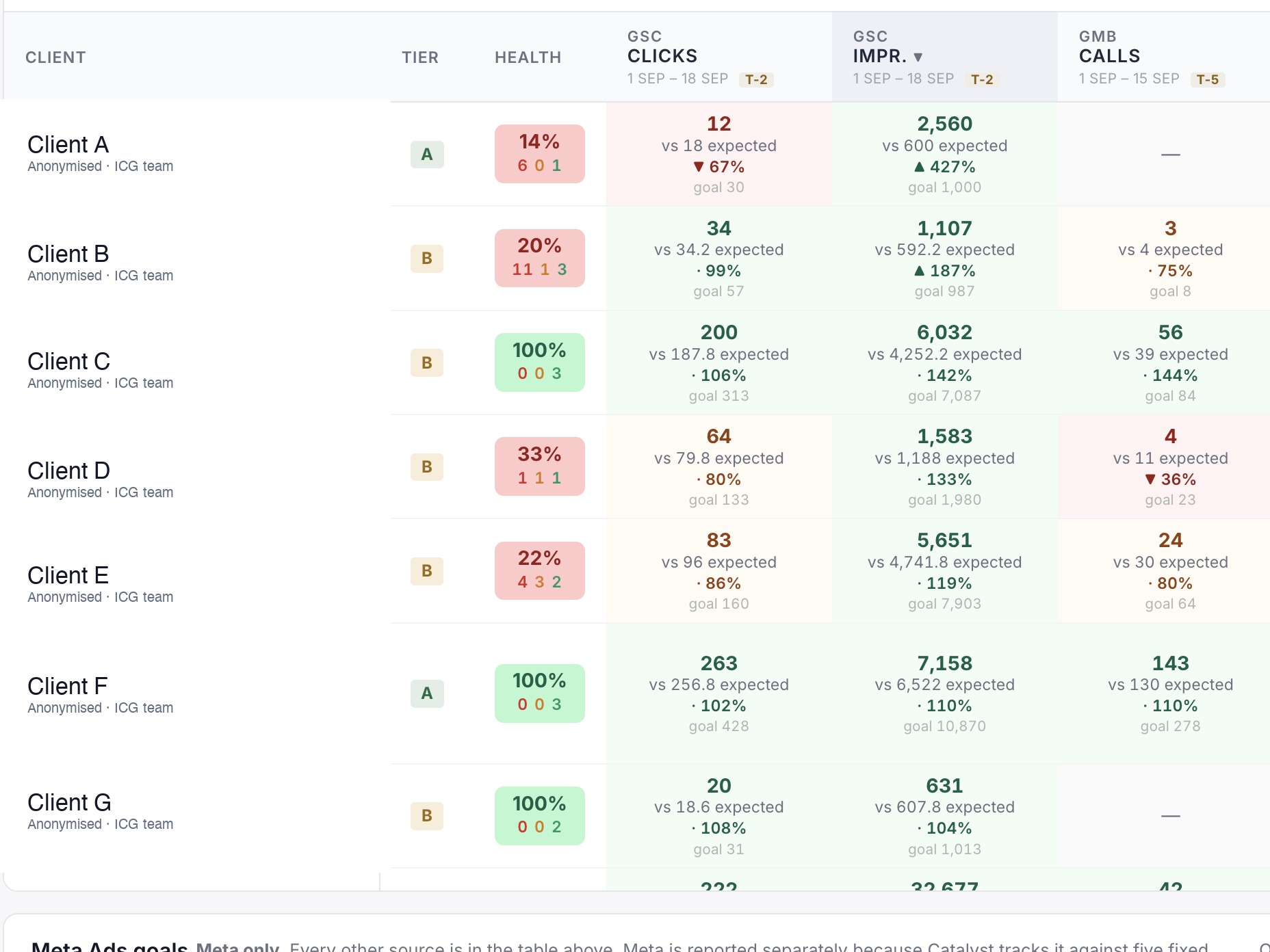
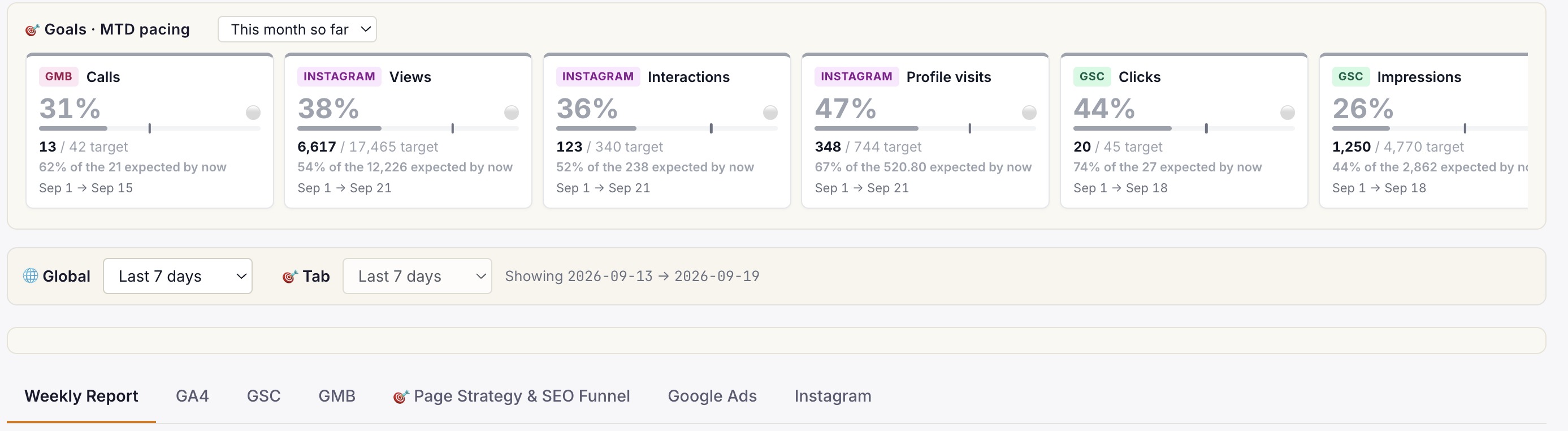
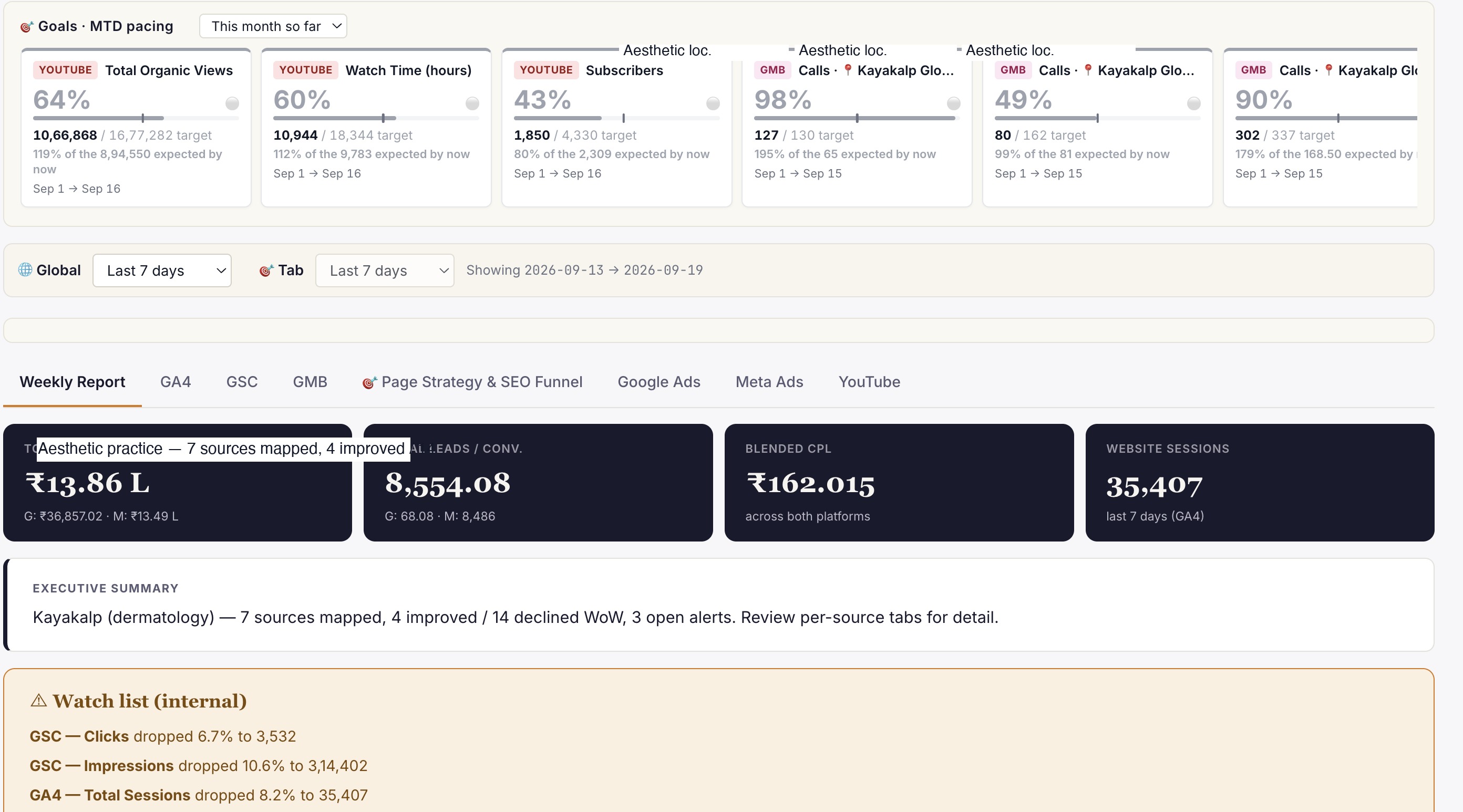
Live client dashboard. GSC, GA4, Google Ads, Meta Ads, IVR calls in one view. Login anytime, not monthly.
Phoenix
Clinic revenue intelligence over your PMS. Daily action queue: Prevent Loss, Maintain & Engage, Grow Revenue. Multi-centre rollout.
Or book a free 30-min audit to see all three in action on your account.
Healthcare brands
that already run on ICG.
A representative slice of the 150+ healthcare brands ICG has delivered for across India. Most engagements remain under NDA.


What ICG clients say · on video.
"Scale up of organic channels and business consulting. ICG has absolute domain authority in their field."
"Working with ICG transformed how we acquire IVF patients in Gurgaon. They understand the fertility journey from inquiry to consult..."
"What Ichelon accomplished — they got all my ideas and worked over 3-4 months to create an amazing, super-customised website."
Need help operationalising this?
Every ICG service is healthcare-only, NMC + DPDP-aware, and built around the patient-research patterns that drive Indian healthcare growth in 2026.
Every practice welcome — packages from ₹20,000/mo.
Goals-Driven engagements · Performance-Linked Payout Models available
More from
ICG.
Five trends shaping Indian healthcare marketing through 2027: AI-first patient research, Conversions API adoption, ABDM discovery, the AEO w...
Healthcare AIO is the discipline of getting your clinic or hospital cited inside Google AI Overviews, ChatGPT and Perplexity answers — not j...
Conversational-search advertising places brand messages inside AI chat answers — ChatGPT, Perplexity, Copilot — rather than beside a results...
Stop guessing.
Book a Diagnostic.
30 minutes. Free. With the AI-powered healthcare-only marketing agency 150+ brands already run on. No slides, no pitch, no hard close.


