


Long-Form vs Shorts for Medical YouTube India: Which Format Works When
A feature-based buyer guide for hospitals, clinics, and IVF chains choosing between long-form medical YouTube, Shorts, and hybrid playlist strategies in India, with a comparison table, per-axis deep dives, and buyer archetypes.
No pitch. Written root-cause diagnosis. AI-powered, healthcare only.
Direct answer
A feature-based buyer guide for hospitals, clinics, and IVF chains choosing between long-form medical YouTube, Shorts, and hybrid playlist strategies in India, with a comparison table, per-axis deep dives, and buyer archetypes.
TL;DR
TL;DR
- Long-form (8-20 minutes) wins on trust, search, AI Overview extraction, and appointment-driving intent for high-consideration procedures like IVF, oncology, cardiac, and complex dental work.
- Shorts (under 60 seconds) wins on subscriber growth, doctor recall, and cheap top-of-funnel reach, but rarely produces measurable appointment volume on its own.
- Hybrid playlist-anchored strategies outperform either format alone for Indian hospitals with 50 to 300 beds, mid-tier IVF chains, and multi-specialty groups.
- Compliance load is higher for Shorts under NMC advertising norms and the DPDP Act 2023, because the format rewards bold claims and clips get remixed faster than consent can be scoped.
- Realistic monthly budgets range from Rs 25,000 for Shorts-only to Rs 2.5 lakh for long-form-heavy programmes with surgical b-roll, before ad spend.
Table of Contents
- Why this comparison matters for Indian healthcare buyers
- The eight axes to compare on
- Main comparison table
- Discovery mechanics and algorithm behaviour
- Trust building and E-E-A-T signals
- Production cost and doctor time in INR
- DPDP Act 2023 and NMC advertising compliance surface
- Search and AI Overview visibility
- Lead attribution and funnel role
- Repurposing and content multiplication
- Long-term compounding versus short-term reach
- Which format fits which buyer
- How ICG helps as a neutral advisor
- The 70-30 pricing model for YouTube programmes
- Frequently asked questions
Why this comparison matters for Indian healthcare buyers
Every healthcare marketing head in India walks into 2026 with the same knot in their stomach. The board wants proof that YouTube is worth the doctor time. The paid ads budget is under pressure because Meta CPMs keep drifting up. Google search is being reshaped by AI Overviews. And somewhere in the middle of that noise sits a real question that nobody wants to answer plainly: are we shooting long educational videos, are we shooting Shorts, or are we doing both, and if both, in what ratio.
The answer is not the same for a 60-bed cosmetic dental practice in Pune as it is for a 240-bed multi-specialty hospital in Hyderabad or a five-centre IVF chain across South India. And the cost of choosing wrong is not theoretical. We have watched hospitals burn 14 months and Rs 22 lakh producing polished long-form videos that nobody found, because the channel had no Shorts velocity feeding the algorithm. We have also watched clinics rack up 40,000 subscribers on viral myth-busting Shorts and then wonder why their appointment book looks exactly the same as the day they started.
The Indian healthcare market has three constraints that make this format decision harder than it looks abroad. First, doctor availability is genuinely scarce, especially in the top three specialties any hospital wants to promote. Every hour of a cardiologist or an IVF consultant on camera has a real opportunity cost measured in patients not seen. Second, the compliance perimeter is tightening. The Digital Personal Data Protection Act of 2023 has made patient consent for video content a written, purpose-specific, revocable process. The National Medical Commission continues to enforce restrictions on self-promotion, guaranteed outcomes, and superlative language. Third, the buyer research pattern in Indian healthcare is unusually long. Prospective IVF patients research for two to five months. Cardiac surgery families spend three to eight weeks reading and watching before they walk into a consultation. That research window rewards a certain kind of content and punishes another.
This guide walks through the actual features and mechanics of long-form video, Shorts, and hybrid playlist strategies so a marketing director, a hospital administrator, a clinic owner, or an agency evaluator can decide which mix fits their situation. It compares categories and approaches, never named vendors or channels, and grounds every recommendation in Indian regulatory, pricing, and buyer-behaviour reality.
The eight axes to compare on
Before any comparison is meaningful, the axes have to be named. Most format debates online collapse because people are arguing about different things without saying so. One person is talking about reach, another about credibility, a third about cost, and none of them have listed the trade-offs cleanly. Here are the eight axes that actually matter for a serious healthcare YouTube programme in India.
- Discovery mechanics and algorithm behaviour: how the platform surfaces the format, who sees it, and how quickly reach decays.
- Trust building and E-E-A-T signals: whether the format can carry the expertise, experience, authoritativeness, and trustworthiness signals that medical content requires.
- Production cost and doctor time in INR: the real all-in cost per finished asset, including scripting, filming, editing, thumbnails, captioning, and QA.
- DPDP Act 2023 and NMC advertising compliance surface: how much regulatory risk the format introduces per unit of content.
- Search and AI Overview visibility: whether the format ranks in Google search, appears in video carousels, or gets cited in AI-generated answers.
- Lead attribution and funnel role: whether the format can be measured, and where it sits in the appointment journey.
- Repurposing and content multiplication: how well one shoot yields many downstream assets across web, WhatsApp, Meta, and email.
- Long-term compounding versus short-term reach: whether the asset keeps working after month six, or dies at week two.
Main comparison table
| Axis | Long-form educational (8 to 20 min) | Shorts (under 60 sec) | Hybrid playlist-anchored |
|---|---|---|---|
| Discovery mechanics | Subscriber feed, search results, suggested videos, session-based recommendation | Shorts shelf, algorithmic swipe feed, low subscriber dependence | Both surfaces, with Shorts feeding subscribers into long-form via end screens and pinned comments |
| E-E-A-T strength | High. Room for credentials, sourcing, case discussion, and doctor tone | Low to moderate. Format compresses nuance and rewards claims over caveats | High. Long-form carries authority, Shorts carry personality |
| Cost per asset (INR) | Rs 12,000 to Rs 60,000 depending on b-roll and doctors | Rs 1,500 to Rs 6,000 if batched from raw footage | Rs 45,000 to Rs 1.2 lakh per publishing week |
| Doctor time per asset | 45 to 120 minutes of camera plus 30 minutes of review | 3 to 8 minutes if batched, 15 to 25 if standalone | Structured monthly block of 3 to 5 hours per specialty |
| DPDP and NMC risk load | Moderate. Long context reduces misinterpretation, but patient consent scope must include YouTube plus embeds | High. Remix, reshare, and out-of-context clipping expand consent risk; bold hooks tempt NMC violations | Moderate. Compliance review is unified across both formats before publish |
| Search and AIO visibility | Strong. Chapters, transcripts, and schema pull into video carousels and AI Overviews | Weak. Rarely surface in web search or answer engines for high-intent queries | Strong. Long-form does the search lifting, Shorts do the recall lifting |
| Lead attribution | Trackable via UTM links in descriptions, pinned comments, end screens, and cards | Weak. Limited link real estate, low click-through, high anonymous view volume | Strong. Shorts drive subscribers who convert via long-form UTM links |
| Repurposing yield | One shoot yields 4 to 8 Shorts, 2 to 3 web embeds, 1 WhatsApp broadcast, 2 email pieces | One shoot yields the Short only, unless raw footage is retained | Highest. Every long-form shoot is planned as a Shorts factory from day one |
| Compounding behaviour | Assets keep earning views 12 to 36 months after publish | 90 percent of lifetime views arrive within 14 days | Long-form compounds, Shorts refresh the top of funnel monthly |
Discovery mechanics and algorithm behaviour
Long-form videos and Shorts do not share a discovery engine. Long-form lives in the browse feed, the subscriber feed, YouTube search, and suggested videos on the right rail. It rewards session watch time, so a viewer who watches your video and then keeps watching related content signals to the algorithm that your video is a good session starter. Shorts live in a swipe feed that is almost entirely algorithmic. Subscribers matter less. What matters is the swipe-through rate, the loop rate, and the share rate in the first two hours.
The practical consequence for Indian healthcare channels is that a Shorts-heavy strategy will grow subscribers faster in the first ninety days but will not necessarily grow the kind of subscribers who watch long educational videos later. If your goal is a subscriber base that consumes structured content, you need long-form running alongside Shorts from month one. If your goal is broad brand recall for a doctor or a hospital name, Shorts alone can get you there.
Trust building and E-E-A-T signals
Medical content sits under Google and YouTube's Your Money or Your Life category. That means every ranking and recommendation system on both platforms weights expertise, experience, authoritativeness, and trustworthiness heavily. Long-form gives you the space to name the doctor, show credentials, cite guidelines, discuss cases with appropriate caveats, and let a consultant's actual clinical voice come through. Shorts compress all of that into a hook, a claim, and a call to action. Even a well-produced Short cannot carry the same E-E-A-T load as a structured long-form video with chapters, sources, and a full-body reasoning arc.
For high-stakes specialties, the trust gap is decisive. A prospective IVF patient will not book a consultation on the strength of a 45-second myth-busting Short. They will book after watching a 12-minute video where a consultant explains the workup, the honest success rates by age band, and what the first month of protocol looks like.
Production cost and doctor time in INR
Cost conversations in Indian healthcare marketing get vague fast. Here are grounded ranges from actual client programmes across the last 18 months, in Indian rupees, all-in, before ad spend.
A polished long-form video with a single doctor, one location, minimal b-roll, professional editing, chapters, thumbnails, and captions costs Rs 12,000 to Rs 25,000 per finished asset. Add surgery b-roll, multi-camera setup, animation, or two doctors, and the number moves to Rs 30,000 to Rs 60,000. Batching four to six videos in a single shoot day reduces per-asset cost by 30 to 45 percent.
Shorts produced from raw footage of long-form shoots cost Rs 1,500 to Rs 3,000 per Short in editing time alone. Standalone Shorts that require their own shoot cost Rs 4,000 to Rs 6,000 including doctor scheduling. Doctor time is the real constraint. A cardiologist earning Rs 25,000 to Rs 45,000 per outpatient day has a genuine opportunity cost for every camera hour, and that cost has to be modelled honestly.
A serious mid-market hospital programme with two long-form videos a month and eight to twelve Shorts a month lands between Rs 60,000 and Rs 1.8 lakh in monthly production cost, plus channel management, thumbnails, publishing, and reporting.
DPDP Act 2023 and NMC advertising compliance surface
The compliance load differs sharply between the two formats. The DPDP Act 2023 classifies patient audio and video as personal data, and health data attracts a higher standard of consent. Every patient testimonial, every clinical footage snippet, and every recognisable face requires written, informed, purpose-specific consent naming YouTube and any embed surfaces as distribution channels. The consent must include a withdrawal mechanism.
Shorts increase risk because clips get downloaded, remixed, resurfaced on other platforms, and used out of context faster than any hospital can respond. The National Medical Commission's advertising code adds another layer. Registered medical practitioners are prohibited from self-promotion, superlative claims, guaranteed outcomes, and comparative testimonials of the "best in city" variety. The short-hook, high-claim, quick-payoff format that performs well on Shorts is exactly the format that tempts violations. Most compliant hospitals we work with restrict Shorts to doctor-only monologues, myth-busting, and recovery guidance, and keep patient stories in long-form where context and caveats are preserved.
Search and AI Overview visibility
Long-form videos surface in Google search results, appear in video carousels, and increasingly get cited in AI Overviews for informational queries. That happens when the video has proper chapters, a structured transcript, a description that answers the query in the first 150 characters, and video schema on the page where it is embedded. Shorts almost never appear in Google search results or AI Overviews for high-intent queries. They live inside the YouTube app and the Shorts shelf.
For a hospital, this matters because search-driven appointment enquiries usually start with a specific query. Someone in Bengaluru types the name of a procedure and a city. If your long-form video is chaptered, transcribed, and embedded on a matching money page on your website, it can appear in the video carousel and get pulled into an AI Overview citation. A Short cannot do that job. This is why our YouTube AI-native product, YODA, is built around a long-form-first structure with Shorts as a downstream layer, not the other way around.
Lead attribution and funnel role
Attribution on YouTube is imperfect for every format, but long-form has more surface to work with. Description links, pinned comments, end screens, and cards can carry UTM-tagged URLs. When a viewer clicks through and eventually books an appointment, the CRM can attribute the source. On Shorts, the link real estate is smaller, the click-through rate is lower, and the anonymous view volume is much higher. A Shorts-heavy channel will show impressive impression and view numbers while the CRM shows almost no traceable YouTube-sourced enquiries.
The right way to think about it is functional. Shorts are a top-of-funnel awareness layer that grow subscribers and doctor recall. Long-form is a mid-funnel consideration layer that answers real questions and drives web visits. The two together, with proper UTM discipline in every long-form description, is how a channel starts contributing to the appointment book.
Repurposing and content multiplication
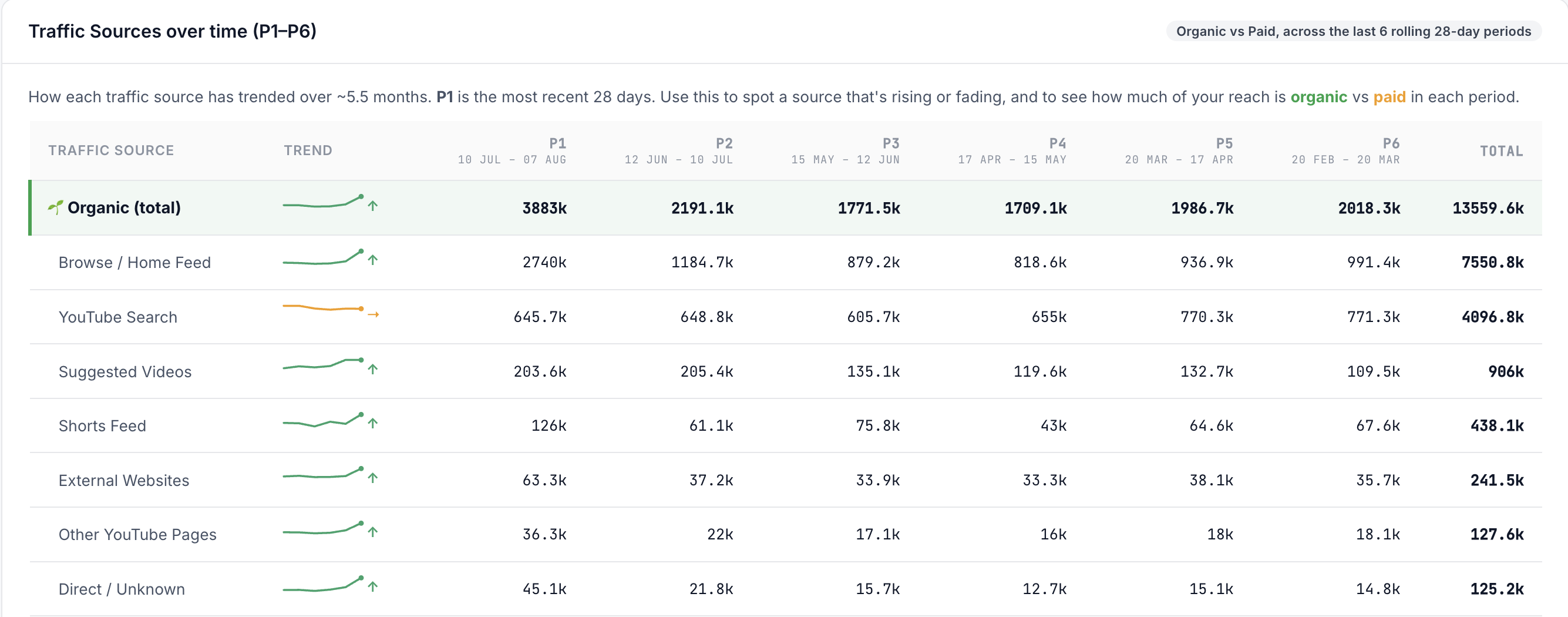
The economics of a YouTube programme change once you plan every long-form shoot as a Shorts factory. A 14-minute long-form video, shot with clean audio and one B-camera capturing tighter framing, can yield four to eight vertical Shorts, two or three homepage and money-page embeds, one WhatsApp broadcast clip, and material for two email newsletter sends. That multiplication is where the ROI on doctor time actually comes from.
A Shorts-only strategy has almost no repurposing yield. The clip is the deliverable. If the raw footage was not planned for reuse, there is nothing to cut down or expand into. This is why hybrid programmes almost always outperform either pure format for hospitals that can invest in even a modest production process.
Long-term compounding versus short-term reach
A long-form medical explainer on a well-optimised channel keeps earning views for 18 to 36 months. We have client videos published in early 2024 that still drive appointment enquiries in 2026. Shorts do not compound. Roughly 90 percent of a Short's lifetime views arrive in the first 14 days, and the tail is negligible.
The strategic implication is straightforward. If you stop producing for a month, a long-form-heavy channel keeps sending traffic. A Shorts-only channel goes cold within three weeks. Long-form is the asset class. Shorts are the flow.
Which format fits which buyer
Single dental clinic in a Tier-2 city
A solo or two-chair dental clinic with limited doctor time and a monthly marketing budget under Rs 40,000 should start Shorts-heavy. Fourteen to twenty Shorts a month batched from two half-day shoots, one long-form video a month explaining a signature procedure, and playlist structuring around the top three services. The goal is recognisable doctor recall in a 5 km radius, backed by one solid piece of long-form content that anchors search and answers the "cost of this procedure in my city" query.
100 to 300 bed multi-specialty hospital
Mid-sized hospitals need hybrid, with a bias to long-form for the top three service lines. A workable cadence is two long-form videos per month per priority specialty, plus eight to twelve Shorts across the channel. Compliance review must be centralised. Doctor scheduling should be blocked in production days rather than scattered across the month. Web-side embeds of long-form on the matching service pages, with video schema, are where most of the search value comes from.
Mid-tier IVF chain with 3 to 8 centres
IVF is a long-consideration, high-emotion category. Long-form is doing 70 percent of the work. Two long-form videos per centre per month, structured around specific chapters for cost, timeline, eligibility, and the honest success-rate conversation by age band. Shorts play a supporting role for myth-busting, doctor recall, and recovery guidance. Patient testimonials always long-form, with DPDP-scoped consent that names YouTube and embed surfaces.
Solo cosmetic dermatologist in a metro
A metro cosmetic practice with a personal-brand doctor benefits from a Shorts-forward strategy for growth, backed by a monthly long-form piece that goes deep on one procedure or one myth. The doctor's personality is the moat, and Shorts are the format that carries personality. Long-form is the format that converts. Compliance rigour on NMC self-promotion norms is especially important in this segment because the temptation to over-claim is high.
How ICG helps as a neutral advisor
Ichelon Consulting Group works with 300+ live healthcare clients across dental, IVF, hospitals, aesthetics, and specialty clinics. We are format-agnostic and vendor-neutral. Our YouTube AI-native product, YODA, is designed around long-form as the anchor asset and Shorts as the downstream layer, but we tune the ratio for every client based on doctor availability, specialty, buyer research pattern, and compliance appetite. Our Meta Catalyst IQ engine handles paid amplification when a video needs to reach beyond organic. Angryturtle keeps the Google Business Profile side compounding. AtomCRM tracks the appointment enquiries that come through with proper UTM discipline, so the marketing team can show the board a real attribution picture instead of a vanity view count. For hospitals running a full digital operation, HealthPro 360 handles the RCM and EHR overlay so the marketing pipeline connects cleanly to the operational one.
The 70-30 pricing model for YouTube and AIO programmes
ICG's YouTube SEO and AIO service packages start at Rs 50,000 per month and follow our 70-30 pricing model. Seventy percent of the fee is fixed, covering the production plan, publishing rhythm, compliance review, schema, and reporting. Thirty percent is tied to a 12-month performance target on a sliding-scale slab. If the channel hits the growth or enquiry target, the variable fee lands at the higher slab. If it underperforms, the variable fee drops. Foundation, Growth, and Scale tiers exist to match cadence and specialty depth to the size of the practice, mirroring the same 70-30 logic that runs our SEO packages at Rs 49,999, Rs 74,999, and Rs 99,999 per month, and our Google Ads engagements above Rs 5 lakh in monthly spend. This is how we keep incentives honest.
Frequently asked questions

The FAQ pairs are available above the fold in structured form for scanning. If your specific situation is not covered, the fastest path to a real answer is a 20-minute conversation with our healthcare YouTube team. We will look at your channel, your specialty mix, your doctor availability, and your compliance appetite, and tell you which format ratio fits, before we quote anything.
Book a free 30-minute Brand & Growth Diagnostic.
It's a working session, not a sales pitch — you leave with a written root-cause analysis you can act on, whether or not you engage ICG.
Questions readers ask
about this topic.
The three platforms
behind every ICG engagement.
Beacon
CAPI middleware that fixes Event Match Quality, translates CRM statuses to Meta-standard events, dedups across channels.
Agency OS
Live client dashboard. GSC, GA4, Google Ads, Meta Ads, IVR calls in one view. Login anytime, not monthly.
Phoenix
Clinic revenue intelligence over your PMS. Daily action queue: Prevent Loss, Maintain & Engage, Grow Revenue. Multi-centre rollout.
Or book a free 30-min audit to see all three in action on your account.
Healthcare brands
that already run on ICG.
A representative slice of the 150+ healthcare brands ICG has delivered for across India. Most engagements remain under NDA.


What ICG clients say · on video.
"Scale up of organic channels and business consulting. ICG has absolute domain authority in their field."
"Working with ICG transformed how we acquire IVF patients in Gurgaon. They understand the fertility journey from inquiry to consult..."
"What Ichelon accomplished — they got all my ideas and worked over 3-4 months to create an amazing, super-customised website."
Need help operationalising this?
Every ICG service is healthcare-only, NMC + DPDP-aware, and built around the patient-research patterns that drive Indian healthcare growth in 2026.
Every practice welcome — packages from ₹20,000/mo.
Goals-Driven engagements · Performance-Linked Payout Models available



More from
ICG.
Five trends shaping Indian healthcare marketing through 2027: AI-first patient research, Conversions API adoption, ABDM discovery, the AEO w...
Healthcare AIO is the discipline of getting your clinic or hospital cited inside Google AI Overviews, ChatGPT and Perplexity answers — not j...
Conversational-search advertising places brand messages inside AI chat answers — ChatGPT, Perplexity, Copilot — rather than beside a results...
Stop guessing.
Book a Diagnostic.
30 minutes. Free. With the AI-powered healthcare-only marketing agency 150+ brands already run on. No slides, no pitch, no hard close.


