


Instagram Analytics Tool Categories for Medical India: A Buyer's Guide
A neutral, category-first comparison of Instagram analytics tools for Indian hospitals, clinics, IVF chains, and pharma D2C brands — with eight axes, an eight-column table, price bands in rupees, and buyer archetypes mapped to tiers.
No pitch. Written root-cause diagnosis. AI-powered, healthcare only.
Direct answer
A neutral, category-first comparison of Instagram analytics tools for Indian hospitals, clinics, IVF chains, and pharma D2C brands — with eight axes, an eight-column table, price bands in rupees, and buyer archetypes mapped to tiers.
TL;DR
TL;DR
- Instagram analytics tools for Indian healthcare fall into six practical tiers — native Meta insights, DIY cloud dashboards, mid-market social suites, healthcare-aware compliance overlays, enterprise intelligence platforms, and agency-managed hybrids.
- The one axis most buyers skip is compliance posture — NMC social conduct guidance, DPDP Act 2023 obligations, and ABDM-adjacent practitioner verification. Filter here first; then look at dashboards.
- Pricing in India runs from Rs 0 (native) to Rs 1,20,000+/month (enterprise). Most Indian medical brands land between Rs 8,000 and Rs 40,000 all-in.
- A single dental clinic gets 80 percent of what it needs from native insights plus one focused add-on. A 100-bed multispecialty hospital needs a mid-market suite paired with a compliance overlay. A pharma D2C brand should look at intelligence platforms only if it is running paid campaigns above Rs 5 lakh a month.
- ICG's stance is neutral — we advise on category fit before brand, and we run Prism Pulse as an agency-managed layer on top of whatever underlying tool a client already owns.
Table of contents
- Why this comparison matters for Indian healthcare marketers
- The eight axes to compare on
- Main comparison table — six category tiers, eight axes
- Per-axis deep dives
- Which tier fits which buyer
- How ICG advises on this choice
- The 70-30 pricing model for managed services
- FAQ
Why this comparison matters for Indian healthcare marketers
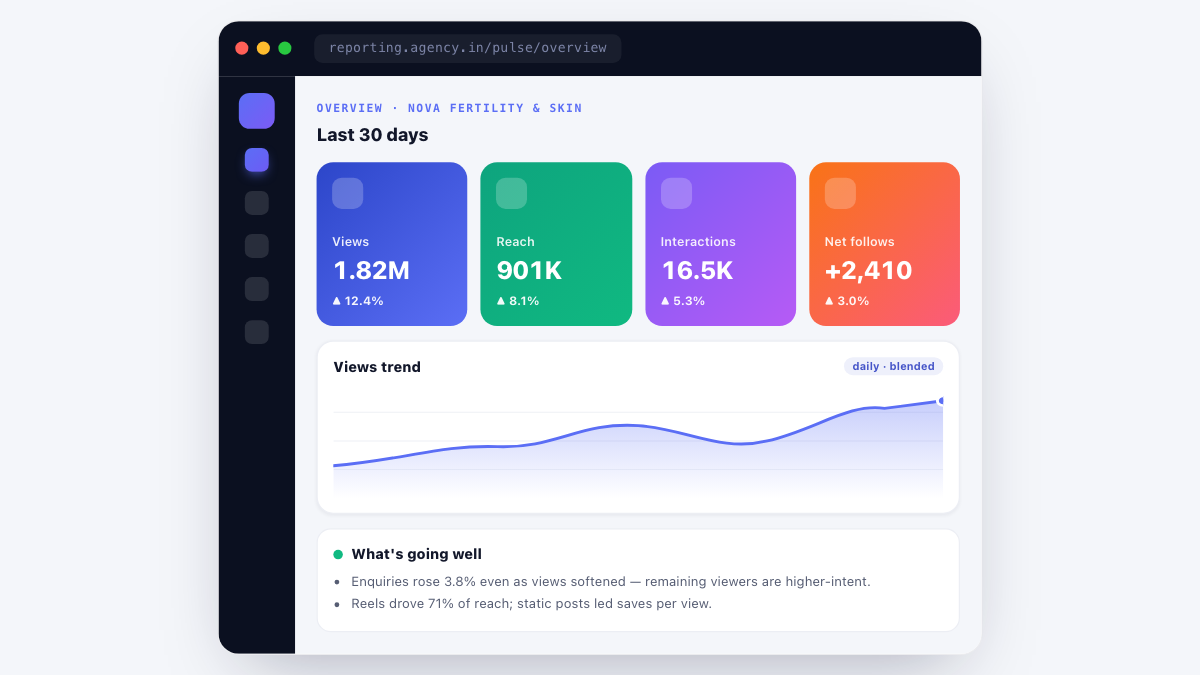
Last month I sat with a five-chair dental group in Bengaluru. They had six Instagram accounts — three abandoned, two run by different receptionists, one by an agency the founder had forgotten they hired. Nobody could tell me which reel had actually driven an appointment enquiry. This is not the exception in Indian healthcare. It is the norm.
The problem is rarely a lack of tools. It is the wrong tool bought for the wrong reason. Hospitals purchase enterprise intelligence platforms and touch four percent of the feature set. Single-doctor clinics pay for suites built for e-commerce fashion brands and wonder why the doctor-content workflow feels alien. Pharma marketing teams run reports that look impressive in a boardroom and predict nothing about the next quarter's growth.
The stakes have shifted quickly. The National Medical Commission's social media conduct advisories from 2022 and 2023 have put doctor-authored content under a sharper lens — testimonials, drug brand mentions, before-after imagery, procedure claims. The Digital Personal Data Protection Act 2023 (in force from 2024, with enforcement scaling through 2026) treats patient-adjacent data as personal data, including anything a comment or a direct message might expose. The Ayushman Bharat Digital Mission's push around HPR-registered practitioner identity is quietly reshaping what "verified medical account" will mean over the next two to three years.
An Instagram analytics tool that does not factor these in is a chart-making spreadsheet — pretty, and dangerous. This guide compares the categories, not any specific vendor. Once you understand the tiers and the axes, you can plug any three shortlisted tools into the same evaluation grid and stop being sold to.
The eight axes to compare on
Before you schedule a demo, decide what you are actually comparing on. Most healthcare marketing teams anchor on monthly price and the visual polish of the dashboard. Neither predicts fit. In our own client evaluations we use eight axes, and we score each tool from one to five on each.
- Compliance posture — NMC readiness, DPDP Act 2023 obligations, ABDM identity signals.
- Data granularity — the depth at which the tool measures reels, stories, carousels, live sessions, comments, and direct-message sentiment.
- Competitor benchmarking depth — whether you can see, at hashtag or handle level, what similar healthcare brands are doing and how it is landing.
- Reporting cadence and format — daily, weekly, monthly; auto-generated PDF versus dashboard-only; white-labelled or not.
- Team collaboration and multi-role access — how many seats, what roles, which approval flows for doctor-authored content.
- Integration with Meta Ads and downstream CRM — one-way, two-way, or none; whether spend and enquiry are visible in the same view.
- India-specific customisation — timezone, festival and season calendars, Indic scripts, and the ability to segment by state or metro.
- Attribution from post to enquiry to footfall — how far down the funnel the tool can genuinely follow a viewer.
Main comparison table — six category tiers, eight axes
The table below scores the six category tiers on the eight axes. Scores are directional, not absolute — individual products within a tier will vary. Use this as a shortlisting frame, not a final verdict.
| Axis | Native Meta insights | DIY cloud dashboard | Mid-market social suite | Healthcare-aware compliance overlay | Enterprise intelligence platform | Agency-managed hybrid |
|---|---|---|---|---|---|---|
| Compliance posture (NMC, DPDP, ABDM) | Weak — general-purpose | Weak to moderate | Moderate — policy tooling exists | Strong — designed for it | Strong on data governance, weak on NMC nuance | Strong — governed by agency SOP |
| Data granularity | Moderate (basic reel and story metrics) | Moderate to high | High | Moderate — compliance-first | Very high, including comment mining | High — matched to brand's need |
| Competitor benchmarking | None | Basic — handle counts | Moderate — a handful of tracked accounts | Moderate — clinical-category focused | Deep — unlimited handles, hashtags, share-of-voice | Curated — 5 to 15 relevant peers |
| Reporting cadence and format | Manual only | Weekly and monthly auto | Configurable, white-label | Monthly compliance-audit style | Real-time plus scheduled | Weekly narrative plus monthly deep dive |
| Team access and roles | Meta Business Manager roles only | 2 to 5 seats typical | 10 to 25 seats, granular roles | Limited seats; audit trail is the feature | Unlimited seats, SSO | Client seats plus agency team |
| Meta Ads and CRM integration | Ads yes; CRM no | Ads partial; CRM basic | Ads yes; CRM via connectors | Ads limited; CRM strong on consent | Ads full; CRM via API | Full — managed by agency |
| India customisation | Basic — timezone only | Weak — largely US-defaults | Moderate | Strong — built for India | Weak to moderate | Strong — India-first by design |
| Attribution to enquiry | Post-level only | UTM-based, shaky on IG | Link-in-bio plus UTM | Consent-gated enquiry mapping | Multi-touch, needs data engineer | End-to-end, agency-owned |
| Typical monthly price (INR) | Rs 0 | Rs 2,000 to Rs 8,000 | Rs 15,000 to Rs 40,000 | Rs 20,000 to Rs 60,000 | Rs 1,00,000 to Rs 3,00,000+ | Rs 25,000 to Rs 1,00,000 (bundled) |
| Best fit | Very small clinics; DIY founders | Growing single-location practices | 2 to 10 location chains | Hospitals, diagnostics chains | Pharma D2C; large hospital groups | Any brand that wants managed ops |
Per-axis deep dives
1. Compliance posture — NMC, DPDP, and ABDM readiness
This is the axis Indian buyers most often ignore and later regret. The NMC's social media guidance for registered medical practitioners has real teeth — testimonials from patients, drug brand names, unverified claims, and comparative statements can all trigger disciplinary action against the doctor whose face appears in the reel. DPDP Act 2023 places a duty on you as data fiduciary to protect any personal data flowing through your Instagram operations, including comment threads, direct messages, and lead-gen forms.
Look for a tool that lets you flag content by risk category before it publishes, keeps an audit trail of who approved what, and offers a way to redact or delete engagement data on request. Native insights and generic DIY dashboards will not do this. Healthcare-aware overlays and agency-managed hybrids treat it as a first-class feature. Enterprise platforms have the data-governance backbone but rarely understand NMC-specific rules — you will need to configure that layer yourself.
2. Data granularity — beyond reach and impressions
Reach and impressions are the entry-level metrics. What you actually need is the ability to see saves, shares, and profile visits per reel, story completion and tap-back rates, carousel swipe depth, DM open rate and reply rate, and comment sentiment at least at a positive-negative-neutral level. For medical accounts, the ability to segment DM enquiries by procedure or specialty saves hours of manual triage every week.
Native insights give you the core metrics but not the derived ones. DIY dashboards are hit-or-miss — some are excellent, some are cosmetic. Mid-market suites and enterprise platforms shine here. If your team is small and pressed for time, a lower-granularity tool with a clearer summary can beat a very granular one nobody has time to read.
3. Competitor benchmarking depth
For Indian healthcare, competitor benchmarking is less about copying and more about pricing your own creative effort correctly. If a comparable IVF chain in your city is posting six reels a week with an average engagement rate of 4.2 percent, and you are at 1.1 percent, the diagnosis is not "post more" — it is a content strategy overhaul.
Native tools do nothing on this axis. DIY dashboards track a handful of handles, usually with a delay. Mid-market suites let you follow ten to twenty peers. Enterprise intelligence platforms are the deepest, offering hashtag-level share of voice and creative frequency analysis — but the depth is only useful if someone on your team reads and acts on it weekly. An agency-managed hybrid curates the five to fifteen peers actually worth watching and reports narratively rather than numerically.
4. Reporting cadence and format
Weekly is usually the right cadence for growing Indian medical brands. Daily creates alert fatigue. Monthly is too slow to fix creative that is failing. Ask specifically whether the report is auto-generated PDF, a live dashboard link, or a hybrid; whether it is white-labelled if you are an agency; and whether it includes a written narrative or only charts.
A chart without a sentence beside it is not a report. It is homework. The best reports in this category answer three questions: what happened, why it happened, and what to do next week. Look for tools whose reports do that, or an agency layer that adds the narrative for you.
5. Team collaboration and multi-role access
For a single clinic, one editor and one admin are enough. For a hospital, you need clinician-facing roles, marketing-team roles, agency-team roles, and a compliance reviewer role. The specific feature to test — draft an internal reel script, route it for medical review, then for marketing approval, then to the schedule. If the tool cannot do that flow with clear notifications and an audit trail, it is not fit for a hospital.
Enterprise platforms tend to have the most role granularity but the fewest medical-content workflows. Healthcare-aware overlays are the reverse. Mid-market suites offer a workable middle. Agency-managed hybrids externalise most of this by putting agency-side reviewers in the workflow.
6. Meta Ads and CRM integration
Instagram organic and Meta Ads are inseparable in practice. If your analytics tool cannot see paid amplification data alongside organic performance, you are guessing whether a reel took off on its own or was pushed. Similarly, if enquiries from Instagram cannot land into your CRM tagged with source, campaign, and creative, you cannot close the loop.
Native insights show ad data but only inside Meta's own interface. DIY dashboards usually do a partial job. Mid-market suites and enterprise platforms are strongest here, though the CRM connection often needs a paid connector. Agency-managed hybrids typically own this integration on your behalf as part of the service.
7. India-specific customisation
The subtle test — can the tool schedule around Ganesh Chaturthi, Diwali, or Onam in your region without you manually flagging them? Does it handle Hindi, Tamil, Telugu, or Marathi captions in its sentiment engine? Can it segment audience by state or metro? Does it display all timestamps in IST by default?
Most global tools default to US-centric settings, and Indian teams end up making manual adjustments that erode the value of automation. Healthcare-aware overlays built in India, and agency-managed hybrids run by Indian teams, are the strongest on this axis by default.
8. Attribution from post to enquiry to footfall
The holy grail. Ideally you can trace a specific reel to a specific set of DM enquiries, from there to booked appointments in your CRM, and from there to the patients who actually walked in. In practice, Indian healthcare journeys are long and multi-touch — a patient might see three reels over four months before enquiring.
Native and DIY tools stop at post-level metrics. Mid-market suites can approximate the enquiry step through link-in-bio and UTMs. Compliance overlays add consent gating so the enquiry data is legally usable. Enterprise platforms can build a multi-touch model but usually require a data engineer to maintain. Agency-managed hybrids offer the closest thing to end-to-end because the agency owns each step in the chain.
Which tier fits which buyer
Single dental or aesthetic clinic — 1 to 2 doctors
Stay with native Meta insights plus one DIY dashboard for scheduling and weekly summary reports. Total spend Rs 2,000 to Rs 5,000 a month. Do not buy a mid-market suite — the seat count and feature depth will go unused. The compliance risk at this size is manageable if the treating doctor personally reviews every reel before publishing. Revisit the tool stack when you cross three practitioners or three locations.
Mid-tier IVF or fertility chain — 3 to 5 centres
A mid-market social suite is the right base layer, with a healthcare-aware compliance overlay bolted on top. Combined spend Rs 30,000 to Rs 60,000 a month. This buyer is usually running Meta Ads at Rs 3 to 8 lakh a month too, and the analytics tool must see both organic and paid in one place. The compliance overlay matters because IVF messaging is a hot zone under NMC advisories — success-rate claims, before-after visuals, and testimonials all need audit trails.
100-bed multispecialty hospital
Mid-market suite plus healthcare-aware compliance overlay, and an agency-managed layer on top if the marketing team is under five people. Combined spend Rs 50,000 to Rs 1,20,000 a month excluding agency fees. This buyer usually has multiple stakeholders — CMO, marketing head, department heads, and often a hospital administrator who wants a monthly compliance-audit report. Enterprise platforms are overkill unless the hospital is part of a larger group with 10-plus units.
Pharma D2C or wellness brand
Enterprise intelligence platform, plus an agency-managed layer for creative and compliance. Combined spend Rs 1,50,000 to Rs 4,00,000 a month. The scale of paid amplification, the volume of user-generated content, and the DPDP obligations on consumer data justify the enterprise price tag. Without the agency layer, though, most of the platform's features sit unused.
Diagnostics chain or radiology network
Similar to the hospital archetype but with heavier compliance weight, since diagnostic content is often patient-report adjacent. Healthcare-aware compliance overlay is non-negotiable. The organic-Instagram opportunity is smaller than for hospitals or IVF, so budget can shift toward compliance and away from creative depth.
How ICG advises on this choice
Ichelon Consulting Group is an agency, not a software vendor. We advise on category fit before brand. For each client we run the eight-axis scoring in a two-hour working session, shortlist three tools within the right tier, and let the client pick on price and dashboard preference. We stay tool-neutral because the tool is the smallest part of a working Instagram operation — the harder work is creative cadence, doctor collaboration, and compliance governance.
Where clients want a managed layer that sits on top of whatever tool they own, we run Prism Pulse — our Instagram analytics reporting layer built specifically for Indian healthcare. Prism Pulse handles narrative reporting, peer benchmarking, and DPDP-aware enquiry tagging as a monthly service. It is not a replacement for your underlying tool; it is the analyst you did not have to hire.
Alongside Prism Pulse we also run adjacent products where they are relevant — Meta Catalyst IQ for the paid amplification engine, Prism Spy for competitor Meta Ads intelligence, YODA for the YouTube arm, and Angryturtle for the Google Business Profile side. All of them are optional. A client can take one and skip the rest.
The 70-30 pricing model for managed services
When Instagram analytics is bundled into a broader social or SEO retainer, ICG uses a 70-30 model. Seventy percent of the fee goes to execution — creative production, publishing, reporting, community management, compliance review. Thirty percent goes to strategy and senior oversight — the working sessions, the quarterly re-planning, the founder-level review calls.
Our published tiers for the SEO backbone are Foundation at Rs 49,999 a month, Growth at Rs 74,999 a month, and Scale at Rs 99,999 a month. When Instagram analytics and Meta Ads are added on, the same 70-30 split governs the extension — Google Ads engagements typically start at ad-budget levels of Rs 5,00,000 a month, and YouTube or AIO work starts at Rs 50,000 a month in retainer. The point of the split is to keep senior time protected while keeping execution accountable to the same brief.
FAQ


Is native Instagram Insights enough for a small clinic?
For a single-doctor clinic with one or two locations, native insights are enough for the first six to twelve months. Pair them with a simple content calendar and a monthly review with your doctor and one marketing resource. Move up a tier only when you cross three practitioners, three locations, or Rs 50,000 a month in paid amplification.
Do I need a DPDP-specific analytics tool?
You need a DPDP-compliant workflow, not necessarily a DPDP-specific tool. Any Instagram operation that collects DMs, comments, or lead-form entries is processing personal data under the Act. The tool matters less than the process — consent, retention, deletion rights, and breach notification all need documented flows. Healthcare-aware overlays help, but a well-run mid-market suite with the right SOPs can meet the same standard.
How much should a 100-bed hospital budget for Instagram analytics alone?
Between Rs 40,000 and Rs 90,000 a month for the tooling and reporting layer, excluding creative production and paid media. The number sounds high until you realise it is often less than one full-time salary and covers audit trails your compliance team will otherwise need to build manually.
Are enterprise intelligence platforms worth it for hospitals?
Rarely, unless the hospital is part of a group with ten-plus units or is running paid amplification above Rs 10 lakh a month. Enterprise platforms are built for consumer brands with high-volume comment streams, real-time crisis monitoring needs, and multi-country footprints. Most Indian single-city hospitals will use less than a quarter of the feature set.
What does an agency-managed hybrid actually do that a tool cannot?
Three things a tool structurally cannot do — write the narrative interpretation of the numbers, chase your doctors for approval on time, and adjust the creative brief for next month based on what worked this month. Tools show you the score of last week's match; agencies help you coach the team for next week's game.
How do I evaluate whether a tool handles NMC compliance well?
Ask the vendor to demonstrate five specific workflows — flagging a testimonial before publication, capturing an audit trail of who approved a reel, restricting drug brand mentions in captions, redacting a comment on request, and generating a monthly compliance report by practitioner. If they cannot demonstrate all five in a live demo, they are not compliance-ready for Indian medical practice.
Should Instagram analytics sit inside the CRM or outside it?
Outside for analysis, inside for enquiry data. The dashboard and reporting engine should live in your analytics tool. But the tagged enquiry — with source, campaign, creative, and consent status — should flow into your CRM within minutes. If the two systems cannot talk to each other in near-real-time, you will end up with a spreadsheet-based reconciliation process that quietly breaks every month.
Does ABDM affect Instagram accounts today?
Directly, not yet. Indirectly, yes. ABDM's push to make HPR-registered practitioner identity the trust standard is nudging platforms and audiences toward verified doctor profiles. Over the next two to three years, expect that verification signals — HPR ID, NMC registration number, verified badge — will start to influence organic reach and audience trust in ways they do not today. Choose a tool that gives you room to add verification metadata to posts.
What is the fastest way to shortlist three tools for a demo?
Score your top eight axes from one to five in importance for your buyer archetype. Discard any tool that scores below three on your top three axes. From the remaining, ask each for a demo on a real scenario from your account — not their canned demo data. The one that adapts fastest to your data is usually the right pick, regardless of feature count.
Can ICG help even if we already have a tool we like?
Yes. Most of our Instagram analytics engagements start with a client who already has a tool and wants better use of it. Prism Pulse sits on top and adds the narrative reporting, peer benchmarking, and enquiry tagging layer without replacing the underlying subscription. Where the underlying tool is a poor fit, we will say so — and help with the switch — but we never lead with a rip-and-replace.
Book a free Meta ads account audit.
Raman Soni's team pulls your account, checks CAPI/EMQ, reviews creative for NMC compliance, and shows where CPQL is leaking. 45 minutes, actionable output.
Questions readers ask
about this topic.
The three platforms
behind every ICG engagement.
Beacon
CAPI middleware that fixes Event Match Quality, translates CRM statuses to Meta-standard events, dedups across channels.
Agency OS
Live client dashboard. GSC, GA4, Google Ads, Meta Ads, IVR calls in one view. Login anytime, not monthly.
Phoenix
Clinic revenue intelligence over your PMS. Daily action queue: Prevent Loss, Maintain & Engage, Grow Revenue. Multi-centre rollout.
Or book a free 30-min audit to see all three in action on your account.
Healthcare brands
that already run on ICG.
A representative slice of the 150+ healthcare brands ICG has delivered for across India. Most engagements remain under NDA.


What ICG clients say · on video.
"Scale up of organic channels and business consulting. ICG has absolute domain authority in their field."
"Working with ICG transformed how we acquire IVF patients in Gurgaon. They understand the fertility journey from inquiry to consult..."
"What Ichelon accomplished — they got all my ideas and worked over 3-4 months to create an amazing, super-customised website."
Need help operationalising this?
Every ICG service is healthcare-only, NMC + DPDP-aware, and built around the patient-research patterns that drive Indian healthcare growth in 2026.
Every practice welcome — packages from ₹20,000/mo.
Goals-Driven engagements · Performance-Linked Payout Models available
More from
ICG.
Five trends shaping Indian healthcare marketing through 2027: AI-first patient research, Conversions API adoption, ABDM discovery, the AEO w...
Healthcare AIO is the discipline of getting your clinic or hospital cited inside Google AI Overviews, ChatGPT and Perplexity answers — not j...
Conversational-search advertising places brand messages inside AI chat answers — ChatGPT, Perplexity, Copilot — rather than beside a results...
Stop guessing.
Book a Diagnostic.
30 minutes. Free. With the AI-powered healthcare-only marketing agency 150+ brands already run on. No slides, no pitch, no hard close.


