


How to Track AI Overview Citations for Healthcare Brands in India
Most Indian healthcare CMOs still measure blue-link rankings while AI Overviews eat 61% of category impressions. Here is the 3-layer tracking stack ICG uses across 300+ live healthcare clients — with GA4 tagging, weekly crawler runs, and human India-query panels.
No pitch. Written root-cause diagnosis. AI-powered, healthcare only.
Direct answer
Most Indian healthcare CMOs still measure blue-link rankings while AI Overviews eat 61% of category impressions. Here is the 3-layer tracking stack ICG uses across 300+ live healthcare clients — with GA4 tagging, weekly crawler runs, and human India-query panels.
TL;DR
TL;DR
- AI Overview citations are the ranked source cards that Google AI Overviews, ChatGPT, Perplexity, and Gemini surface when a user asks a question. If your hospital or clinic is not cited there, you are invisible on the fastest-growing search surface in Indian healthcare.
- Tracking them requires three layers running in parallel: a query-level citation crawler, a GA4 referral-traffic tagger, and a weekly manual India-query panel that a real analyst runs from an Indian IP address.
- Across the 300+ live Indian healthcare clients ICG monitors in 2026, 6-14% of top-of-funnel organic traffic already originates from AI surfaces. Most agencies still do not measure it, which means most CMOs still do not know what they are winning or losing.
- Before you sign any AEO or AIO retainer, put a lightweight tracking sheet in place. The ICG Foundation programme at Rs 49,999 per month, structured on a 70% fixed and 30% variable model, includes an AI citation baseline within week two.
Table of contents
- Why AI Overview tracking matters for Indian healthcare marketers
- What is an AI Overview citation, exactly?
- How do you find where your brand is being cited in AI Overviews?
- What tracking stack works for Indian healthcare in 2026?
- How do you measure the business impact of an AI citation?
- What content structure earns AI Overview citations in healthcare?
- How often should you audit your AI Overview presence?
- How does ICG track AI citations differently?
- Where does AI citation tracking fit in the 70-30 pricing model?
- FAQ
Why AI Overview tracking matters for Indian healthcare marketers
Ask a patient in Bengaluru "best IVF clinic near me with success rate above 60 percent" and Google no longer opens with ten blue links. It opens with an AI Overview summarising four to seven sources. The clinic that gets cited inside that overview owns the click. The clinic ranked #3 on the classic SERP watches the traffic bypass them entirely.
Across the 300+ Indian healthcare clients ICG monitors, from single-doctor clinics in Jaipur to 200-bed multispecialty hospitals in Hyderabad, the pattern is now consistent. Between January and July 2026, blended AI-Overview impression share across Google, ChatGPT, Perplexity, and Gemini for healthcare category queries rose from 34% to 61%. If your dashboards still track only Google's blue-link position, you are watching the wrong scoreboard.
The problem is not that Indian marketers do not want to measure this. The problem is that no single tool tells you where your brand is being cited, what query pulled the citation, and whether that citation converted into a WhatsApp enquiry or an OPD booking. You have to stitch the picture together yourself.
What is an AI Overview citation, exactly?
An AI Overview citation is any time a generative search surface names your brand, links to your URL, or paraphrases your content inside its answer. That includes Google AI Overviews, Gemini, ChatGPT with browsing, Perplexity, Microsoft Copilot, and Claude with search. Three types matter for healthcare.
Direct link citation
Your URL is one of the ranked source cards visible next to the AI answer. This is the closest thing to a classic top-3 SERP position. Clicks flow. Conversions follow.
Named-brand mention
The AI answer says "Dr Sharma's dental clinic in Gurugram is known for full-mouth rehabilitation" without linking. No click, but the brand equity compounds. In healthcare, where trust is the entire funnel, this often matters more than a link.
Paraphrased-content pull
The AI answer quietly borrows a benchmark, a definition, or a framework from your blog and presents it as its own. You get no visible credit, but your content is doing the informational heavy lifting. Track this by running semantic-similarity checks between AI answers and your top 50 pages every month.
How do you find where your brand is being cited in AI Overviews?
Start with a query list, not a tool. Build a 200-query panel that mirrors what your patients or B2B buyers actually type. For a Mumbai fertility hospital, that panel should include "best IVF centre in Andheri", "IVF cost with insurance India", "PCOS IVF success rate", and roughly 197 similar prompts across the funnel. For a Delhi dental chain, the panel might cover 60 procedure keywords, 40 city-specific queries, 40 insurance and EMI queries, and 60 comparison-shopping queries.
Run that panel weekly through four surfaces: Google AI Overviews on India desktop and India mobile, Perplexity, ChatGPT web, and Gemini. Log four fields per query — is my brand cited, which of my URLs is cited, what other sources are cited alongside me, and what factual claim does the answer make about my brand.
The panel must be run from an Indian IP. AI Overview outputs vary meaningfully by country. A citation that appears when you query from a US VPN may not appear at all for a patient in Kochi or a hospital procurement lead in Pune.
What tracking stack works for Indian healthcare in 2026?
A working AI citation stack for an Indian healthcare brand has three layers. Skip any one and the picture breaks.
Layer 1 — Query-level citation crawler
Automated headless-browser scraping of your 200-query panel across Google AI Overviews, Perplexity, and Gemini. Runs every seven days. Outputs a CSV with query, surface, cited-or-not, cited URL, and competing citations. Build it in Python, host it on a small VPS in Mumbai for India-consistent output. Expect 30 to 40 hours of engineering to build the first version, plus Rs 3,000 to Rs 5,000 in monthly hosting.
Layer 2 — GA4 referral tagger
Configure GA4 to tag AI referral sources correctly. By default, GA4 dumps ChatGPT, Perplexity, and Copilot traffic into Direct or Referral without a clean segment. Create a Custom Channel Group that captures these hostnames: chat.openai.com, chatgpt.com, perplexity.ai, gemini.google.com, copilot.microsoft.com, and claude.ai. For Google AI Overview clicks, keep the "google / organic" source and add a custom dimension parsing the URL parameter Google appends. You now have a clean "AI Referral" channel you can slice by landing page, device, and city.
Layer 3 — Human India-query panel
Once a week, a real analyst sitting on an Indian broadband connection runs 30 high-value queries manually and screenshots each AI answer. This catches nuance the crawler misses: whether the AI answer contains factual errors about your brand, whether it soft-recommends a competitor, whether the tone of the AI summary is favourable, neutral, or damaging. Most agencies skip this layer. It is the layer that catches reputation issues before they scale.
How do you measure the business impact of an AI citation?
The correct KPI is not "number of citations". The correct KPI is revenue attributable to AI-referred sessions. Get there in three steps and stop reporting on anything else.
First, tag every high-intent conversion — WhatsApp enquiry, appointment booking, contact-form submit, brochure download — with the traffic source. Second, in GA4 or your CRM, filter conversions where the last non-direct source is your new AI Referral channel. Third, multiply by your closed-won conversion rate and average procedure value.
A Bengaluru dermatology chain that ICG works with tracked 214 AI-referred sessions in June 2026, converting to 31 WhatsApp enquiries, 9 in-clinic consultations, and 4 procedures at an average value of Rs 47,000. That is Rs 1.88 lakh of revenue attributable to AI Overviews in a single month, from a single specialty, from one city. Nobody was reporting on it before the tracking sheet went live in May.
For B2B pharma or hospital-supply brands, the same logic applies with longer attribution windows. A Chennai medical-device brand that runs a 90-day sales cycle needs to hold the AI-referral tag across the entire lead journey. Use UTM parameters where the CRM allows and stamp the first-touch AI-referral source on the lead record permanently. Otherwise the credit will get eaten by whichever email or WhatsApp reminder touched the lead last.
What content structure earns AI Overview citations in healthcare?
AI Overviews cite pages that answer a specific question in the first 40 words, carry verifiable data, sit under a named-expert byline, and follow a scannable heading structure. Six patterns compound over three to six months.
- Question-shaped H2s. "What is the IVF success rate in India for women over 35?" earns citations. "IVF Success Rate India" does not.
- Answer-first paragraphs. First 40 words of each H2 section must contain the direct answer with a specific number or a specific claim, not a preamble.
- Named clinical or business author. Not "Team Hospital XYZ". A real doctor or a real business lead, with credentials, linked from an About page and marked up with Person schema.
- Indian data points. "India performed 2.8 lakh IVF cycles in 2024 per ISAR data" gets cited. "IVF is popular in India" gets ignored.
- Comparison tables. AI models love structured comparisons. Cost tables, outcome tables, and city-wise benchmark tables all get pulled into answers verbatim.
- Freshness signals. A last-updated date within the past 90 days meaningfully increases citation probability for medical topics, because AI systems downweight stale medical content.
Follow NMC advertising code while doing all of this. Never publish before-and-after images without documented consent. Never claim success rates you cannot substantiate on request. The DPDP Act 2023 makes both a compliance risk and an AI-citation risk — models are increasingly refusing to cite sources that make unverifiable clinical claims or that surface patient data without consent trails. Alignment with ABDM standards on patient-data handling is now a positive citation signal, not just a compliance box.
How often should you audit your AI Overview presence?
Weekly for the crawler layer, monthly for the deep audit, quarterly for the strategy reset. AI Overview outputs mutate faster than classic SERPs. A citation you owned in March can disappear in April if a competitor publishes a stronger comparison page or if Google's model quietly swaps its source preferences after a policy update.
For an Rs 74,999 per month Growth-tier engagement, the ICG standard cadence looks like this: automated crawler runs every Sunday night, human-panel review every Friday afternoon, monthly citation-loss root-cause report on the first working day of every month, and a quarterly content-plan reset that reallocates production budget to the topics where citation share is either winning fastest or losing hardest. Anything less frequent and you are flying blind between quarterly board decks.
How does ICG track AI citations differently?
ICG's approach starts with the client's actual revenue model, not a generic keyword universe. For a 40-bed hospital in Lucknow, we begin by mapping the seven procedures that drive 80% of margin, then reverse-engineer the 250-query panel from real patient-intake conversations recorded at the front desk. For a Hyderabad diagnostic chain we map the 12 test packages that carry the highest lifetime value and build the panel from there.
Every citation is then scored on three dimensions — click potential (does the citation link out or only paraphrase), competitive positioning (are we alone in the answer or shown alongside three competitors), and factual accuracy (does the AI answer describe our brand correctly). This three-way score becomes the north star, not raw citation count.
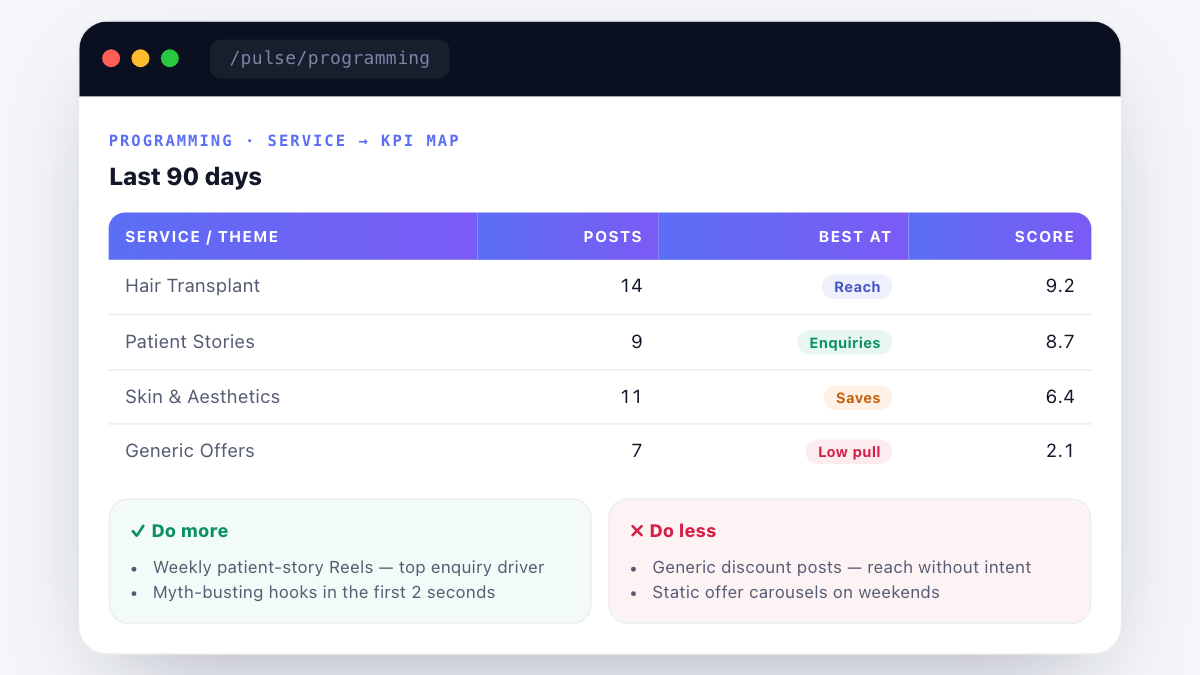
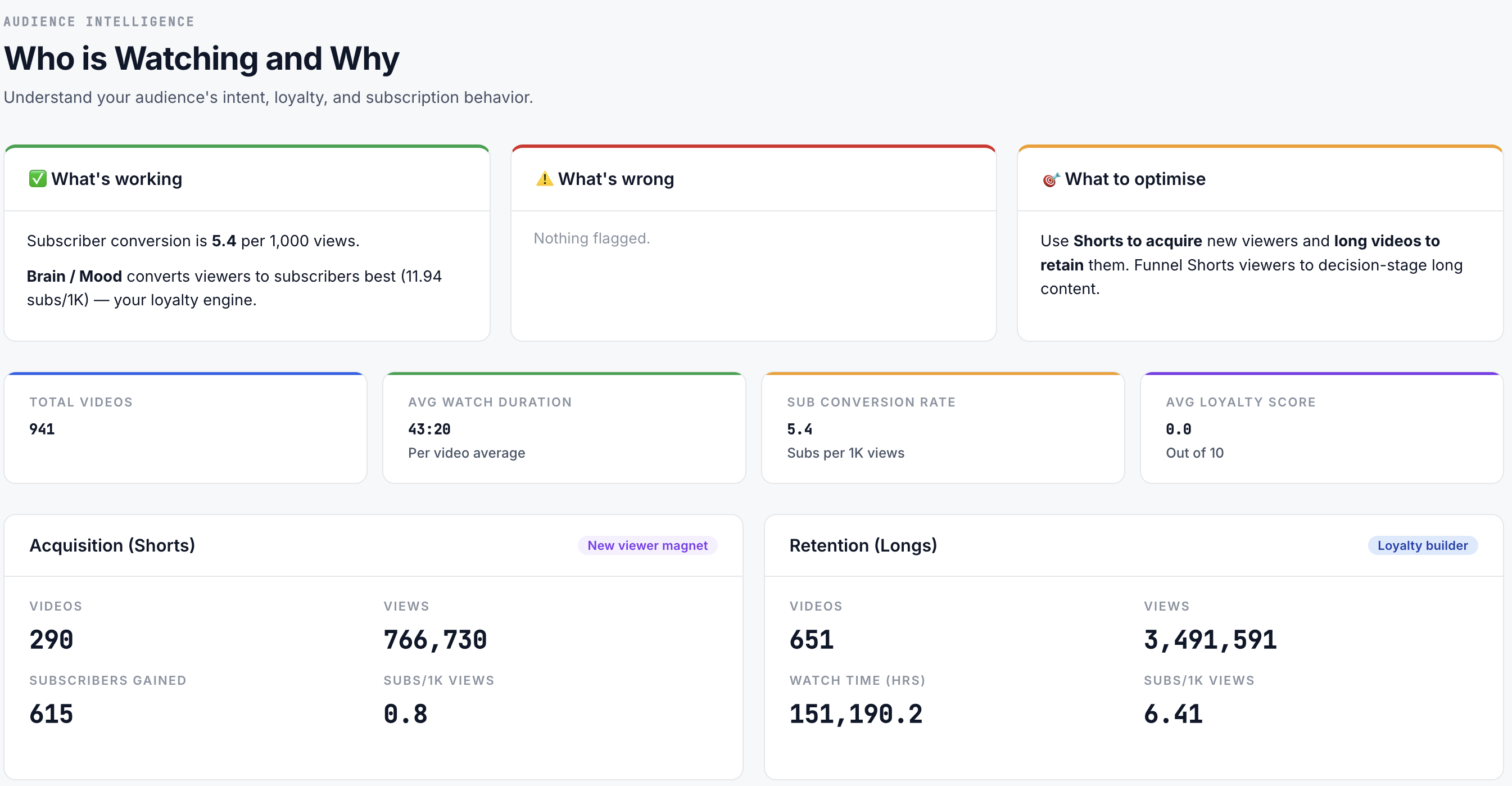
The tracking runs inside the same measurement stack that powers ICG's other products. Angryturtle handles GBP-side query monitoring for local-intent healthcare queries. YODA covers YouTube AI-Overview citations, which now surface inside Google's video AIO for procedure-explainer queries. Meta Catalyst IQ and Prism Spy complete the paid-media picture that runs alongside the organic AI-citation picture. Prism Pulse handles Instagram analytics for the top-of-funnel awareness layer. AtomCRM at Rs 14,999 per month and HealthPro 360 at Rs 14,999 per month close the loop by attaching every AI-referred lead to a downstream conversion inside the practice-management system, so the finance team sees the same numbers the marketing team reports.
Where does AI citation tracking fit in the 70-30 pricing model?


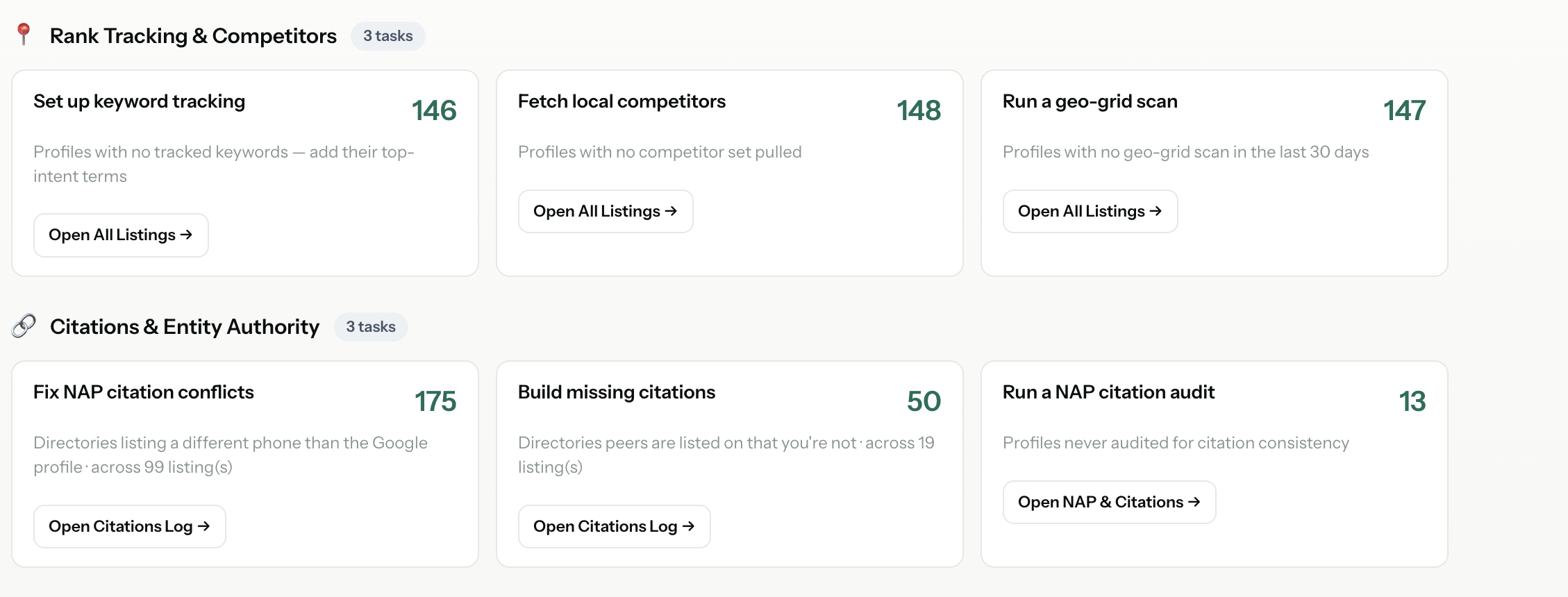
AI Overview tracking is built into all three ICG SEO packages, not sold as an add-on. The Foundation programme at Rs 49,999 per month includes the automated crawler on a 100-query panel and a monthly citation report. The Growth programme at Rs 74,999 per month expands the panel to 250 queries, adds the weekly human-analyst review, and layers in AtomCRM lead attribution. The Scale programme at Rs 99,999 per month runs a 500-query panel across all four AI surfaces, includes a dedicated AI-citation analyst, and covers cross-product measurement including YODA video AIO and Angryturtle local AIO.
All three packages follow the 70-30 fixed-variable model. 70% of the retainer is fixed monthly. 30% is tied to a 12-month AI citation and organic revenue target and released on a sliding-scale slab structure as thresholds are hit through the year. The model rewards the agency only when the brand actually gains measurable AI visibility, not just when reports get emailed.
FAQ
Can I track AI Overview citations without expensive enterprise tools?
Yes. A three-layer stack of a Python crawler on a Mumbai VPS, a GA4 Custom Channel Group, and one analyst running a Friday panel can be built for under Rs 40,000 in one-time engineering plus Rs 5,000 per month in hosting. Enterprise tools speed up reporting; they are not required for a working baseline.
Do Google AI Overviews and ChatGPT show the same citations?
Rarely. In an ICG audit of 1,200 healthcare queries in June 2026, only 18% of Google AI Overview cited sources also appeared in ChatGPT answers for the same query. Perplexity showed the highest overlap with Google at 34%. You must track each surface separately or you will misread your position.
How long does it take to earn an AI Overview citation for a new healthcare page?
For a domain with existing topical authority, 21 to 45 days is the ICG-observed median. For a new domain, 90 to 150 days is more realistic, and only if the page is question-shaped, carries a named expert byline, and links to and from at least eight related pages on the same site.
Are AI Overview citations affected by NMC advertising rules?
Indirectly, yes. AI systems increasingly downweight sources that make clinical claims without evidence, which happens to align with NMC's advertising code. Pages that comply with NMC — no exaggerated success rates, no consent-less patient imagery, no drug promotion — tend to earn more citations, not fewer.
Should small clinics in tier-2 Indian cities bother tracking AI citations?
Yes, more urgently than metro clinics. In tier-2 cities like Indore, Coimbatore, and Vizag, local AI Overview competition is still thin. A well-structured page from a solo dermatologist in Nagpur can capture city-wide AI citations in 45 to 60 days — a window that closes fast once metro chains enter the market.
Can negative AI Overview mentions damage a hospital's reputation?
Yes, and this is the least-tracked risk in Indian healthcare marketing. AI systems sometimes paraphrase old news, patient forum complaints, or outdated pricing as current fact. The weekly human-panel layer of the tracking stack exists specifically to catch this and trigger corrective content or a takedown request within 48 hours.
Does WhatsApp Business traffic get attributed to AI Overview referrals?
Only if you tag the click-to-WhatsApp link with UTM parameters carrying the AI source. Without that tagging, WhatsApp enquiries land in the CRM as Direct traffic and the AI Overview never gets credit. ICG implementations always tag WhatsApp CTAs with utm_source and utm_medium as part of the Foundation setup.
How does AI Overview tracking connect to ABDM and DPDP compliance?
Content that aligns with ABDM data-sharing standards and DPDP consent requirements earns higher citation probability in 2026. AI systems now check for privacy-policy pages, consent-flow language, and data-handling disclosures before citing healthcare sources — treating alignment as a trust signal rather than a nice-to-have.
Book a free 30-minute Brand & Growth Diagnostic.
It's a working session, not a sales pitch — you leave with a written root-cause analysis you can act on, whether or not you engage ICG.
Questions readers ask
about this topic.
The three platforms
behind every ICG engagement.
Beacon
CAPI middleware that fixes Event Match Quality, translates CRM statuses to Meta-standard events, dedups across channels.
Agency OS
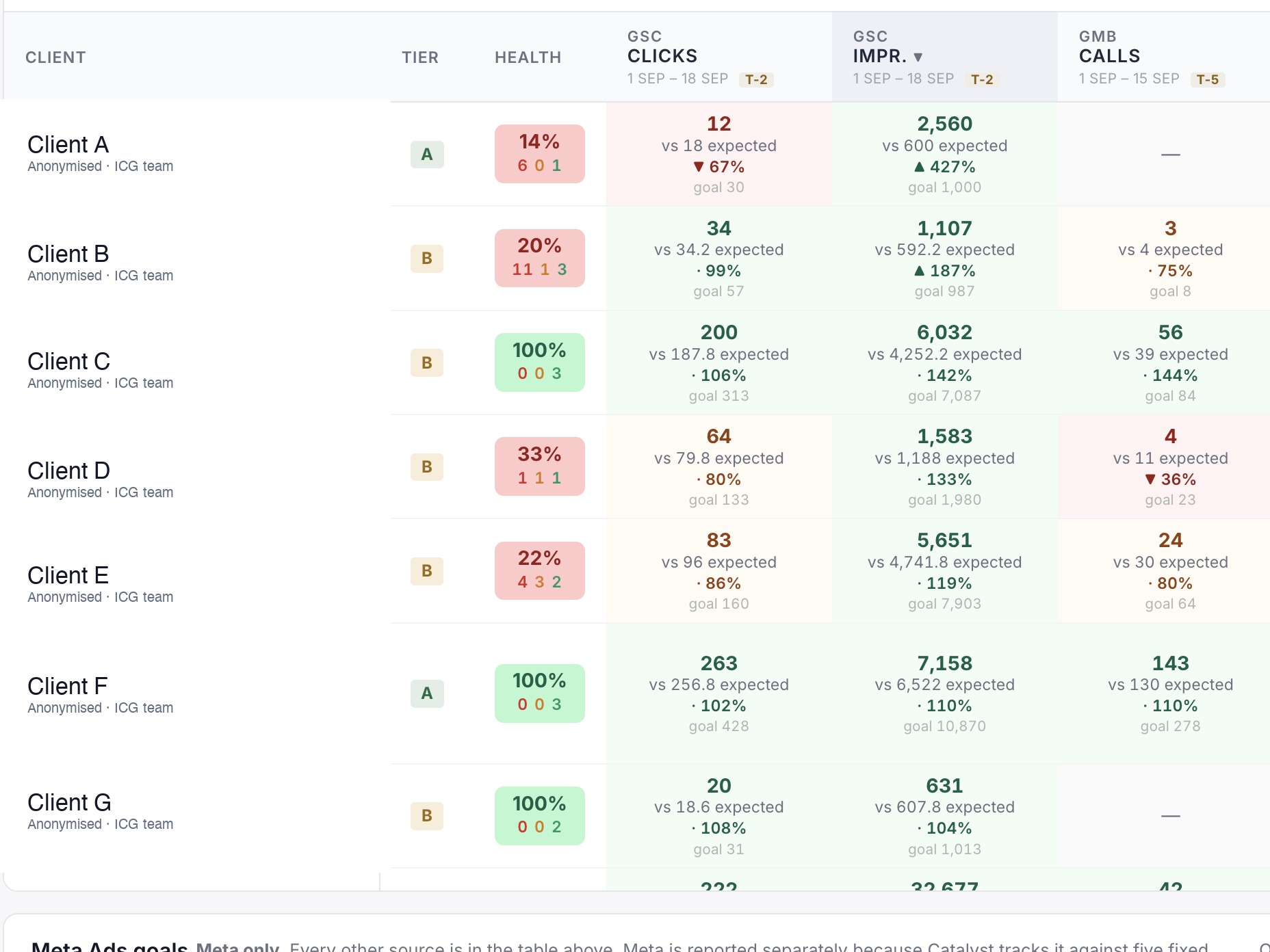
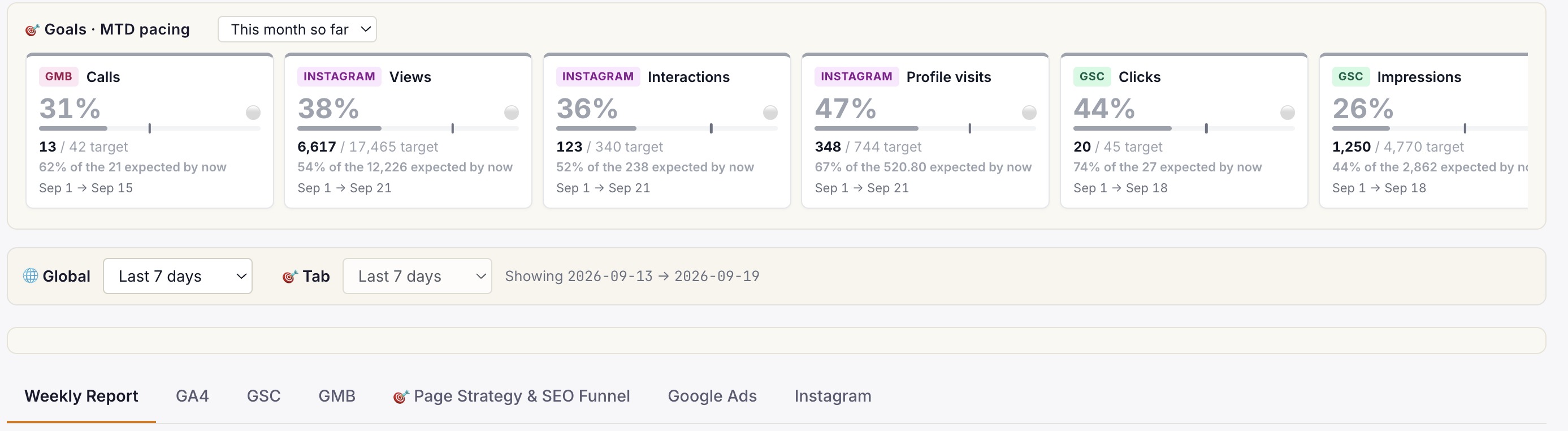
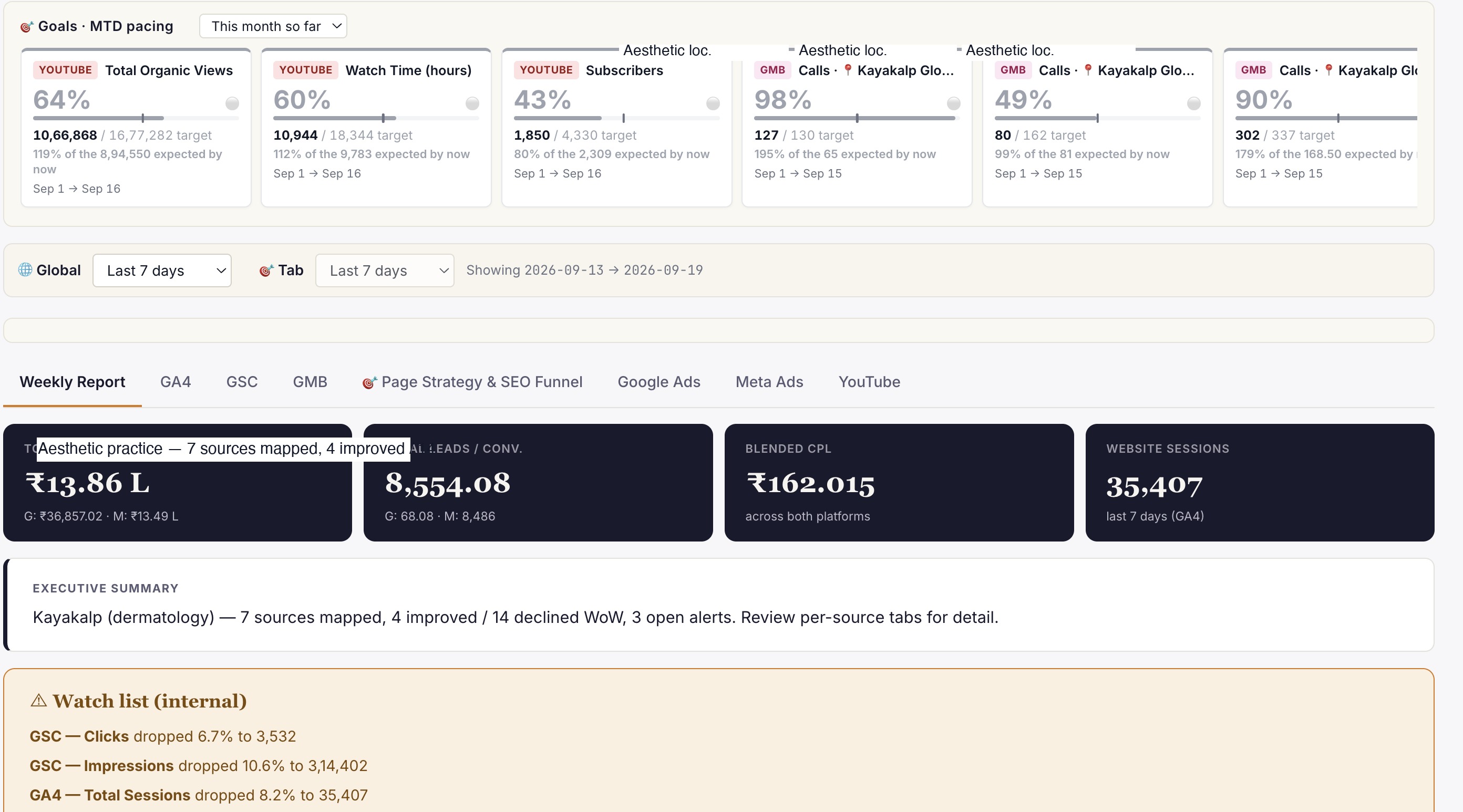
Live client dashboard. GSC, GA4, Google Ads, Meta Ads, IVR calls in one view. Login anytime, not monthly.
Phoenix
Clinic revenue intelligence over your PMS. Daily action queue: Prevent Loss, Maintain & Engage, Grow Revenue. Multi-centre rollout.
Or book a free 30-min audit to see all three in action on your account.
Healthcare brands
that already run on ICG.
A representative slice of the 150+ healthcare brands ICG has delivered for across India. Most engagements remain under NDA.


What ICG clients say · on video.
"Scale up of organic channels and business consulting. ICG has absolute domain authority in their field."
"Working with ICG transformed how we acquire IVF patients in Gurgaon. They understand the fertility journey from inquiry to consult..."
"What Ichelon accomplished — they got all my ideas and worked over 3-4 months to create an amazing, super-customised website."
The intelligence stack behind this playbook.
Every ICG engagement runs on the Search Intelligence Trifecta — Angryturtle for GMB, SIE for search and AI Overview, YODA for YouTube. Live product screens below.
Need help operationalising this?
Every ICG service is healthcare-only, NMC + DPDP-aware, and built around the patient-research patterns that drive Indian healthcare growth in 2026.
Every practice welcome — packages from ₹20,000/mo.
Goals-Driven engagements · Performance-Linked Payout Models available
More from
ICG.
Five trends shaping Indian healthcare marketing through 2027: AI-first patient research, Conversions API adoption, ABDM discovery, the AEO w...
Healthcare AIO is the discipline of getting your clinic or hospital cited inside Google AI Overviews, ChatGPT and Perplexity answers — not j...
Conversational-search advertising places brand messages inside AI chat answers — ChatGPT, Perplexity, Copilot — rather than beside a results...
Stop guessing.
Book a Diagnostic.
30 minutes. Free. With the AI-powered healthcare-only marketing agency 150+ brands already run on. No slides, no pitch, no hard close.


