


How to Handle Negative Reviews on GMB in India: A Doctor's Playbook
A one-star review on your Google Business Profile can shave 15-20% off a clinic's monthly footfall in an Indian metro. This is the doctor-safe framework we use across 300+ healthcare clients to respond, remove, and recover — without falling foul of the DPDP Act or NMC rules.
No pitch. Written root-cause diagnosis. AI-powered, healthcare only.
Direct answer
A one-star review on your Google Business Profile can shave 15-20% off a clinic's monthly footfall in an Indian metro. This is the doctor-safe framework we use across 300+ healthcare clients to respond, remove, and recover — without falling foul of the DPDP Act or NMC rules.
TL;DR
TL;DR
- Never confirm the patient relationship in a public reply. Under the DPDP Act 2023 and NMC's professional conduct rules, saying "we treated you on 12 May" in a GMB reply is a disclosure of health information — even if the reviewer named themselves first.
- Only four categories of GMB reviews are actually removable in India: fake/spam, off-topic, conflict of interest, and reviews containing personal attacks or restricted content. Everything else — including harsh but honest feedback — stays up.
- A structured 48-hour response beats a legal notice ten times out of ten. The reviews that damage rankings are the ones that sit unanswered for weeks, not the ones with a calm, human clinic reply below them.
- Reputation is a system, not a task. Clinics that ask every 20th patient for a review — quietly, with a WhatsApp link — never have a rating problem, because the maths of new 5-stars overwhelms the maths of the occasional 1-star.
Table of contents
- Why negative GMB reviews hit Indian clinics harder
- What does Google's review policy actually allow you to remove in India?
- How should a doctor reply to a negative GMB review without breaking DPDP or NMC rules?
- What is the 48-hour framework we use across ICG's 300+ healthcare clients?
- When can you legally get a negative review removed in India?
- How do negative reviews affect your local pack ranking in Indian metros?
- How do the best Indian clinics prevent negative reviews from ever landing?
- How does ICG manage GMB reputation differently?
- FAQ
Why negative GMB reviews hit Indian clinics harder
The direct answer: an Indian patient reads six to eight reviews before choosing a doctor, compared with two to three in most Western markets, because trust in institutional healthcare here is still built one profile at a time. That behaviour makes every review, good or bad, count for more.
Three structural realities amplify this. First, India's local pack — the three-clinic map card that shows up when someone Googles "gynaecologist near me" or "dentist in Kothrud" — drives roughly 44% of first-page clicks in metros like Delhi, Mumbai, Bengaluru, Hyderabad and Pune. If your rating dips below 4.2 while three competitors sit at 4.6+, you fall out of that card, and no amount of SEO on your website will recover the walk-ins.
Second, NMC's professional conduct regulations still restrict what a doctor can say publicly about a patient case — which means clinics often stay silent when a review is unfair, and silence reads to the next patient as guilt. Third, WhatsApp forwarding culture means one screenshot of a badly-handled reply can travel through resident welfare associations, mother groups and colony WhatsApp circles in a single afternoon. In Tier-2 cities like Nashik, Coimbatore, Vizag and Indore, that single afternoon is often the entire reputational event.
What does Google's review policy actually allow you to remove in India?
The direct answer: Google's global review policy lets you flag a review for removal only if it fits one of five buckets — spam and fake content, off-topic, restricted content, illegal content, or conflict of interest. Reviews that are simply negative, subjective, or emotionally worded are protected and will stay up even after multiple flags.
Here is what we see actually get removed in Indian healthcare cases:
| Category | Example we've seen removed | Approx. success rate |
|---|---|---|
| Fake / spam | Same reviewer name posting 1-star reviews across 8 unrelated clinics in Ghaziabad in one week | ~70% |
| Off-topic | Review complaining about parking at the mall, not the dental clinic inside it | ~55% |
| Personal attack / restricted | Review naming a nurse's caste, religion, or using slurs | ~80% |
| Conflict of interest | Ex-employee 1-star review posted the week after termination | ~30% — hard to prove |
| Honest but harsh feedback | "Doctor rushed my consultation, felt unheard" | ~0% — stays up |
The lesson we take into every client onboarding: assume 90% of the negatives you get will never come down. Build the response system around that reality, not around the fantasy of a magic removal button.
How should a doctor reply to a negative GMB review without breaking DPDP or NMC rules?
The direct answer: the reply must acknowledge the emotion, invite the reviewer offline, and never confirm or deny that the person was ever a patient. Under the Digital Personal Data Protection Act 2023, health information is sensitive personal data — and even a public reply that says "when you visited us for your appointment" is a disclosure, because you have just linked a name to a health service.
Here is a doctor-safe template we've deployed across gynaecology, dental, dermatology and IVF clinics from Gurugram to Chennai:
"Thank you for taking the time to share your feedback. Every experience at our clinic matters to us and we take concerns of this nature seriously. We would like to understand what happened and make it right — please write to us at care@[clinic].com or call [front desk number] between 10 am and 6 pm, and our practice manager will personally look into it. — Dr [Name], Medical Director."
Notice what the reply does not do. It does not say "we treated you". It does not say "you never came here". It does not argue clinical facts. It does not name the doctor who saw the patient. It signs off with the medical director's name, not the treating doctor's, which is a subtle NMC safeguard. And it gives an offline route, because the DPDP-safe conversation cannot happen in a public thread.
What is the 48-hour framework we use across ICG's 300+ healthcare clients?
The direct answer: within 48 hours of a negative review landing, a healthcare business must complete four steps — triage, verify, respond, and route to recovery — because reviews that sit unanswered beyond 72 hours cause measurable ranking drops in the local pack.
The framework, in the order we run it:
- Hour 0-4: Triage. Classify the review into one of three buckets — removable (fits Google's policy), addressable (real complaint about service), or malicious (competitor, ex-staff, or coordinated attack). Screenshot immediately with timestamp — GMB reviews can be edited by the reviewer and your evidence can vanish.
- Hour 4-12: Verify internally. Practice manager pulls the OPD register or EHR log to check whether the reviewer's name appears in the last 90 days. Do this quietly — no clinical staff should be told the review exists. Loose talk in Indian clinics is how counter-reviews start.
- Hour 12-24: Respond publicly. Post the DPDP-safe reply. Do not delegate this to a marketing intern. In the ICG playbook, only three people are authorised: the practice manager, the medical director, or the ORM lead assigned to the account.
- Hour 24-48: Route to recovery. If the reviewer engages offline, resolve genuinely and — only after resolution — politely ask if they would consider updating the review. Never bribe, never offer discounts for review changes. This is both an NMC and a Google policy landmine.
When can you legally get a negative review removed in India?
The direct answer: outside Google's own policy route, the only legal escalations available to an Indian clinic are a takedown notice under the IT Rules 2021 for defamatory content, a police complaint under IPC 500 or the new BNS defamation provisions, or a civil suit for damages — and all three are disproportionate for 99% of negative reviews.
The one situation where escalation is worth it: a coordinated attack. We saw a fertility clinic in south Delhi receive fourteen 1-star reviews in nine days, all from new Google accounts with no other review history, all mentioning suspiciously similar phrasing about "unethical practices". That is a pattern Google's spam team responds to when you file a bulk flag with evidence — reviewer usernames, screenshots, and a short cover note. Eleven of the fourteen came down in six weeks.
For a single unhappy patient with a genuine grievance, legal escalation is nearly always the wrong move. It signals to the next reader that your clinic sues its critics, which is a far worse reputational injury than the review itself.
How do negative reviews affect your local pack ranking in Indian metros?
The direct answer: Google's local ranking algorithm weights three signals — relevance, distance, and prominence — and reviews feed heavily into prominence. A rating drop from 4.6 to 4.1 in a competitive category like "dentist Andheri West" or "IVF centre Whitefield" typically drops a clinic from local pack position 2 to position 6-8, which effectively removes it from mobile search real estate.
Three specifics Indian clinic marketers should know:
- Recency matters more than raw count. Ten fresh reviews from the last 60 days outweigh forty reviews from three years ago. This is why a clinic that stops asking for reviews slowly bleeds ranking even without a single negative.
- Reply rate is a ranking factor now. Clinics that reply to 90%+ of reviews (positive and negative) hold local pack positions more stably than those with 30% reply rates, based on tracking we've run across 120+ Indian GMB profiles over eighteen months.
- Photo freshness compounds with reviews. Profiles that add 4-6 fresh photos monthly and reply to reviews weekly outperform pure-text profiles by roughly 22% in impressions.
How do the best Indian clinics prevent negative reviews from ever landing?
The direct answer: they build a review-request system into the discharge and follow-up flow so that satisfied patients — who are always the silent majority — become vocal, and the occasional unhappy patient becomes statistically drowned out rather than proportionally loud.
The mechanics that work in Indian clinical settings:
- The front-desk WhatsApp ask. After payment, a short message: "Thank you for visiting Dr [X]. If your experience was good, would you leave a two-line Google review? [link]". No incentive, no template. Conversion in our data: 12-18% of asked patients actually leave a review.
- The 24-hour follow-up. A brief WhatsApp check-in the day after — "Hope you're feeling better. Let us know if anything is off." This surfaces the unhappy patient privately, before they surface publicly.
- The escape valve. A visible in-clinic QR code that says "Tell us how we did" and routes to an internal feedback form, not to Google. Unhappy patients almost always take the path of least resistance. Give them one that isn't a 1-star review.
- Cadence, not blitzes. Asking 5-8 patients per week for 50 weeks beats asking 200 patients in one month. Google's spam filter flags sudden review spikes, especially from IPs in the same clinic locality.
How does ICG manage GMB reputation differently?
Our approach at Ichelon Consulting Group is built for the Indian clinic operator who doesn't have a full-time ORM team. Reputation runs inside Angryturtle, our Google Business Profile operating system, which handles the review-response cadence, the photo-and-post calendar, and the GMB Q&A seeding that keeps a profile ranking. When the same clinic is running Instagram, Prism Pulse tracks the reputation ripple across social. When Meta ads amplify the practice, Meta Catalyst IQ and Prism Spy ensure the paid layer doesn't get contaminated by an unaddressed review crisis. YouTube reputation — increasingly the second search engine for Indian patients — is handled inside YODA, our AI-native YouTube stack. Lead capture from every recovered patient flows into AtomCRM, and for multi-doctor hospitals, HealthPro 360 layers the RCM and EHR overlay so complaints route to the right department, not the wrong inbox.
Where GMB reputation sits inside ICG's 70-30 packages
ICG's healthcare marketing engagements run on a 70-30 fixed-variable model. The three core tiers — Foundation at Rs 49,999/month, Growth at Rs 74,999/month, and Scale at Rs 99,999/month — bundle a fixed monthly retainer with a variable performance layer keyed to leads, footfalls, or booked consults. GMB and reputation management sits inside the fixed 70% across all three tiers, because reputation is not a lever you should turn off in a slow month — it compounds only when it's continuous. Clinics with more than 3 GMB locations typically start on Growth; single-location practices start on Foundation.
FAQ
 Meta Catalyst IQ Audience Size analysis showing the fatigue and saturation curves for each audience segment in a Meta Ads account" width="1200" height="675" loading="lazy" decoding="async" style="width:100%;height:auto;display:block;">
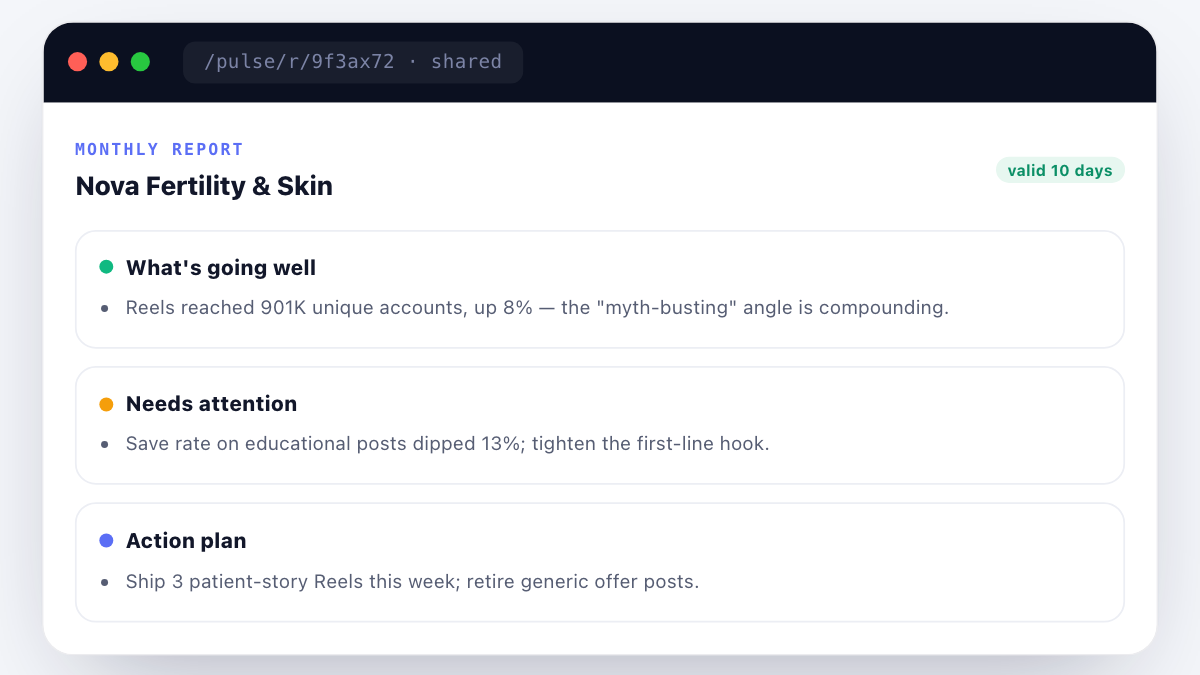 Prism Pulse client-shareable monthly report with what-is-working, needs-attention and action-plan sections signed off for a healthcare Instagram account" width="1200" height="675" loading="lazy" decoding="async" style="width:100%;height:auto;display:block;">

Book a free 30-minute Brand & Growth Diagnostic.
It's a working session, not a sales pitch — you leave with a written root-cause analysis you can act on, whether or not you engage ICG.
Questions readers ask
about this topic.
The three platforms
behind every ICG engagement.
Beacon
CAPI middleware that fixes Event Match Quality, translates CRM statuses to Meta-standard events, dedups across channels.
Agency OS
Live client dashboard. GSC, GA4, Google Ads, Meta Ads, IVR calls in one view. Login anytime, not monthly.
Phoenix
Clinic revenue intelligence over your PMS. Daily action queue: Prevent Loss, Maintain & Engage, Grow Revenue. Multi-centre rollout.
Or book a free 30-min audit to see all three in action on your account.
Healthcare brands
that already run on ICG.
A representative slice of the 150+ healthcare brands ICG has delivered for across India. Most engagements remain under NDA.


What ICG clients say · on video.
"Scale up of organic channels and business consulting. ICG has absolute domain authority in their field."
"Working with ICG transformed how we acquire IVF patients in Gurgaon. They understand the fertility journey from inquiry to consult..."
"What Ichelon accomplished — they got all my ideas and worked over 3-4 months to create an amazing, super-customised website."
The intelligence stack behind this playbook.
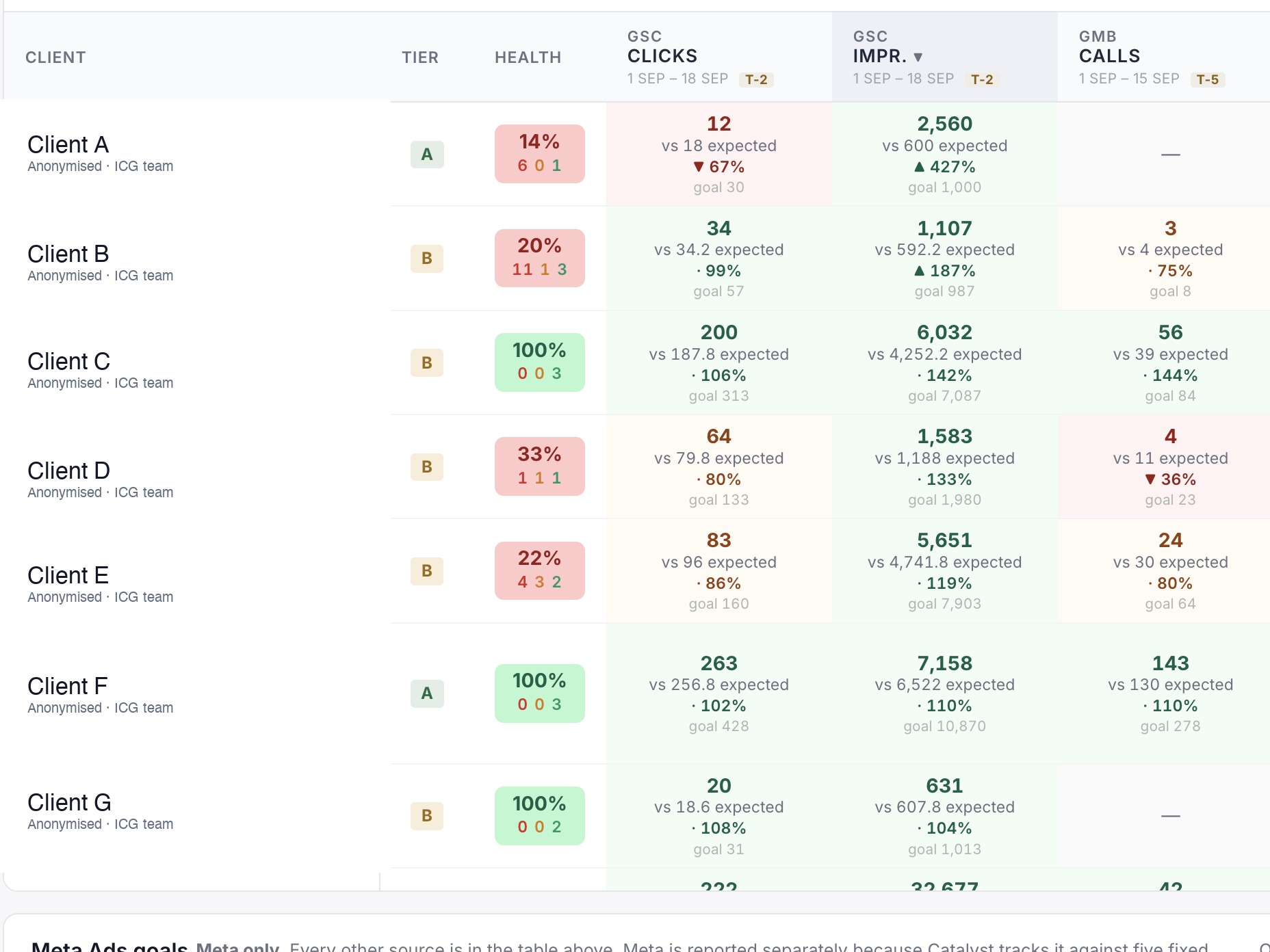
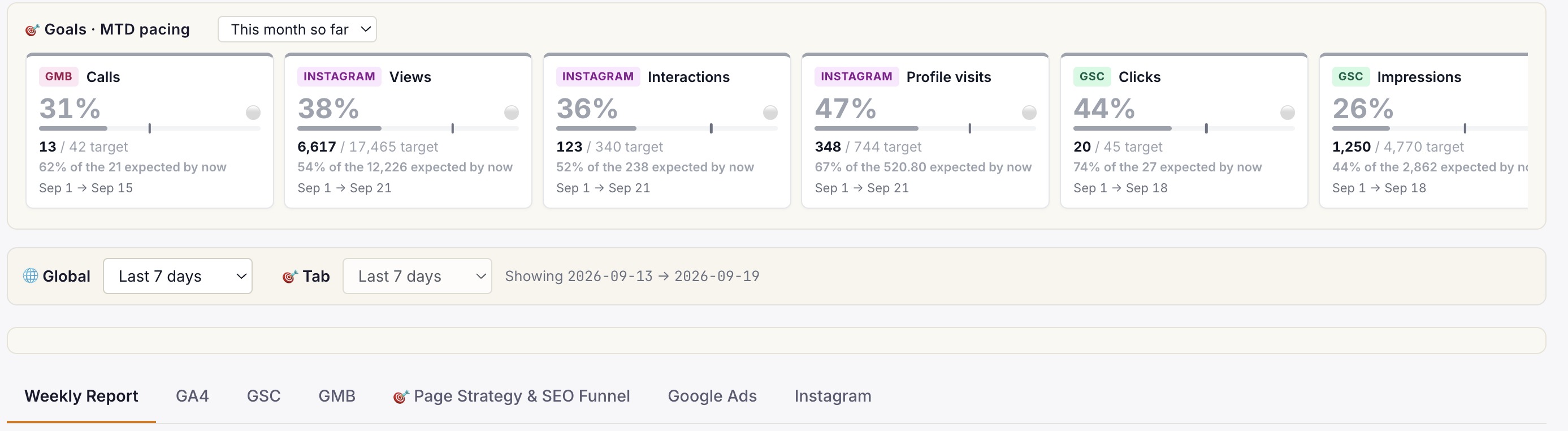
Every ICG engagement runs on the Search Intelligence Trifecta — Angryturtle for GMB, SIE for search and AI Overview, YODA for YouTube. Live product screens below.
Need help operationalising this?
Every ICG service is healthcare-only, NMC + DPDP-aware, and built around the patient-research patterns that drive Indian healthcare growth in 2026.
Every practice welcome — packages from ₹20,000/mo.
Goals-Driven engagements · Performance-Linked Payout Models available
More from
ICG.
Five trends shaping Indian healthcare marketing through 2027: AI-first patient research, Conversions API adoption, ABDM discovery, the AEO w...
Healthcare AIO is the discipline of getting your clinic or hospital cited inside Google AI Overviews, ChatGPT and Perplexity answers — not j...
Conversational-search advertising places brand messages inside AI chat answers — ChatGPT, Perplexity, Copilot — rather than beside a results...
Stop guessing.
Book a Diagnostic.
30 minutes. Free. With the AI-powered healthcare-only marketing agency 150+ brands already run on. No slides, no pitch, no hard close.


