


Healthcare Marketing Agency vs Digital Agency: 2026 Comparison
Compare a healthcare marketing agency vs a generic digital agency on compliance, CPQL, specialty depth, and ROI — with a 2026 decision framework and buyer checklist.
No pitch. Written root-cause diagnosis. AI-powered, healthcare only.
Direct answer
Compare a healthcare marketing agency vs a generic digital agency on compliance, CPQL, specialty depth, and ROI — with a 2026 decision framework and buyer checklist.
TL;DR
By Hanuman Sihag, Head of Innovation Chamber & SEO Lead at ICG.
Table of contents
What is different about a healthcare marketing agency?
A specialist healthcare marketing agency has structural capabilities that a generalist digital marketing agency cannot replicate without years of healthcare-only work:
YMYL compliance knowledge: the Indian Medical Council advertising guidelines, Meta Ads healthcare policy, Google's healthcare advertising restrictions, and the specific content rules for each specialty (before/after compliance for dermatology, success rate restrictions for IVF). Generalist agencies learn these by making expensive policy violations; specialist agencies already know them.
CPQL benchmarks: a healthcare-only agency knows that the average IVF CPQL in Delhi NCR in 2026 is ₹2,200 and that top-quartile is ₹1,120. A generalist agency has no comparable data. Without benchmarks, there is no way to tell whether a client's CPQL is excellent or terrible.
Patient lifecycle architecture: the IVF consideration cycle is 4-9 months. Hair transplant is 4-6 months. A LASIK decision takes 2-3 weeks. Each specialty requires a different nurture architecture. Generalist agencies apply a generic e-commerce-derived conversion funnel to all categories; healthcare specialists build specialty-specific lifecycle systems.
AEO for medical content: medical AEO requires MedicalClinic, Physician, MedicalProcedure, and MedicalCondition schema — not just standard FAQPage. It also requires medical-reviewer E-E-A-T compliance. Generalist agencies implementing AEO for healthcare content miss these requirements and produce schema that does not trigger health-specific AI citation.
The compliance dimension
Healthcare marketing compliance is not optional. Violations have consequences: Meta Ads accounts get restricted, Google Ads campaigns get disapproved, websites get manual actions from Google's quality review team. For a clinic spending ₹3 lakh/month on advertising, a week-long account restriction while compliance issues are resolved is a ₹75,000 revenue disruption.
ICG has not had a healthcare client account restricted for compliance violations in 7 years of healthcare-only practice. This is not luck. It is the result of understanding Indian Medical Council guidelines, platform-specific healthcare policies, and YMYL content standards well enough to produce compliant work the first time.
The benchmark dimension
The most powerful capability a specialist healthcare agency brings is benchmark data. Without it, a clinic has no context for evaluating its own performance. A CPQL of ₹1,800 for a dermatology clinic in Gurgaon could be excellent (if the benchmark is ₹2,500) or terrible (if the benchmark is ₹980). Without the benchmark, the clinic and its generalist agency cannot tell the difference.
ICG publishes healthcare CPQL benchmarks from its 150+ client portfolio precisely because this data is the foundation of every performance conversation. "Your IVF CPQL is ₹1,400 — that is 26% above our top-quartile benchmark of ₹1,120 but 36% below the market average of ₹2,200" is a diagnostic statement that leads to a specific intervention. "Your performance is good but could be better" is not.
The tool and tech dimension
A specialist healthcare agency has built or integrated the specific technology stack that healthcare marketing requires: lead management systems that handle CPQL at the stage level, AI patient lifecycle bots trained on healthcare-specific knowledge, AEO monitoring tools that track AI citation for medical queries, attribution platforms (like Beacon) that reconcile Meta CAPI with CRM data, and PMS integrations that connect patient outcomes to marketing spend.
A generalist agency uses tools designed for e-commerce, SaaS, or FMCG and applies them to healthcare. The tools are wrong for the problem. The result is data that looks right but measures the wrong things.
When a generalist agency works — and when it really does not
A generalist agency can work for healthcare when: the clinic's primary need is website development, social media content production (organic, not paid), or video production — functions where healthcare domain knowledge is less critical than creative and technical execution.
A generalist agency consistently fails in healthcare when: it runs paid advertising campaigns (CPQL benchmark blindness and compliance risk), when it produces clinical or procedure content (YMYL compliance failures), when it reports on performance (no CPQL context means no useful diagnosis), or when it implements schema for medical content (generic schema misses healthcare-specific schema requirements).
The cost of choosing wrong
ICG has onboarded healthcare clients who spent 18-24 months with generalist agencies before switching. The financial cost is the retainer and ad spend during that period — often ₹40-80 lakh in total investment. The larger cost is the opportunity cost: the 18-24 months of compounding SEO authority, CPQL improvement, AEO citation, and patient lifecycle automation that was not built during that period. A competitor who chose a specialist agency from the beginning has a 18-24 month head start that cannot be bought back.
Frequently asked questions
 Meta Catalyst IQ Audience Size analysis showing the fatigue and saturation curves for each audience segment in a Meta Ads account" width="1200" height="675" loading="lazy" decoding="async" style="width:100%;height:auto;display:block;">
What makes a healthcare marketing agency different?
Healthcare-only or healthcare-primary client base, CPQL benchmarking data from a real healthcare portfolio, specialty-specific knowledge of patient decision cycles, YMYL and IMC compliance expertise, medical schema implementation capability, and AEO for medical content. These cannot be approximated by a generalist agency without years of healthcare-only work.
Can a generalist agency do healthcare marketing?
For general brand and social content: yes. For paid acquisition, SEO, AEO, and performance marketing: no, not to the standard that specialist agencies deliver. The benchmark gap alone — not knowing what a good CPQL looks like for a given specialty — means that generalist agencies optimise toward the wrong targets.
How do I tell if an agency is genuinely healthcare-specialist?
Ask three questions: (1) "What is the average IVF CPQL in Delhi NCR from your client portfolio?" (2) "Can I see the diagnostic brief you produced for one of your healthcare clients before any campaign started?" (3) "What is your process for YMYL compliance review of healthcare content?" If they cannot answer all three specifically, they are generalists.
Are specialist healthcare agencies more expensive?
Not significantly. ICG engagements start at ₹1.5 lakh/month — comparable to mid-tier generalist agency retainers. The difference is not cost; it is the CPQL outcome. At equal cost, a specialist healthcare agency produces a CPQL 30-50% below what a comparably-priced generalist achieves because of benchmark intelligence, compliance efficiency, and lifecycle architecture.
What should I look for in a healthcare marketing agency's portfolio?
Look for: named healthcare clients across multiple specialties (not one or two case studies), specific CPQL data shared publicly (benchmark publications or case study metrics), evidence of AEO capability (does the agency appear in AI Overviews for healthcare queries?), and publications or research about healthcare marketing (thought leadership requires genuine domain expertise).
Should I use the same agency for all healthcare specialties?
If the agency works across multiple specialties and has benchmark data for each, yes. A single agency with cross-specialty visibility can identify patterns — that the CPQL improvement achieved for IVF also applies to dermatology with modifications, or that the YouTube authority strategy that works for hair transplant adapts well to plastic surgery. Cross-specialty intelligence is a genuine advantage.
The tool ICG uses to run this at scale: Angryturtle
ICG runs local SEO and GBP intelligence for 150+ Indian healthcare brands using Angryturtle — our own AI-native GBP intelligence and management OS. The platform scores every profile 0-100 via a proprietary Rank OS model with five weighted dimensions (Relevance, Review Health, Freshness, Entity Authority, AIO Readiness), publishes edits, Posts, media, and review replies directly to Google, and includes Ask Maps AIO Readiness scoring for Google AI Overviews and ChatGPT visibility.
 angryturtle/05-demand-clusters.png" alt="Angryturtle Demand Clusters —
 Available in two shapes: self-serve at ₹999/- per month for solo owners with 1-2 profiles, and ICG's managed service from ₹25,000/- per month where our healthcare specialists execute inside the same platform. Both are anchored in the Healthcare Local SEO Agency India pillar page which has full scope, methodology and pricing.
Book a demo on WhatsApp → or start a free trial at angryturtle.ai →
Side-by-side scorecard: healthcare agency vs generic digital agency
Most clinic and hospital founders don't need a philosophical debate — they need a scorecard they can hand to a partner or an internal team. Below is the exact framework ICG's Client Elevation Programme uses when a hospital group asks us to review a shortlist of agencies before signing.
| Dimension | Generic digital agency | Healthcare-specialist agency |
|---|---|---|
| DCI / MCI / NMC ad-code review | Rare — usually learned after a takedown | Pre-flight on every creative and landing page |
| CPQL benchmarks by specialty | Blended across industries | Segmented: IVF, dental, aesthetics, ortho, oncology |
| Consent + patient-data handling | Standard form pixel | Consent-first lead capture, DPDP-aware routing |
| Creative reviewer | Copywriter | Clinician-reviewed claims |
| Reporting layer | Ad-platform dashboards | Lead-quality + conversion-to-consult |
When a generic digital agency is actually the right call
Not every healthcare brand needs a specialist on day one. If you're a pharma OTC brand running pure awareness, a wellness product with no medical claims, or a hospital HR team hiring for a careers site, a strong generalist can perform. The moment your funnel touches a diagnosis, a doctor's name, a procedure price, or a patient testimonial, the compliance load flips and the specialist premium pays for itself.
How ICG operationalises the specialist edge
- Local visibility — Angryturtle runs the Google Business Profile OS across every branch so map-pack leads compound without a monthly retainer sink.
- Paid-media intelligence — Prism Spy mines competitor Meta Ads libraries so your creative rotation lands on hooks already validated in the specialty.
- Video authority — YODA ships AI-native healthcare YouTube so doctors rank on the queries patients search before they walk in.
The point isn't the tool stack — it's that a healthcare-marketing agency owns the compliance, the specialty benchmarks, and the operating system. A generic digital agency owns the media buy. For most Indian clinics and hospital groups scaling past the first crore of annual marketing spend, that difference is worth the switch. WhatsApp Rohit if you want a second opinion on a shortlist you're already reviewing.
Book a free 30-minute Brand & Growth Diagnostic.
It's a working session, not a sales pitch — you leave with a written root-cause analysis you can act on, whether or not you engage ICG.
Questions readers ask
about this topic.
The three platforms
behind every ICG engagement.
Beacon
CAPI middleware that fixes Event Match Quality, translates CRM statuses to Meta-standard events, dedups across channels.
Agency OS
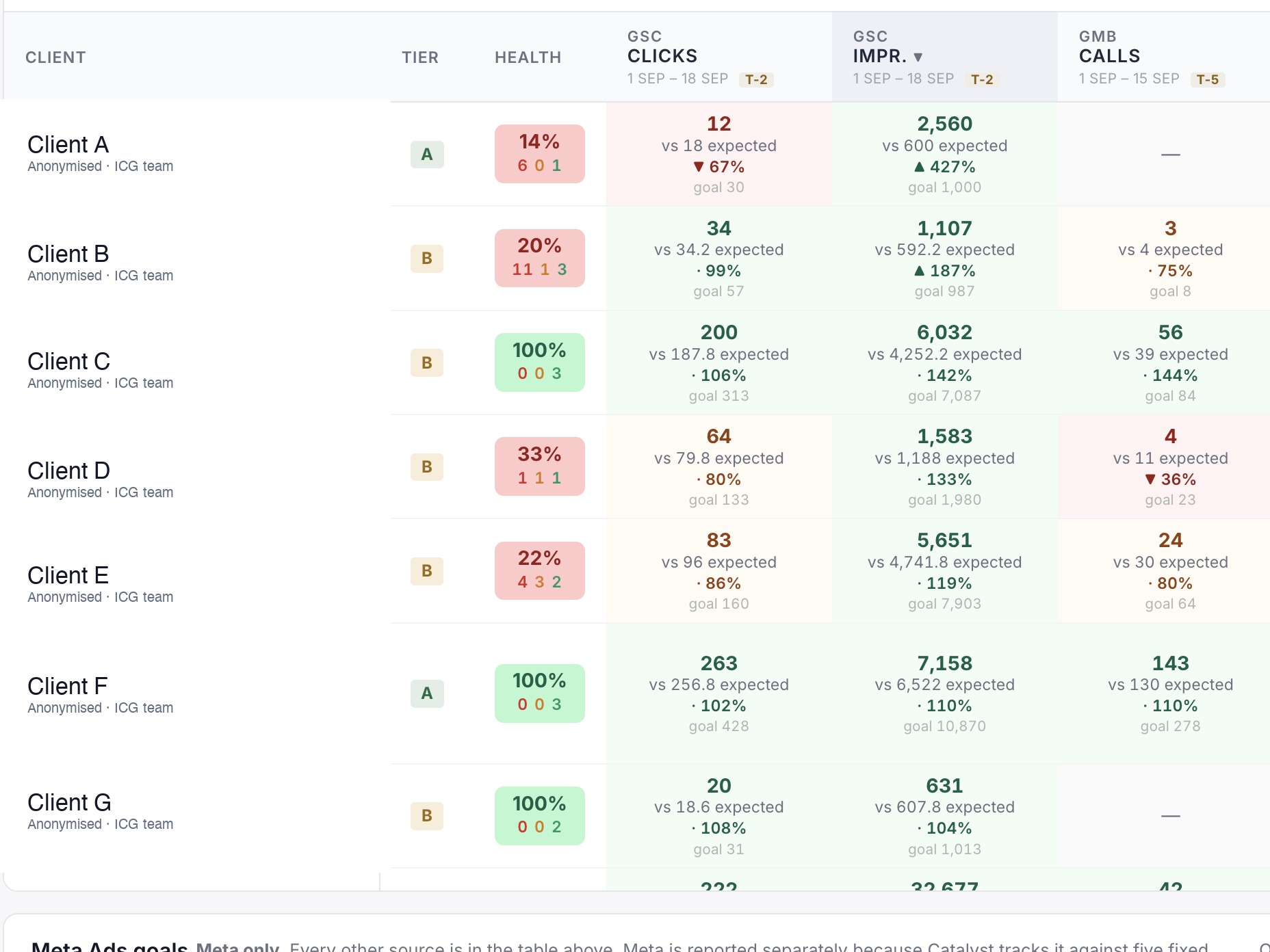
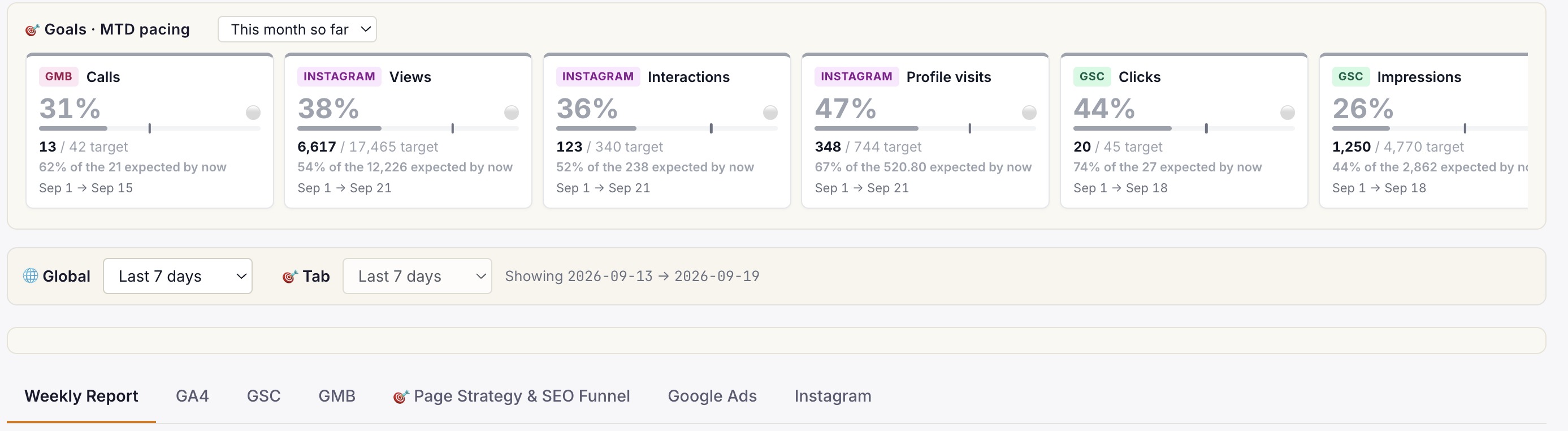
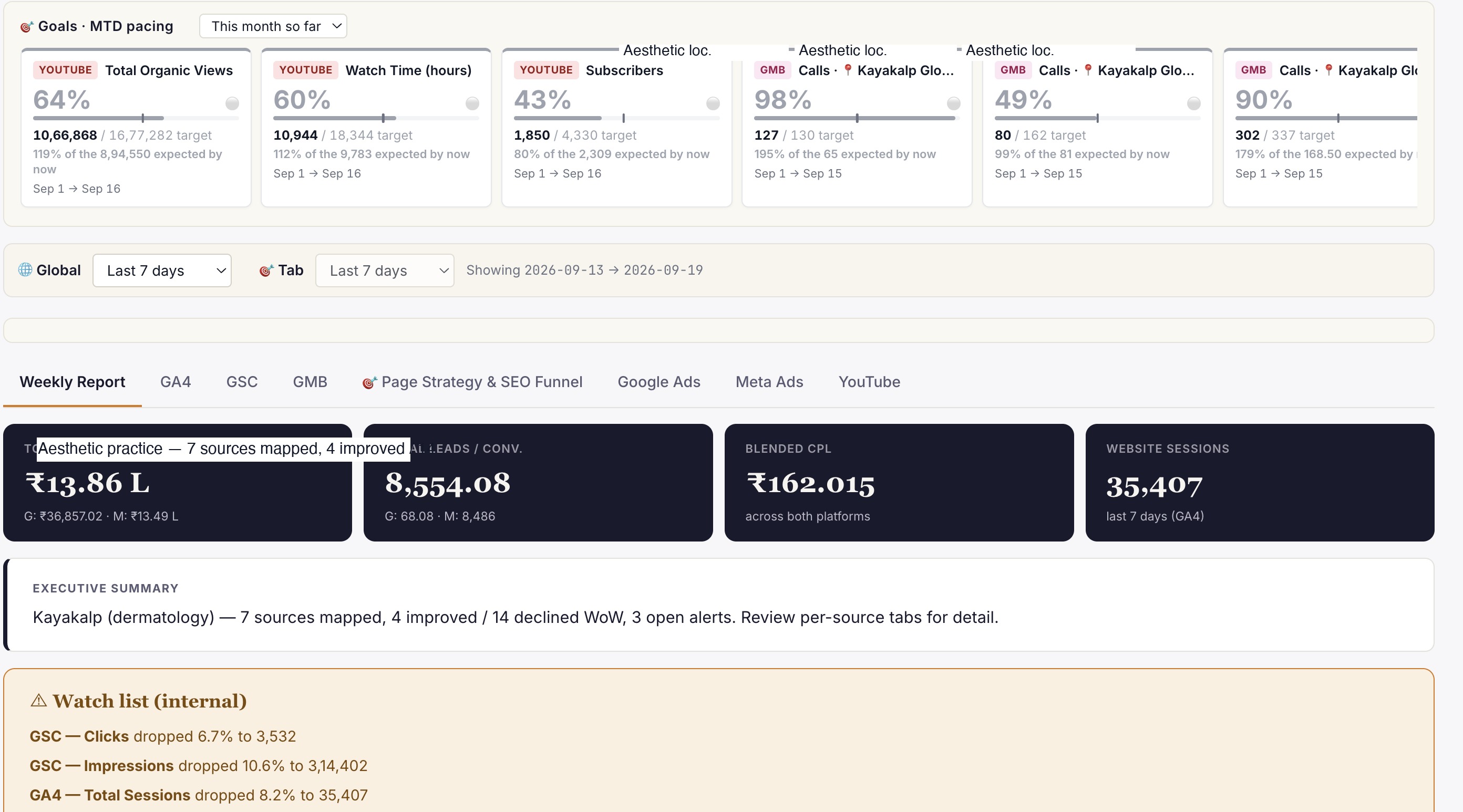
Live client dashboard. GSC, GA4, Google Ads, Meta Ads, IVR calls in one view. Login anytime, not monthly.
Phoenix
Clinic revenue intelligence over your PMS. Daily action queue: Prevent Loss, Maintain & Engage, Grow Revenue. Multi-centre rollout.
Or book a free 30-min audit to see all three in action on your account.
Healthcare brands
that already run on ICG.
A representative slice of the 150+ healthcare brands ICG has delivered for across India. Most engagements remain under NDA.


What ICG clients say · on video.
"Scale up of organic channels and business consulting. ICG has absolute domain authority in their field."
"Working with ICG transformed how we acquire IVF patients in Gurgaon. They understand the fertility journey from inquiry to consult..."
"What Ichelon accomplished — they got all my ideas and worked over 3-4 months to create an amazing, super-customised website."
Need help operationalising this?
Every ICG service is healthcare-only, NMC + DPDP-aware, and built around the patient-research patterns that drive Indian healthcare growth in 2026.
Every practice welcome — packages from ₹20,000/mo.
Goals-Driven engagements · Performance-Linked Payout Models available
More from
ICG.
Five trends shaping Indian healthcare marketing through 2027: AI-first patient research, Conversions API adoption, ABDM discovery, the AEO w...
Healthcare AIO is the discipline of getting your clinic or hospital cited inside Google AI Overviews, ChatGPT and Perplexity answers — not j...
Conversational-search advertising places brand messages inside AI chat answers — ChatGPT, Perplexity, Copilot — rather than beside a results...
Stop guessing.
Book a Diagnostic.
30 minutes. Free. With the AI-powered healthcare-only marketing agency 150+ brands already run on. No slides, no pitch, no hard close.


