


Dermatology Meta Ads Creative Strategy in India: What Actually Works in 2026
A working playbook for Indian dermatology clinics, agencies, and hospital marketing teams building Meta ads creative in 2026 — formats, hooks, before-after handling under Meta and Indian ad policy, DPDP-safe workflows, city-level CPQL benchmarks, and a 30-day testing sprint you can copy.
No pitch. Written root-cause diagnosis. AI-powered, healthcare only.
Direct answer
A working playbook for Indian dermatology clinics, agencies, and hospital marketing teams building Meta ads creative in 2026 — formats, hooks, before-after handling under Meta and Indian ad policy, DPDP-safe workflows, city-level CPQL benchmarks, and a 30-day testing sprint you c...
TL;DR
TL;DR
- Dermatology creative on Meta dies in India for three repeatable reasons: over-claim in copy, careless before-and-after handling, and generic Hindi-English mixing that reads translated instead of native.
- The formats winning in 2026 are 9-15 second doctor-led Reels, static carousels framed as concern-to-outcome, and slower 30-45 second brand-story videos reserved for retargeting.
- Tier 1 dermatology CPQL sits at roughly Rs 380-620 for cosmetic dermat and Rs 180-340 for medical dermat. Tier 2 cities run 30-45 percent lower on both.
- DPDP Act compliance now demands consent-first creative, especially for user-generated before-and-after clips and testimonial reuse.
Table of contents
- Why does dermatology Meta creative fail more often than other healthcare verticals?
- What creative formats work for dermatology in India in 2026?
- How should we handle before-and-after imagery under Meta and Indian ad policy?
- What hooks convert Tier 1 versus Tier 2 city audiences?
- How do we structure a 30-day creative testing sprint for a dermatology clinic?
- What does a healthy dermatology Meta CPQL look like in India?
- How does the DPDP Act change dermatology ad creative in 2026?
- How does ICG approach dermatology Meta creative differently?
Why this matters for Indian dermatology marketers right now
Dermatology in India is quietly the most commercially crowded pocket of healthcare on Meta. Hair, acne, pigmentation and anti-ageing are being fought over by standalone clinics, chain brands, cosmetology setups, and D2C skincare labels bidding on the exact same intent. If you run marketing for a dermat brand or manage the account for one, you already know the ad account gets loud fast and cheap creative burns out inside three weeks.
What changed in 2026 is not the audience. It is the enforcement layer. Meta has tightened its health-and-medical creative reviews for Indian advertisers through the year, and the DPDP Act is now shaping consent, retention and testimonial reuse in ways your agency contract probably has not caught up with. Add the NMC's continuing scrutiny of exaggerated cosmetic claims, and the room for lazy creative has shrunk sharply.
The good news: the clinics that treat creative as a system, not as a monthly deliverable, are pulling clean unit economics. This piece is the playbook we use with dermat clients across Bengaluru, Mumbai, Pune, Hyderabad, Chandigarh and Kochi in 2026. It is written for hospital marketing directors, agency owners, and clinic-owner doctors who treat their practice as a business.
Why does dermatology Meta creative fail more often than other healthcare verticals?
Dermatology creative fails because it triggers three problems at once: category-level ad policy sensitivity, an image-heavy format that invites over-promise, and a saturated auction that punishes generic hooks within days. Fix any two and you still lose. All three have to move.
Compare it to, say, dental or IVF. Dental creative can lean on smile transformations without stepping on Meta's medical claims line because the outcome is culturally understood as cosmetic. IVF has an emotionally cohesive story arc that carries a Reel on its own. Dermatology sits awkwardly between medical and cosmetic, so every claim you make is being judged twice: once by Meta's automated review, once by the viewer's scepticism.
The clinics that struggle most are the ones running the same three ads for six weeks, refreshing only the caption. In the healthcare accounts we audited between January and July, dermat ads decayed 40-55 percent faster on CTR than the account average. That is not a bidding problem. It is a creative volume problem.
What creative formats work for dermatology in India in 2026?
Three formats are pulling weight on Indian dermat accounts in 2026: doctor-led Reels at 9-15 seconds for cold prospecting, concern-to-outcome static carousels for consideration, and 30-45 second story videos for retargeting. Everything else is either a variant of these or a nostalgic hangover from 2023.
Doctor-led short Reels
The consultant on camera, in the clinic, speaking directly to the concern. Not to a script that reads like a brochure. The best-performing hook we see is the doctor saying the concern out loud in the patient's language: "aapke baalon ka thinning agar six months se badh raha hai to..." Then a specific, honest observation, then a soft CTA. No jump cuts. No text-heavy overlays. Meta's auction rewards watch-time completion, and dermat viewers watch a doctor's face longer than they watch stock footage.
Concern-to-outcome carousels
Slide one names the concern in plain language. Slides two and three explain what the clinic actually does about it — the diagnostic step, the procedure, the follow-up. Slide four is a soft social proof card. Slide five is the ask. Static carousels are still the highest-intent format for booking-focused campaigns in Tier 1 India, especially for premium price points where the viewer wants to read before they tap.
Retargeting story videos
These are for people who already visited the site or engaged with the Reel. Longer format, calmer pace, real patient walk-through where consent is properly documented, real doctor voiceover. Frequency is where these earn their keep. A 30 second retargeting film shown three or four times to a warm audience converts at 2-3x cold prospecting on our accounts.
How should we handle before-and-after imagery under Meta and Indian ad policy?
Before-and-after imagery is not banned outright in India, but Meta's ad reviewers apply near-zero tolerance to before-after that implies guaranteed outcomes, single-session transformations, or unrealistic contrasts. Add NMC's advertising guidance and DPDP consent obligations on top, and the workflow has to change.
Our working rule with dermat clients in 2026: never place a before-after directly in a cold prospecting ad. Use them only in the middle of a Reel narrative where the doctor is explaining the process, or on landing pages behind a soft gate. When they must appear in creative, they need to be paired with visible session count, timeline, and a written note that individual results vary — not as fine print, but as spoken audio inside the Reel.
On the consent side, DPDP now makes it explicit: you need documented consent to use a patient's image in advertising, that consent has to be specific to the purpose, and the patient can withdraw it. That means your creative library needs a live consent register with expiry dates. If a piece of before-after creative has been running for eleven months and consent was for six, you are exposed. We keep this in AtomCRM as a custom object tied to the patient record so the marketing team cannot pull a piece of user-generated content into rotation without seeing the consent status first.
What hooks convert Tier 1 versus Tier 2 city audiences?
Tier 1 dermat audiences respond to specificity and credentialing: named consultants, specific technology, transparent pricing bands. Tier 2 audiences respond to trust proxies and outcome language: familiar-looking patients, local language, before-and-during storytelling instead of before-and-after.
Concretely, a Bengaluru hair-restoration clinic doing well on Meta is often leading with something like "consulted with our senior trichologist, twelve-month plan, transparent per-session cost." The same clinic's Coimbatore branch does better with "yaar ke suggestion pe aayi thi, ab family bhi aati hai" — the trust-through-familiarity angle.
Hindi-English mixing needs a mention. Most dermat ads we see in Indian accounts are written in what looks like Hindi copy translated from English by a marketing coordinator who does not speak Hindi as a first language. It reads flat and it kills conversion. If you cannot afford a native copywriter for every language, write the ad in English and let the doctor speak it in their language on the Reel. That is more honest than fake vernacular and it performs better.
How do we structure a 30-day creative testing sprint for a dermatology clinic?
A 30-day sprint for a dermat account should ship 18-24 creative variants across three concern areas, run each variant for 5-7 days at meaningful spend, kill the bottom 40 percent by day 10, and use days 20-30 to iterate on the two strongest hooks with format changes rather than message changes.
Week one: concept sprint
Pick three concerns the clinic actually treats profitably. Not the ones the doctor is proudest of — the ones with cash margin. For a mid-sized cosmetic dermat setup in Pune we worked with recently, that meant pigmentation, laser hair reduction, and acne scar revision, in that order. Build six creative variants per concern: two doctor Reels, two carousels, two testimonial or process videos.
Week two: filter
Run each variant for 5-7 days. Do not judge on CTR alone. The metric that matters for dermat is landing-page-to-consult-booking rate, and that only stabilises after 40-60 clicks per variant. Kill anything below the account median on that combined metric.
Week three: double down
Take the top two hooks and produce three format variants of each: a shorter cut, a version with a different opening line, and a version with a different CTA. This is where competitor creative intelligence from Prism Spy earns its keep — you can see what neighbouring dermat brands are running and what has been running the longest, which is a proxy for what is working for them.
Week four: retargeting build
Use the last week to build the retargeting layer: 30-45 second films for anyone who watched more than 50 percent of the prospecting Reels. Cap frequency at three per week. This is usually where CPQL drops sharply in the second month.
What does a healthy dermatology Meta CPQL look like in India?

Healthy CPQL for dermatology on Meta in India in 2026 depends on subcategory and city tier. Cosmetic dermat in Tier 1 metros runs Rs 380-620 per qualified lead when creative and landing pages are tight. Medical dermat runs Rs 180-340 in the same cities. Tier 2 CPQLs are 30-45 percent lower across the board.
Two caveats matter more than the numbers. First, qualified lead has to be defined properly — a phone number is not a lead. We use consulted-and-scheduled as the definition, which usually means CPQL numbers look 2-3x higher than what agencies advertise, but they are honest.
Second, hair-restoration and body-contouring behave more like high-ticket cosmetic categories than dermat. Expect Rs 900-1,400 per genuinely qualified lead for hair transplant campaigns in Delhi NCR, and treat anything under Rs 700 as suspect until you have verified it converts to consult and case.
How does the DPDP Act change dermatology ad creative in 2026?
DPDP forces three changes to your creative workflow: consent has to be documented and purpose-specific, retention windows for patient likeness in creative must be finite, and any custom-audience uploads from your CRM to Meta need a lawful basis and a data processing record. Ignoring these is not a small risk in 2026.
What that looks like operationally: your creative library needs a consent field per asset, your ads manager needs a review cadence tied to consent expiry, and your CRM-to-Meta sync needs to be audited every quarter. The clinics we onboard in 2026 spend the first two weeks cleaning this up before we ship creative, because the ABDM ecosystem is pushing the whole industry toward auditable patient-data handling regardless of DPDP enforcement dates.
How does ICG approach dermatology Meta creative differently?
Most agencies treat Meta creative as a monthly output problem. We treat it as a system with four moving parts: creative volume, hook library, consent register and competitor signal. Meta Catalyst IQ is our internal Meta Ads engine that ties these four together, so a creative brief starts with what is already tested in the account, what neighbouring dermat brands are running via Prism Spy, and what the clinic's own consent register allows us to publish.
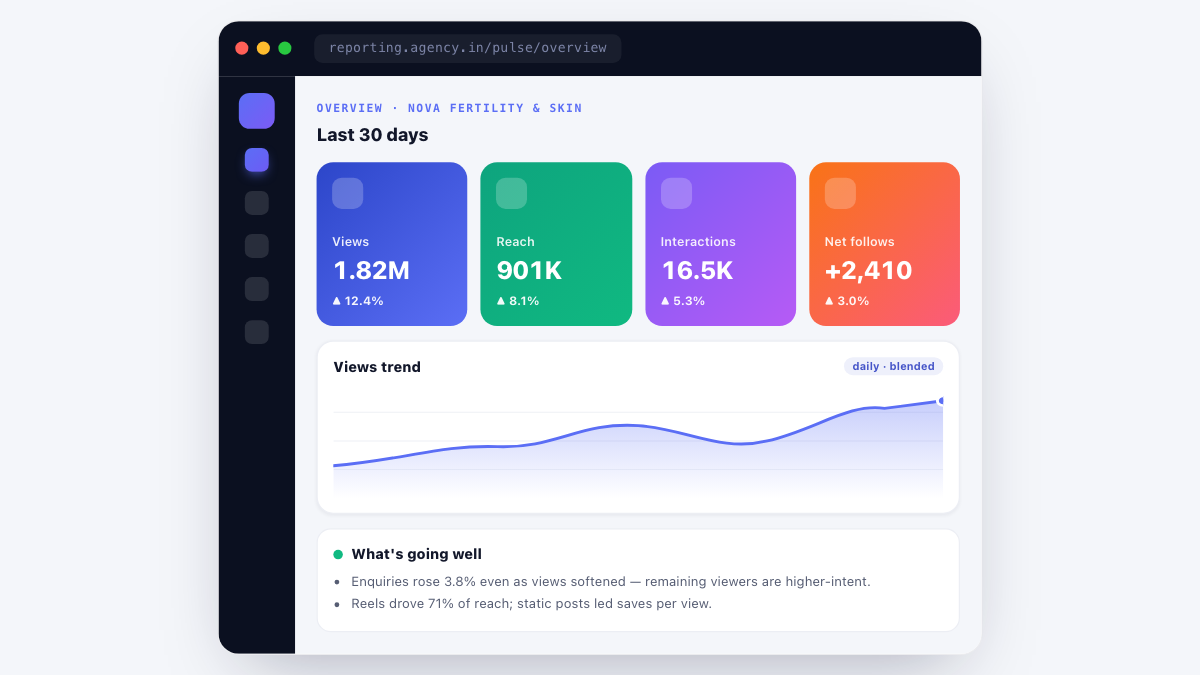
Instagram-side, Prism Pulse gives us organic-content signal that feeds back into paid — a doctor Reel that performs organically almost always outperforms the same clip written by a coordinator, and Prism Pulse tells us which organic hooks are earning real saves and shares rather than vanity likes. On the lead side, AtomCRM sits between the ads and the consult desk, so the definition of qualified lead is enforced at the source and creative decisions are made on consult-to-case data instead of raw form fills.
Where the 70-30 model fits for dermatology accounts

For clinics and hospital groups building a full Meta and paid social programme, ICG runs a 70-30 fixed-variable model with three anchor tiers: Foundation at Rs 49,999 per month, Growth at Rs 74,999 per month, and Scale at Rs 99,999 per month. Seventy percent is a fixed retainer covering strategy, creative, media buying and reporting. Thirty percent is tied to a twelve-month outcome target agreed at kickoff — usually a blended CPQL band and a consult-to-case conversion floor. For Meta budgets above Rs 5 lakh a month the same model extends into media management, so incentives stay aligned with unit economics rather than with vanity metrics.
A short checklist before you ship your next dermat Meta creative
- Is the doctor on camera, and are they saying the concern in the viewer's language rather than a marketing tagline?
- Is every claim in the ad defensible if a Meta reviewer or an NMC-aware peer pulls it up?
- Is the before-and-after paired with session count, timeline, and a note that individual results vary — spoken, not in fine print?
- Is the consent for every identifiable patient in the creative logged with expiry, and is it currently valid?
- Is the lead definition on the landing page consult-and-scheduled, or are you counting phone numbers?
- Do you have at least six live variants per concern area, and are you killing the bottom 40 percent by day 10?
If the answer to any of those is no, the fix is upstream of the ad account. Sort that first, then spend.
Book a free Meta ads account audit.
Raman Soni's team pulls your account, checks CAPI/EMQ, reviews creative for NMC compliance, and shows where CPQL is leaking. 45 minutes, actionable output.
Questions readers ask
about this topic.
The three platforms
behind every ICG engagement.
Beacon
CAPI middleware that fixes Event Match Quality, translates CRM statuses to Meta-standard events, dedups across channels.
Agency OS
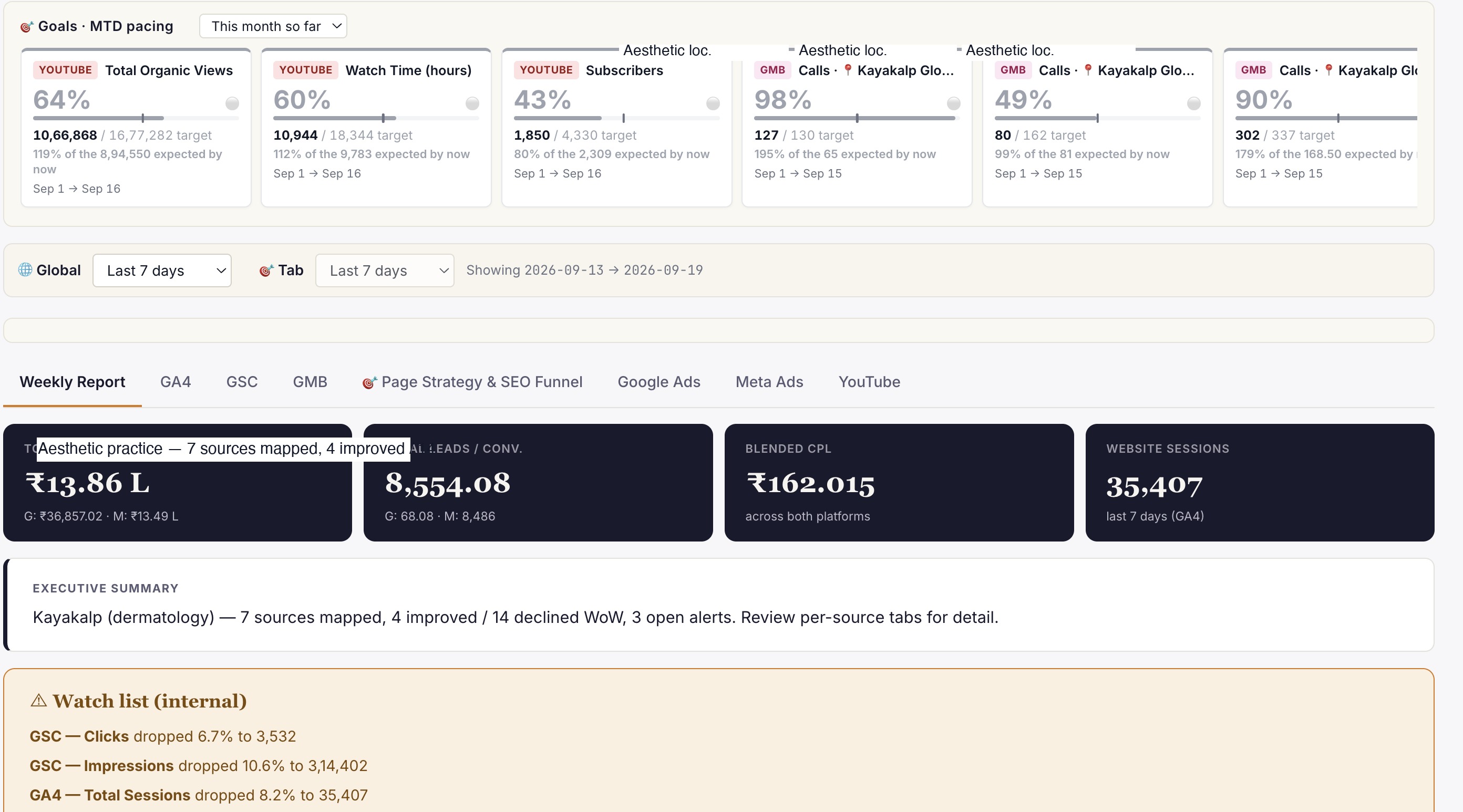
Live client dashboard. GSC, GA4, Google Ads, Meta Ads, IVR calls in one view. Login anytime, not monthly.
Phoenix
Clinic revenue intelligence over your PMS. Daily action queue: Prevent Loss, Maintain & Engage, Grow Revenue. Multi-centre rollout.
Or book a free 30-min audit to see all three in action on your account.
Healthcare brands
that already run on ICG.
A representative slice of the 150+ healthcare brands ICG has delivered for across India. Most engagements remain under NDA.


What ICG clients say · on video.
"Scale up of organic channels and business consulting. ICG has absolute domain authority in their field."
"What Ichelon accomplished — they got all my ideas and worked over 3-4 months to create an amazing, super-customised website."
"Working with ICG felt like working with an in-house growth team that happens to specialise in healthcare."
Need help operationalising this?
Every ICG service is healthcare-only, NMC + DPDP-aware, and built around the patient-research patterns that drive Indian healthcare growth in 2026.
Every practice welcome — packages from ₹20,000/mo.
Goals-Driven engagements · Performance-Linked Payout Models available


More from
ICG.
Five trends shaping Indian healthcare marketing through 2027: AI-first patient research, Conversions API adoption, ABDM discovery, the AEO w...
Healthcare AIO is the discipline of getting your clinic or hospital cited inside Google AI Overviews, ChatGPT and Perplexity answers — not j...
Conversational-search advertising places brand messages inside AI chat answers — ChatGPT, Perplexity, Copilot — rather than beside a results...
Stop guessing.
Book a Diagnostic.
30 minutes. Free. With the AI-powered healthcare-only marketing agency 150+ brands already run on. No slides, no pitch, no hard close.


