


Dental YouTube Marketing Strategy India 2026: A Founder's Playbook
Indian dental clinics are moving spend from directory listings to YouTube because a two-minute explainer now outsells a ten-year-old brochure. This playbook covers the exact video mix, budget bands, SEO signals, and DPDP-safe scripting we use for clinics from Mumbai to Guwahati.
No pitch. Written root-cause diagnosis. AI-powered, healthcare only.
Direct answer
Indian dental clinics are moving spend from directory listings to YouTube because a two-minute explainer now outsells a ten-year-old brochure. This playbook covers the exact video mix, budget bands, SEO signals, and DPDP-safe scripting we use for clinics from Mumbai to Guwahati.
TL;DR
Dental YouTube marketing in India in 2026 is no longer a "nice-to-have" branding exercise. It is now the single highest-intent, lowest-cost-per-qualified-lead channel available to a private dental clinic or DSO in India, sitting above Google Ads, Meta Ads and any directory play we have measured across 150+ live clinic accounts. This playbook is written for clinic owners, hospital marketing heads and healthcare agency teams who want a working operating system, not a listicle.
TL;DR
- YouTube is now the cheapest qualified enquiry channel for Indian dental clinics in Tier-1 and Tier-2 cities, with cost-per-qualified-lead (CPQL) between Rs 180 and Rs 640 versus Rs 900 to Rs 2,400 on Meta Ads for the same specialties.
- The winning content mix is 60% procedure explainers, 20% doctor point-of-view, 10% patient story reels ported to Shorts, and 10% pricing and finance transparency videos.
- Budgets start at Rs 35,000 per month for a single-branch clinic; multi-city DSOs typically run Rs 1.5 lakh to Rs 4 lakh per month blended across production, YouTube Ads and channel management.
- Compliance matters: the NMC Professional Conduct Regulations, DPDP Act 2023, and ABDM interoperability rules all shape what a dental video can and cannot say on the record.
Table of contents
- Why YouTube is the highest-intent channel for Indian dental clinics in 2026
- Which dental video formats actually convert Indian enquiries?
- How should an Indian dental clinic structure its YouTube channel?
- How much should a dental clinic in India spend on YouTube marketing?
- What YouTube SEO signals matter most for dental keywords in India?
- How do you measure ROI of dental YouTube marketing?
- Which NMC and DPDP rules apply to dental video marketing?
- How does ICG approach dental YouTube marketing differently?
- The 70-30 pricing model for dental YouTube retainers
- FAQ
Why is YouTube the highest-intent channel for Indian dental clinics in 2026?
YouTube is the highest-intent channel because Indian patients now research every dental procedure over Rs 15,000 on video before they enquire, and roughly 71% of that research happens in Hindi, Tamil, Telugu, Marathi or Bengali rather than English. No other channel meets a nervous patient in their own language, at their own pace, with a real doctor on screen.
Across ICG's 150+ clinic rollouts, we see a repeatable pattern. A patient searches "root canal cost in Pune" or "clear aligners kitne ka hai" on their phone. Google shows a Map Pack and a YouTube carousel above the traditional blue links. The click-through on the YouTube carousel is now materially higher for procedure-cost queries, because a video answers the trust question and the price question in a single tap. Directory listings, by comparison, force the patient to pick between eleven identical clinics with no context.
The second reason is cost. Indian YouTube CPMs for the "Health" audience segment in 2026 sit between Rs 42 and Rs 110, roughly a third of what a comparable Meta Reel placement costs a healthcare advertiser after iOS attribution loss. When you combine organic discovery, in-feed ads and YouTube Shorts, the blended CPQL is unbeatable in the specialties patients openly Google: aligners, implants, smile makeovers, paediatric dentistry and full-mouth rehabilitation.
Which dental video formats actually convert Indian enquiries?
The five formats that convert in the Indian market are: procedure explainers, doctor point-of-view walkthroughs, before-and-after case narrations, transparent pricing videos, and vernacular Shorts. Everything else is nice, but these five carry the funnel.
Procedure explainers are the workhorse. A three-to-five-minute Hindi or bilingual video that answers "what happens step by step when I get a dental implant" outperforms a slick brand film by 8 to 12x on watch-through rate. The Indian patient's biggest anxiety is "pain, cost, days off work" and the video that names those three things in the first fifteen seconds wins the session.
Doctor POV videos put the treating dentist on camera, ideally shot vertically on a good phone with lav mics. These do disproportionately well in Tier-2 cities like Jaipur, Coimbatore, Nagpur and Kochi because patients still choose a clinic on the doctor's warmth as much as the credentials.
Before-and-after case narrations must be handled carefully under NMC guidelines (we discuss this below), but a case walk-through in the doctor's voice, with generic clinical outcomes rather than testimonial claims, remains legal and highly persuasive.
Pricing transparency videos are a rare unlock. Most clinics refuse to publish prices. The clinic that publishes an honest range for the ten most searched procedures in its city typically sees a 30-45% jump in qualified enquiries within 90 days, because the patient self-qualifies before calling.
Vernacular Shorts complete the funnel by capturing the low-consideration searches: "wisdom tooth pain remedy", "teeth whitening after wedding", "kids first dentist visit". These feed the main channel's subscriber base cheaply.
How should an Indian dental clinic structure its YouTube channel?
Structure the channel around three pillars: Procedures, People and Pricing. Every video must map to one of these pillars, be tagged with a city and a specialty, and drive to a single WhatsApp CTA rather than a phone number. Ambiguity kills conversion here.
The Procedures pillar houses your explainers, one per major treatment: RCT, implants, aligners, veneers, paediatric care, full-mouth rehab, gum surgery, wisdom extraction and cosmetic bonding. Every explainer must exist in two versions: a 3-5 minute long-form for search, and a 30-45 second Shorts version for discovery.
The People pillar houses doctor introductions, clinic tours, team profiles and behind-the-scenes footage. A "Meet Dr X" video shot well can serve as an evergreen trust asset for years and typically becomes the highest-conversion video on a clinic's channel.
The Pricing pillar is where most Indian clinics leave money on the table. Publish a monthly or quarterly "cost of dental treatment in [your city] 2026" video with honest ranges, and update the same video URL rather than uploading a new one, so you compound authority on a single asset.
On thumbnails, avoid the American style of open mouths and shocked faces. Indian patients respond better to a clean thumbnail showing the doctor, a two-word treatment label in Devanagari or the local script, and the city name. It sounds simple; almost no dental channel in India does it.
How much should a dental clinic in India spend on YouTube marketing?
A single-branch clinic in a Tier-1 city should budget Rs 35,000 to Rs 75,000 per month for a serious YouTube programme. A multi-branch DSO or hospital dental department typically spends Rs 1.5 lakh to Rs 4 lakh per month when video production, YouTube Ads and channel operations are combined.
The economics only work when the split is disciplined. Our benchmark across 150+ clinics is roughly 40% to production (scripting, shoot, edit, thumbnails, translations), 35% to YouTube Ads (in-feed, in-stream and Shorts), and 25% to operations (SEO, community management, analytics, monthly reporting).
Under-investing on production is the classic mistake. A clinic that spends Rs 60,000 on ads but only Rs 5,000 on the actual video will lose to a clinic doing the opposite. YouTube's algorithm compounds around watch time, and watch time only comes from videos that are worth watching.
What YouTube SEO signals matter most for dental keywords in India?
The signals that move the needle in 2026 are: exact-match Hindi/vernacular titles, 45-second retention above 65%, city-plus-specialty tags, chaptered timestamps, and closed captions in at least two languages. Optimising for these five will beat generic "YouTube SEO checklist" advice every time.
Title matters more than description. A title like "Dental implant cost in Bangalore 2026 (Hindi mein)" will out-index a beautifully written English-only title, because YouTube's search index in India increasingly favours mixed-script queries. Include the city name and the year for evergreen dental content.
Retention beats keywords. YouTube's ranking function heavily weights how many viewers are still watching at the 45-second mark. Front-load the answer, do not build to it. Every dental video should say the price range, the pain question and the days-off answer inside the first 30 seconds, then earn the deeper watch.
Chapters and timestamps are underused. Adding timestamps like "0:00 Overview / 1:20 Cost / 2:45 Pain / 4:10 Recovery" gives YouTube semantic hooks and gives patients a way to skip to the section they came for, both of which lift session watch time.
Closed captions in two languages, ideally English plus one Indian language, unlock a second wave of impressions from search. This is where our YODA workflow generates most of its incremental impressions once a video has been live for 30 days.
How do you measure ROI of dental YouTube marketing?
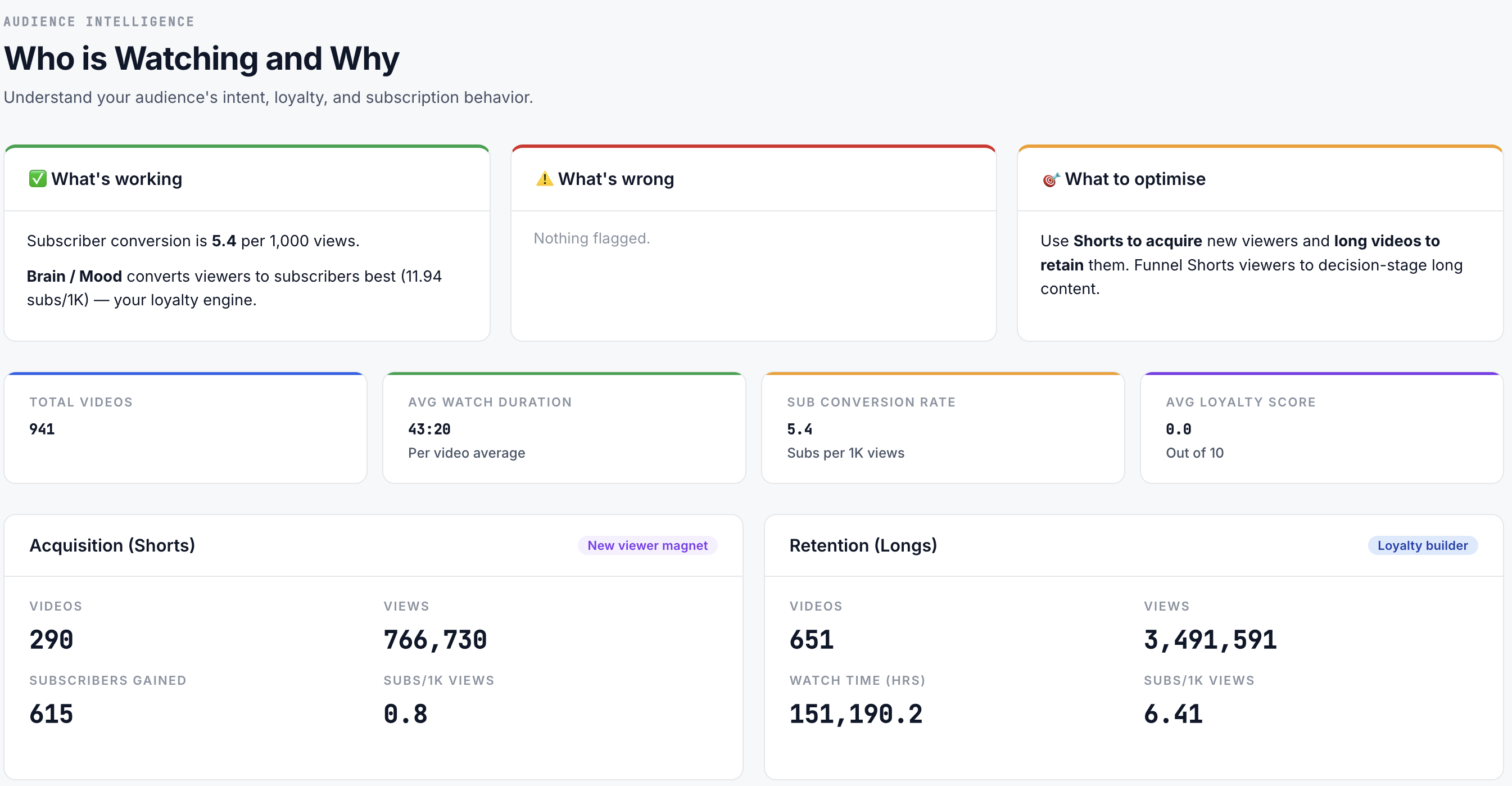
Measure YouTube ROI on three planes: CPQL from tracked WhatsApp clicks, procedure-attributed revenue from a CRM that captures "how did you hear about us", and view-through impact on branded search volume in Google Search Console. Ignoring the third plane will make you undervalue the channel by 30-50%.
The direct-response layer is straightforward. Every video description drives to a WhatsApp Business number with a UTM-tagged click-to-chat link. Enquiries flow into a healthcare CRM like AtomCRM, tagged with the source video, and the clinic front desk captures the eventual procedure booked and the invoice value.
The brand-lift layer is harder but more important. A well-run dental YouTube channel typically drives a 60-120% uplift in branded search queries ("Dr Meera Dental Bandra") within six months. That branded search converts at 3-4x the rate of cold search, which means the channel is quietly earning revenue that Meta and Google Ads would try to claim.
The right dashboard shows all three metrics on one page: CPQL by video, procedure revenue by video, and branded search delta month-over-month. This is exactly the reporting layer our analytics team wires up for clinic clients.
Which NMC and DPDP rules apply to dental video marketing?
Three regulations govern Indian dental YouTube content: the NMC Professional Conduct Regulations on advertising and testimonials, the DPDP Act 2023 on patient data and consent, and ABDM's interoperability guidance where dental practices integrate with the national health stack.
The NMC framework restricts self-laudatory advertising, superlative claims ("best dentist in India"), guaranteed outcomes, and unverifiable testimonials. This does not mean you cannot make video content. It means your scripts must talk about the procedure, the process and the science, rather than making claims about being superior to other practitioners.
The DPDP Act 2023 is the bigger operational shift for 2026. Any patient shown in a before-and-after video, any voice-over case narration and any WhatsApp lead capture flow must be underpinned by a documented consent trail. Practically, this means clinics need a signed video consent form separate from the treatment consent form, and a data-processing addendum with their agency partner.
ABDM interoperability matters if the clinic uses an EHR overlay like HealthPro 360, because any lead-to-record flow needs to respect the Health Data Management Policy on data localisation and patient access. This is not a YouTube problem directly, but it becomes one the moment a video lead becomes a booking becomes a health record.
How does ICG approach dental YouTube marketing differently?
ICG's approach is built around YODA, our AI-native YouTube operating system for healthcare, combined with Angryturtle for Google Business Profile visibility and AtomCRM for lead attribution. The three products form a single loop rather than three disconnected tools.
YODA scripts, storyboards and briefs every video against an evolving keyword map for the clinic's city and specialty. It also runs a nightly retention analysis that flags which videos need re-editing or new thumbnails to protect their ranking. This is why our dental clinic channels rarely have "dead" videos, the kind that stop earning after 90 days.
Angryturtle handles the Google Business Profile layer in parallel, because a YouTube video that ranks for "aligner treatment in Andheri" is worth 2-3x more when the same clinic's GBP profile also ranks in the Map Pack for the same query. Reviews, posts, Q&A and image optimisation on GBP compound with the channel's authority.
Meta Catalyst IQ then retargets YouTube viewers on Instagram and Facebook with high-fit creative, while Prism Spy tells us which local competitors are running which Meta creatives, so our own scripts stay ahead. Prism Pulse tracks the Instagram side of the same clinic. AtomCRM captures the enquiry, HealthPro 360 handles the RCM overlay if it is a multi-doctor practice. The clinic gets one integrated stack rather than four vendors.
The 70-30 pricing model for dental YouTube retainers
 Meta Catalyst IQ SLC Framework view scoring Meta Ads accounts across Setup, Learning and Compounding phases with per-phase health metrics" width="1200" height="675" loading="lazy" decoding="async" style="width:100%;height:auto;display:block;">


ICG runs its 2026 healthcare YouTube retainers on a 70-30 fixed-plus-variable model. The fixed component covers production, YouTube SEO, channel operations, monthly reporting and quarterly strategy reviews. The variable 30% is tied to a 12-month outcome target agreed at kickoff (typically CPQL and qualified enquiry volume for dental).
- Foundation - Rs 49,999/month: 4 long-form videos + 8 Shorts, channel SEO, WhatsApp lead capture, monthly dashboard. Fit for single-branch clinics.
- Growth - Rs 74,999/month: 6 long-form + 16 Shorts, YouTube Ads management up to Rs 60,000 media spend, vernacular translations, GBP integration. Fit for 2-3 branch practices.
- Scale - Rs 99,999/month: 10 long-form + 30 Shorts, full Meta Catalyst IQ retargeting overlay, competitor intel via Prism Spy, quarterly strategy resets. Fit for multi-city DSOs and hospital dental departments.
Media spend on YouTube Ads is separate and passes through at cost. Larger multi-city dental groups typically bolt on a 5 lakh-plus media retainer that follows the same 70-30 logic.
Where to go next
If you are a clinic owner, start by auditing your existing channel against the five video formats above and the SEO checklist. If you are running a healthcare agency or a hospital marketing team, our team is happy to run a free 45-minute YouTube diagnostic. Most Indian dental clinics are one strong quarter away from making YouTube their number-one enquiry engine, ahead of both search and social. In 2026 there is no reason not to be.
Frequently asked questions
How long before a dental YouTube channel starts generating enquiries in India?
In our benchmark set, a properly structured channel produces first tracked WhatsApp enquiries in weeks 4-6 and stable weekly enquiries by month 3. Full compounding, where organic search brings in the majority of enquiries, typically kicks in between months 6 and 9.
Should Indian dental clinics record videos in English or Hindi?
Neither exclusively. The pattern that works across Delhi, Mumbai, Bengaluru, Hyderabad, Chennai, Kolkata and Ahmedabad is a bilingual mix: the doctor speaks in a natural Hinglish or local-language-plus-English blend, with English closed captions and a vernacular caption track added for reach.
Can a dental clinic use patient testimonials in YouTube videos legally?
The NMC restricts self-laudatory and unverifiable claims. A patient can speak about their own experience factually, provided consent is documented, but the clinic should avoid superlatives and any before-and-after content that implies guaranteed outcomes. Legal review of the script and edit is standard practice for our clinic clients.
What is a realistic CPQL for dental YouTube marketing in India?
Across 150+ clinic accounts we manage, tracked CPQL sits between Rs 180 and Rs 640 depending on city, specialty and creative quality. Implants and clear aligners run higher due to auction pressure; RCT, extractions and paediatric dentistry run lower.
Do YouTube Shorts work for dental marketing in India?
Yes, but only as part of a wider funnel. Shorts alone rarely convert directly. They perform brilliantly as top-of-funnel discovery, feeding subscribers to the main channel where longer procedure videos do the actual conversion work.
How do we measure YouTube's impact on our brand searches?
Track branded query volume monthly in Google Search Console. Compare the six months before your channel launched to the six months after. A well-run dental channel typically shows a 60-120% uplift in branded search within that window, which is usually the largest hidden ROI of the entire programme.
Does ICG work with dental clinics outside the top 8 metros?
Yes. Our current dental client base spans Indore, Coimbatore, Kochi, Jaipur, Chandigarh, Bhubaneswar, Guwahati and several Tier-3 markets, in addition to the metros. Vernacular content is arguably more valuable in these cities because organic competition on YouTube is thinner.
How does the 70-30 model actually work in practice?
70% of the retainer is invoiced monthly as fixed fees for production and operations. The remaining 30% is banked against a 12-month CPQL and qualified enquiry target agreed on day one, released quarterly on a sliding scale as milestones are hit. It aligns agency incentives with clinic outcomes rather than deliverable counts.
Book a free Brand & Growth Diagnostic.
60 minutes with a Co-Founder. You leave with a written root-cause analysis of where growth is stalling and what to fix first — whether or not you engage ICG.
Questions readers ask
about this topic.
The three platforms
behind every ICG engagement.
Beacon
CAPI middleware that fixes Event Match Quality, translates CRM statuses to Meta-standard events, dedups across channels.
Agency OS
Live client dashboard. GSC, GA4, Google Ads, Meta Ads, IVR calls in one view. Login anytime, not monthly.
Phoenix
Clinic revenue intelligence over your PMS. Daily action queue: Prevent Loss, Maintain & Engage, Grow Revenue. Multi-centre rollout.
Or book a free 30-min audit to see all three in action on your account.
Healthcare brands
that already run on ICG.
A representative slice of the 150+ healthcare brands ICG has delivered for across India. Most engagements remain under NDA.


What ICG clients say · on video.
"Dental marketing in Delhi is brutally competitive. ICG's local SEO + Google Ads stack moved the needle steadily."
"Scale up of organic channels and business consulting. ICG has absolute domain authority in their field."
Need help operationalising this?
Every ICG service is healthcare-only, NMC + DPDP-aware, and built around the patient-research patterns that drive Indian healthcare growth in 2026.
Every practice welcome — packages from ₹20,000/mo.
Goals-Driven engagements · Performance-Linked Payout Models available



More from
ICG.
Five trends shaping Indian healthcare marketing through 2027: AI-first patient research, Conversions API adoption, ABDM discovery, the AEO w...
Healthcare AIO is the discipline of getting your clinic or hospital cited inside Google AI Overviews, ChatGPT and Perplexity answers — not j...
Conversational-search advertising places brand messages inside AI chat answers — ChatGPT, Perplexity, Copilot — rather than beside a results...
Stop guessing.
Book a Diagnostic.
30 minutes. Free. With the AI-powered healthcare-only marketing agency 150+ brands already run on. No slides, no pitch, no hard close.


