


What is black hat SEO? A detection, recovery and compliance guide for Indian healthcare
What is black hat SEO, in plain terms? It is any technique used to rank a website that works by manipulating a search engine's systems rather than by makin…
No pitch. Written root-cause diagnosis. AI-powered, healthcare only.
Direct answer
What is black hat SEO, in plain terms? It is any technique used to rank a website that works by manipulating a search engine's systems rather than by makin…
TL;DR
By Hanuman Sihag — Head of Innovation Chamber & SEO Lead, ICG, and Abhishek Kumar — Sr. Manager, SEO and AIO, ICG.
Reviewed for strategy and compliance accuracy by Abhash Kumar — Co-Founder, Strategy, ICG.
Neither the authors nor the reviewer is a clinician; this is a strategy and compliance review, not a clinical sign-off.
What is black hat SEO, in plain terms? It is any technique used to rank a website that works by manipulating a search engine's systems rather than by making the page genuinely useful, and Google's own spam policies are what actually define the line. For a clinic or hospital marketing team, the more useful question usually isn't the definition, it's what happens after: whether a ranking drop is a real penalty or a false alarm, how long recovery takes, and whether the agency running your medical SEO is quietly trading a short-term ranking bump for a compliance problem you'll be the one answering for. That last part is the layer most guides skip. In India, several of the tactics on this list carry regulatory exposure under the NMC and ASCI on top of whatever Google does to your rankings, which means the penalty can arrive from a regulator before it ever shows up in Search Console.
Table of contents
- What is black hat SEO?
- How Google actually catches it: detection mechanics
- Content manipulation tactics that still get flagged
- If you've already been hit: manual actions, algorithmic penalties, and the recovery path
- The gap most guides miss: local-listing and review fraud in Indian healthcare
- Where black hat SEO becomes a regulatory problem, not just a ranking one
- What compliant healthcare SEO looks like instead
- FAQ
What is black hat SEO?
Black hat SEO is Google's informal term for tactics that violate its content and spam policies, whether or not the person running them knows the policy exists. Google Search Central publishes the actual spam policies for Google Search, and the label applies to anything that tries to game those systems rather than earn a ranking through genuinely useful pages. Grey-hat sits in between, tactics that don't clearly break a written rule but exploit a loophole Google hasn't closed yet; white-hat is everything built to satisfy the reader first and the algorithm second, as a byproduct. One distinction matters more here than in most industries covered by SEO guides: black hat is Google's classification, not a legal one. A tactic can be entirely within Google's rules and still be illegal or professionally sanctionable in India, and a tactic can violate no Indian law while still costing a site its rankings overnight. Healthcare content sits at the intersection of both systems, which is the reason this guide exists.
How Google actually catches it: detection mechanics
Understanding what is black hat SEO in practice starts with how Google's systems actually flag it, because the mechanism decides what recovery looks like later. One path is algorithmic: automated classifiers trained to spot patterns, like unnatural link-graph structures, templated low-value pages generated at scale, or content-quality signals that correlate with thin or manipulative pages, and these systems adjust rankings continuously without ever notifying the site owner. A separate path is manual: a human reviewer at Google, often acting on a spam report or a targeted review of a site, examines pages directly and applies a Manual Action, which does generate a notification inside Search Console. The Search Quality Rater Guidelines that Google's human reviewers work from single out medical and health content by name as a canonical example of Your Money or Your Life content, the category where quality signals are held to the highest bar because bad information can cause real harm. That's worth sitting with for a moment: a hospital or clinic site isn't judged by the same threshold as a recipe blog or a local plumbing site, it's judged by the threshold Google reserves for pages that can affect someone's health, finances or safety. Our pillar guide to healthcare SEO goes deeper on what E-E-A-T and YMYL mean in practical terms for a medical site's content decisions.
Content manipulation tactics that still get flagged
Google's content-quality classifiers score a page largely on whether it was produced to serve a reader or to occupy a keyword. The current spam policy names this directly as scaled content abuse: producing many pages, by any method, primarily to manipulate rankings rather than to help anyone, and the classifier doesn't care whether the text came from a human writer paid too little per word or a language model with no editorial layer behind it. That single distinction quietly retires a claim that used to circulate in older SEO advice, that AI-generated content is inherently a violation. It isn't. Scaled, unreviewed content that adds nothing beyond what already ranks is the violation, and a clinic that publishes ten AI drafts a week with a clinician reviewing none of them is at exactly the same risk as one publishing ten spun articles by hand. Keyword stuffing sits in the same family: repeating a term unnaturally in the body or meta description past the point of readability, a signal Google's classifiers pick up independent of who or what wrote the sentence. Duplicate content, whether copied across a multi-location practice's city pages or lifted from a competitor, dilutes the signal a page needs to rank and can waste the crawl budget a larger site depends on to get its real pages indexed promptly. Hidden text, still occasionally used on older healthcare sites in the form of white-on-white keyword blocks left over from a previous vendor, works the same way it did fifteen years ago and gets caught the same way it did fifteen years ago. The practical fix for scaled-content risk isn't writing less, it's adding a real editorial layer: Content HQ runs ICG's own fact-check and AI-tell scoring workflow before anything publishes, and for sites carrying years of accumulated duplicate or orphaned pages, the Crawl Budget Optimiser reads server logs and Search Console crawl stats to find what's wasting the budget your real pages need.
If you've already been hit: manual actions, algorithmic penalties, and the recovery path
A ranking drop is not automatically a manual action, and most of the panic that follows one is a misdiagnosis. Traffic falls for dozens of reasons that have nothing to do with a penalty: a core algorithm update reweighting quality signals, a competitor's page genuinely improving, a technical regression from a site migration, seasonal demand shifting. The way to tell the difference is to check the Manual Actions report inside Google Search Console directly, because that report is the only place a true manual action shows up, and if it's empty, you are not dealing with a manual action no matter how sharp the drop looks. A real Manual Action names the specific issue, unnatural links, thin content, user-generated spam, and comes with a path to fix it: correct the underlying pages, remove or disavow the offending signals, then file a reconsideration request describing what changed. The request itself should be specific rather than apologetic: name the exact pages that triggered the action, describe what was actually wrong with them (a purchased link scheme, a batch of unreviewed spun content, whatever the notification pointed to), and document the fix with dates, so the reviewer isn't asked to take the correction on faith. A vague request that says the site "has improved" without naming what changed is one of the more common reasons a first reconsideration attempt gets rejected, forcing a second round that adds weeks to the timeline. Google reviews that request and either lifts the action or explains what's still wrong, and clinics should expect the review itself to take anywhere from a few days to several weeks depending on how specific and well-documented the submission was. An algorithmic penalty offers none of that structure. There's no notification, no report entry, and critically, no reconsideration request to file, because there's nothing to appeal, the algorithm reassesses the site continuously as its content and links change, and recovery means the underlying quality problem has to actually improve, then wait for the next recrawl and reassessment cycle to reflect it. That reassessment cycle is not instant even after the fix is genuinely made. Google has to recrawl the affected pages, reprocess the signals, and let the ranking systems catch up, which is why algorithmic recovery timelines are inherently fuzzier than a manual action's and shouldn't be promised to a clinic owner as a fixed number of weeks. Sites recover faster from a genuine manual action than from an algorithmic reassessment precisely because the manual path has a defined process and the algorithmic one doesn't. If you're not sure which one you're looking at, an audit is usually the fastest way to find out before you spend weeks fixing the wrong problem.
The gap most guides miss: local-listing and review fraud in Indian healthcare
Angryturtle currently manages 143 Google Business Profiles across ICG's healthcare client base, with a combined average rating of 4.76 stars and zero suspensions across the entire portfolio, in a market where suspension is one of the more common outcomes of listing-level manipulation. That zero exists because the tactics that get profiles suspended are well documented and entirely avoidable, not because listing fraud is rare. Three patterns show up repeatedly in Indian healthcare specifically, and none of them get a mention in most black-hat SEO guides written for a US audience.
Fake and incentivised reviews
A clinic offering a discount for a five-star Google review, or a staff member posting reviews from personal accounts for a doctor they work for, both violate Google's review policies and put the reviews at risk of mass removal. Practo, Justdial and Lybrate run their own review-authenticity checks too, and a listing caught gaming one platform often gets flagged across the others once a pattern search connects the accounts. The removal itself tends to arrive in a batch rather than one review at a time, since the detection systems on these platforms flag clusters of accounts that reviewed the same handful of clinics in a short window, so a clinic can lose thirty or forty reviews overnight rather than the handful that were actually incentivised.
Bulk or duplicate GBP creation
Creating multiple listings for one physical clinic, or a listing at a doctor's home address rather than the registered practice, is a direct violation of Google's guidelines on business eligibility and location representation. It's also the single most common cause of the suspensions that Angryturtle's client base has avoided entirely, because a suspended profile doesn't just lose rank, it disappears from Maps and local search until the appeal resolves, which can take weeks. The pattern shows up most often when a clinic changes agencies and the new vendor creates a fresh listing rather than claiming the existing one, leaving two active profiles competing against each other for the same address.
Paid doctor-listing manipulation
Aggregator platforms that let clinics pay for higher placement in "top doctors near you" results create an incentive to misrepresent credentials, specialisations or patient volumes to qualify for premium placement. That's a platform-policy violation on its face, and as the next section covers, it can also cross into territory the NMC treats as a professional-conduct issue rather than just an advertising one.
The compliant route to the reviews a clinic actually needs is more mechanical than most owners expect, and our guide on building patient reviews for a doctor in India covers the process that doesn't carry any of this risk. If you're not sure which of your clinic's listings or content decisions carry this kind of exposure, an audit is the fastest way to find out.
Where black hat SEO becomes a regulatory problem, not just a ranking one
Several of the tactics above are already restricted in India before Google ever gets involved. The NMC Ethics Code 2026 restricts solicitation of patients and the use of testimonials in a doctor's advertising, which means a fake or incentivised review naming a specific practitioner isn't just a Google policy problem, it can become a professional-conduct complaint against that named doctor personally, filed with the medical council rather than with a search engine. That distinction changes who the exposure lands on: a ranking penalty hits the website, a professional-conduct complaint hits the doctor's registration. The ASCI Healthcare Guidelines separately govern truthful-claims requirements in health advertising, and outcome or success-rate claims used purely as ranking bait, a "98% success rate" headline dropped into a landing page to win a featured snippet, sit squarely inside what ASCI treats as a misleading-claims complaint even where Google's own spam policies would have no objection to the page at all. For IVF and fertility content specifically, the ART (Regulation) Act 2021 adds a further restriction on advertising success rates without the qualification the regulation requires, which makes fertility one of the specialties where a ranking-motivated content decision most easily becomes a regulatory one. This is a compliance-awareness summary, not legal advice; confirm specific claims with regulatory counsel before publishing them.
What compliant healthcare SEO looks like instead
Across 46 active healthcare client engagements over the rolling 12 months from July 2025 to July 2026, spanning Delhi NCR, Mumbai, Bangalore, Chennai, Hyderabad and Kolkata, ICG's clients saw a 38 to 58 percent reduction in cost per qualified lead within the first 90 days, without any of the tactics covered above, last verified 2026-07-26. The reduction comes from the same place the risk in black-hat tactics comes from: content and technical decisions that either serve the reader and the regulator at once, or don't. ICG builds every engagement around what we call the MMT framework, Marketing times Medicine times Technology, three disciplines that have to operate together rather than in sequence. Marketing built without clinical review produces claims that read well and get flagged by ASCI. Clinical accuracy without marketing judgment produces content nobody searches for. Either one without a technologist behind it produces pages that say the right thing and never get crawled properly. MMT forces every piece of content through clinical review before publication and every campaign through a triad, marketer, clinical reviewer, systems engineer, rather than leaving any one of the three to work alone. You can read the full framework, along with the five others ICG runs engagements on, at /about/frameworks. Our SEO and medical SEO services are both built on it, and the healthcare SEO agency page covers how that translates into an actual engagement.
If you'd rather talk through where your own site sits before committing to anything, book a call and we'll walk through it as a diagnostic conversation, not a pitch.
FAQ
What is black hat SEO? Black hat SEO is any technique that manipulates search rankings by exploiting a search engine's systems rather than by making a page genuinely useful, as defined by Google's own spam policies.
Is AI-generated content automatically black hat SEO? No. Google's policy targets scaled, low-value content published without real editorial oversight, regardless of whether a human or an AI tool produced the draft. Reviewed, accurate content produced with AI assistance is not a violation on its own.
What's the difference between a manual action and an algorithmic penalty? A manual action is a human reviewer's decision, shows up in Search Console's Manual Actions report, names the specific issue, and can be appealed through a reconsideration request. An algorithmic penalty is a continuous automated reassessment with no notification and no appeal process; recovery depends on the underlying quality issue actually improving.
Are fake Google reviews for a clinic actually illegal in India, or just against Google's policy? Both, depending on the details. They violate Google's review policies outright, and where a review names a specific doctor and was solicited or incentivised, it can also breach the NMC Ethics Code 2026's restrictions on testimonials and patient solicitation, exposing the named practitioner to a professional-conduct complaint.
Can a single clinic legally run multiple Google Business Profile listings? Not for one physical location. Google's guidelines require one listing per eligible location, and creating duplicates, or listings at a practitioner's home address rather than the registered clinic, is a policy violation that risks suspension of every listing involved, not just the extra ones.
How long does black hat SEO recovery usually take? It depends on which type of penalty you're dealing with. A manual action can resolve within days to a few weeks once the reconsideration request is approved. Algorithmic recovery has no fixed timeline, since it depends on Google's next reassessment of the site after the underlying issue is fixed, which can take anywhere from several weeks to a few months.
This article is for general strategy and compliance awareness and does not constitute legal advice. Confirm specific advertising or regulatory claims with qualified counsel before publishing.
Book a free SEO diagnostic.
Hanuman Sihag's team runs a live crawl, checks technical health, cannibalisation, schema coverage and content gaps. 60 minutes, prioritised fix list.
The three platforms
behind every ICG engagement.
Beacon
CAPI middleware that fixes Event Match Quality, translates CRM statuses to Meta-standard events, dedups across channels.
Agency OS
Live client dashboard. GSC, GA4, Google Ads, Meta Ads, IVR calls in one view. Login anytime, not monthly.
Phoenix
Clinic revenue intelligence over your PMS. Daily action queue: Prevent Loss, Maintain & Engage, Grow Revenue. 46-centre rollout.
Or book a free 30-min audit to see all three in action on your account.
Healthcare brands
that already run on ICG.
A representative slice of the 150+ healthcare brands ICG has delivered for across India. Most engagements remain under NDA.


What ICG clients say · on video.
"Scale up of organic channels and business consulting. ICG has absolute domain authority in their field."
"Working with ICG transformed how we acquire IVF patients in Gurgaon. They understand the fertility journey from inquiry to consult..."
"What Ichelon accomplished — they got all my ideas and worked over 3-4 months to create an amazing, super-customised website."
The intelligence stack behind this playbook.
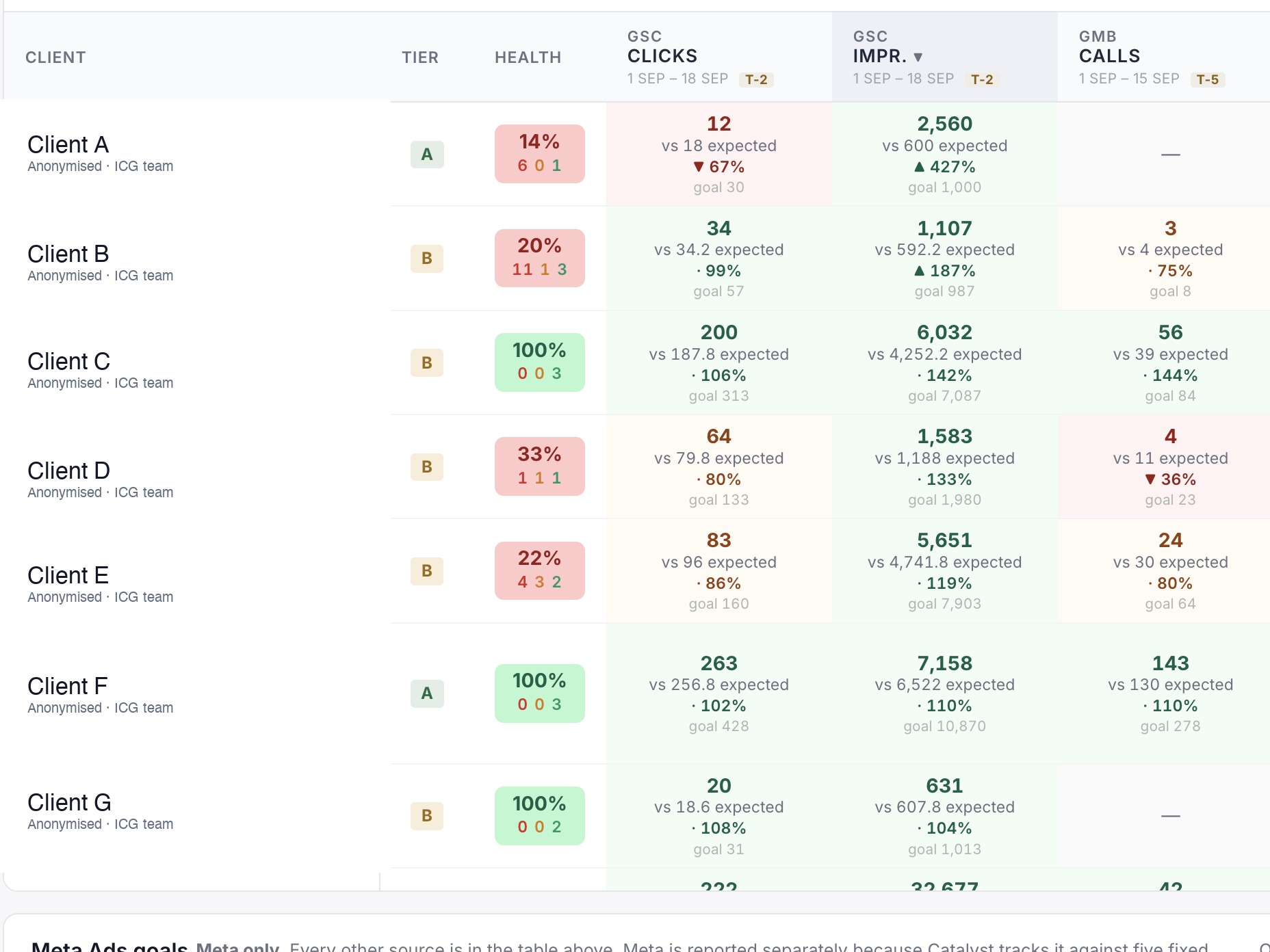
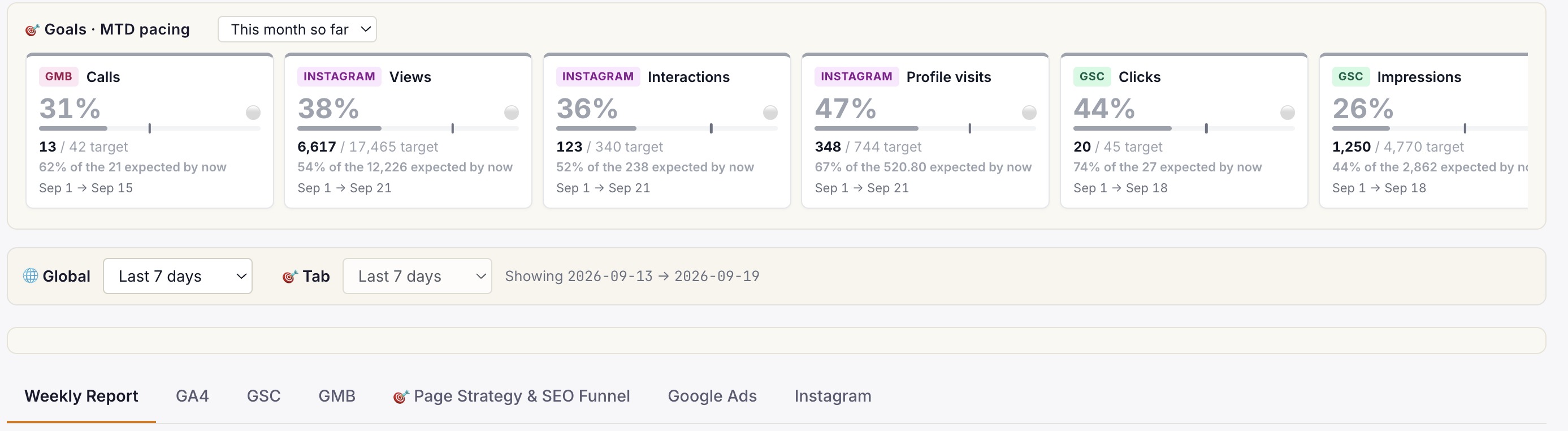
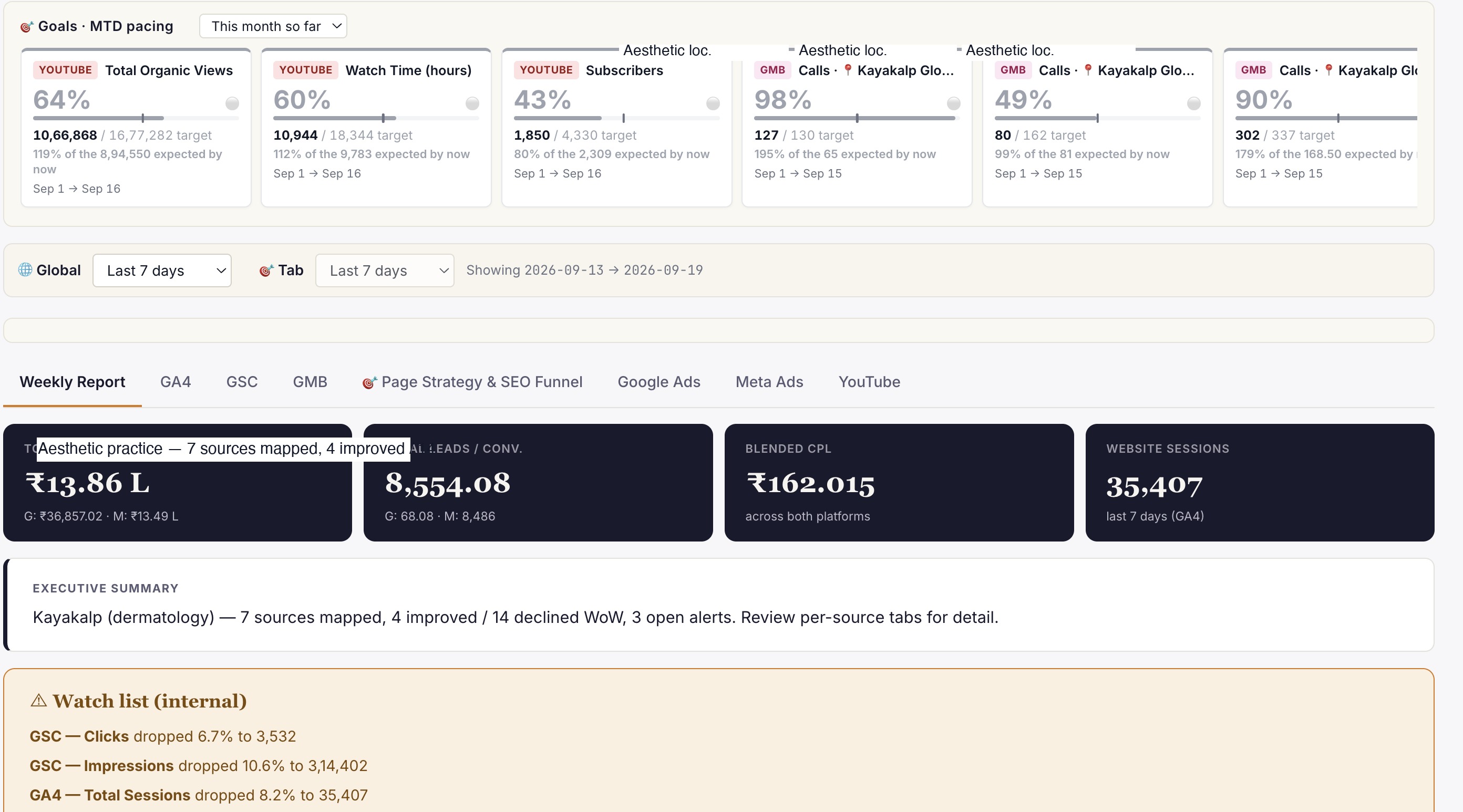
Every ICG engagement runs on the Search Intelligence Trifecta — Angryturtle for GMB, SIE for search and AI Overview, YODA for YouTube. Live product screens below.
Need help operationalising this?
Every ICG service is healthcare-only, NMC + DPDP-aware, and built around the patient-research patterns that drive Indian healthcare growth in 2026.
Every practice welcome — packages from ₹20,000/mo.
Goal-linked packages · Fixed retainer + Goal-based Variable Pay · 19-month average client retention — industry-leading.
More from
ICG.
Healthcare AIO is the discipline of getting your clinic or hospital cited inside Google AI Overviews, ChatGPT and Perplexity answers — not j...
Conversational-search advertising places brand messages inside AI chat answers — ChatGPT, Perplexity, Copilot — rather than beside a results...
NABH digital compliance means every claim, image and testimonial your hospital publishes online matches what an accreditation surveyor can v...
Stop guessing.
Book a Diagnostic.
30 minutes. Free. With the AI-powered healthcare-only marketing agency 150+ brands already run on. No slides, no pitch, no hard close.


