


Multi-Location PMS India: Hospital Chains Playbook 2026
What breaks in a multi-location PMS at 3, 8 and 15+ sites — and the architecture, migration and governance India's hospital chains use to fix it. Talk to ICG.
No pitch. Written root-cause diagnosis. AI-powered, healthcare only.
Direct answer
What breaks in a multi-location PMS at 3, 8 and 15+ sites — and the architecture, migration and governance India's hospital chains use to fix it. Talk to ICG.
TL;DR
A practice management system that works perfectly at a single location often breaks at three, fails at eight, and produces operational disaster at fifteen or more locations. The failure pattern is consistent across hospital chains and clinic groups: data silos accumulate, patient records duplicate, billing reconciliation drifts, and the senior leadership loses operational visibility into what's happening at any individual centre.
This article covers the multi-location PMS architecture that actually scales — what to look for, what to avoid, and how to migrate from a single-location PMS to a multi-location platform without breaking ongoing operations.
What breaks at multi-location scale
1. Patient record duplication
A patient who visits your Gurgaon clinic and then your Delhi clinic should be one record, not two. Single-location PMS systems silo by location — the same patient becomes two records with separate visit histories, separate billing, separate clinical notes.
By the time the chain has 5+ locations, 15-25% of patient records are duplicates. By 15 locations, that exceeds 40%. The operational consequences:
- Retention strategy fails (you don't know patient X visited centre A then centre B)
- CLTV calculations distort
- Cross-location referral attribution breaks
- Clinical continuity (drug allergies, prior conditions) doesn't follow the patient
2. Multi-location billing complexity
Each location bills independently. Reconciliation at the group level requires consolidating spreadsheets, reconciling discrepancies, and accepting that some revenue is just impossible to attribute correctly.
Multi-location PMS handles:
- Inter-centre transfers (patient enrolled at centre A, treated at centre B)
- Centralised payment plan tracking (patient pays at multiple centres against single plan)
- Insurance/TPA claims aggregation (one patient, one claim, multiple centre touches)
- Group-level revenue recognition
3. Inventory + pharmacy duplication
Each centre tracks inventory independently. Stock-out at centre A while centre B has surplus. Expired stock at centre C. Pharmacy reordering happens 8 times instead of once at the group level. Margin gets eaten by inventory inefficiency.
Multi-location PMS centralises inventory visibility while allowing per-centre operational autonomy.
4. Centralised reporting failure
Senior leadership wants weekly operational reports across all centres. Single-location PMS produces this only via manual aggregation — typically by an analyst spending 2-4 days each month consolidating spreadsheets. By the time the report is ready, the data is stale.
Multi-location PMS produces real-time group-level dashboards: revenue by centre, by specialty, by doctor; patient volume trends; retention by centre; inventory status; staff utilisation.
5. Role-based access at group level
Centre managers see their centre. Specialty heads see their specialty across centres. Senior leadership sees everything. Billing team sees billing data. Clinicians see clinical data. Single-location PMS doesn't have this hierarchy — it's typically "centre admin sees everything in this centre."
Multi-location PMS supports a role hierarchy: group → region → centre → department → role.
6. Doctor schedule arbitration
A doctor who works at two centres needs unified schedule visibility. Single-location PMS produces conflicting bookings, double-booked slots, and patient frustration. Multi-location PMS shows the doctor's full schedule across centres.
The multi-location PMS architecture
A PMS that genuinely scales to 15+ locations has these architectural primitives:
1. Unified patient record with centre-level context
Patient X is one record. Their visit history shows visits at centres A, B, C — but it's one patient, one CLTV calculation, one clinical history.
2. Centre-level billing with group-level consolidation
Each centre bills independently for operational autonomy. Group-level consolidation rolls up automatically — no manual reconciliation.
3. Centralised inventory with per-centre views
Group-level inventory dashboard. Per-centre operational views. Inter-centre transfers tracked. Automated reordering at group level with per-centre allocation.
4. Real-time group dashboards
Senior leadership sees everything live — revenue, volume, retention, inventory, staff utilisation — across all centres. No analyst spending days consolidating.
5. Role hierarchy at group level
Group leadership sees everything. Region heads see their region. Centre heads see their centre. Department heads see their department across centres. Each role has appropriate access scoped correctly.
6. Doctor schedule unification
Doctors who work across multiple centres see one unified schedule. Booking conflicts impossible. Patient sees doctor's full availability.
7. Migration tooling
For chains migrating from single-location PMS to multi-location: data migration tooling that handles deduplication of patient records, reconciliation of billing, unification of clinical histories. This is the part most vendors handle badly.
How HealthPro 360 handles multi-location
HealthPro 360 was built multi-location from day one. All 7 architectural primitives are native:
- Unified patient records with cross-centre history
- Centre-level billing + automatic group consolidation
- Centralised inventory with per-centre operational views
- Real-time group dashboards
- 5-level role hierarchy (group → region → centre → department → role)
- Doctor schedule unification across centres
- Migration tooling with deduplication
Phoenix overlay for chains on existing PMS
For chains already on single-location-architecture PMS (EMR-first clinic software, regional HMS suites, budget clinic software, open-source hospital systems) that don't want to migrate, Phoenix provides group-level overlay:
- Reads from each centre's PMS via API
- Deduplicates patient records at the Phoenix layer
- Surfaces group-level intelligence even when the PMS is silo'd
This is how Phoenix runs for multi-centre chains — Phoenix doesn't replace the centre-level PMS; it adds the group-level intelligence layer above it.
The migration playbook
For a 5-15 location chain considering migration from single-location PMS to multi-location:
- Data audit at each centre. Patient counts, duplicate analysis, billing reconciliation status.
- Pilot at one centre. Migrate one centre. Run parallel for 4 weeks. Validate.
- Region-by-region rollout. Group centres geographically. Migrate one region at a time. 6-8 weeks per region.
- Group consolidation. Activate group-level dashboards. Train leadership team.
- Sunset legacy systems. Read-only legacy for 6 months. Then archive.
Total timeline for 10-centre migration: 6-9 months. ICG's implementation methodology supports this end-to-end.
Related reads
- Practice Management Software India pillar
- HealthPro 360
- Phoenix product page
- Phoenix Revenue Intelligence Implementation Guide
- HealthPro 360 vs regional HMS suites — multi-location comparison
Multi-location PMS scorecard: what to audit before you migrate
Most hospital groups only discover their PMS is failing at scale after the third location goes live. By that point the cost of ripping it out is 6-9 months of parallel-running two systems. Before you commit to a new platform — or before you extend your current one — run this 10-point scorecard across every location that will connect to the master instance.
| Capability | Single-site PMS | Multi-location PMS you actually need |
|---|---|---|
| Patient record | Location-scoped MRN | Group-wide UHID, location-tagged visits |
| Doctor roster | One schedule per doctor | Cross-location roster with travel buffer |
| Inventory | Per-branch stock | Central procurement, branch-level consumption |
| GST + billing | Single GSTIN | State-wise GSTINs, consolidated MIS |
| Reports | Location dashboards | Group P&L, doctor-productivity across sites |
The three failure modes we see most
- Duplicate UHIDs — the same patient gets a new record at every branch, killing lifetime-value tracking and cross-selling.
- Rogue price masters — each location's admin edits the tariff; corporate loses control of package pricing within 90 days.
- Reporting drift — location managers hand-key MIS into Excel because the PMS doesn't roll up cleanly. Board sees stale numbers.
If three or more rows above are red for your setup, you're already carrying hidden operational debt. The fix is either a platform migration (see best PMS in India 2026) or a chain-overlay layer that sits on top of what each branch already runs — the approach we detail in our hospital-chain digital operations playbook.
ICG's growth team runs this audit inside every Client Elevation Programme engagement with multi-site groups. For chains that also want centralised local-search and reputation control across every branch, we pair the PMS work with Angryturtle so Google Business Profiles for all locations move in lockstep. Chat with a Co-Founder if you want a walkthrough on your current stack.
Book a free 30-minute Brand & Growth Diagnostic.
It's a working session, not a sales pitch — you leave with a written root-cause analysis you can act on, whether or not you engage ICG.
Questions readers ask
about this topic.
The three platforms
behind every ICG engagement.
Beacon
CAPI middleware that fixes Event Match Quality, translates CRM statuses to Meta-standard events, dedups across channels.
Agency OS
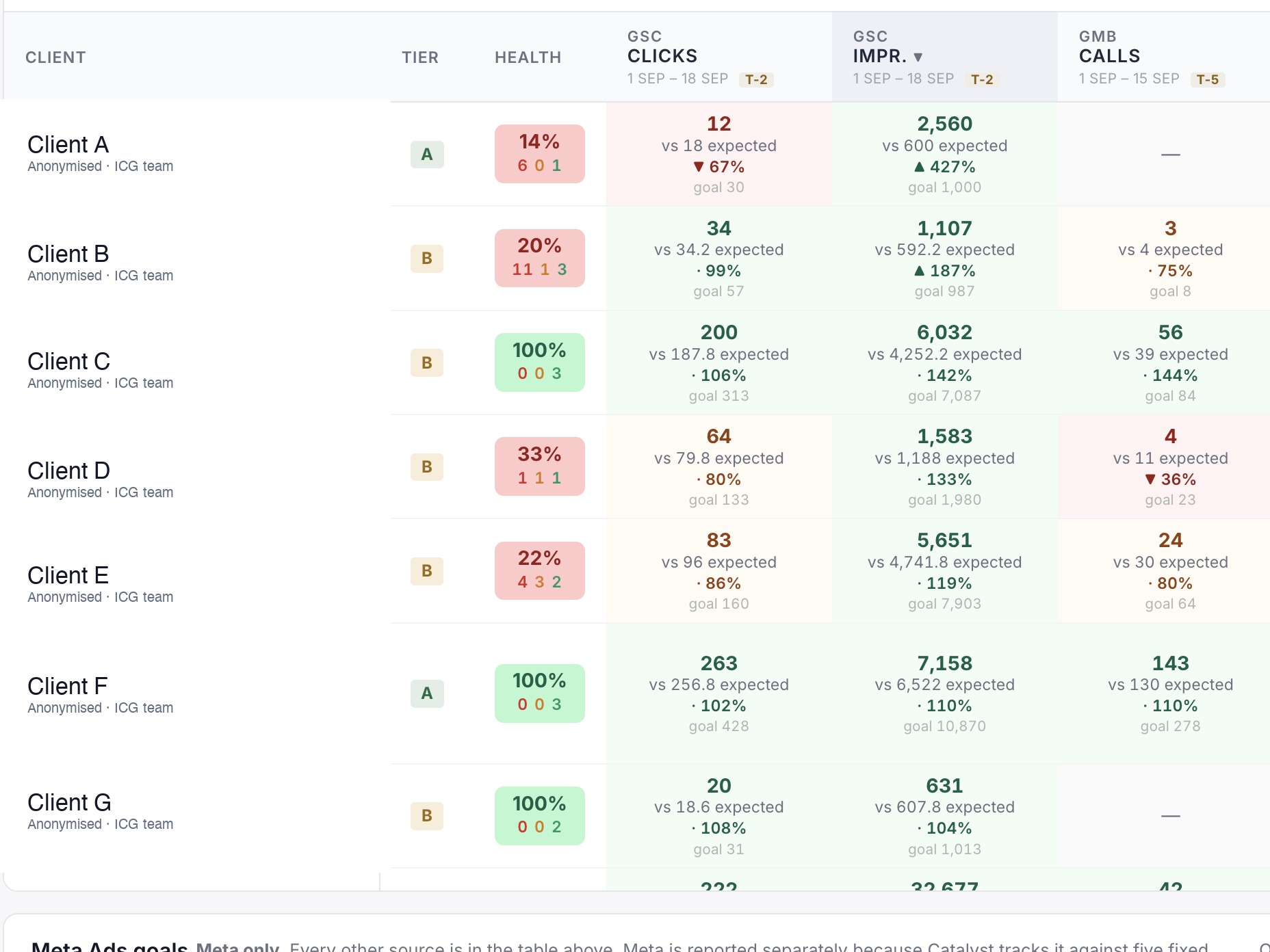
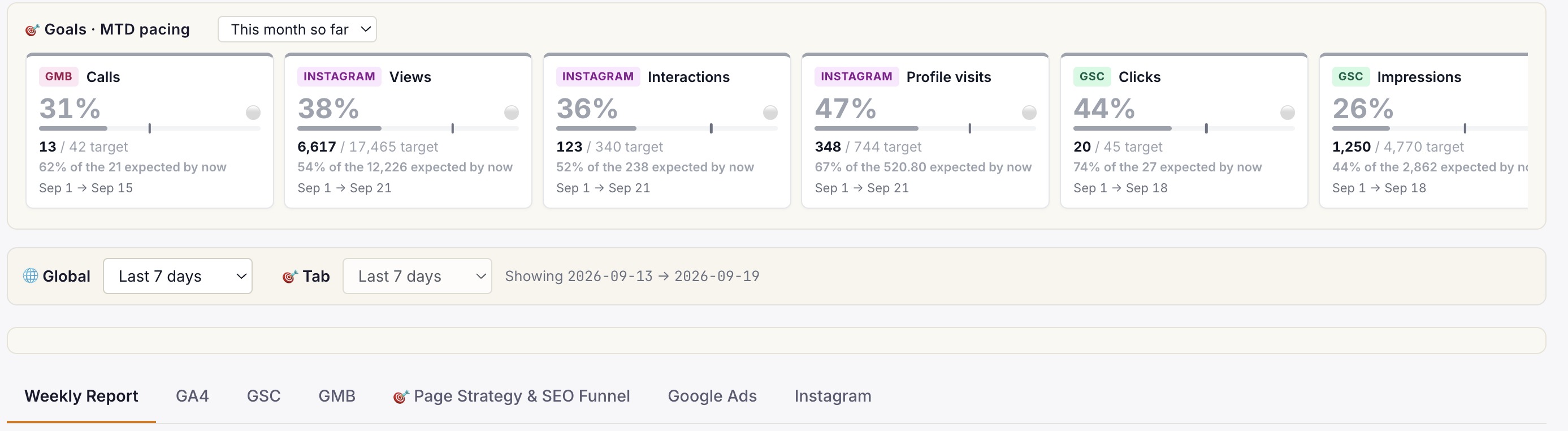
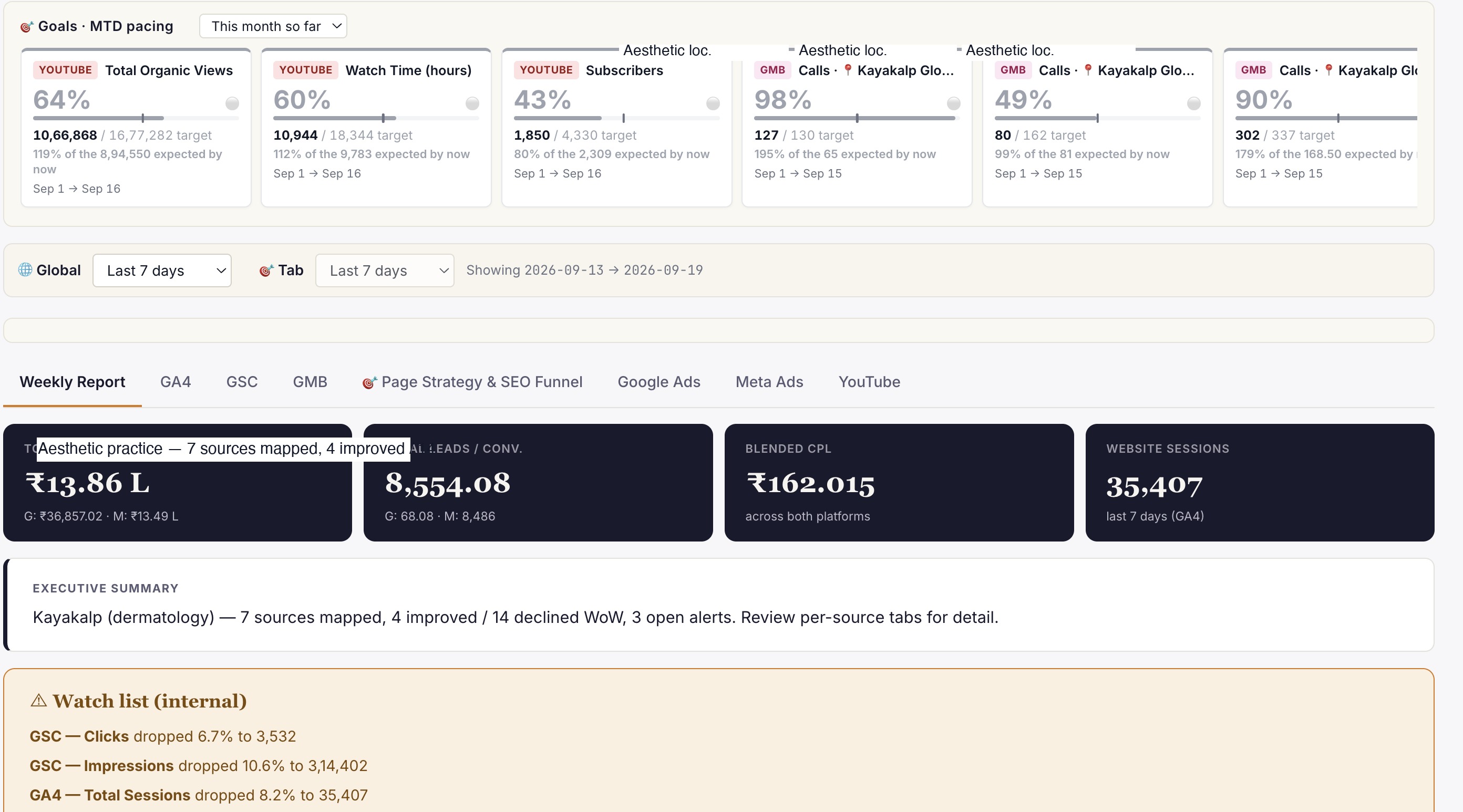
Live client dashboard. GSC, GA4, Google Ads, Meta Ads, IVR calls in one view. Login anytime, not monthly.
Phoenix
Clinic revenue intelligence over your PMS. Daily action queue: Prevent Loss, Maintain & Engage, Grow Revenue. Multi-centre rollout.
Or book a free 30-min audit to see all three in action on your account.
Healthcare brands
that already run on ICG.
A representative slice of the 150+ healthcare brands ICG has delivered for across India. Most engagements remain under NDA.


What ICG clients say · on video.
"Mental health marketing requires a different sensitivity. ICG built compliance-aware campaigns that respect both patients and our..."
"Bariatric surgery patients need a long consideration cycle. ICG built a content + paid system that respects that timeline."
"Working with ICG felt like working with an in-house growth team that happens to specialise in healthcare."
Need help operationalising this?
Every ICG service is healthcare-only, NMC + DPDP-aware, and built around the patient-research patterns that drive Indian healthcare growth in 2026.
Every practice welcome — packages from ₹20,000/mo.
Goals-Driven engagements · Performance-Linked Payout Models available
More from
ICG.
Five trends shaping Indian healthcare marketing through 2027: AI-first patient research, Conversions API adoption, ABDM discovery, the AEO w...
Healthcare AIO is the discipline of getting your clinic or hospital cited inside Google AI Overviews, ChatGPT and Perplexity answers — not j...
Conversational-search advertising places brand messages inside AI chat answers — ChatGPT, Perplexity, Copilot — rather than beside a results...
Stop guessing.
Book a Diagnostic.
30 minutes. Free. With the AI-powered healthcare-only marketing agency 150+ brands already run on. No slides, no pitch, no hard close.


