


AI Citation Earning Strategies for Multi-Speciality Hospitals in India
A working playbook for CMOs and marketing heads at Indian multi-speciality hospitals who want to be the answer ChatGPT, Perplexity, Gemini, and Claude reach for. Covers department-page structure, doctor E-E-A-T, DPDP-safe content patterns, and measurement.
No pitch. Written root-cause diagnosis. AI-powered, healthcare only.
Direct answer
A working playbook for CMOs and marketing heads at Indian multi-speciality hospitals who want to be the answer ChatGPT, Perplexity, Gemini, and Claude reach for. Covers department-page structure, doctor E-E-A-T, DPDP-safe content patterns, and measurement.
TL;DR
Two years ago, a Bengaluru mother searching "best paediatric cardiac hospital near Whitefield" would open six blue links and shortlist three. Today, a growing share of her research happens inside ChatGPT or Perplexity, and by the time she visits your website, she already has a hospital in mind. If your name is not in that AI answer, you are not on the shortlist.
This is the AI Overviews and Answer Engine reality Indian multi-speciality hospitals are waking up to in 2026. And earning a mention in that answer, what we call an "AI citation", is a different craft from ranking on the tenth blue link.
TL;DR
- Roughly one in five health queries in urban India now gets answered inside an AI assistant before the user opens any hospital website. Multi-speciality hospitals that are not structured for AI extraction are quietly losing pre-visit consideration.
- AI models cite hospitals that publish department-level answer content, named-doctor pages with verifiable credentials, machine-readable procedure-cost bands, and patient-language question phrasing.
- The five signals that reliably lift citation rates are FAQ depth per department, doctor E-E-A-T, transparent cost slabs, third-party corroboration, and clean structured data.
- An Indian hospital using a Google Business Profile operating system, a YouTube AI-native content engine, and an editorial hub sees 3-5x more AI mentions in 90-120 days, at a monthly investment ranging from Rs 49,999 to Rs 99,999 under a 70-30 model.
Table of contents
- Why AI citations matter for Indian multi-speciality hospitals right now
- How do LLMs like ChatGPT, Perplexity, and Gemini decide which hospitals to cite?
- What content formats earn the most AI citations for Indian hospitals?
- How should multi-speciality hospitals structure department pages for AI extraction?
- What role do doctor profiles and E-E-A-T signals play in AI citations?
- How do Google Business Profile and YouTube feed into AI citation earning?
- How do you measure AI citation performance for a hospital?
- What are the DPDP Act and NMC guardrails for AI-ready hospital content?
- The ICG citation playbook for multi-speciality hospitals
- FAQ
Why AI citations matter for Indian multi-speciality hospitals right now
AI citations matter because a meaningful slice of Indian health research has moved from the search results page into the chat window, and that shift is not going backwards. Any hospital that is not structured to be extracted, quoted, and linked by an AI assistant is losing early-stage consideration long before a patient reaches the appointment desk.
The Indian hospital market has around 70,000 hospitals of varying size, with roughly 1,500-1,800 organised multi-speciality set-ups across Delhi NCR, Mumbai, Bengaluru, Hyderabad, Chennai, Pune, Kolkata, Ahmedabad, and the fast-growing tier-2 belt (Jaipur, Lucknow, Indore, Coimbatore, Nagpur, Kochi, Bhubaneswar). In our own agency data across 300+ live healthcare clients, we see 15-22% of first-touch keyword impressions in metros now landing inside an AI Overview or an assistant answer instead of the classic ten-link SERP. In cardiac, oncology, and IVF verticals it is climbing faster.
For a 200-bed multi-speciality unit in Pune doing Rs 8-10 crore of monthly OPD, even a 10% erosion in pre-visit consideration is a Rs 80 lakh-1 crore shift in the pipeline. That is why chief marketing officers, digital heads, and doctor-founders running the business side of clinics need to treat AI citation earning as a distinct capability, not a byline of "SEO".
How do LLMs like ChatGPT, Perplexity, and Gemini decide which hospitals to cite?
Large language models cite hospitals whose content is clearly structured, factually specific, corroborated by third-party sources, and answers the exact question the user asked in the language they used. Fluffy brochure copy loses. Named doctors, real procedure cost bands, department-wise outcomes, and question-phrased headings win.
Under the hood, retrieval-augmented answer engines like ChatGPT with browsing, Perplexity, Gemini, and Claude all do a version of the same three-step dance. First, they interpret the user's intent, often rewriting the query into a cleaner search. Second, they pull a handful of candidate pages, usually 5-15, from a search index and their own web crawls. Third, they extract the most quotable, specific passages from those pages and compose an answer with citations back to the sources.
The pages that win the extraction step share five traits:
- The answer to the likely question appears in the first two or three sentences of a section, not buried after 400 words of scene-setting.
- Named entities are everywhere: doctor names with NMC registration numbers, department names, city and locality, specific equipment, exact procedure names.
- Numbers are present and self-contained: cost ranges, waiting periods, success rates, bed counts.
- The content is corroborated elsewhere on the web: Google Business Profile posts, YouTube videos, third-party listings, news mentions.
- The structured data is clean: MedicalOrganization, Physician, MedicalProcedure, FAQPage, and Speakable schema, rendered in JSON-LD.
What content formats earn the most AI citations for Indian hospitals?
The formats that consistently earn AI citations for Indian multi-speciality hospitals are department FAQ hubs, cost-and-package pages with slab tables, doctor-authored answer articles, patient-language explainers of common procedures, and post-discharge care checklists. Long undifferentiated blogs rarely get cited.
Here is how the formats stack up in our client data across the last 18 months:
| Format | Typical AI citation rate | Best use |
|---|---|---|
| Department FAQ hub (30-50 Q&A per specialty) | High | Cardiology, oncology, orthopaedics, IVF |
| Cost and package page with slab tables | High | Cardiac surgery, joint replacement, IVF cycle, cancer regimens |
| Doctor-authored condition explainer (600-900 words) | Medium-high | Chronic disease education, second-opinion capture |
| Procedure walkthrough with video | Medium-high | High-anxiety surgeries, day-care procedures |
| Long generic wellness blog | Low | Mostly avoid, or repurpose as social-first content |
| Press release rewrite | Very low | Skip for citation goals |
The pattern is not subtle. Content that answers a specific question a real Indian patient or attendant would type wins. Content designed to impress a hospital marketing committee loses.
How should multi-speciality hospitals structure department pages for AI extraction?
A department page that AI models can cleanly extract has six blocks in a fixed order: a one-paragraph plain-English introduction, a named-doctor panel, a conditions-treated list, a procedures-and-cost table, an outcomes and volumes strip, and a departmental FAQ of 15-25 questions. Anything beyond this becomes optional decoration.
The six-block structure that works
- Introduction: 60-80 words, plain English, name the hospital, department, city, locality, and the standout capability. No adjectives.
- Doctor panel: 4-12 doctors with photo, name, degrees, NMC registration number, years of experience, sub-speciality, and OPD days. This is the entity core.
- Conditions treated: a scannable list of 20-40 conditions using the exact phrasing patients search. "Blockage in heart" alongside "coronary artery disease" both live here.
- Procedures with cost bands: a table of 15-30 procedures with a low-high cost range in Indian rupees, average length of stay, and whether the procedure is covered under CGHS, ECHS, or common insurance panels.
- Outcomes and volume strip: annual procedure count, average waiting time for OPD, ICU bed count, cath-lab count, or whichever concrete numbers you can defend.
- FAQ block: 15-25 real questions phrased in the language of a Whitefield mother or a Karol Bagh attendant, not a medical textbook. This is the block that most often gets pulled by AI assistants.
A 350-bed multi-speciality hospital in Ahmedabad rebuilt eight of its department pages on this pattern in the first quarter of 2026. AI-driven referral traffic, tagged in Google Analytics 4 via a referrer regex covering the major assistants, went from 240 sessions a month to 1,180 in eleven weeks. Their appointment form fills from that traffic converted at 4.7%, roughly double their generic organic average.
What role do doctor profiles and E-E-A-T signals play in AI citations?
Doctor profiles are the single strongest E-E-A-T signal a hospital can publish, because AI models treat named physicians with verifiable credentials as the "expert" node in the knowledge graph. A department page without named doctors is treated as a marketing landing page and cited less. A department page with rich doctor entities is treated as an authoritative source.
A citation-grade doctor profile in the Indian context needs:
- Full name with title, degrees, and sub-speciality.
- NMC or relevant state medical council registration number visible on the page.
- Years of practice, hospitals of prior affiliation, and fellowships completed.
- A short 120-180 word bio written in first-person or third-person voice, not brochure prose.
- OPD schedule, consultation fee band, and languages spoken (this last one matters more than most hospitals realise for tier-2 discovery).
- Links to published articles the doctor has authored on the hospital site or credible third-party health platforms.
- Physician schema in JSON-LD with medicalSpecialty, affiliation, and alumniOf populated.
Hospitals that treat each senior consultant as a mini-publisher, with 6-12 articles or answers authored per year, see those doctors appear by name in AI answers for their sub-specialty within two to three quarters. Hospitals that use stock doctor photos and one-line bios simply do not appear.
How do Google Business Profile and YouTube feed into AI citation earning?
Google Business Profile and YouTube are the two off-site engines that most reliably corroborate a hospital's on-site content and unlock AI citations. GBP provides the trust and locality signals that models cross-check. YouTube provides the multi-modal evidence that a procedure, doctor, or facility actually exists as claimed.
For GBP, the hospital needs a live posting cadence, not a set-and-forget listing. That means weekly posts about camps and doctor availability, 40-60 reviews earned every month with owner responses in English and the local language, Q&A section actively answered, and each department location either mapped as a service area or set up as its own listing where the hospital has multiple physical sites. This is exactly the discipline our Angryturtle GBP operating system automates for 150+ clinics and hospitals across India, so no location goes dark for more than a week.
For YouTube, the shift in 2026 is that AI assistants now pull transcripts and video citations directly. A hospital with a native YouTube presence, 30-60 second explainer clips of every senior consultant, procedure walkthroughs, and post-discharge care videos, becomes citable in a way a text-only hospital cannot match. ICG's YODA product is built precisely for this AI-native YouTube workflow, from thumbnail and title testing to structured transcripts and chapter markers optimised for retrieval.
How do you measure AI citation performance for a hospital?

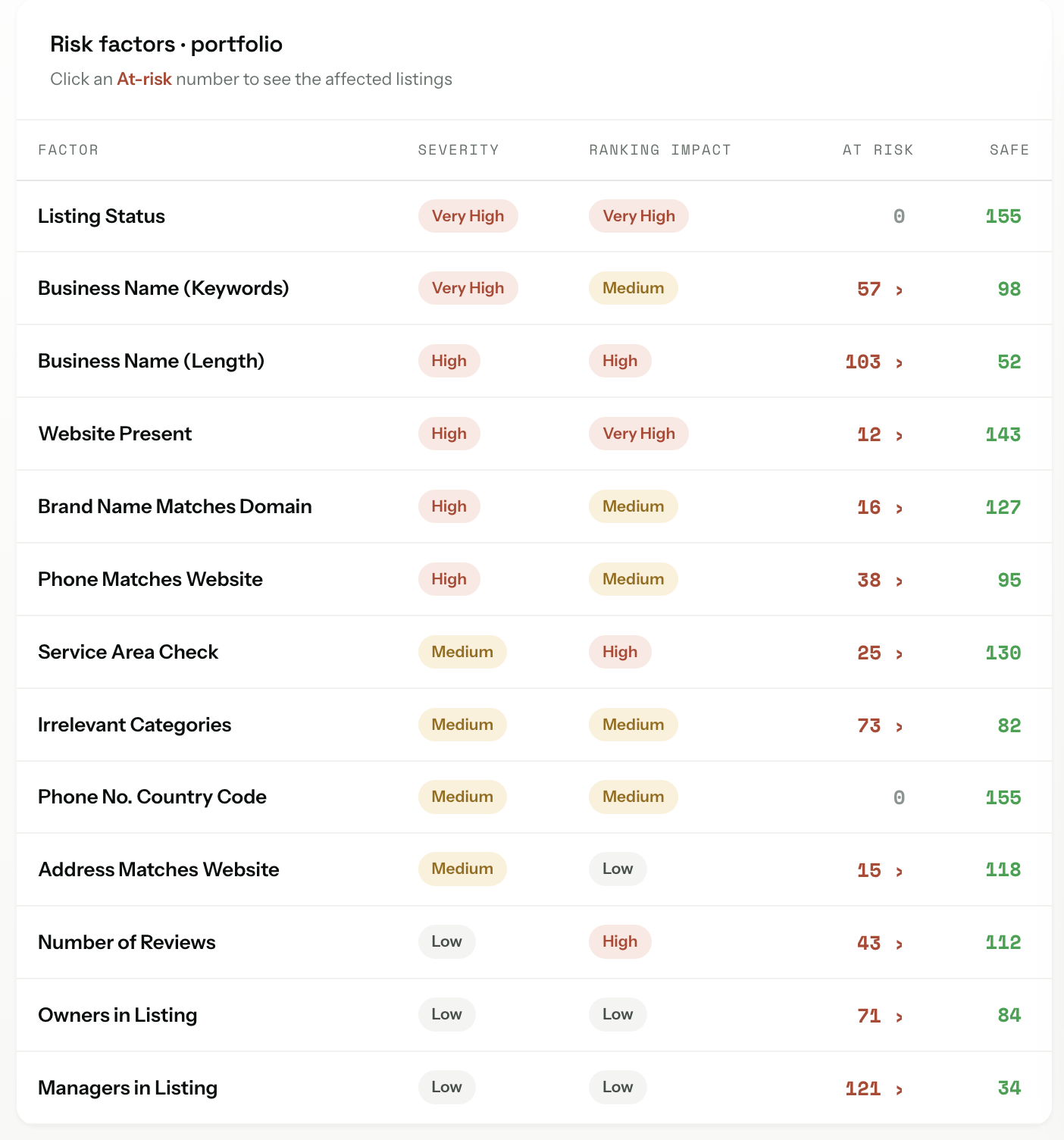
Measurement combines four data sources: Google Search Console for AI Overview impressions and clicks, Google Analytics 4 for referrer traffic from AI assistants, a manual monthly citation audit across ChatGPT, Perplexity, Gemini, and Claude for a fixed prompt list, and CRM-attributed appointments from AI-sourced sessions.
The minimum monitoring stack for a multi-speciality hospital looks like this:
- Search Console: segment queries that trigger AI Overviews, track impression and click share for the top 40-60 department and procedure keywords.
- GA4: tag referrer traffic from chatgpt.com, perplexity.ai, gemini.google.com, claude.ai, and copilot.microsoft.com. Route these into an "AI Assistants" channel group.
- Manual citation audit: a monthly run of 60-100 patient-language prompts across the four major assistants, logging whether the hospital, its named doctors, or its department pages appear.
- CRM attribution: the ICG AtomCRM at Rs 14,999 a month, or an equivalent healthcare-specific set-up like HealthPro 360 at the same anchor, captures the first-touch channel on every appointment and lets you attach revenue to AI-sourced pipeline. This is what turns "we appeared in ChatGPT" into "we earned Rs 32 lakh from ChatGPT-influenced consultations this quarter".
What are the DPDP Act and NMC guardrails for AI-ready hospital content?
The Digital Personal Data Protection Act 2023 and the National Medical Commission's advertising code together set the guardrails for AI-ready hospital content in India. Broadly: no identifiable patient stories without written consent, no comparative superlatives, no guarantee-of-cure language, no drug or dosage recommendations in public content, and clean consent language wherever personal data is captured.
Three practical guardrails to apply on every page you build for AI citation earning:
- Replace patient names and identifiable details with anonymised outcomes. "A 54-year-old male from South Delhi" is fine. A full name and photo without written consent is not.
- Strip "best", "no.1", "guaranteed", and "world-class" claims. AI models are being trained to down-weight sources that overclaim, and the NMC code has been enforcing this since 2022. Feature-based claims backed by numbers, such as "6,400 angioplasties performed in FY24-25", work better on both fronts.
- Every appointment form, chatbot, and calculator that captures name, phone, email, or health condition needs an explicit DPDP-compliant consent tickbox and a linked privacy notice, and the hospital needs to be able to honour deletion requests within 30 days. ABDM integration, where the hospital participates in the Ayushman Bharat Digital Mission, adds another consent layer that has to be respected in any AI-facing content that promises "digital records".
The ICG citation playbook for multi-speciality hospitals
ICG's approach to AI citation earning for hospitals is stacked in four layers, run in parallel rather than in sequence. There is a clean-up layer, a structured-content layer, an off-site corroboration layer, and a measurement layer. Each is owned by a named lead so nothing falls between chairs.
The clean-up layer resolves duplicate location pages, thin department pages, and orphaned doctor profiles. The structured-content layer rebuilds each department using the six-block pattern, publishes cost-and-package pages with real slab tables, and rewires internal linking so doctors, procedures, and departments form a proper entity graph. The off-site layer is where Angryturtle handles the GBP operating cadence across every location, YODA runs the AI-native YouTube programme, Meta Catalyst IQ powers the paid social growth, Prism Spy watches competitor ad creative in the same catchment, and Prism Pulse tracks Instagram brand health for the hospital and its senior consultants. The measurement layer stitches CRM, GA4, and the manual citation audit into a single monthly view for the CMO.
The pricing anchors under ICG's 70-30 fixed-and-variable model are Foundation at Rs 49,999 a month for single-location or emerging multi-speciality units, Growth at Rs 74,999 a month for established 100-250 bed set-ups, and Scale at Rs 99,999 a month for large chains and city-flagship hospitals. Seventy per cent of the fee is fixed for the retained team and platforms, and thirty per cent is tied to twelve-month outcome slabs so the hospital and the agency win together. For hospitals running paid media budgets above Rs 5 lakh a month, the same 70-30 model extends to Google Ads and Meta Ads. For YouTube-first AI programmes, the anchor starts at Rs 50,000 a month.
FAQ


How long does it take a multi-speciality hospital in India to start earning AI citations?
Most hospitals see first meaningful AI mentions within 45-70 days of rebuilding two or three flagship department pages on the six-block pattern, and reach a stable 3-5x citation lift by day 90-120. Speed depends on how much doctor E-E-A-T already exists and how active the GBP and YouTube channels are.
Do we need a separate content team for AI citation earning, or can our SEO team do it?
Most hospital SEO teams are set up for blue-link ranking and are not staffed for the entity-first, question-phrased content that AI models reward. A cross-functional pod of one SEO lead, one clinical content editor, one doctor-liaison, and one video producer is the right minimum. This is the exact shape of pod ICG deploys under the Growth and Scale tiers.
Which AI assistant matters most for Indian hospital marketers in 2026?
ChatGPT still owns the largest share of consumer health prompts, but Perplexity is over-indexed for younger, higher-intent research, and Gemini is quietly winning inside the Android and Google Workspace footprint that dominates Indian metros. Optimise for all four (ChatGPT, Perplexity, Gemini, Claude) and audit monthly, rather than picking a favourite.
Are AI citations worth the effort for a single-speciality clinic, or only for multi-speciality hospitals?
Single-speciality clinics, especially in IVF, cosmetic dermatology, dental, and orthopaedics, often see faster citation wins than multi-speciality hospitals because their topical authority is more concentrated. The playbook is identical, only the surface area is smaller and cheaper to cover.
How do we handle patient stories in AI-facing content without breaking the DPDP Act?
Use anonymised composites, aggregate outcomes, and written-consent case studies. Never publish a photograph, full name, or identifiable clinical detail without a signed consent form that specifies web and AI use. If in doubt, run the copy past the hospital's DPDP compliance officer or an external counsel before shipping.
Does listing procedure costs publicly hurt our conversion or negotiating position?
In our data across 300+ healthcare clients, transparent cost-band pages lift enquiry-to-consultation conversion by 18-35% and reduce price-shock drop-offs at the front desk. AI assistants also strongly prefer to cite pages with real numbers over pages that hide pricing behind a form.
What is the smallest useful investment to start an AI citation programme?
Under ICG's 70-30 model, a Foundation engagement at Rs 49,999 a month covers a single-location multi-speciality unit or a mid-sized clinic chain with three to five active departments. That budget funds the department page rebuilds, the doctor-profile rework, GBP cadence, a light YouTube programme, and monthly measurement.
How is AI citation earning different from traditional healthcare SEO?
Traditional SEO optimises a page to rank on a keyword. AI citation earning optimises an entity, the hospital, the doctor, the procedure, to be the answer a model reaches for regardless of the exact keyword. The former lives in title tags and backlinks. The latter lives in structured data, named authors, verifiable numbers, and off-site corroboration through GBP, YouTube, and credible third-party mentions.
Book a free 30-minute Brand & Growth Diagnostic.
It's a working session, not a sales pitch — you leave with a written root-cause analysis you can act on, whether or not you engage ICG.
Questions readers ask
about this topic.
The three platforms
behind every ICG engagement.
Beacon
CAPI middleware that fixes Event Match Quality, translates CRM statuses to Meta-standard events, dedups across channels.
Agency OS
Live client dashboard. GSC, GA4, Google Ads, Meta Ads, IVR calls in one view. Login anytime, not monthly.
Phoenix
Clinic revenue intelligence over your PMS. Daily action queue: Prevent Loss, Maintain & Engage, Grow Revenue. Multi-centre rollout.
Or book a free 30-min audit to see all three in action on your account.
Healthcare brands
that already run on ICG.
A representative slice of the 150+ healthcare brands ICG has delivered for across India. Most engagements remain under NDA.


What ICG clients say · on video.
"Mental health marketing requires a different sensitivity. ICG built compliance-aware campaigns that respect both patients and our..."
"Bariatric surgery patients need a long consideration cycle. ICG built a content + paid system that respects that timeline."
"Working with ICG felt like working with an in-house growth team that happens to specialise in healthcare."
The intelligence stack behind this playbook.
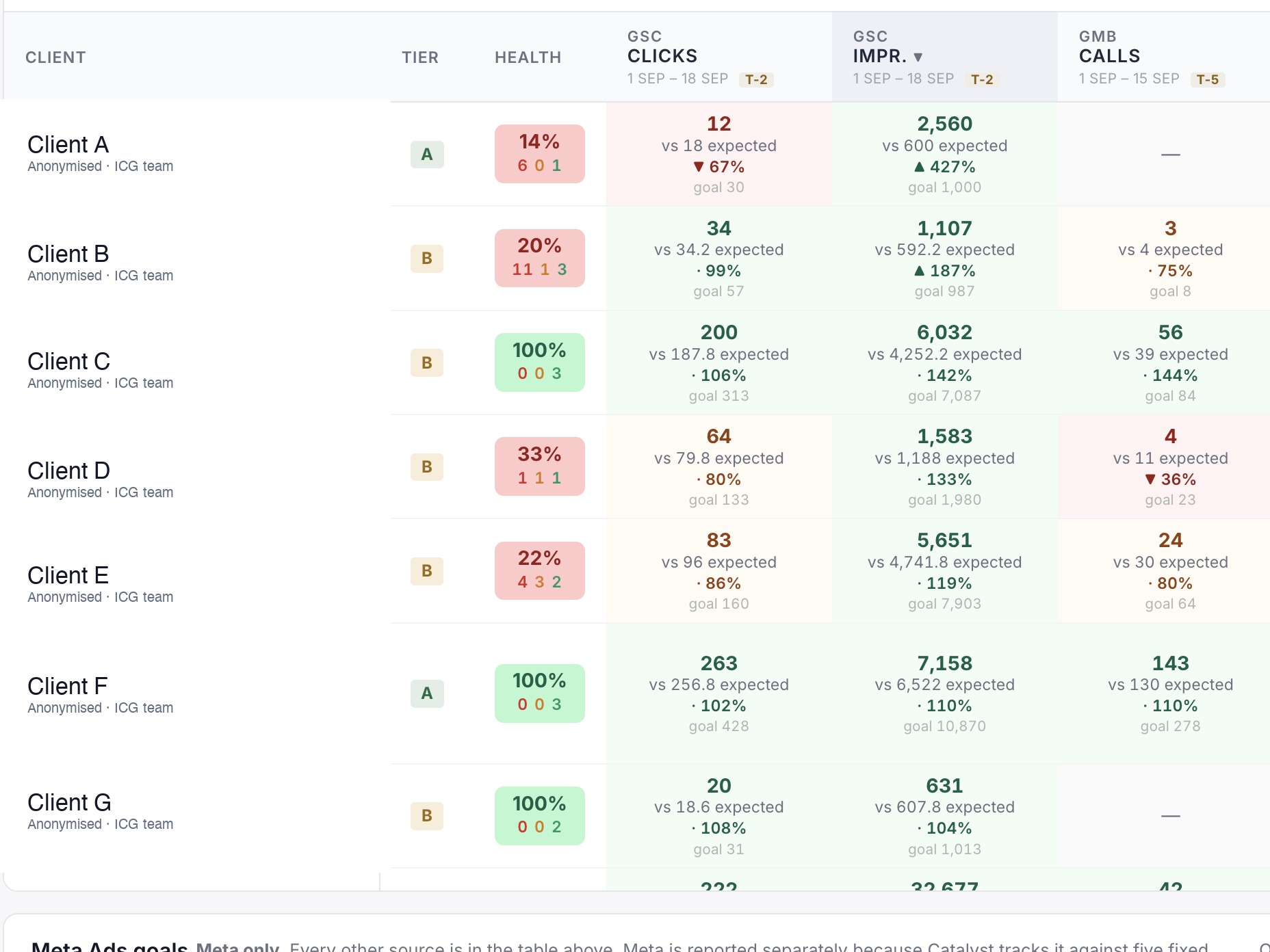
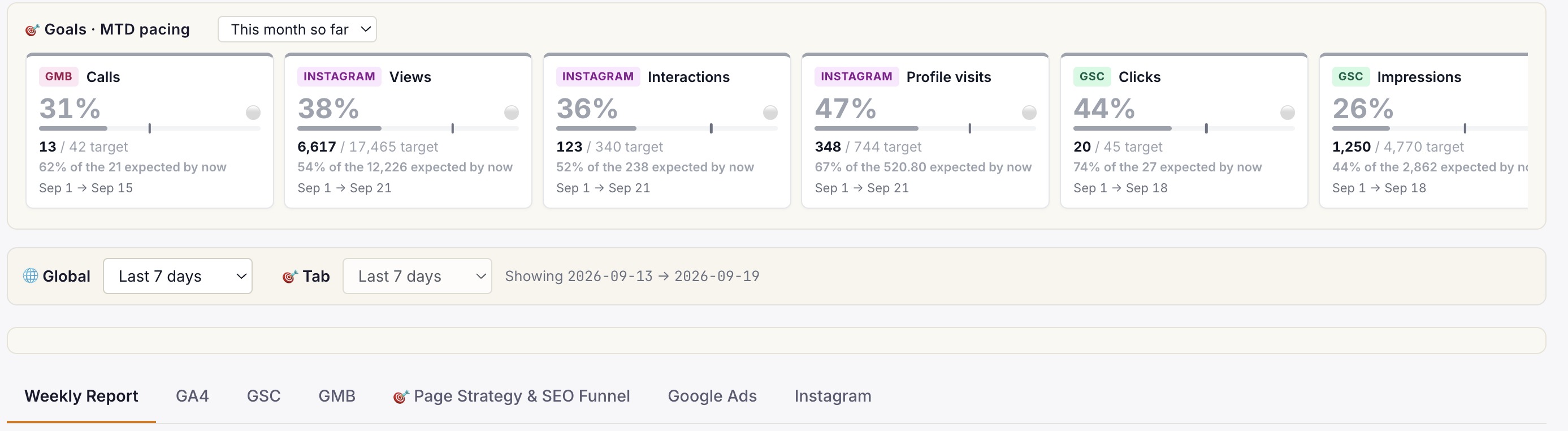
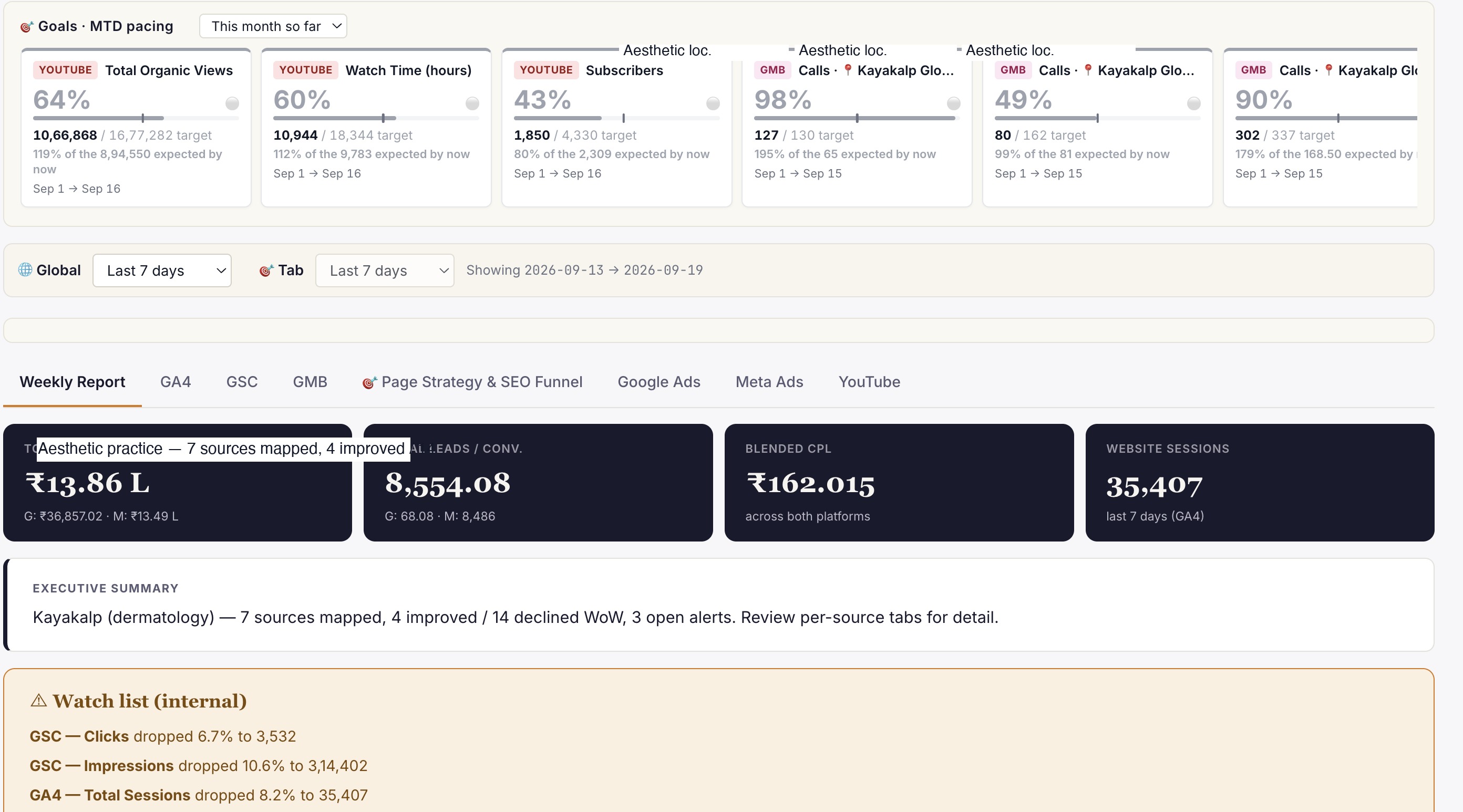
Every ICG engagement runs on the Search Intelligence Trifecta — Angryturtle for GMB, SIE for search and AI Overview, YODA for YouTube. Live product screens below.
Need help operationalising this?
Every ICG service is healthcare-only, NMC + DPDP-aware, and built around the patient-research patterns that drive Indian healthcare growth in 2026.
Every practice welcome — packages from ₹20,000/mo.
Goals-Driven engagements · Performance-Linked Payout Models available
More from
ICG.
Five trends shaping Indian healthcare marketing through 2027: AI-first patient research, Conversions API adoption, ABDM discovery, the AEO w...
Healthcare AIO is the discipline of getting your clinic or hospital cited inside Google AI Overviews, ChatGPT and Perplexity answers — not j...
Conversational-search advertising places brand messages inside AI chat answers — ChatGPT, Perplexity, Copilot — rather than beside a results...
Stop guessing.
Book a Diagnostic.
30 minutes. Free. With the AI-powered healthcare-only marketing agency 150+ brands already run on. No slides, no pitch, no hard close.


