


Geo-Grid Rank Tracking — 100 search points, one city map.
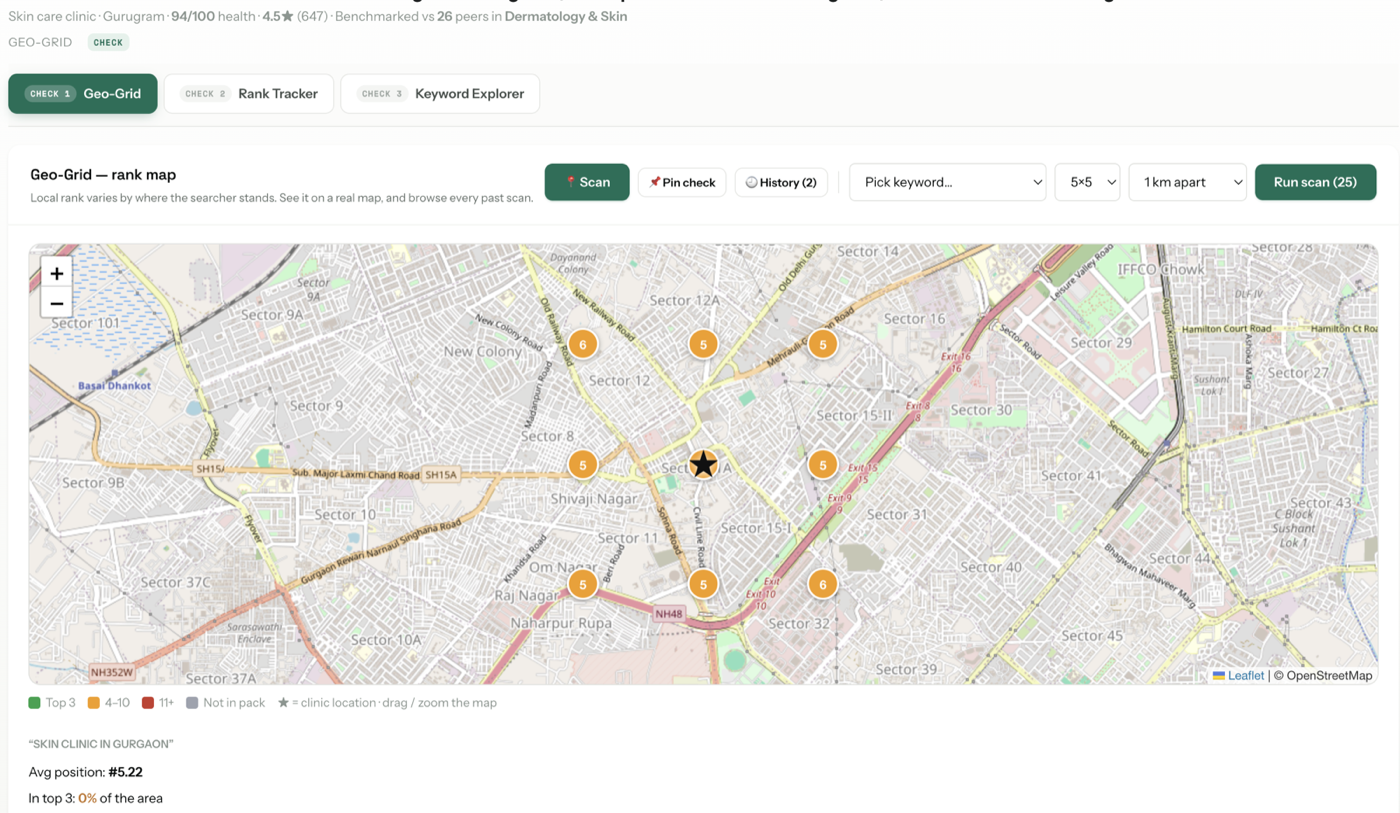
Geo-Grid Rank Tracking samples a healthcare listing's local-pack rank at 100 fixed points on a city map, typically at 500m, 1km, and 2km radii. It exposes the gap between "we rank at the clinic" and "we rank across the catchment" — the difference that determines whether a listing wins its city or only its street.
How it works.
A ranking tool that returns a single number for a keyword is misleading in local search. Google's local pack is proximity-weighted — the closer the searcher, the higher the listing floats — so "rank 1 for IVF Delhi" often means rank 1 only when you stand inside the clinic. Geo-grid tracking fixes that by asking Google the same question from 100 latitude-longitude points on a grid centred on the address. Each point returns the local pack Google would show a searcher at that spot. The output is a heat map, not a number. Green cells are where the listing wins; amber and red are where a competitor wins; the ratio of green-to-red is the honest measure of local dominance.
- Anchor the grid. Centre 10x10 grid on the verified GBP address; set radius by specialty catchment (2km dental, 5km IVF, 10km multi-specialty).
- Assemble the keyword set. Money terms first — "IVF centre near me", "dental clinic in [locality]", "pediatric hospital [city]".
- Sample every point. Query Google's local pack for each keyword at each of the 100 grid coordinates.
- Render the heat map. Colour every cell by rank position; overlay competitors so their strong-hold cells are visible.
- Diagnose the weak zones. Red cells cluster in patterns — a corridor, a postcode, a competitor's catchment; the pattern names the fix.
- Cycle. Ship the remediation, resample the grid seven days later, compare deltas cell by cell.
Why it matters for
Indian healthcare.
Geo-grid tracking is where ASCI claim compliance gets tested honestly. A clinic that markets itself as "the local IVF centre serving South Delhi" but shows red across every grid cell more than 800m from the pin is making an unsubstantiable catchment claim. ASCI expects claims to be supported by evidence — a geo-grid is the evidence. For NABH-accredited hospitals, the grid also validates catchment coverage claims made in accreditation documentation. And for multi-location chains, the grid is the honest way to compare centre-to-centre local dominance without inflated proximity-boosted numbers — a governance record any healthcare board can defend.
How ICG uses this.
Every one of the 143+ listings on Angryturtle carries an active geo-grid across its primary keyword set. The grid is where the ICG Local SEO team validates whether the last week's work moved the map — a red cell that turned amber, an amber cell that turned green. On a dental chain in Bengaluru, the grid revealed the chain ranked 1-3 within 500m of each of five centres but slid to 8-15 at the 2km ring; a citation-building push in adjacent postcodes plus a local-post cadence lifted grid-average rank from 6.8 to 3.4 in four months. 4.76-star portfolio rating and 76 average health score are the aggregate; the grid is where they get proved cell by cell.
| Grid ring | Typical starting rank | Post-remediation rank (60-90d) |
|---|---|---|
| At the pin (0m) | 1-2 | 1 |
| Inner ring (500m) | 3-5 | 1-2 |
| Mid ring (1km) | 6-9 | 2-4 |
| Outer ring (2km) | 10-15 | 3-6 |
| Catchment edge (5km) | 16-20+ | 6-12 |
| Grid average | 6.8 (portfolio observed) | 3.4 (portfolio observed) |
Frequently asked questions.
Why does a listing rank #1 at the clinic but #12 two kilometres away?
Google's local pack is proximity-weighted. Rank near the pin is almost always inflated because the searcher is close to the address. Two kilometres away, proximity stops helping and the ranking exposes the real signals — category correctness, review depth, citation authority, and how well the landing page matches the query. That is where competitors win the local pack.
How large is the geo-grid — how many search points per city?
Angryturtle samples 100 fixed points per listing on a 10x10 grid centred on the clinic address. Grid extents are configurable per specialty — a 2km radius suits dental catchments, 5km suits IVF and specialty hospitals with wider draw. Each point records the actual local pack ranking Google would return for a searcher at that exact latitude and longitude.
How often does Angryturtle refresh the geo-grid?
Weekly for standard tracking, daily for keywords flagged as high-priority. The full 100-point grid across the primary keyword set refreshes every seven days by default. Movement above a two-position threshold generates an alert in the operator queue. Historical grids are retained so an operator can compare last month's heat map against this month's.
How much rank movement does one geo-grid cycle typically produce?
On a listing with a healthy Rank OS score, one full remediation cycle — resolve NAP conflicts, restructure services, close the local-post gap in the demoted grid cells — typically moves grid-average rank three to five positions over 60 to 90 days. That is portfolio-wide observed behaviour across 143+ managed listings, not a hypothetical.
Read next.
See your geo-grid
heat map today.
ICG runs a free 30-min Brand & Growth Diagnostic that pulls your live GBP and shows exactly where geo-grid rank tracking sits on Angryturtle — cell by cell, with the competitor overlay.
