Paid search agency serving Dallas-Fort Worth and the US
Ichelon Consulting US runs Google Ads and Bing Ads spend management for buyers across nine industries and every part of the United States. Search, Performance Max, Shopping, Display and Discovery all sit under one delivery spine — measured against margin-adjusted CPA and profit-per-click, not vanity impressions. Every account is architected against the correct compliance frame from the first campaign draft, because a well-optimized keyword list matters nothing if the landing page is inadmissible in the client's regulatory environment.

- Ichelon Consulting US runs paid search on Google Ads and Bing Ads as one integrated spend layer — Search, Performance Max, Shopping, Display and Discovery across both platforms.
- Server-side conversion tracking is default. Enhanced conversions, offline conversion imports and CRM-tied revenue signals feed the bidding model so it optimizes to profit, not to form-fill count.
- Cross-industry delivery: healthcare, SaaS, fintech, e-commerce, real estate, edtech, medical devices, pharma and manufacturing — each carries a different platform policy overlay and each is scoped at kickoff.
- Compliance-scoped from campaign draft. HIPAA for healthcare, SOC 2 for SaaS, PCI-DSS for e-commerce, CFPB for fintech, FDA policy for pharma and devices, Fair Housing for real estate ad copy and audience targeting.
- Retainers custom-scoped per engagement · from $499/month exclusive of media spend.
- Dallas, Texas LLC
- US client team · Central Time (CST)
- 25+ US healthcare clients
- BAA signed with every client
- HIPAA compliance training across client and delivery teams
- Contracts and invoices in USD
-
 Primary Care · North Dallas, TXCase study →
-
 MedSpa · North Dallas, TX
-
 Skin Care · Beverly Hills, CA
-
 Dental · Christiansburg, VACase study →
-
 Pediatrics · Blacksburg, VACase study →
-
 Pediatric Dentistry · Blacksburg, VACase study →
-
 Dental · Roanoke, VACase study →
-
 Functional Medicine · Telehealth · USACase study →
“They were able to get all my ideas and work with me over a period of three to four months and create this amazing website. It's super customized, very modern, and it incorporates all the elements that I had wanted — the patient portal, nice pictures, a very interactive website, patient reviews. I would highly recommend their company to anyone who wants to make an excellent website.”
Six paid search services across Google Ads and Bing Ads
Paid search in 2026 is not simple keyword bidding. Signal quality feeds bidding quality, landing-page architecture feeds Quality Score, and audience layering feeds Performance Max reach. Our six-service delivery spine covers the signal-to-spend chain end-to-end, on both major platforms.
1. Google Ads Search and Bing Ads Search
Keyword architecture built to margin-per-click economics, ad-group structure tuned to Quality Score, RSA asset libraries with pin discipline, negative-keyword hygiene against the search terms report, and cross-platform bid parity between Google Ads and Bing Ads.
2. Performance Max campaigns
PMax structured by margin band and inventory depth, with asset groups per audience signal, brand-exclusion lists, negative-keyword protection where the platform permits, and campaign-level bid strategy tuned to the client's actual profit picture, not a vanity ROAS number.
3. Google Shopping and Microsoft Merchant Center
Product-feed engineering for both platforms, feed rule discipline for out-of-stock and low-margin SKUs, GTIN and MPN correctness, custom-label strategy for margin-tier bidding, and daily feed hygiene monitoring so disapprovals do not compound.
4. Conversion tracking and signal quality
Server-side tag deployment, enhanced conversions, offline conversion imports from the CRM, revenue-value pass-through, cross-domain and cross-device stitching, and consent-mode integration for CCPA opt-outs. Signal quality is the bidding model's oxygen.
5. Audience strategy and remarketing
First-party audience uploads, similar-audience refresh cadence, funnel-stage list construction, remarketing exclusion discipline, and consent-scoped audience list hygiene. First-party data is the durable moat in a signal-loss world.
6. Landing pages and Quality Score
Landing-page architecture tuned to Quality Score, Core Web Vitals remediation for the pages ads actually land on, message-match discipline between ad and page, form-completion friction audit, and A/B testing of headline and hero variants against the campaign-level goal.
Practice serving these US metros
Delivered from a Dallas-Fort Worth base, the paid search practice serves buyers headquartered across the DFW metroplex and accounts running nationally across the United States and neighboring US markets.
Every paid search account is scoped against the correct regulatory frame
Angryturtle · SIE · YODA make paid search cheaper
Paid search economics improve when organic, local and video capture reduces the intent load on the paid layer. The Trifecta strips away the queries you should never have to bid on — brand terms with defensible SERP presence, high-intent local queries covered by strong Google Business Profile presence, and video-first queries that YouTube already owns.
Angryturtle · GBP OS
Strong local pack presence reduces the branded and near-me bidding load on Google Ads. Angryturtle at $29/month for solo, bundled into managed retainers for fleet accounts.
SIE · Search Intelligence Engine
Organic pillar-and-hub content captures the top-funnel intent that would otherwise burn paid budget. Every organic ranking earned on a comparison query is a paid impression you no longer need to buy.
YODA · YouTube AIO
YouTube ranking on the review-and-comparison surface reduces bidding pressure on those SERP terms. Paid budget then gets concentrated on the bottom-funnel intent where paid actually converts.
How the paid search practice runs day-to-day
Paid search runs on a documented weekly and monthly cadence. Weekly ships cover bid adjustments, search-terms review, negative-keyword additions, and asset-refresh cycles. Monthly ships cover strategic review, competitor auction insights, landing-page A/B rotation, and the full profit-adjusted performance report.
Kickoff and audit · weeks 1–2
Account audit across Google Ads and Bing Ads, conversion tracking audit, feed audit for Shopping-eligible accounts, compliance frame confirmation, keyword and audience baseline, and the wasted-spend inventory that anchors the first optimization sprint.
Restructure phase · weeks 3–6
Account restructure against the margin-per-click economics, ad-group tightening, RSA asset library rebuild, negative-keyword sweep, feed rules for Shopping, and server-side conversion deployment where the client stack supports it.
Compounding phase · month 2 onwards
Weekly optimization cadence, monthly strategic review, quarterly landing-page overhaul against Quality Score data, and rolling A/B testing of headline and hero variants. Reporting into the wider growth stack where the client also runs organic.
Backed by ICG global leadership
Every US paid search engagement has direct line-of-sight to the ICG Leadership Team and to a senior performance reviewer who has scaled paid accounts across the consent-mode transition, iOS signal loss and Performance Max rollouts.
Our own tools run inside every engagement
Ichelon Consulting US uses software built by our own product team. Practices can also use most tools on their own, billed in USD.
Paid search in the US — common questions
Do you run Bing Ads or Google Ads only?
Both, as one integrated layer. Bing Ads still carries meaningful incremental reach across older-cohort and enterprise-desktop audiences, and Microsoft Merchant Center runs alongside Google Shopping for retail catalogs. Cross-platform bid parity and negative-keyword sync keep the two accounts from cannibalizing each other.
How do you handle server-side conversion tracking?
Server-side tag containers wherever the client stack supports it, with enhanced conversions on Google Ads, offline conversion imports from the CRM, revenue-value pass-through, and consent-mode integration for CCPA opt-outs. Signal quality is what the bidding model actually optimizes against.
Can you run paid search for healthcare without breaking HIPAA?
Yes. No PHI ever flows to ad platforms, server-side events strip identifiers before send, remarketing lists never contain treatment-context signals, and campaign copy is scoped to the state medical board rules for the relevant jurisdiction. Landing pages are audited for HIPAA-safe form architecture before spend begins.
How do you scope Fair Housing compliance for real estate ads?
Ad copy avoids protected-class language, audience-targeting rules follow the Housing special ad category, exclusion lists are engineered to avoid disparate-impact patterns, and every campaign is spot-checked against Fair Housing Act guidance before publish.
Do you charge a percentage of ad spend?
No. Retainers are flat fees, custom-scoped against the actual delivery load — number of campaigns, number of platforms, compliance overlay, reporting cadence. Percentage-of-spend fee models create the wrong incentives.
What is a typical US paid search engagement cost?
Retainers custom-scoped per engagement · from $499/month exclusive of media spend. Multi-platform, multi-country and regulated-industry accounts scale up from the floor; single-account single-country engagements sit closer to it.
Scope your US paid search engagement with Ichelon Consulting US
Book a 30-minute benchmarking call with a member of the Leadership Team, email the US practice lead, or WhatsApp us in your time zone.
Ichelon Consulting US in the US — other service pillars
Google Ads in the nine-stage patient journey
- 0Foundations
- 1Demand gen
- 2Capture
- 3Lead quality
- 4Lead mgmt
- 5Scheduling
- 6Show-up
- 7Conversion
- 8Retention
It works in demand capture. Spend should follow the searches that book, and every paid enquiry should be screened and called back fast. Our own software runs the work, and every stage is reported against a monthly target on Ichelon Agency OS.
See all nine stages and the tool behind each one →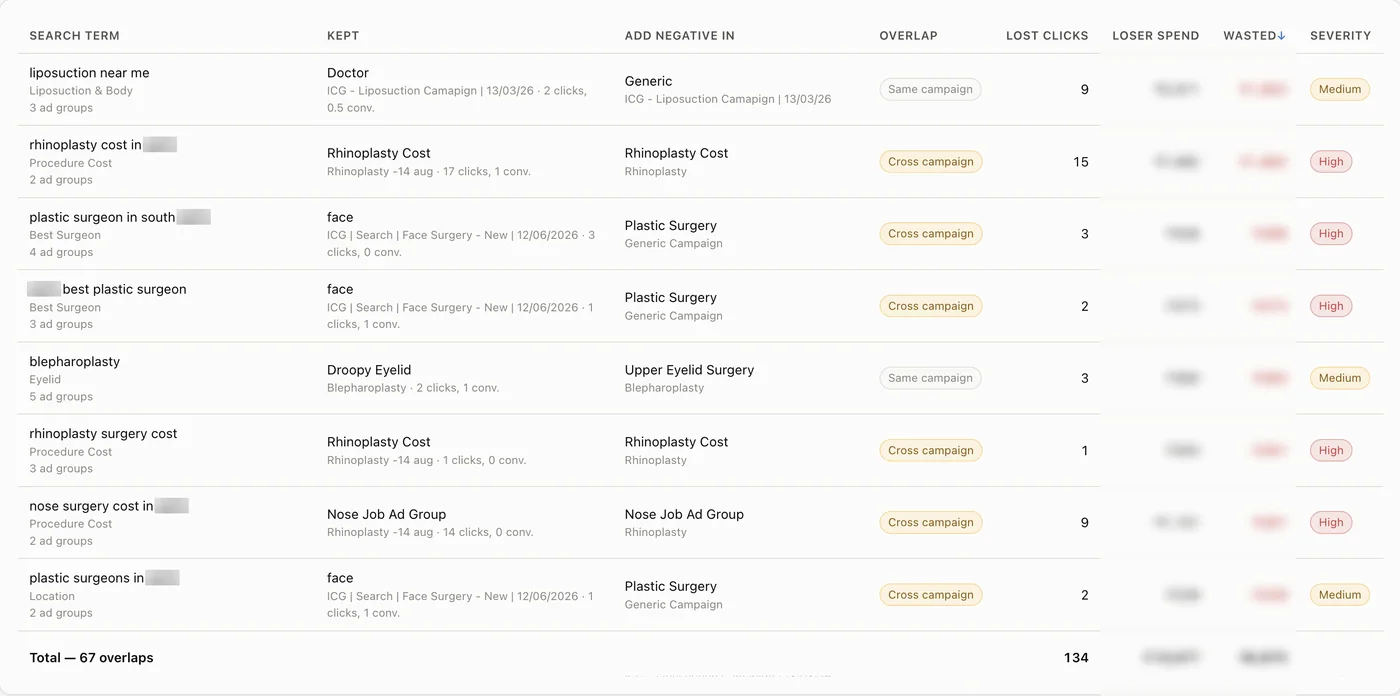
Common questions
What does PPC mean in healthcare advertising?
PPC (pay-per-click) in healthcare means ads where a practice pays each time someone clicks, mainly Google and Microsoft search ads shown for searches such as 'urgent care near me.' Keywords, bids and landing pages are tuned for calls and bookings. Healthcare PPC must also follow Google's healthcare ad policies and keep conversion tracking free of patient health information.
What does a healthcare PPC agency do?
A healthcare PPC agency plans, builds and manages paid search and display campaigns for practices: keyword research by service and location, ad copy that meets Google's healthcare policies, landing pages, call and booking tracking without patient data, bid and budget management, and negative keywords to cut waste. It should report cost per booked visit monthly and leave account ownership with the practice.
What is a PPC outsourcing agency?
A PPC outsourcing agency runs your paid search campaigns in place of an in-house hire, or delivers the work white-label for another agency. Practices use one to get specialist skills, tools and testing without adding salaries. In healthcare, confirm the outsourced team signs a BAA, knows Google's medical ad policies, and that the practice keeps ownership of the ad account and data.
Is PPC still worth it for healthcare in 2026?
Yes, for most practices, because search ads reach people at the moment they look for care. PPC pays off when cost per booked visit stays well below a patient's lifetime value. Clicks cost more in competitive specialties and AI Overviews now take space on some results, so tight keyword lists, call tracking and strong landing pages matter more than budget size.