


YouTube vs Instagram for Healthcare Brands in India: The 2026 Buyer's Guide
A neutral, feature-based comparison of YouTube and Instagram for Indian healthcare brands across seven axes: intent, NMC compliance, DPDP, cost, attribution, AI Overview visibility and audience reach, with buyer-fit picks for hospitals, IVF chains and dental clinics.
No pitch. Written root-cause diagnosis. AI-powered, healthcare only.
Direct answer
A neutral, feature-based comparison of YouTube and Instagram for Indian healthcare brands across seven axes: intent, NMC compliance, DPDP, cost, attribution, AI Overview visibility and audience reach, with buyer-fit picks for hospitals, IVF chains and dental clinics.
TL;DR
TL;DR
- YouTube is a search-and-shelf platform; Instagram is a discovery-and-recall platform. For Indian healthcare buyers, that single distinction decides most of the strategy.
- Pick YouTube-led when your treatment has a long consideration window (IVF, orthopaedics, cardiac, oncology, dental implants) and patients Google before they call.
- Pick Instagram-led when the specialty is visual, elective and impulse-driven (aesthetic dermatology, cosmetic dentistry, hair transplant, weight loss, IVF community-building).
- Run both once you cross Rs 3-4 lakh per month in combined media spend, because the cheapest lead in Indian healthcare is a warm audience retargeted from long-form YouTube to short-form Instagram.
- Compliance is not equal. NMC 2023 professional-conduct rules, DPDP Act 2023 consent language and platform-specific health policies land differently on each surface; the risk profile matters as much as the media mix.
Table of Contents
- Why this comparison matters for Indian healthcare brands
- The seven axes to compare on
- Main comparison table
- Per-axis deep dives
- Which platform fits which buyer
- How ICG helps as a neutral advisor
- The 70-30 pricing model for social and video services
- FAQ
Why this comparison matters for Indian healthcare brands
Most Indian healthcare marketing directors we speak with have inherited a split budget: a founder or medical director who wants "more YouTube" because a competitor's doctor went viral, and a marketing manager who is fluent in Reels because that is where the audience lives. The two camps are usually arguing past each other, because YouTube and Instagram are not substitutes. They are different demand generators serving different stages of the same patient journey.
In 2026, that argument is no longer a matter of taste. Three shifts have hardened the trade-off. First, AI Overviews and Google's video-carousel surfacing now pull YouTube content into search results within days of publish, which changes the shelf-life math for any specialty with a search-heavy funnel. Second, the National Medical Commission's professional-conduct regulations tightened what a registered medical practitioner can and cannot claim on social surfaces, and the enforcement is uneven across platforms. Third, the Digital Personal Data Protection Act 2023 has raised the compliance cost of tracking, retargeting and lead capture, and each platform's ad manager handles Indian consent language differently.
For a 100-bed multispecialty in a Tier-1 city, or a five-clinic dental group in Bengaluru, or a mid-tier IVF chain running six centres, the platform decision is a capital-allocation question, not a creative-preference question. This guide compares the two platforms on the seven axes that actually decide return on marketing spend in Indian healthcare.
The seven axes to compare on
Before any dashboard or agency deck, force the comparison down to features you can verify. We use these seven axes with every hospital and clinic group we advise:
- Intent depth - is the user searching for a solution or being interrupted with one?
- Content shelf life - does a well-made asset earn views for 90 days or 90 minutes?
- AI Overview and search surfacing - does the content compound into Google's answer layer?
- NMC and platform compliance risk - how the platform's health policy plus the NMC advertising code interact
- Production cost per usable asset - realistic Indian production costs, not global benchmarks
- Attribution and lead capture - how cleanly a view becomes a tracked enquiry under DPDP consent rules
- Audience demographics in India - who is actually reachable, by age band, city tier and language
Main comparison table
| Axis | YouTube | |
|---|---|---|
| Intent depth | High. Users type a symptom or procedure query and pick a video to watch for 4-14 minutes. | Low to medium. Users scroll a feed; interest is triggered by pattern-interrupt visuals or a familiar creator. |
| Content shelf life | Long. A well-optimised video can earn views for 12-36 months and get re-surfaced by search. | Short. Reels peak in 48-72 hours; static posts fade in 24-48 hours; Stories vanish in 24 hours. |
| AI Overview and search surfacing | Strong. Video chapters, transcripts and structured metadata are ingested by Google and cited in AI Overviews. | Weak. Instagram is largely walled off from Google's crawl; discovery lives inside the app. |
| NMC and platform compliance risk | Medium. Long-form allows disclaimers, credentials on screen, and consent references in description. | High. Short-form leaves little room for disclaimers; before-after and testimonial formats trip both NMC and platform policy. |
| Production cost per usable asset | Higher per asset: Rs 15,000-60,000 per doctor-led long-form in India when done properly. | Lower per asset: Rs 2,500-8,000 per Reel, but you need 12-20 a month to matter. |
| Attribution and lead capture | Cleaner. Card links, description CTAs and end-screens push traffic to a UTM-tagged landing page and CRM. | Messier. DMs, comment funnels and lead forms need in-app plumbing and DPDP-compliant consent handling. |
| Audience demographics in India | Broadest reach: 30-65 age band, Tier-1 to Tier-3, strong in Hindi, Tamil, Telugu, Marathi, Bengali dubbing. | Skews 18-40, Tier-1 and Tier-2 dominant, English and Hinglish first; regional-language creators are rising but thinner. |
Per-axis deep dives
Intent depth: search versus scroll
YouTube is the second-largest search engine used by Indian patients before they book. When a 42-year-old woman in Pune types "IVF success rate after 40" or a 58-year-old man in Chennai types "knee replacement recovery time," they are already inside the consideration set. A doctor-led video that answers the query, cites data honestly and closes with a soft call to action converts because the viewer arrived with a question. Instagram is different. The user opened the app for entertainment or social recall and encountered a Reel by accident. The specialty either fits an aesthetic, curiosity-driven format or it does not. Dermatology, cosmetic dentistry, hair restoration, fertility community-building and wellness thrive here. Cardiology, oncology and complex surgery struggle because the emotional frame is wrong.
Content shelf life and the compounding math
A YouTube video is an asset on your balance sheet. A Reel is a marketing expense. That is not a value judgement, it is a math statement. A 6-minute video on "PCOS treatment options in India" published in January can still be earning organic views next December, and each view carries an implicit citation for the doctor and the brand. Instagram content depreciates fast. The best Reels programmes we see accept this and treat the platform as a rhythm engine: 12-20 posts per month, most of which will die, a handful of which will breakout and one of which will change the enquiry pipeline for a quarter. If your CFO asks "what do I own after 12 months of spend?" the answer differs sharply between the two platforms.
AI Overview and search surfacing
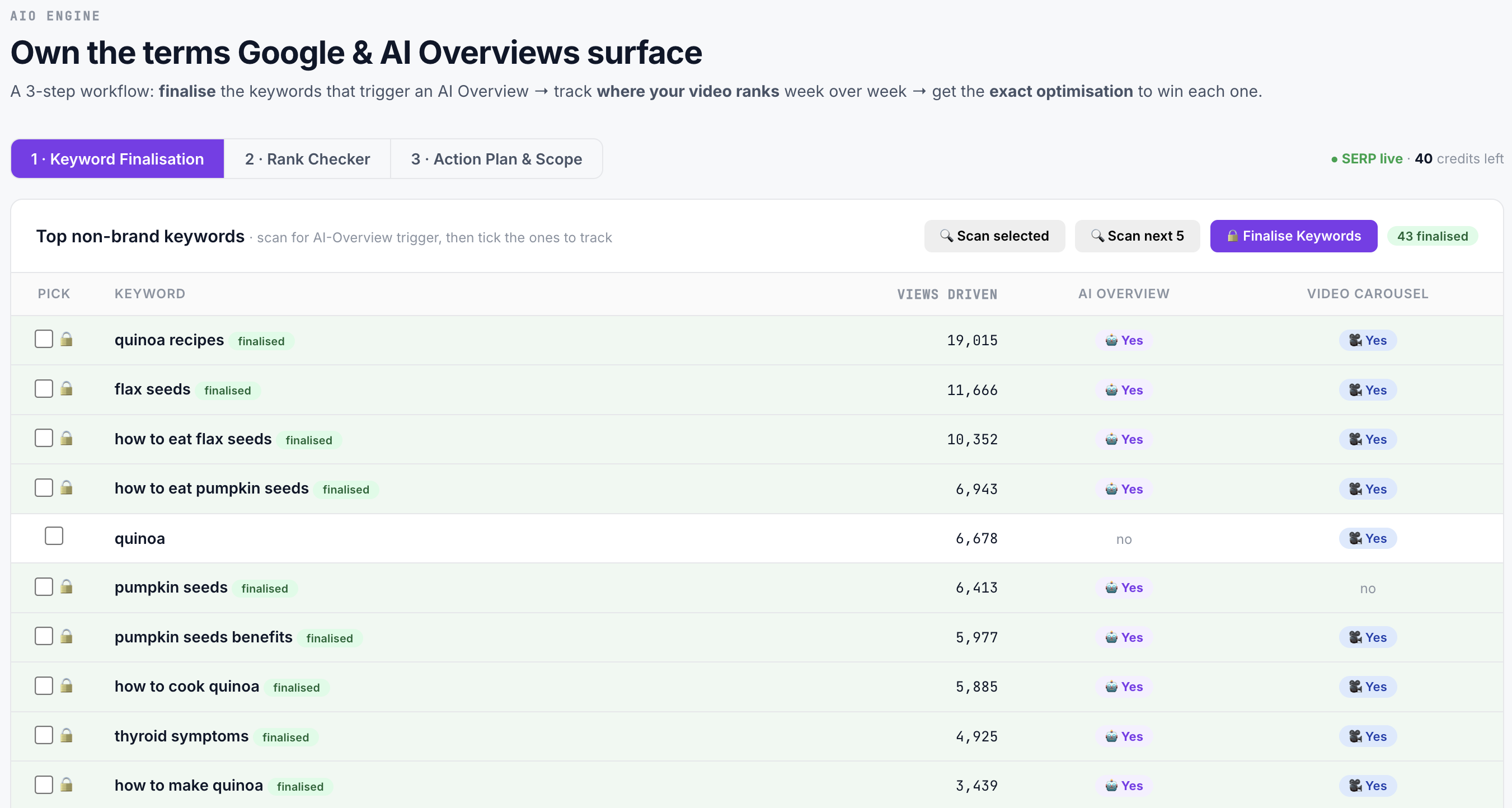
Google's AI Overview layer increasingly cites YouTube videos as sources for health queries, particularly when the video has clean chapter markers, a full transcript, structured description and a credible on-screen practitioner. That means a single well-produced video can earn traffic three ways: direct YouTube search, Google's video carousel, and citation inside an AI-generated answer. Instagram content, by contrast, is mostly invisible to Google. A viral Reel does not become a search-engine asset. For any healthcare brand betting on AI-native discovery, YouTube is not one channel among many, it is the video layer of your SEO strategy. This is the thesis behind YODA, ICG's AI-native YouTube system, and it is the reason we push clients with long-consideration specialties to fund YouTube first and treat Instagram as amplification.
NMC and platform compliance risk
The National Medical Commission's professional-conduct regulations restrict what a registered medical practitioner can claim in advertising, prohibit self-aggrandisement, and require caution around before-after imagery, patient testimonials and outcome guarantees. Both platforms are covered by these rules; the difference is how much room the format gives you to comply. A long-form YouTube video can carry a spoken disclaimer at the top, a credentials card on screen, an ethics statement in the description and links to the practitioner's NMC registration. A 15-second Reel cannot. Add platform-level health policies, which restrict certain surgical, weight-loss and fertility claims, and the practical result is that many aesthetic and elective specialties get more ad rejections on Instagram than on YouTube for the same underlying claim. This is not a reason to avoid Instagram; it is a reason to design creative with compliance baked in from the first storyboard, not bolted on at review.
Production cost per usable asset in India
Global benchmarks mislead Indian buyers. A doctor-led YouTube long-form video, done to a standard that actually ranks, costs between Rs 15,000 and Rs 60,000 per finished piece in India once you account for scripting, doctor time, two-camera shoot, editing, thumbnail engineering and chapter markers. A Reel, done well, costs Rs 2,500-8,000 per piece, but you cannot judge a Reels programme by any single unit. The unit of analysis is a monthly cadence of 12-20 pieces. Divide the monthly cost by the pieces that actually move enquiry volume and the effective cost per usable Reel is often higher than the sticker price suggests. YouTube's cost per finished asset is higher, but each asset earns for longer, so the amortised cost per view is usually lower for search-driven specialties.
Attribution, lead capture and DPDP Act 2023
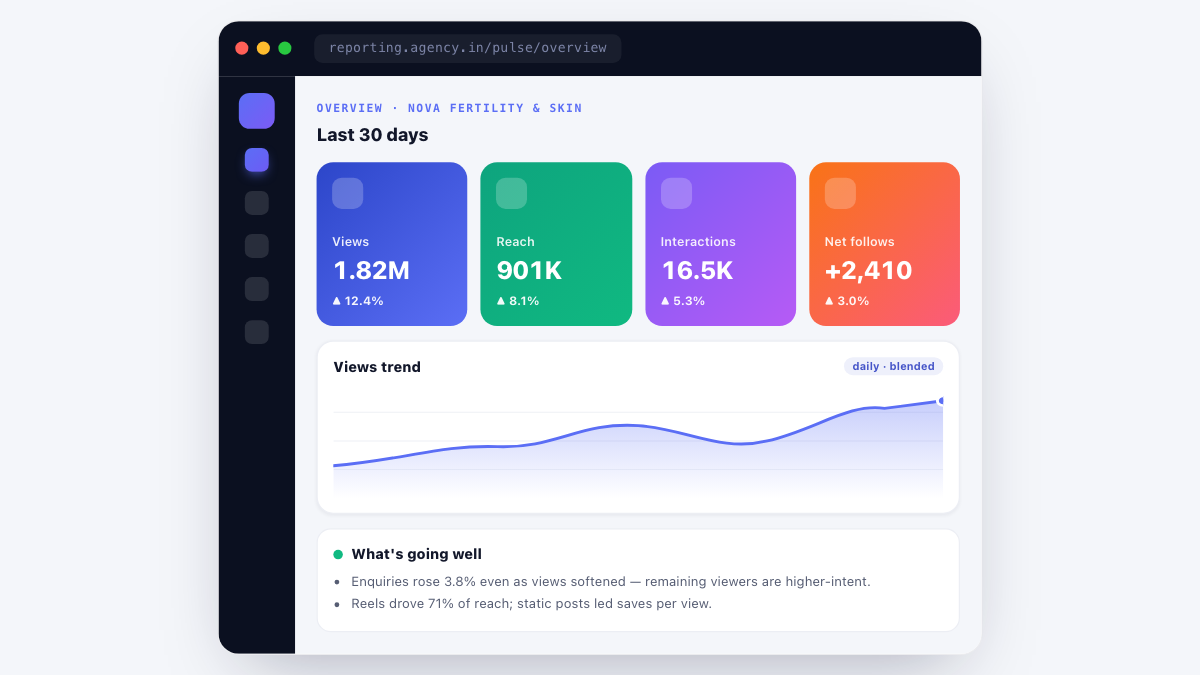
Attribution is where most healthcare brands lose money without knowing it. On YouTube, the standard flow - description link, end-screen card, pinned comment, and a UTM-tagged landing page that feeds a CRM - is well understood, and DPDP-compliant consent language can live on the landing form. On Instagram, the flow is fragmented across DMs, comment funnels, in-app lead forms and profile-link tools. Each of these needs its own DPDP-compliant consent capture, its own data-retention policy and its own path into the CRM. If you are running Meta Ads for lead generation on Instagram, the in-platform lead form is fast but leaks context unless you enrich it with a real CRM handshake. Prism Pulse, our Instagram analytics stack, and the Nexus CRM stitch these flows together so that a Reel view, a DM enquiry and a booked consultation are visible as one funnel rather than three disconnected screens.
Audience demographics in India
YouTube reaches almost every Indian household with a smartphone and a data pack, which is now the majority of the country. It skews slightly older than Instagram, indexes strongly in Tier-2 and Tier-3 cities, and carries regional-language content at scale. Instagram, in India, still skews 18-40 and Tier-1/Tier-2, though regional-language creators are growing in dental, dermatology and fertility niches. If your patient panel is majority under 40, urban and English-comfortable, Instagram reach maps to your audience. If your panel is 40-plus, includes Tier-2 and Tier-3 catchment, or depends on family decision-makers who prefer regional-language content, YouTube reach is deeper. Most hospitals we advise discover, once they run the demographic overlay, that their audience is bimodal - a Reels-fluent under-40 segment and a YouTube-native 40-plus segment - and the media mix should reflect that split rather than a single-platform bet.
Which platform fits which buyer
100-bed multispecialty hospital, cardiology and oncology heavy
Lead with YouTube. Fund 2-3 doctor-led long-form videos a month across cardiology, oncology and internal medicine. Layer Instagram for community, hospital-culture content, doctor birthdays, patient-support-group updates and event marketing. The economics: expect Rs 50,000-1.2 lakh a month for a compliant YouTube programme, and Rs 40,000-80,000 for a Reels cadence that keeps the brand top-of-mind for referring physicians and local patients.
Single-location dental clinic in a Tier-1 city
Lead with Instagram, supported by a lightweight YouTube presence. Cosmetic dentistry, aligners and implants respond to visual proof, before-after storytelling within compliance limits, and creator collaborations. YouTube here plays a trust-building role - three to four evergreen videos on procedures, cost and recovery - not a volume role. Budget Rs 25,000-60,000 a month all-in.
Mid-tier IVF chain with 6-10 centres
Run both, weighted toward YouTube. IVF is a research-heavy, high-consideration decision with a 4-12 week enquiry window. YouTube captures search intent from women and couples actively investigating options. Instagram builds the emotional community, hosts the Q&A lives with fertility specialists, and carries the success-story format under NMC-compliant framing. Expect combined media plus production of Rs 2.5-6 lakh a month for a chain of this size, with the split roughly 60 percent YouTube and 40 percent Instagram.
Diagnostic lab chain in Tier-2 and Tier-3 cities
Lead with YouTube, especially in regional languages. Diagnostic categories - preventive health checks, women's health panels, cardiac markers, diabetes management - are search-heavy, price-sensitive and family-decision driven. YouTube's demographic reach and shelf life win here. Instagram carries offers, festival-linked packages and health-day content, but is secondary. Budget Rs 60,000-1.5 lakh a month, tilted 70:30 toward YouTube.
How ICG helps as a neutral advisor
Ichelon Consulting Group works with more than 300 healthcare brands across India, including 150-plus clinics and multi-specialty hospitals. We are not a platform reseller and we do not take spiffs from any ad network. Our job is to pick the right media mix for the specialty, the catchment, the compliance envelope and the founder's risk appetite - then to execute against it with named practitioners and measured outcomes. On the YouTube side, YODA is our AI-native production and ranking system that turns doctor time into ranked, cited assets in Google's AI answer layer. On the Instagram side, Prism Pulse gives you the analytics and Prism Spy shows what competing brands are actually spending on Meta Ads, so your creative and budget decisions are informed rather than assumed. Meta Catalyst IQ runs the paid layer for Instagram and Facebook. The Nexus CRM and, for hospitals, the HealthPro 360 RCM and EHR overlay, close the loop from a view to a booked consultation to a paid procedure. Every recommendation we make can be traced to a feature, a compliance clause or a cost - not a vendor preference.
The 70-30 pricing model for social and video services


For the service layer around either platform, we price on a 70-30 model. Seventy percent of the fee is fixed and covers strategy, production, publishing, compliance review and reporting. Thirty percent is tied to a 12-month outcome target agreed upfront, on a sliding-scale slab. This applies across our SEO tiers (Foundation Rs 49,999 per month, Growth Rs 74,999 per month, Scale Rs 99,999 per month) and extends to Google Ads engagements on media budgets of Rs 5 lakh and above, and to YouTube SEO and AI Overview engagements on YouTube media budgets of Rs 50,000 and above. Media spend on Instagram or YouTube is separate from the service fee and is billed transparently at platform rates. For hospitals and clinic groups running combined YouTube plus Instagram programmes, the 70-30 model aligns the agency's incentives with your enquiry pipeline rather than with vanity metrics like reach or impressions.
FAQ
Is YouTube or Instagram better for a new hospital brand in India?
For a new brand, start with YouTube if your specialties are search-driven (cardiology, orthopaedics, oncology, IVF, diagnostics) and start with Instagram if they are visual-elective (aesthetic dermatology, cosmetic dentistry, hair restoration). If your specialty mix is broad, fund a lean YouTube programme first because those assets keep earning, then layer Instagram once you have three to five evergreen videos live.
How much should an Indian clinic spend on YouTube versus Instagram per month?
A single-location clinic can run a credible programme on Rs 40,000-80,000 a month including production and modest media. A multi-location group typically spends Rs 2-6 lakh a month combined. The split depends on specialty: search-heavy specialties tilt 60-70 percent toward YouTube; visual-elective specialties tilt 60-70 percent toward Instagram.
Does the NMC advertising code apply differently to YouTube and Instagram?
The code applies equally to both, but the format of each platform makes compliance easier or harder. YouTube's long-form gives you room for disclaimers, credentials and consent references. Instagram's short-form does not, which raises the practical risk of self-aggrandising claims, testimonial misuse and before-after content that crosses the line. Design creative for compliance from the storyboard stage on either platform.
How does the DPDP Act 2023 affect lead capture on these platforms?
Any lead you capture from either platform must have an explicit, informed, purpose-limited consent under DPDP. On YouTube, the standard flow is a UTM-tagged landing page with a consent-compliant form. On Instagram, in-app lead forms, DM funnels and comment tools each need their own consent capture and data-handling policy. Route both into a single CRM with DPDP-compliant retention rules rather than storing leads in spreadsheets or platform inboxes.
Can Instagram Reels rank in Google search?
Rarely and unreliably. Instagram content is largely walled off from Google's crawl. Reels can appear in Google's short-video results in narrow cases, but you cannot build a search strategy on it. If AI Overview and Google search visibility matter to your enquiry pipeline, YouTube is the primary video surface.
What about YouTube Shorts versus Instagram Reels?
Both are short-form. YouTube Shorts benefits from the platform's search and recommendation graph, so a Short can drive subscribers to your long-form channel. Instagram Reels benefits from the app's higher session frequency and creator collaboration culture. Treat Shorts as a top-of-funnel feeder for YouTube long-form; treat Reels as a standalone brand-building rhythm.
How long before we see enquiry-pipeline movement from YouTube?
Compliance-safe, doctor-led YouTube programmes typically start moving enquiry volume in months three to five, with compounding gains from month six onward as videos accumulate search authority and AI Overview citations. Instagram usually shows brand-lift signals faster (weeks four to eight) but plateaus without continuous production.
Can our in-house team run this, or do we need an agency?
In-house works for a single-location clinic with a marketing manager, a freelance editor and a doctor willing to spend two hours a week on camera. For multi-location groups, hospitals or IVF chains, in-house teams usually cannot sustain compliance review, production quality, AI Overview optimisation and CRM integration together. That is when a specialist partner earns its fee.
Does ICG recommend one platform over the other?
Our default recommendation for search-driven, high-consideration specialties in Indian healthcare is YouTube-first, Instagram-supporting. For visual, elective specialties, the reverse. But the honest answer for any specific brand depends on catchment, specialty mix, doctor availability, compliance appetite and CRM maturity. We audit those inputs before recommending a mix.
Book a free Meta ads account audit.
Raman Soni's team pulls your account, checks CAPI/EMQ, reviews creative for NMC compliance, and shows where CPQL is leaking. 45 minutes, actionable output.
Questions readers ask
about this topic.
The three platforms
behind every ICG engagement.
Beacon
CAPI middleware that fixes Event Match Quality, translates CRM statuses to Meta-standard events, dedups across channels.
Agency OS
Live client dashboard. GSC, GA4, Google Ads, Meta Ads, IVR calls in one view. Login anytime, not monthly.
Phoenix
Clinic revenue intelligence over your PMS. Daily action queue: Prevent Loss, Maintain & Engage, Grow Revenue. 46-centre rollout.
Or book a free 30-min audit to see all three in action on your account.
Healthcare brands
that already run on ICG.
A representative slice of the 150+ healthcare brands ICG has delivered for across India. Most engagements remain under NDA.


What ICG clients say · on video.
"Scale up of organic channels and business consulting. ICG has absolute domain authority in their field."
"Working with ICG transformed how we acquire IVF patients in Gurgaon. They understand the fertility journey from inquiry to consult..."
"What Ichelon accomplished — they got all my ideas and worked over 3-4 months to create an amazing, super-customised website."
Need help operationalising this?
Every ICG service is healthcare-only, NMC + DPDP-aware, and built around the patient-research patterns that drive Indian healthcare growth in 2026.
More from
ICG.
Healthcare AIO is the discipline of getting your clinic or hospital cited inside Google AI Overviews, ChatGPT and Perplexity answers — not j...
Conversational-search advertising places brand messages inside AI chat answers — ChatGPT, Perplexity, Copilot — rather than beside a results...
NABH digital compliance means every claim, image and testimonial your hospital publishes online matches what an accreditation surveyor can v...
Stop guessing.
Book a Diagnostic.
30 minutes. Free. With the AI-powered healthcare-only marketing agency 150+ brands already run on. No slides, no pitch, no hard close.


