


Reputation Monitoring Across Google, Quora and Reddit — What Actually Matters
The six signals that actually move revenue
Across 143 managed healthcare portfolios, six signals correlate with movement in booked-consultation numbers. Everything else is directional at best.
Signal 1 · Brand-SERP first-page positive share
The percentage of the top 10 Google results for the clinic name query, weighted by variant search volume, that read as positive or neutral. A single top-3 negative pulls the number down by 10-14 percentage points and moves brand-search-to-consult conversion by roughly the same. Monitored weekly.
Signal 2 · Google Business Profile rating trajectory
Not just the current rating. The 90-day trajectory — is the profile drifting up or down? A profile drifting from 4.7 to 4.5 loses map-pack ranking even before it hits 4.5. A profile drifting from 4.4 to 4.6 gains before it crosses the threshold. Monitored daily.
Signal 3 · Negative review response SLA compliance
Percentage of negative reviews responded to inside the SLA window. Below 80 per cent, Google's algorithm de-prioritises the profile on the "responsive business" signal. Above 95 per cent, the algorithm rewards it. Monitored daily.
Signal 4 · Negative Reddit thread rank position
Where the highest-ranking negative Reddit thread sits on Google for the brand name query. Top-10 is a slow bleed. Top-3 is an active crisis. Displacement content is the recovery lever. Monitored weekly.
Signal 5 · Top-3 Quora answers on brand-adjacent queries
Whether the top three Quora answers on category-consideration queries ("best X clinic in Y") position the brand favourably or unfavourably. Disclosed expert answers under the doctor's Quora account are the lever. Monitored weekly.
Signal 6 · Unaddressed clinical-content comments on ads
Comments on live Meta ads that ask specific clinical questions and sit un-replied. Every unaddressed clinical comment on a live ad drops the ad's CTR by 2-3 per cent and doubles the CPQL over the campaign lifecycle. Monitored real-time via Prism Pulse.
The signals that look important and are not
Cadence — how often each signal is monitored
| Signal | Cadence | Trigger threshold |
|---|---|---|
| GBP review posting | Real-time | Any negative review |
| Meta ad comment | Real-time | Any clinical or complaint comment |
| Reddit thread velocity | Daily | 200 upvotes / 30 comments in 48h |
| YouTube comment velocity | Daily | Coordinated attack signal |
| Brand-SERP composition | Weekly | Any drop of >5 points |
| Quora answer position | Weekly | Any drop below top 3 on tracked query |
| AI Overview citation share | Quarterly | Trend down for two quarters |
Cross-surface pattern detection
The single biggest gap in most reputation setups is treating each surface as siloed. A negative Reddit thread often mirrors a Quora question and a YouTube comment thread and a Google review — and if the reputation team responds on one and misses the other three, the crisis metastasises across surfaces even while the "response" is happening.
ReputationShield's cross-surface detector runs a daily correlation check across five surfaces:
- Reddit — new thread mentioning the brand or doctor.
- Quora — new question or edited answer mentioning the brand or doctor.
- YouTube — new comment on the brand's or aggregator's videos.
- Meta — spike in negative comments on organic or paid.
- Google Reviews — new negative review.
When three or more surfaces show correlated new negative activity inside 72 hours, the pattern is treated as a coordinated attack until proven otherwise. See the crisis playbook for the workflow.
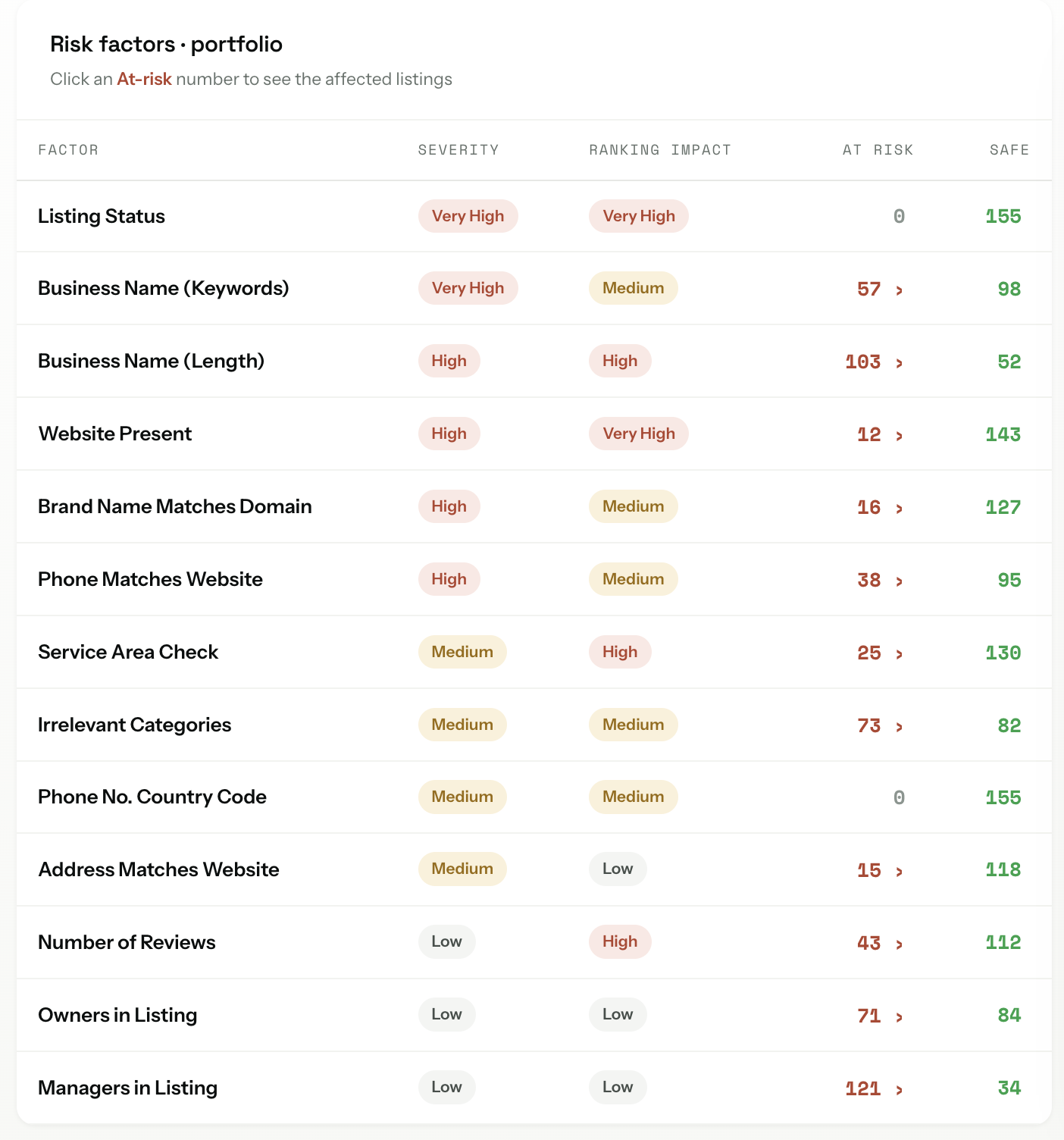
Angryturtle → Angryturtle's risk-factors panel surfaces the same local-reputation signals — review sentiment shifts, NAP inconsistencies, citation drops — that often accompany a coordinated Reddit or Quora flare-up, so the response team sees the full picture, not just one surface.
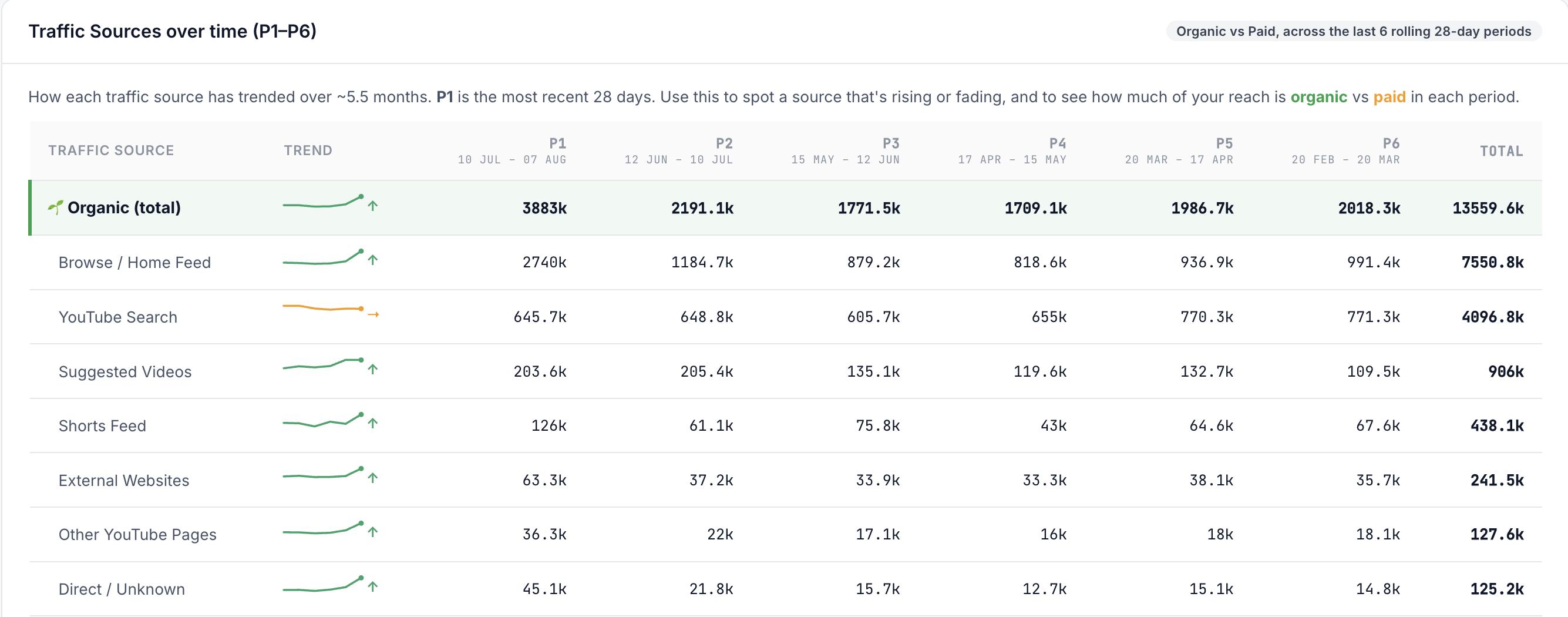
YODA → YODA cross-references where reputation-sensitive video traffic actually originates, so a Reddit-linked or Quora-linked video spike gets flagged the same day it happens.
What monitoring dashboards get wrong
Three common failures:
- Volume-first framing — reporting "mentions this month" as the headline. A hundred neutral mentions matter less than a single top-3 Google result carrying a negative signal.
- Sentiment score as decision input — sentiment analysis on short review text is 60-70 per cent accurate at best. Making decisions on the noisy 30-40 per cent is what triggers false-positive escalations that damage relationships and burn credibility.
- Missing rank-position context — showing "45 negative mentions" without telling the operator that 42 of them are on page-5 forum posts nobody sees. Rank-position weighting is the difference between actionable data and background noise.
AI Overview citation share — the leading signal
An emerging signal on the priority list. AI Overview citations are a leading indicator — sources cited in AI Overview today are often the sources that dominate traditional Google ranking six months later. Tracking which sources AI Overview cites for brand-adjacent queries is the earliest available warning that the brand's content strategy is on-track or off-track for the AI-first search era.
Companion read: how ICG lands in AI Overviews.
Signal to action — the routing map
| Signal breach | Owner | Response |
|---|---|---|
| Brand-SERP drop >5 pts | Reputation lead | Content displacement plan + link-building |
| GBP rating drift down | Angryturtle ops | Cadence acceleration + review-response audit |
| Reddit top-3 negative | Reputation writer | Displacement content SEO + disclosed reply |
| Quora top-3 negative | Quora ops | Better disclosed expert answer + Tier 1 queue |
| Meta clinical comment sitting | Prism Pulse ops | Reply inside SLA + hide-rule audit |
| Coordinated attack detected | Reputation lead + principal | Full crisis workflow |
How ReputationShield packages this
ReputationShield Starter runs Signals 1-3 with weekly cadence. Growth adds Reddit and Quora monitoring, and moves brand-SERP and rating cadence to daily. Scale adds full cross-surface detection, real-time Meta and GBP monitoring, and AI Overview citation tracking. Enterprise adds multi-brand watchlists and dedicated reputation lead. Full pricing on the ReputationShield page.
Get a cross-surface reputation audit
A 45-minute Benchmarking call maps all six signals for your brand — current state, priority breaches, and the fastest recovery levers.
WhatsApp ICG ReputationShield tiersCompanion reads
GMB via Angryturtle · Reddit playbook · Quora strategy · Crisis playbook.
FAQ
Which signals actually move revenue?
Six — brand-SERP positive share, GBP rating trajectory, review response SLA, Reddit thread rank, Quora top-3 answers, unaddressed clinical ad comments.
What is brand-SERP first-page positive share?
The percentage of the top 10 Google results for the clinic name query that read positive or neutral, weighted by variant volume.
How often should monitoring run?
Real-time GBP and Meta, daily Reddit and YouTube, weekly Quora and brand-SERP, quarterly AI Overview.
Do most dashboards measure the right things?
Most over-index on volume and sentiment score — both directional, both weakly correlated with booked consultations.
How does AI Overview citation figure in?
Leading signal — today's cited sources tend to become tomorrow's Google traditional-ranking winners.
