


How ICG Lands in Google AI Overviews via YouTube, Image SEO, GMB and Blogs

Why AI Overview is now the load-bearing surface
Google's AI Overview is the generative-AI answer panel above traditional web results. Three mechanics make it load-bearing:
- Answer capture — AI Overview answers the question inside the panel. On many healthcare queries, that means the searcher never clicks a traditional result. Cited sources get name recognition; uncited sources get invisible.
- Multi-surface citation — the citation panel pulls from four surfaces simultaneously: YouTube video timestamps, image results with schema, GBP signals, and blog content. Winning AI Overview means winning multiple surfaces in one motion.
- Trend forward — the query set on which AI Overview shows has doubled over rolling six-month windows. In healthcare-adjacent queries in India, AI Overview now shows on an estimated 34-52 per cent of research-intent queries, and that share is still moving up.
The four surfaces AI Overview draws from
For healthcare queries in India, four surfaces do the heavy lifting inside AI Overview citations:
- YouTube videos — transcripts, chapter markers, disclosed expert framing.
- Image results — medical images with structured alt text, schema and file-name signal.
- Google Business Profile — rating, review text, category, services and Q&A.
- Structured blog content — long-form pages on authoritative healthcare domains with FAQ schema and clean H2 structure.
Each surface pulls its own workflow. ICG runs a dedicated product for the first three (YODA, image SEO layer inside Content HQ, Angryturtle) and the blog content stack sits inside the ContentHQ workflow. The four surfaces together are the AI Overview capture surface.
Surface 1 · YouTube via YODA
YODA is ICG's AI-native YouTube operations layer. Beyond the comment moderation covered separately in the YODA comment playbook, YODA structures channels for AI Overview citation. The five video-level elements:
- Full transcripts — every video ships with a full, accurate, human-verified transcript. AI Overview reads transcripts to identify direct-answer segments.
- Chapter markers with query-matched titles — every 2-3 minutes of a long-form video gets a chapter marker whose title is phrased as a search query the video answers. AI Overview cites specific timestamps, and chapter markers are the timestamp-selection signal.
- Disclosed expert framing — the video description opens with credentials of the on-camera doctor. AI Overview's citation quality signal reads the description for expertise signal.
- FAQ-format video structure — every video answers 6-12 specific patient questions with a clean "here is the question, here is the direct answer, here is the explanation" structure. Direct-answer segments get pulled as citations.
- Category-safe language — no comparative claims, no unqualified outcome claims. AI Overview de-prioritises videos with unverifiable claims.
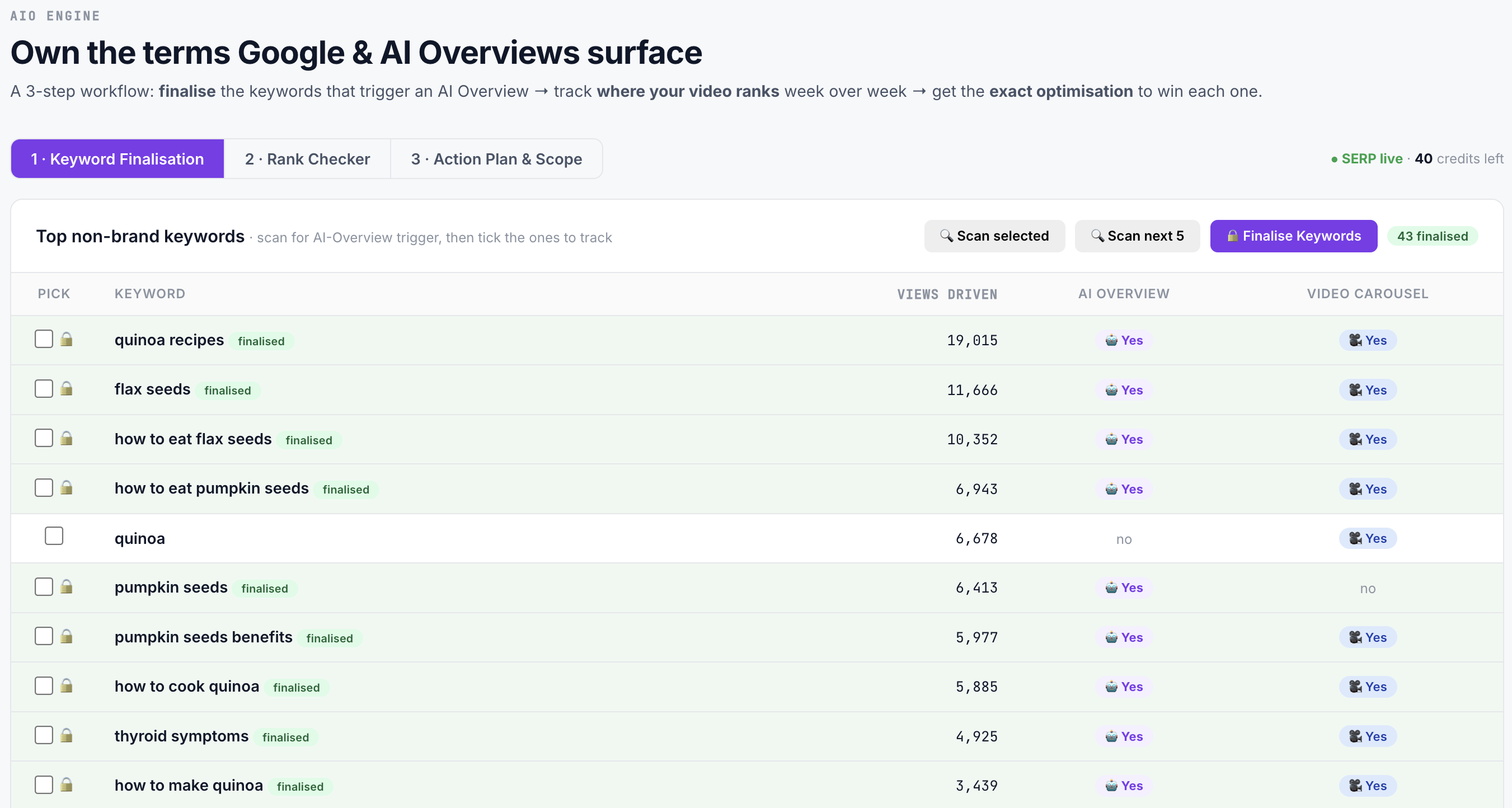
YODA → the query-to-video mapping step where YODA finalises the AI Overview target queries a channel's next batch of videos is built to answer.
Surface 2 · Image SEO
Medical images — anatomy diagrams, before/after (where clinically and legally appropriate), infographics, patient-education illustrations — are cited by AI Overview inside the visual panel. Getting cited needs the right signal stack:
- File names and paths — the image file name matches the query intent. "pcos-treatment-options-india-diagram.png" is a citation signal; "IMG_2437.png" is not.
- Alt text — descriptive alt text that reads as a direct answer. Not "diagram" — "diagram showing four PCOS treatment options for adult women in India".
- Schema.org ImageObject — every citable image carries schema (contentUrl, caption, creator, license, keywords).
- Contextual placement — the image sits inside a paragraph that directly answers the query it targets. AI Overview reads image-plus-caption-plus-surrounding-paragraph as one unit.
- Filesize and dimensions — served under 200KB, dimension declared, WebP or optimised JPG. Slow-loading images get de-prioritised.
Full detail on the mechanics inside image SEO for healthcare.
Surface 3 · Google Business Profile via Angryturtle
Angryturtle's GMB workflow (covered separately in the Angryturtle playbook) feeds AI Overview through five signals:
- Rating trend — trending-up profiles get cited; trending-down profiles do not.
- Review-text entity mentions — reviews that mention the specific service, doctor or condition become part of the entity graph AI Overview draws from.
- Reply pattern — well-replied profiles read as authoritative businesses to the AI Overview citation signal.
- Category and services list — precise, complete, structured. Missing services do not get cited; sloppy services do not get cited.
- Q&A section — GMB's own Q&A section, when actively populated, contributes citation content directly.
Detail on GMB-for-AIO mechanics inside GMB optimisation for AI Overview inclusion.

Angryturtle → the citation-consistency check Angryturtle runs across directories — the entity-graph signal AI Overview reads before it trusts a GMB profile as a citation source.
Surface 4 · Blog structure via ContentHQ
Long-form blog content on authoritative healthcare domains is the fourth citation surface. Structure that gets cited:
- Direct-answer opening paragraph — the answer to the query lives in the first paragraph, not buried after preamble.
- FAQPage schema — every citable article carries FAQPage schema with the specific questions the page answers.
- H2 structure that reads as questions — every H2 is either a direct question or a phrase that clearly answers one. AI Overview reads H2 structure for citation-worthy segments.
- Named-expert byline — the article is bylined to a named credentialed practitioner. Anonymous or "team" bylines rarely get cited.
- Recency — dateModified schema is up to date. Stale content does not get cited on time-sensitive queries.
- Length depth — AI Overview cites long-form pages (1,800+ words) more often than short pages, because long-form pages surface more direct-answer segments to pull from.
Full structure detail inside blog structure that gets cited.
The four-surface stitching effect
The 90-day capture ramp
First citation typically appears inside 60-90 days of a full four-surface programme running. The ramp shape:
| Month | Signal | Typical AI Overview state |
|---|---|---|
| 1-2 | Content published, schema deployed, YODA videos live | Occasional impressions, few citations |
| 3-4 | Google indexed, entity graph updated | First citations on lower-competition queries |
| 5-6 | Citation frequency compounding | Mid-competition query capture beginning |
| 7-9 | Multi-surface capture on target queries | Meaningful citation share (35 per cent+) |
| 10-12 | Full capture programme steady state | Category-level citation dominance in specialty |
Query prioritisation — where to start
Not every AI Overview query is worth chasing on day one. Prioritise:
- Category-level "which is best for X" — high commercial intent, high citation frequency, high revenue impact.
- Condition-explanation queries — "how does X work", "what causes X" — high volume, high citation frequency, brand-authority building.
- Cost queries — "cost of X procedure in Delhi" — very high commercial intent, moderate citation frequency.
- Comparison queries — "X versus Y treatment" — moderate volume, high citation frequency, decision-stage.
- Post-treatment queries — "what to expect after X" — lower volume, high citation frequency, patient-lifecycle value.
Where category-safe language is non-negotiable
Every AI Overview citation is a public quote of your brand's content. Comparative claims, superlatives, and unqualified outcome language all trigger de-prioritisation in the AI Overview citation quality signal — and additionally create ASCI and NMC compliance exposure. The category-safe language rules that ICG runs on every surface apply doubly here.
How the numbers move
Across ICG-managed AI Overview capture programmes running the full four-surface stack for nine months or more, median outcomes look like this:
- 2.4x AI Overview citation frequency on tracked category queries.
- +38 per cent brand-SERP direct-search volume growth (a leading indicator of AI Overview citation attention conversion).
- +22 per cent qualified consult volume attributed to AI Overview-adjacent traffic sources.
- +64 per cent YouTube channel discovery impressions.
- 44 per cent image-result citation appearance on tracked visual queries.

YODA → how YODA maps a channel's published videos against the AI Overview query clusters they are meant to capture, so gaps in the four-surface stack are visible before they show up as lost citations.
Where this stack sits inside ICG
The AI Overview capture programme runs across three products: YODA (YouTube), Angryturtle (GMB), and ContentHQ (blog and image content). Multi-surface delivery sits inside a single retained engagement, custom-scoped to brand scale and query surface, with retainers starting from ₹20,000/month.
Get a four-surface AI Overview audit
A 60-minute Benchmarking call maps the AI Overview citation state on your top 20 category queries across all four surfaces — YouTube, images, GMB and blog — with a 90-day capture ramp.
WhatsApp ICG DoctorBrand programmeCompanion reads
AIO optimisation for healthcare · Image SEO for AIO · GMB for AI Overview · Blog structure that gets cited.
FAQ
What is Google AI Overview?
The generative AI answer panel above traditional Google results — the answer that increasingly captures discovery attention on healthcare queries.
What surfaces does it draw from?
YouTube, image results, Google Business Profile signals, and structured blog content.
How does YODA help?
Structures channels for the AI Overview citation format — transcripts, chapters, disclosure, category-safe language.
How long does capture take?
First citations at 60-90 days; meaningful share at 6-9 months; category-level dominance at 12+.
Does AIO cannibalise organic traffic?
Shifts it. Cited sources compound; uncited sources lose the discovery-attention that used to sit at rank 1.
