


Medical SEO India 2026: Playbook for Clinics & Hospitals
Medical SEO for Indian clinics and hospitals in 2026 - ranking framework, EEAT signals, local pack tactics and AEO plays that pull qualified enquiries.
No pitch. Written root-cause diagnosis. AI-powered, healthcare only.
Direct answer
Medical SEO for Indian clinics and hospitals in 2026 - ranking framework, EEAT signals, local pack tactics and AEO plays that pull qualified enquiries.
TL;DR
By Hanuman Sihag, Head of Innovation Chamber & SEO Lead at ICG.
What is medical SEO and why does it differ from regular SEO?
Medical SEO is search engine optimisation for healthcare websites — clinics, hospitals, specialist practices, diagnostic centres, and health brands. It differs from regular SEO in three significant ways that most generalist agencies underestimate until a campaign fails.
First, healthcare is a YMYL category. Google applies its highest editorial scrutiny to health-related content because incorrect information can cause real physical or financial harm. A legal blog that gets a fact slightly wrong is annoying. A dermatology page that describes a contraindicated treatment combination can hurt someone. Google knows this and weights its ranking signals accordingly.
Second, medical SEO requires actual medical knowledge. Writing about IVF treatment success factors, hair transplant recovery timelines, or diabetic retinopathy screening protocols requires understanding the subject well enough to write accurately, avoid compliance violations, and structure content that a specialist would trust. Generalist content writers cannot do this without a medical reviewer.
Third, the ranking competition in medical SEO is intense and the stakes are high. "Best dermatologist in Delhi" is a query worth ₹15,000-₹40,000 in patient value per click. The brands competing for it — Apollo, Medanta, established specialist clinics — have been building domain authority for years. New entrants need a structured, pillar-based content architecture to compete.
The YMYL framework: how Google scrutinises medical content
YMYL stands for Your Money or Your Life. Google classifies health content in the highest tier of YMYL — alongside financial advice and legal guidance — because mistakes in this category have severe consequences for users.
For medical SEO, this means four things in practice:
E-E-A-T signals are mandatory: Experience (has the author treated patients with this condition?), Expertise (what are their qualifications?), Authoritativeness (does the domain have a track record in this specialty?), and Trustworthiness (is the information accurate, current, and cited?).
Author credentials must be explicit: the name of the doctor or medical professional who reviewed the content, their qualifications, and their registration number should appear on every health content page.
Factual accuracy is a ranking signal: pages that make claims contradicted by consensus medical literature are downranked. Google's Quality Raters explicitly flag "contradicts expert consensus" as a quality failure.
Update dates matter: medical content older than 18 months without an update date is treated as potentially outdated. Dates should be displayed and content should be reviewed annually at minimum.
The 5 pillars of medical SEO
Pillar 1: Medical-reviewer workflow
Every piece of health content on your website needs a named medical reviewer — a registered practitioner who has reviewed the content for accuracy. This is not a formality. Google's Search Quality Evaluator Guidelines explicitly ask raters to assess whether health content was reviewed by qualified practitioners.
The medical-reviewer workflow has 4 steps: (1) writer produces a first draft based on a brief, (2) the treating doctor or a designated medical reviewer reads it for clinical accuracy, (3) reviewer signs off or requests corrections, (4) reviewer's name and credentials appear in the byline or a dedicated reviewer box at the bottom of the article.
The practical impact: ICG analysis of healthcare content performance shows that doctor-reviewed content ranks on page 1 for competitive specialty queries 3 times faster than non-reviewed content targeting the same keywords. The EEAT signal from a named medical reviewer is that significant.
Pillar 2: MedicalClinic, Physician, and procedure schema
Schema markup is the single highest-ROI technical investment in medical SEO. It tells Google and AI engines exactly what type of entity your page represents, which specialties you cover, and what procedures you offer — in a structured format that machines can read without inferring.
Essential schema for healthcare websites:
MedicalClinic (or Hospital): name, address, telephone, medicalSpecialty, availableService, openingHoursSpecification
Physician: for each doctor — name, medicalSpecialty, alumniOf, worksFor, url
FAQPage: on every page that contains Q&A content — critical for AI Overviews and rich results
MedicalProcedure: on each procedure or treatment page (IVF, hair transplant, rhinoplasty etc.)
Speakable: on TL;DR boxes and first-paragraph content — marks content for voice search and AI extraction
Pillar 3: Core Web Vitals for healthcare
Healthcare pages are often image-heavy (procedure galleries, before/after photos) and JavaScript-dependent (booking widgets, interactive forms). This makes them vulnerable to Core Web Vitals failures that suppress rankings.
Targets: LCP (Largest Contentful Paint) under 2.5 seconds, INP (Interaction to Next Paint) under 200ms, CLS (Cumulative Layout Shift) under 0.1. Check every new page in Google Search Console's Core Web Vitals report before indexing.
The most common healthcare site performance failure: lazy loading is not applied to above-the-fold images, causing the LCP element to load late. Apply `loading="lazy"` to all below-the-fold images and preload the hero image.
Pillar 4: Citation building
Citation building in medical SEO means three things: (1) Google Business Profile — complete, verified, and actively maintained for every clinic location; (2) medical directory listings — Practo, JustDial, Lybrate, Sulekha for Indian clinics; (3) editorial mentions — appearing in health journalism, being quoted in relevant articles.
GBP quality is particularly impactful for local medical SEO. A clinic with 200+ verified reviews, complete business information, and active Q&A responses ranks significantly higher in "best [specialty] near me" queries than a clinic with 20 reviews and incomplete information, even with identical website authority.
Pillar 5: AEO — medical SEO's new layer
AEO (Answer Engine Optimisation) is now an integral part of a complete medical SEO strategy. 67% of patients consult AI engines before booking. Medical SEO without AEO captures traditional search traffic but misses the growing AI search layer. Every piece of medical content should have FAQPage schema and Speakable schema to capture both channels simultaneously.
Schema for healthcare websites: which schema for which page type
Page type
Required schema
Recommended schema
Priority
Homepage
Organization, LocalBusiness/MedicalClinic
FAQPage, Speakable
Day 1
Service/specialty page
MedicalProcedure or MedicalSpecialty
FAQPage, MedicalClinic
Per page
Doctor profile page
Physician
Person, alumniOf
Per doctor
Blog/insights article
Article, Person (author)
FAQPage, Speakable, BreadcrumbList
Per article
Location/city page
LocalBusiness
MedicalClinic, GeoCoordinates
Per location
Contact page
LocalBusiness
OpeningHoursSpecification
Low priority
FAQ page
FAQPage
Speakable
Day 1
Technical SEO checklist for healthcare sites
SSL certificate active and all pages served over HTTPS
No www/non-www split (check in GSC — both versions should not be indexing separately)
Canonical tags on all pages pointing to preferred URL
Sitemap.xml submitted to GSC, covering all city pages, service pages, and insights articles
robots.txt checked — /insights/ path must be crawlable
Hreflang not required for India-only sites but check for accidental international signals
Mobile-first indexing: all pages must pass Google Mobile-Friendly Test
Page speed: Core Web Vitals pass for all key pages (run in GSC > Core Web Vitals report)
No broken internal links (run Screaming Frog crawl monthly)
All images have descriptive alt text with keyword context where appropriate
H1 present on every page. Only one H1 per page. H1 contains primary keyword.
Common medical SEO mistakes that trigger Google quality issues
These are the mistakes ICG diagnoses in the first week of every new healthcare SEO engagement:
Content written without medical review: the most common and most damaging. A dermatology page saying "kojic acid is safe for all skin types" is a factual error that a dermatologist reviewer would catch. Google's quality raters are instructed to flag it.
Duplicate location pages: clinics with multiple locations often create city pages that are near-identical except for the city name. Google treats these as thin duplicate content. Each city page needs unique content about that location, its team, its services, and its local context.
Missing author credentials: publishing health content with no named author or reviewer is a baseline EEAT failure. Every health article needs an author name, designation, and qualification.
Over-optimisation: keyword stuffing — using the target keyword in every paragraph — is a YMYL red flag. Google's quality guidelines explicitly note that low-quality health content often has "keyword stuffing" patterns.
Not updating old content: a 2020 article about IVF treatment that has not been reviewed since 2020 will have its date shown as 2020. Google treats this as potentially outdated information in a YMYL context. Set a quarterly content audit to refresh dates and update facts.
Medical SEO timeline: what to expect at each stage
Month
What happens
What to measure
Month 1
Google crawls and indexes new content. Technical fixes take effect. GBP updates propagate.
GSC Coverage report — new pages indexed. Core Web Vitals pass rate.
Month 2-3
Long-tail keywords begin ranking on page 2-3. Local search visibility improves.
GSC Queries — new keywords appearing. GBP calls and direction requests.
Month 4-6
Competitive specialty terms move to page 1-2. First AEO citations appear.
Position tracking for target keywords. AI citation manual checks.
Month 7-9
Cornerstone pages build authority. City pages dominate local queries.
Organic traffic from non-branded queries. CPQL contribution from organic.
Month 10-12
Compounding: each new article lifts the cluster. Backlinks begin accumulating.
Domain authority improvement. Backlink growth from healthcare publishers.
Frequently asked questions
What is medical SEO?
Medical SEO is search engine optimisation for healthcare websites — clinics, hospitals, doctor practices, and health brands. It applies YMYL (Your Money Your Life) editorial standards, requires medical reviewer sign-off on content, and combines schema markup (MedicalClinic, Physician, FAQPage) with keyword optimisation to rank in both traditional search results and AI-generated health answers.
Is medical SEO different from healthcare SEO?
The terms are often used interchangeably. "Medical SEO" tends to refer to content and on-page optimisation for clinical content (treatments, conditions, procedures). "Healthcare SEO" is a broader term that includes digital marketing strategy, local SEO, and AEO alongside content. In practice, a complete healthcare SEO engagement covers both.
How long does medical SEO take to rank?
Long-tail procedure queries ("IVF cost in Delhi 2026", "hair transplant recovery time") typically reach page 1 in 60-90 days with well-structured content and correct schema. Competitive city terms ("best dermatologist Delhi") require 4-8 months. AEO citation (appearing in AI Overviews) can happen within 7-14 days of publishing structured cornerstone content with FAQPage schema.
Do I need a doctor to review my SEO content?
Yes, for all clinical content (treatment descriptions, condition information, procedure guidance). A named medical reviewer with visible credentials is an E-E-A-T signal that Google's quality raters explicitly assess for healthcare YMYL content. Doctor-reviewed content ranks significantly faster and holds rankings more stably than non-reviewed content.
What schema do hospitals need?
Hospitals need: Hospital (not MedicalClinic) at the top level, Department for each specialty unit, Physician for each doctor, MedicalProcedure for each treatment offered, FAQPage on all FAQ content, and LocalBusiness for each physical location with geo-coordinates. Organization schema at the site level wraps all of these.
How much does medical SEO cost in India?
Medical SEO agency retainers in India range from ₹50,000 to ₹5 lakh per month depending on scope. Entry-level (local SEO + basic content): ₹50,000-₹1 lakh. Mid-tier (full content programme + AEO + technical): ₹1.5 lakh-₹3 lakh. Enterprise (hospital group, multi-location, full stack): ₹3 lakh-₹5 lakh+. ICG engagements typically start at ₹1.5 lakh/month for a single-specialty clinic.
Can I rank a new clinic for "best [specialty] in [city]"?
Yes, but it requires 6-12 months of consistent content investment for competitive city terms. New clinics can reach page 1 faster for: "best [specialty] in [specific neighbourhood]" (hyper-local), specific procedure queries ("LASIK surgery cost [city]"), and long-tail condition queries ("PCOS treatment for irregular periods Delhi"). Start with these and build toward the competitive city terms.
What is the difference between YMYL and EEAT?
YMYL (Your Money or Your Life) is a content category classification — it tells Google that this content type has high stakes if incorrect. EEAT (Experience, Expertise, Authoritativeness, Trustworthiness) is the quality framework Google applies to evaluate content quality, with extra weight given to YMYL pages. YMYL is the category; EEAT is the quality measure applied within it.
Medical SEO benchmarks Indian clinics and hospitals should hit in 2026
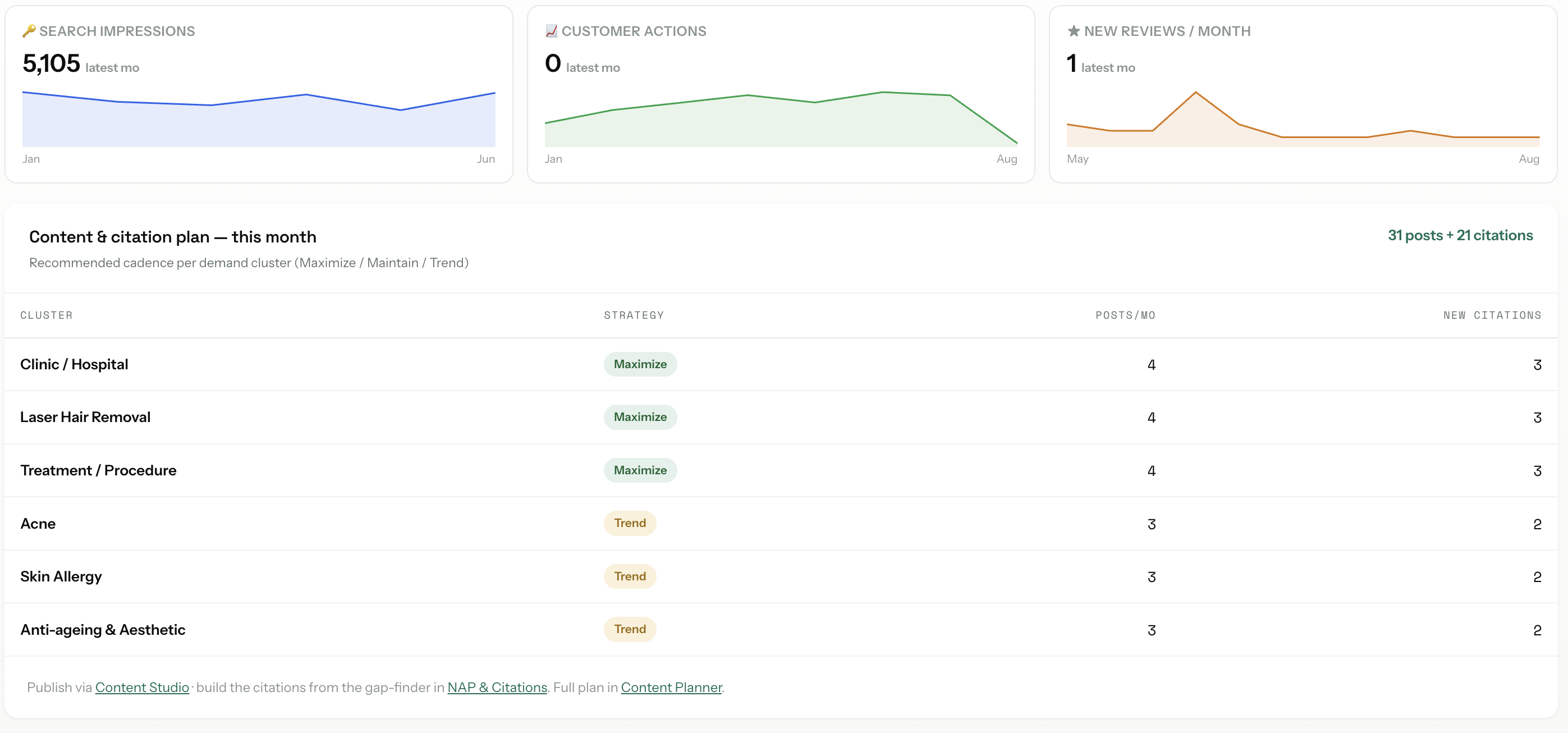
Most healthcare sites we audit rank in the 30-60 zone not because their content is thin, but because the on-page and off-page benchmarks silently drift below what Google now expects from YMYL medical publishers. Before you brief an agency or brief yourself, sanity-check the page against the numbers we see winning cases through in 2026.
| Signal | Weak (rank 30+) | 2026 target (rank 1-5) |
|---|---|---|
| Named clinician byline on every service page | Missing or generic 'Team' link | Named doctor + registration number + Person schema |
| Google Business Profile posts / month | 0-2 | 12-16, geo-tagged, with real photos |
| Review velocity (verified patients) | 1-2 / month | 15-30 / month, replied to within 48 hours |
| Core Web Vitals LCP on mobile | Over 3.5s | Under 2.2s across all templates |
| Internal links into each service page | 1-3 | 8-15 from blogs + hub pages |
| FAQ blocks answering PAA questions | None or 1 generic | 4-6 PAA-aligned questions with FAQPage schema |
Five medical-SEO mistakes we still see Indian healthcare brands making
- Publishing patient-education blogs with no author - Google's medical quality raters explicitly downgrade YMYL content without a named, credentialed writer. Fix it with a named clinician or accredited reviewer byline before you scale content.
- Ignoring the local pack because the website ranks - for most "[specialty] near me" queries, the 3-pack absorbs 60%+ of the clicks. If your GBP is not being worked weekly, you are giving that traffic away. We handle this stack inside Angryturtle, our GBP operating system.
- Skipping AEO for a search world that now answers before it clicks - AI Overviews and voice answers pull from structured, source-cited content. Video is now a first-class AEO surface, which is why we built YODA for healthcare YouTube.
- Treating compliance as a legal problem, not an SEO one - NMC advertising rules, DPDP Act consent flows and NABH claims all shape what you can put on the page. Get them wrong and the page either gets pulled or quietly demoted.
- No internal linking strategy across specialties - hospital sites with 40+ service pages routinely have zero editorial links between them, capping topical authority. A single sprint can move an entire cluster 8-15 positions.
If this list reads like a checklist your current setup would fail on, that is exactly the diagnostic conversation the Client Elevation Programme is built for.
Book a free SEO diagnostic.
Hanuman Sihag's team runs a live crawl, checks technical health, cannibalisation, schema coverage and content gaps. 60 minutes, prioritised fix list.
Questions readers ask
about this topic.
The three platforms
behind every ICG engagement.
Beacon
CAPI middleware that fixes Event Match Quality, translates CRM statuses to Meta-standard events, dedups across channels.
Agency OS
Live client dashboard. GSC, GA4, Google Ads, Meta Ads, IVR calls in one view. Login anytime, not monthly.
Phoenix
Clinic revenue intelligence over your PMS. Daily action queue: Prevent Loss, Maintain & Engage, Grow Revenue. 46-centre rollout.
Or book a free 30-min audit to see all three in action on your account.
Healthcare brands
that already run on ICG.
A representative slice of the 150+ healthcare brands ICG has delivered for across India. Most engagements remain under NDA.


What ICG clients say · on video.
"Scale up of organic channels and business consulting. ICG has absolute domain authority in their field."
"Working with ICG transformed how we acquire IVF patients in Gurgaon. They understand the fertility journey from inquiry to consult..."
"What Ichelon accomplished — they got all my ideas and worked over 3-4 months to create an amazing, super-customised website."
The intelligence stack behind this playbook.
Every ICG engagement runs on the Search Intelligence Trifecta — Angryturtle for GMB, SIE for search and AI Overview, YODA for YouTube. Live product screens below.
Need help operationalising this?
Every ICG service is healthcare-only, NMC + DPDP-aware, and built around the patient-research patterns that drive Indian healthcare growth in 2026.
More from
ICG.
Healthcare AIO is the discipline of getting your clinic or hospital cited inside Google AI Overviews, ChatGPT and Perplexity answers — not j...
Conversational-search advertising places brand messages inside AI chat answers — ChatGPT, Perplexity, Copilot — rather than beside a results...
NABH digital compliance means every claim, image and testimonial your hospital publishes online matches what an accreditation surveyor can v...
Stop guessing.
Book a Diagnostic.
30 minutes. Free. With the AI-powered healthcare-only marketing agency 150+ brands already run on. No slides, no pitch, no hard close.


