


Image SEO for Healthcare — What Actually Ranks in AI Overviews
What kinds of images AI Overview actually cites
Four categories dominate the visual-panel citation surface for healthcare in India:
- Anatomical and diagnostic diagrams — the "what does X look like" or "where is Y in the body" queries.
- Procedure infographics — the "how does X procedure work" queries. Clear step-by-step visual walkthroughs.
- Patient-education visuals with labels — treatment options grids, before/during/after diagrams (drawn, not photographic), comparison tables rendered as visuals.
- Clinical illustrations — where legal and ethical framework allows. Photographic clinical images (dermatology, dental, hair) sometimes get cited but almost always where consent and disclosure are documented and where the image is on a licensed teaching or clinic domain.
What does not get cited: generic stock photography, decorative images without clear subject-of, low-resolution JPEGs, and images without schema.
The six citation-ready signals
Signal 1 · Query-matched file name
File name is a first-order signal. The file name should describe what the image shows, using the query terms a patient would actually search. Examples:
- Bad:
IMG_20240315_2237.jpg - Bad:
diagram1.png - OK:
pcos-diagram.png - Good:
pcos-treatment-options-diagram-india.png - Best:
pcos-treatment-four-options-lifestyle-medication-surgery-india.png
Kebab-case, lowercase, keyword-loaded, but readable — not stuffed. AI Overview's citation signal reads the file name as one of the strongest single indicators of "what this image is about".
Signal 2 · Descriptive alt text
Alt text is the accessibility signal and the citation-quality signal simultaneously. Rules:
- 10-16 words. Under 10 does not describe enough; over 20 dilutes.
- Reads as a direct answer to the query. Not "diagram of PCOS" — "diagram showing four treatment approaches for PCOS: lifestyle, medication, surgery, IVF".
- Includes the specialty and, where relevant, the country or context (India).
- Never starts with "image of" or "picture of" (screen readers already announce it as an image).
- Different from the caption (both count; duplicate signal reduces both).
Signal 3 · ImageObject schema
Every citable image should carry ImageObject schema in the page's structured data. The minimum:
contentUrl— canonical URL of the image file.caption— a caption for the image (different from alt text).creator— the illustrator, photographer or organisation.license— the licence URL for the image (often the clinic's own copyright page).keywords— comma-separated keywords the image is about.representativeOfPage— set to true for the hero image on the topic page.subjectOf— pointing to a MedicalCondition or MedicalProcedure entity where relevant.
Without schema the image can still get cited, but the citation frequency drops sharply. Schema is what tells AI Overview "this image is a citable object with a canonical entity link".
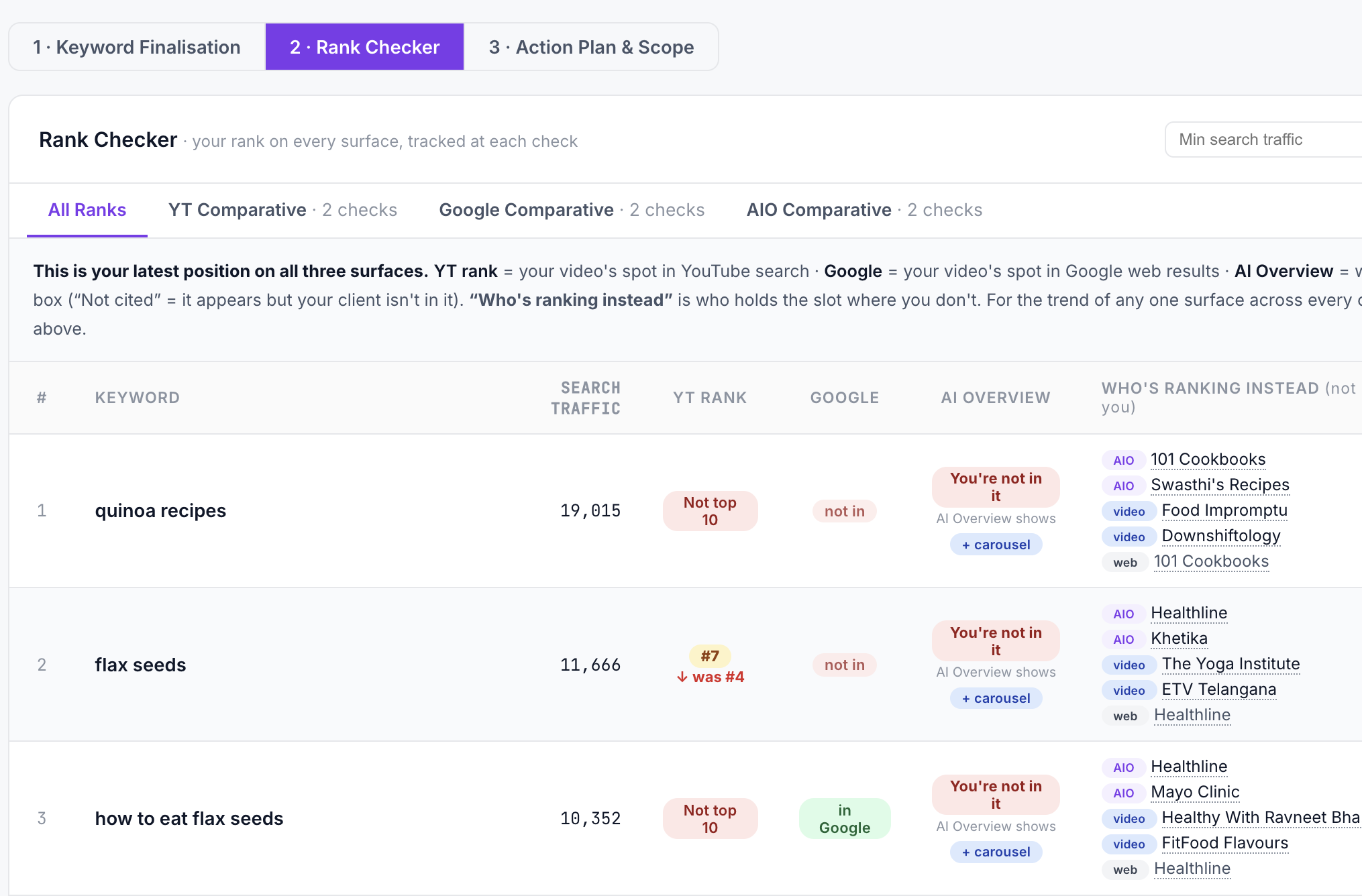
YODA → AI Overview visibility tracking for healthcare search terms — the same lab ICG uses to confirm a client's citable images and content are surfacing inside AI answers.
Signal 4 · Contextual placement
The paragraph the image sits inside matters as much as the image itself. AI Overview's citation reads image-plus-caption-plus-surrounding-paragraph as one unit. Placement rules:
- The paragraph directly above the image should describe what the image shows and why.
- The paragraph directly below the image should reference the image and continue the explanation.
- Every image sits inside an H2 or H3 section whose heading is a searchable query.
- Every image has a visible caption below it — the caption is separate from alt text.
Signal 5 · File size and dimensions
Slow-loading pages get de-prioritised across the AI Overview signal stack. Image performance rules:
- WebP for photographic imagery; PNG for diagrams and infographics with sharp lines.
- Under 200KB for standard images; under 400KB for large infographics.
- Explicit width and height in HTML to prevent layout shift.
- srcset for responsive images — mobile citation frequency is now higher than desktop.
- Lazy-loading below the fold; above-the-fold images loaded eagerly.
Signal 6 · Stable URLs
An image that rewrites URLs every time the CMS republishes cannot build citation authority. URL rules:
- Canonical image URL never changes after publish. If a redesign changes the path structure, 301 the old paths.
- File name in URL matches the file name of the file (many CMSes rewrite; check).
- Every citable image lives at a path structure like
/assets/images/[specialty]/[topic]/[file-name].png, predictable and readable. - No time-based hash in the file name (breaks citation continuity).
The image cluster for a specialty
A specialty programme needs a citable image cluster covering the patient journey. For a mid-scale dermatology programme:
| Cluster | Image count | Format |
|---|---|---|
| Skin-condition atlas (10-15 conditions) | 12-15 | Illustrated diagrams |
| Treatment-options infographics per condition | 10-12 | Infographics |
| Procedure step-by-step visuals | 5-8 | Illustrated sequences |
| Before / after ethical templates | Case-by-case | Drawn representations preferred |
| Doctor and clinic authority images | 3-5 | Photograph plus schema |
The workflow — how ICG builds an image library
- Query and citation gap audit — identify the visual-panel citation queries in the specialty and the current gap.
- Image brief per piece — subject, angle, labels, source, licence, target-query mapping.
- Illustration production — commissioned illustrators for diagrams and infographics; photograph capture for clinical imagery with consent workflow.
- Signal stack application — file name, alt text, schema, placement, performance optimisation.
- Publish inside cluster — image slotted into the corresponding blog / pillar page.
- Sitemap image entries — every citable image entered into an image sitemap for indexing acceleration.
- Monitor and refresh — quarterly review of citation share, refresh imagery on stale pieces.

YODA → Topic-cluster mapping across a healthcare client's content library — how ICG plans the image and video coverage so specialty topics compound instead of competing with each other.
What kills image citation frequency
- Stock imagery. AIO's quality signal reads stock library patterns.
- Low resolution. Anything under 800 pixels wide rarely gets cited.
- Screenshotted competitor images. Provenance signal fails, and copyright issues surface later.
- Image galleries with lightbox JavaScript that hides the image URL. AI Overview cannot cite what it cannot canonicalise.
- Background images set via CSS. Not indexed as images.
- Image URLs that require query strings to serve. Citation URL should be permanent and clean.
How this ties to the four-surface stack
Image SEO is one of the four load-bearing surfaces of AI Overview capture — alongside YouTube via YODA, GMB via Angryturtle, and blog structure via ContentHQ. Full four-surface playbook: how ICG lands in AI Overviews.
How the numbers move
Across specialties running the full image-SEO signal stack for six months or more:
- 44 per cent visual-panel citation appearance on tracked queries in the specialty.
- +2.8x Google Images referral traffic to the domain.
- +31 per cent average time on page for pages with citation-ready images versus the site baseline.
- +18 per cent internal-link click-through from image-caption CTAs.
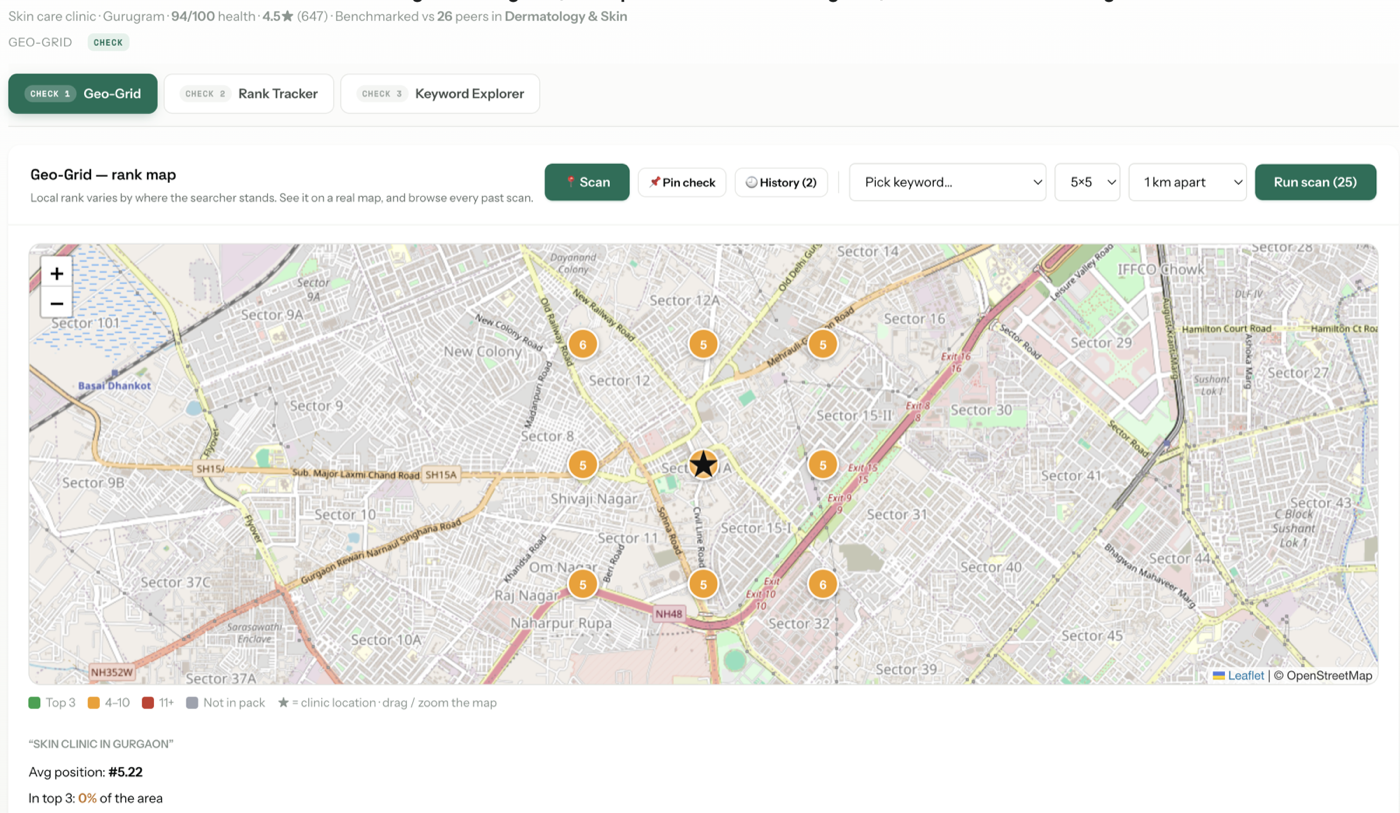
Angryturtle → Neighbourhood-level GMB rank tracking — the same local-signal feed that surfaces alongside citable images in the AI Overview visual panel.
Get an image SEO audit
A 60-minute Benchmarking call maps the current visual-panel citation state on your specialty queries, audits the existing image library for signal gaps, and drafts the 90-day image cluster build.
WhatsApp ICG DoctorBrand programmeCompanion reads
Four-surface AIO playbook · GMB for AI Overview · Blog structure that gets cited.
FAQ
What kinds of images actually get cited?
Diagrams, infographics, patient-education visuals and (where ethical) clinical illustrations.
What makes an image citation-ready?
Six signals — file name, alt text, ImageObject schema, contextual placement, file performance and stable URL.
What is ImageObject schema?
Structured data on the image — canonical URL, caption, creator, licence, keywords, subject-of.
Do stock images work?
Rarely. Custom illustrations, clinic-owned photographs and licensed authority images are the citation stack.
How many images does a specialty need?
15-25 for a mid-scale specialty covering the diagnostic-to-treatment journey.
