


How to Monitor Your Clinic's SEO Outcomes Without a Technical Background
FREE 30-MIN AUDIT
No pitch. Written root-cause diagnosis. AI-powered, healthcare only.
Direct answer
FREE 30-MIN AUDIT
TL;DR
Indicator 1: Organic Search Clicks (Monthly Trend)
Where to find it: Google Search Console → Performance → Total Clicks. Set the date range to last 3 months and compare with the previous 3 months.
What it means: Organic clicks are patients who saw your clinic in Google search results and clicked through to your website. This is the most direct measure of whether SEO is generating patient interest.
What to look for:
FREE 30-MIN AUDIT
Book a free Beacon + Agency OS audit
Written summary on the call. EMQ, intent tier, IVR leak, funnel drop-off. No commitment.
- An upward trend month-over-month is positive
- A flat trend after 3+ months of SEO work means the strategy is not generating new organic interest
- A declining trend is an alert — check whether there was a website change, a technical issue, or a competitor gaining ground
Plain-language target: For a single-centre clinic in a competitive city, 200–500 monthly organic clicks in year 1 of SEO, growing to 800–2,000+ by year 2, is a reasonable expectation.
What your agency should be able to show you: A month-by-month organic clicks chart, with annotations showing what work was done each month. If the chart shows flat or declining clicks with no explanation, ask why.
Indicator 2: Keyword Rankings for Your Key Services
Where to find it: Google Search Console → Performance → Queries. Sort by Impressions. Export and highlight the queries that are relevant to your main services.
What it means: The queries in this report are the actual search terms that triggered your clinic's website to appear in Google results. This is what patients are searching when they find you.
What to look for:
- Your primary service terms should be appearing in this list (e.g., "dermatology clinic [city]", "IVF treatment [city]", "hair transplant [city]")
- Average Position (the column next to Impressions) should be below 10 for your most important terms (position 1–10 = first page)
- If your primary service terms are not in this list at all, your SEO is either very new or not targeting the right keywords
Plain-language interpretation:
- Position 1–3: Very visible — patients are likely seeing and clicking your listing
- Position 4–10: Visible — you are on page 1 but not the first result; some patients click, many do not
- Position 11–20: Barely visible — page 2; almost no clicks
- Position 20+: Not visible — might as well not exist for this query
What to ask your agency: "Show me the ranking positions for these five specific search terms this month and last month." If they cannot produce this in 5 minutes, they are not tracking it.
Indicator 3: Local Pack Visibility (GMB in Google Maps Results)
Where to find it: Google Business Profile Dashboard → Performance → Searches.
What it means: How many times did your clinic appear in the local map pack (the three business listings that appear below the map in Google search) and how many people clicked for directions, called, or visited your website from that listing?
The three GBP actions to track:
- Direction requests: patients looking up how to get to you
- Phone calls from GBP: patients calling directly from the listing
- Website clicks from GBP: patients clicking through to your website from the listing
Why this matters for a clinic: For most healthcare clinics, 25–40% of all patient enquiries originate from the GMB/GBP local listing — not from the clinic website. If you are not tracking GBP performance, you are missing a significant portion of your patient acquisition picture.
What a healthy GBP shows:
- 500–2,000+ monthly searches for an established clinic in a metro
- 50–200+ phone calls per month from GBP
- Direction requests growing month-over-month
What your agency should report: Monthly GBP performance data — searches, direction requests, calls, website clicks — alongside website organic performance. These two together give you the complete local visibility picture.
Indicator 4: New vs Returning Website Visitors
Where to find it: Google Analytics 4 → Reports → Acquisition → Traffic Acquisition. Look for the "New Users" column by channel.
What it means: New users are people visiting your website for the first time. Returning users have been before.
What to look for:
- Organic search should be a significant source of new users
- If new users from organic search are flat or declining, SEO is not bringing new patient awareness
- A healthy ratio for a clinic trying to grow: 60–70% new users, 30–40% returning
The nuance: High returning user counts are not bad — they indicate brand loyalty and patients researching more about their treatment. But for growth, new user acquisition via organic search is what matters.
Indicator 5: Search Queries That Are Bringing In Traffic
Where to find it: Google Search Console → Performance → Queries. Sort by Clicks descending.
What it means: This shows you the specific words patients typed into Google before landing on your website.
What to look for:
- Your clinic name in the list: expected, not a measure of SEO strength
- Service + location queries ("skin clinic Delhi", "IVF centre Gurgaon"): this is strong SEO performance
- Generic condition queries ("acne treatment", "hair loss doctor"): good early-stage SEO
- Competitor brand names: patients comparing — good sign
What is a concern:
- If 80%+ of your clicks come from branded queries (your clinic name), your SEO is not generating any new patient discovery. Every patient who found you already knew your name.
- Almost no service + location queries: your local SEO is not working.
The Five-Minute Monthly SEO Check
Once a month, spend five minutes doing this:
- Open Google Search Console → Total Clicks → Compare last 3 months to previous 3 months. Up, flat, or down?
- Open Google Business Profile Dashboard → Calls this month vs last month. Up, flat, or down?
- Open Google Analytics → Organic new users this month vs last month. Up, flat, or down?
- Search your top service + location query (e.g., "dermatologist in Gurgaon") on Google. Are you on page 1?
- Send a screenshot of #1 and #2 to your agency with the question: "What actions this month drove these numbers?"
If your agency cannot answer that last question clearly, the SEO work is happening in a black box — and you are paying for activity, not outcomes.
How Agency OS Makes This Continuous
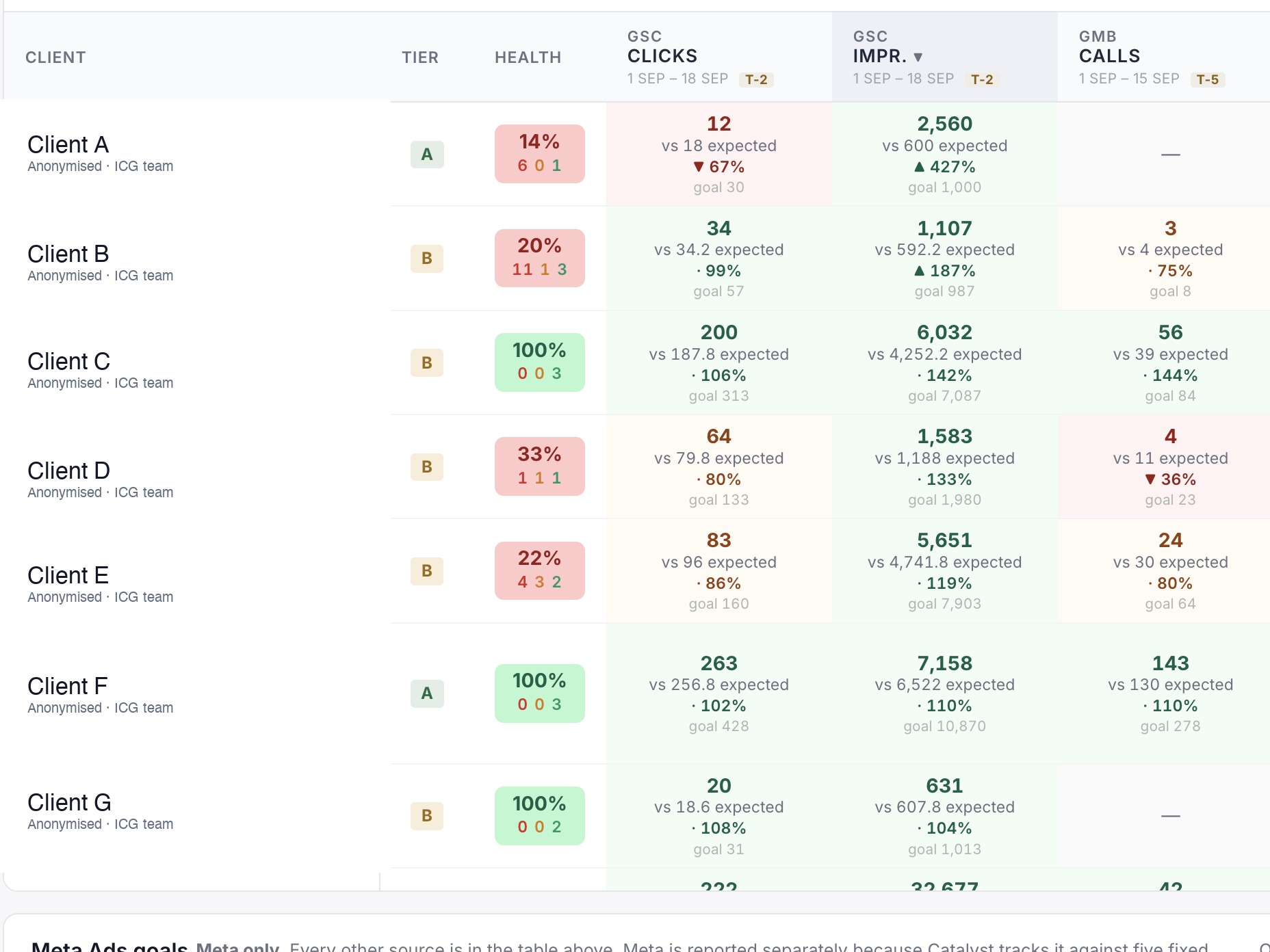
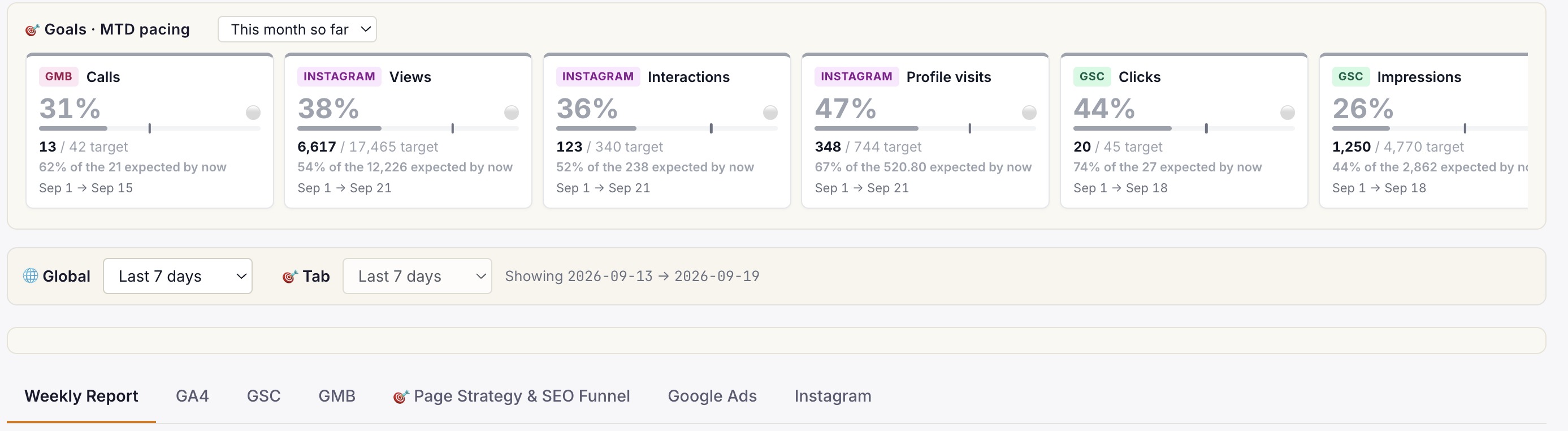
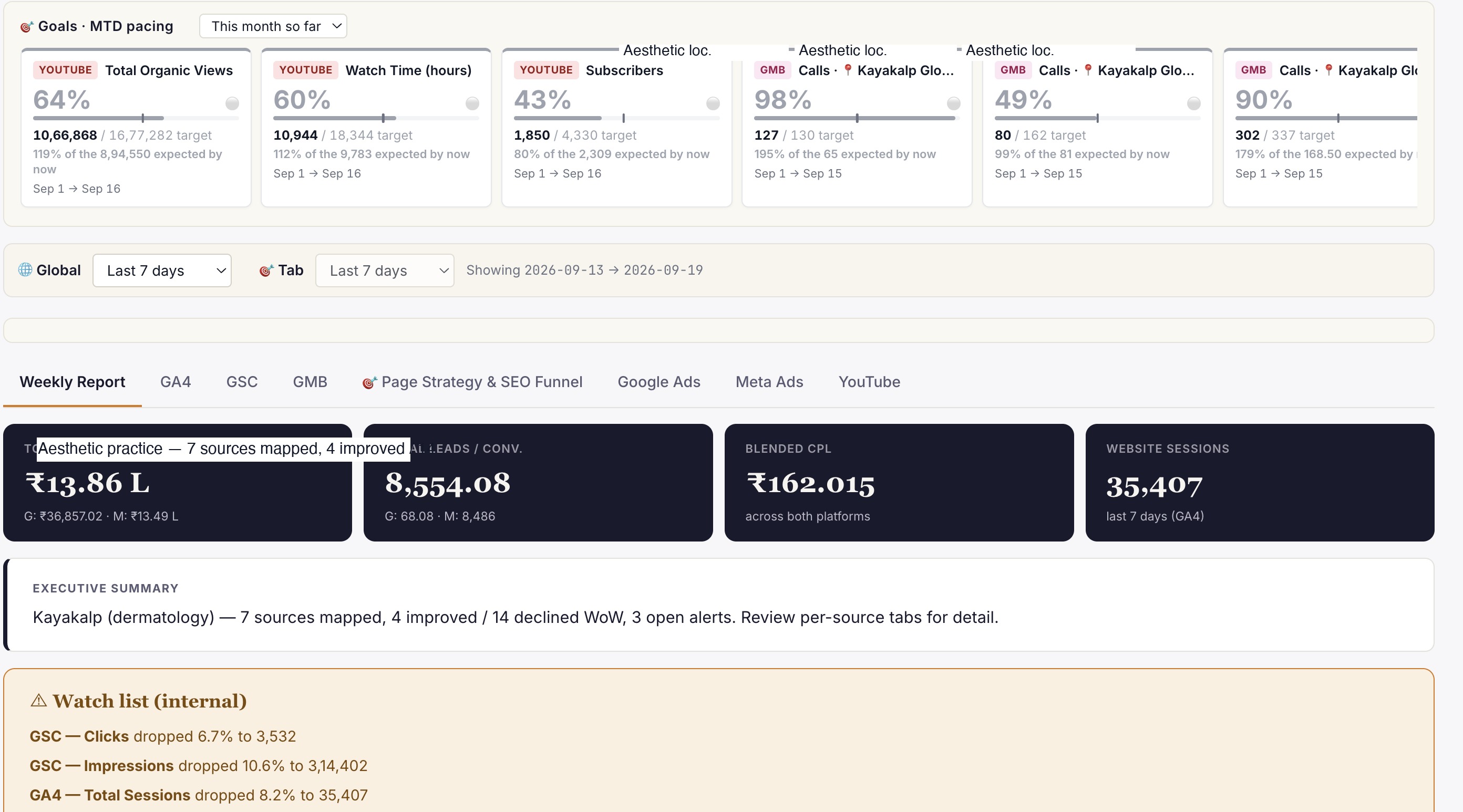
Rather than the monthly five-minute check, Agency OS pulls GSC, GBP, and GA4 data into a single dashboard that updates automatically. The centre manager or clinic owner sees:
- Week-over-week organic click trend
- GBP phone calls, directions, website clicks
- Top-performing search queries
- New user acquisition by channel
Without logging into three separate platforms or waiting for a monthly report.
See Agency OS SEO monitoring →
Want to see how this applies to your clinic? Book a free 30-min audit or WhatsApp the founders.
Book a free SEO diagnostic.
Hanuman Sihag's team runs a live crawl, checks technical health, cannibalisation, schema coverage and content gaps. 60 minutes, prioritised fix list.
Questions readers ask
about this topic.
The three platforms
behind every ICG engagement.
Beacon
CAPI middleware that fixes Event Match Quality, translates CRM statuses to Meta-standard events, dedups across channels.
Agency OS
Live client dashboard. GSC, GA4, Google Ads, Meta Ads, IVR calls in one view. Login anytime, not monthly.
Phoenix
Clinic revenue intelligence over your PMS. Daily action queue: Prevent Loss, Maintain & Engage, Grow Revenue. Multi-centre rollout.
Or book a free 30-min audit to see all three in action on your account.
Healthcare brands
that already run on ICG.
A representative slice of the 150+ healthcare brands ICG has delivered for across India. Most engagements remain under NDA.


What ICG clients say · on video.
"Scale up of organic channels and business consulting. ICG has absolute domain authority in their field."
"Working with ICG transformed how we acquire IVF patients in Gurgaon. They understand the fertility journey from inquiry to consult..."
"What Ichelon accomplished — they got all my ideas and worked over 3-4 months to create an amazing, super-customised website."
The intelligence stack behind this playbook.
Every ICG engagement runs on the Search Intelligence Trifecta — Angryturtle for GMB, SIE for search and AI Overview, YODA for YouTube. Live product screens below.
Need help operationalising this?
Every ICG service is healthcare-only, NMC + DPDP-aware, and built around the patient-research patterns that drive Indian healthcare growth in 2026.
Every practice welcome — packages from ₹20,000/mo.
Goals-Driven engagements · Performance-Linked Payout Models available
More from
ICG.
Five trends shaping Indian healthcare marketing through 2027: AI-first patient research, Conversions API adoption, ABDM discovery, the AEO w...
Healthcare AIO is the discipline of getting your clinic or hospital cited inside Google AI Overviews, ChatGPT and Perplexity answers — not j...
Conversational-search advertising places brand messages inside AI chat answers — ChatGPT, Perplexity, Copilot — rather than beside a results...
Stop guessing.
Book a Diagnostic.
30 minutes. Free. With the AI-powered healthcare-only marketing agency 150+ brands already run on. No slides, no pitch, no hard close.


