


What is Healthcare AEO? Complete Guide for Indian Medical Brands 2026
Healthcare AEO is the practice of making an Indian medical brand cite-worthy inside AI answer engines. Framework, benchmarks, NMC and DPDP signals, and the content structure that gets clinics, hospitals and pharma cited within 60-90 days.
No pitch. Written root-cause diagnosis. AI-powered, healthcare only.
Direct answer
Healthcare AEO is the practice of making an Indian medical brand cite-worthy inside AI answer engines. Framework, benchmarks, NMC and DPDP signals, and the content structure that gets clinics, hospitals and pharma cited within 60-90 days.
TL;DR
TL;DR
- Healthcare AEO (Answer Engine Optimization) is the practice of making a hospital, clinic, pharma or medtech brand cite-worthy inside AI answer engines like ChatGPT, Perplexity, Claude, Gemini and Google AI Overviews. In India, roughly 30-40 percent of high-intent healthcare research now begins inside one of these surfaces.
- AEO is not SEO with extra steps. It rewards direct answers in the first 40 words of every H2, entity-clean author bylines with real clinician credentials, question-shaped headings, schema-tagged FAQs, and India-specific compliance signals (NMC advertising code, DPDP Act, ABDM readiness).
- Indian medical brands that restructure content as question-answer blocks with named expert authors typically start showing up as citations inside 60-90 days. Brands relying on 2019-era SEO stay invisible in AI answers even when they still rank position one in classic Google.
- Ichelon Consulting Group runs healthcare AEO for 300+ live clients on a 70-30 fixed-variable model: Foundation Rs 49,999, Growth Rs 74,999, Scale Rs 99,999 per month. Seventy percent is fixed for execution; 30 percent is tied to actual AI-citation and organic-lead lift over the 12-month engagement.
Table of contents
- Why healthcare AEO is not optional for Indian medical brands in 2026
- What is healthcare AEO and how is it different from SEO?
- Which AI answer engines should Indian healthcare brands optimize for?
- How do AI engines pick which healthcare source to cite?
- What content structure works for healthcare AEO in India?
- What role does E-E-A-T play in healthcare AEO?
- How do you measure AEO success for a healthcare brand?
- What Indian compliance rules matter for healthcare AEO?
- The ICG methodology for healthcare AEO
- The 70-30 AEO engagement model
- Frequently asked questions
Why healthcare AEO is not optional for Indian medical brands in 2026
Google AI Overviews now trigger on roughly one in three commercial healthcare queries in India, and ChatGPT crossed 90 million weekly active Indian users during the last quarter. When a patient in Gurgaon types "best IVF clinic near me" or a hospital procurement head in Hyderabad researches "hospital information system for 200-bed setup", the first surface they see is no longer ten blue links. It is a synthesized paragraph with two to five brand citations, and everyone below that line is functionally invisible.
The Indian healthcare market makes this shift especially painful. Buyers here spend eight to eleven days researching before booking a consultation or a demo. That research now happens across four surfaces: classic Google, Google AI Overviews, one general AI chatbot, and YouTube. If a brand shows up in only one of the four, it loses roughly 55 to 70 percent of consideration-stage share to whichever competitor is showing up in three or four. Healthcare AEO is the discipline of showing up in all four, cleanly and defensibly, without breaking NMC advertising rules or DPDP consent norms.
What is healthcare AEO and how is it different from SEO?
Healthcare AEO is the practice of engineering a medical brand's website, videos, GBP profile and structured data so AI answer engines will quote it directly when a user asks a health, hospital or medical-service question. Classic SEO earns a ranking; AEO earns a citation inside somebody else's answer.
The difference matters because the two disciplines optimize for different units of output. SEO optimizes for a page that a human clicks. AEO optimizes for a paragraph, a bullet, or a two-line quote that a machine lifts and attributes. The machine does not click; it extracts. That single change forces four structural rewrites.
- Answer-first paragraphs. The first 40 words of every H2 must give a self-contained answer that reads correctly even when torn out of context. AI systems prefer these because they can lift them without hallucinating.
- Question-shaped headings. H2s and H3s are written the way a real patient, doctor or procurement head types the query, not the way a marketer would title a brochure.
- Entity clarity. The author must be a real, named clinician or specialist with a verifiable LinkedIn, an NMC or council number where applicable, and a bio page the crawler can reach in one hop.
- Machine-readable structure. FAQPage schema, MedicalOrganization schema, HowTo where relevant, and a clean table of contents with anchor links.
A page can rank number one on Google and still get zero AI citations if these four are missing. The reverse is equally true.
Which AI answer engines should Indian healthcare brands optimize for?
For Indian healthcare brands in 2026 the priority order is Google AI Overviews first, ChatGPT second, Perplexity third, and Gemini plus Claude fourth. This order reflects actual query volume from Indian healthcare buyers, not global averages.
Google AI Overviews sit inside the surface where 92 percent of Indian healthcare research still starts, so a citation there compounds with classic organic. ChatGPT dominates the "explain this to me like I am a hospital owner" and "compare this option to that option" research patterns; roughly 40 percent of consultative healthcare buyers in tier-one Indian cities now use it as a second-opinion layer. Perplexity is smaller in raw volume but is disproportionately used by pharma brand managers, medical device buyers and hospital CXOs because it shows sources by default.
Gemini and Claude matter more for B2B healthcare content (hospital admin, RCM, EHR overlays, pharma listings) than for direct-to-patient content. A Chennai-based multi-specialty group we work with pulls 18 percent of new corporate-tie-up inbounds from research that started inside Gemini or Claude, versus 4 percent from the same group of buyers 18 months ago.
The practical implication: pick the surfaces where your buyer actually asks questions, not the ones that generate the loudest tech-press coverage.
How do AI engines pick which healthcare source to cite?
AI engines pick citations using a scoring stack that combines classic search authority, entity trust, structural extractability and freshness. For healthcare specifically, they add a fifth layer: safety and source-quality checks against known medical publishers, government portals and accredited healthcare organizations.
In our audits of 90+ Indian healthcare websites over the last nine months, seven signals consistently predict citation frequency:
- Named clinician author with a linked bio, credential line and photograph.
- A direct answer inside the first 40 words of the H2 that maps to the query.
- FAQPage schema with 5-8 Q&A pairs that use the actual language a buyer types.
- MedicalOrganization or MedicalBusiness schema with a valid Indian address and phone.
- At least one Indian regulatory reference (NMC, CDSCO, ABDM, DPDP Act) where relevant.
- Internal links from at least three related pillar pages within the same site.
- A last-updated date within the previous 180 days.
Pages that hit six or seven of these get cited roughly 4-6x more often than pages that hit two or fewer, holding domain authority constant. This is the single most actionable finding from Indian healthcare AEO work in the last year.
What content structure works for healthcare AEO in India?
The content structure that works for Indian healthcare AEO is a three-layer stack: a TL;DR block at the top for machine extraction, question-shaped H2 sections with 40-word direct answers, and a schema-tagged FAQ block at the bottom for FAQPage pickup.
Every high-performing Indian healthcare page we track uses roughly the same skeleton. A tight 100-140 word TL;DR with four bullets. A table of contents with anchor links (helps both users and crawlers). Six to nine H2 sections, each phrased as a question a real buyer would type. Inside each H2, the first paragraph is a self-contained answer written in plain English; only after that does the article expand into lists, tables and examples. At the bottom, an FAQ block of five to eight Q&As with FAQPage JSON-LD, followed by a byline that links to a real clinician or specialist page.
Two Indian-specific twists matter. First, cities and specialty terms should be woven in naturally (Bangalore, Mumbai, Pune, Delhi-NCR, dental, IVF, oncology, radiology) so the page qualifies for local-intent queries. Second, currency, phone-number format and language cadence should be Indian. AI engines are increasingly good at detecting content that was written for a US audience and republished for India; those pages get downweighted for Indian queries.
What role does E-E-A-T play in healthcare AEO?
E-E-A-T (Experience, Expertise, Authoritativeness, Trust) is the single largest ranking and citation lever in healthcare AEO. AI engines apply an extra strict version of it because medical content sits inside the YMYL (Your Money or Your Life) category, where a wrong citation carries real downstream harm.
For Indian healthcare brands this translates into four non-negotiables. Every clinical or medical-business article must carry a named byline whose author page includes credentials, experience, city, and where applicable an NMC or council registration reference. The organization must have a live About page with founding team names, roles, office address, and a real Indian landline or WhatsApp number. Third-party mentions (press, published research, conference talks) should be linked from the author bio. And customer proof (case studies, testimonials, before-after where medically allowed) should sit on the same domain, not on a stripped-down landing page.
A Pune-based dental group we work with saw AI-citation frequency triple in 11 weeks after we replaced generic "admin" bylines on 40 pages with a real endodontist byline (linked LinkedIn, credential line, patient-review count). Nothing else on the pages changed.
How do you measure AEO success for a healthcare brand?
You measure AEO success with a four-metric dashboard: AI citation share, AI-referred sessions, branded-search lift, and qualified-lead volume. Ranking positions alone are no longer sufficient because a page can rank number one and still get zero AI citations.
The four metrics that actually move a healthcare business:
| Metric | What it measures | Typical 90-day target |
|---|---|---|
| AI citation share | How often your brand appears inside Google AI Overviews and chatbot answers for tracked queries | Move from 0-5% to 20-35% of tracked queries |
| AI-referred sessions | Sessions from ChatGPT, Perplexity, Gemini referrer strings | 2-6% of total organic sessions |
| Branded search lift | Direct and branded queries growing as AI answers introduce the brand | +25 to +60% over baseline |
| Qualified lead volume | Consult bookings, demo requests, procurement RFPs | +30 to +80% CPQL improvement |
For an Indian multi-city clinic chain we work with, AI-referred sessions grew from 0.4 percent to 4.8 percent of organic traffic in six months, and those sessions converted to a booked consult at 2.3x the rate of classic Google organic sessions. That is the pattern to look for: AI traffic is smaller in volume but higher in intent.
What Indian compliance rules matter for healthcare AEO?
Three Indian frameworks govern what a healthcare brand can and cannot say inside AEO-ready content: the National Medical Commission (NMC) advertising code, the Digital Personal Data Protection (DPDP) Act 2023, and Ayushman Bharat Digital Mission (ABDM) linkages where relevant.
The NMC advertising code restricts self-praise, comparative superiority claims, and testimonials that promise clinical outcomes. Translated into AEO practice: never write "best surgeon in India", never publish before-and-after images without written consent and clinical context, and never use language that guarantees a specific outcome. AI engines increasingly detect these violations and downweight the source; more importantly, a state medical council notice will take the page down anyway.
The DPDP Act requires explicit, revocable consent for any personal data captured on a healthcare site — including form fills, chat interactions and cookie-based tracking. Consent banners must be granular, and privacy-policy pages must be linked from every form. AI engines increasingly parse for these before elevating a source in health-adjacent answers.
ABDM readiness (ABHA linkage, health-data interoperability language, HFR/HPR references where applicable) is not yet a hard AEO ranking signal but is emerging as an authority signal for hospital and clinic pages, especially in tier-one and tier-two cities where ABDM adoption is fastest.
The ICG methodology for healthcare AEO
Ichelon Consulting Group builds healthcare AEO as a stack, not a checklist. The stack has five layers, and every layer maps to a proprietary product we run in-house so the work stays measurable and comparable across 300+ live clients.
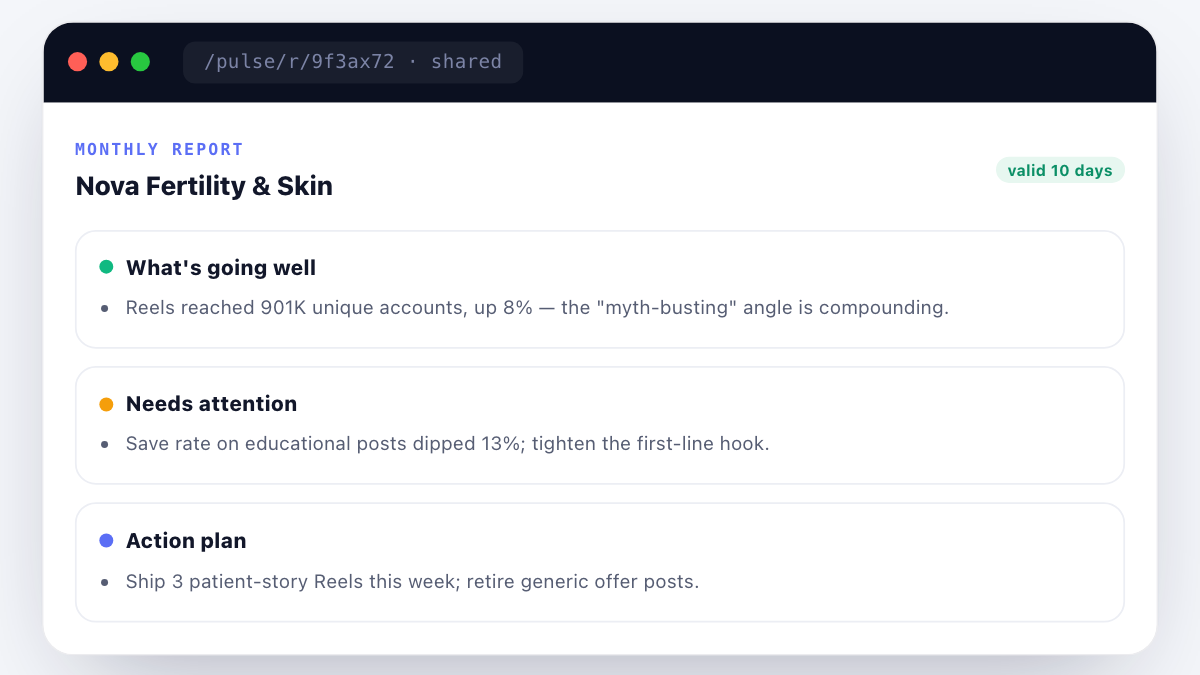
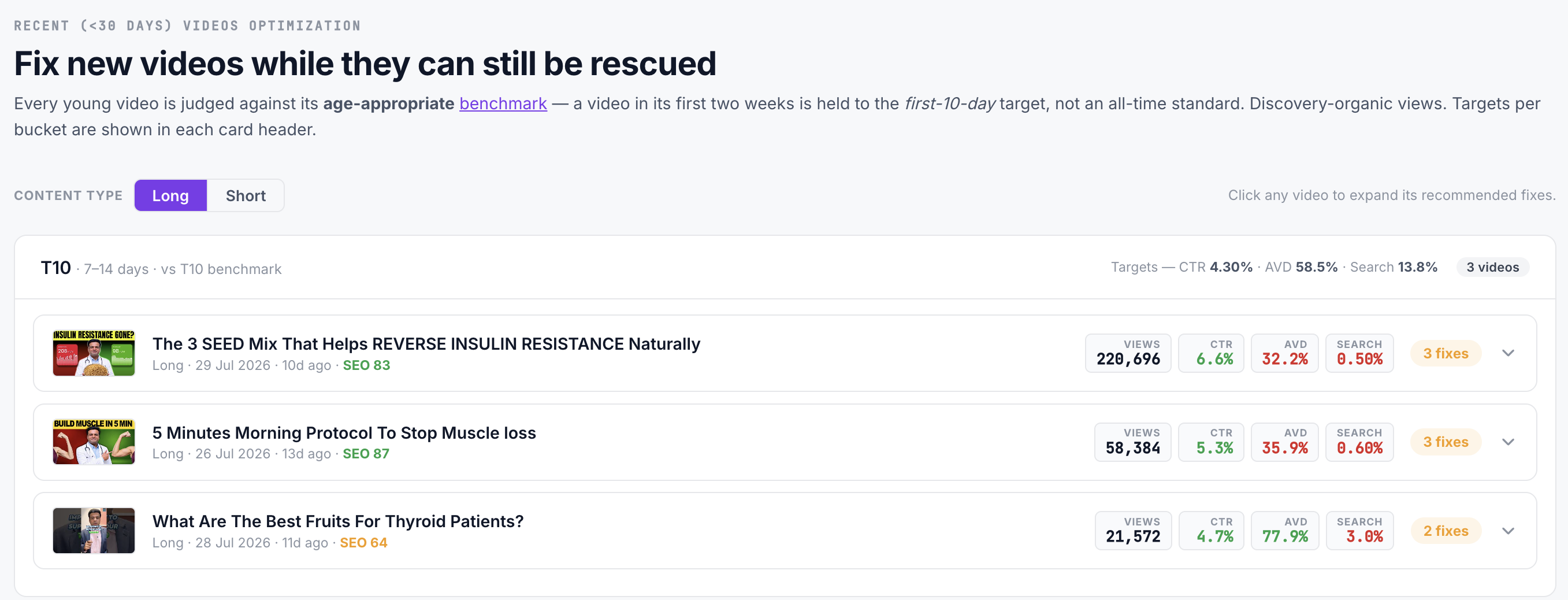
Layer one is local and map authority, driven by Angryturtle, our Google Business Profile operating system. Layer two is video and AI Overviews video pickup, driven by YODA, our AI-native YouTube engine. Layer three is Meta Ads and paid social intent capture, driven by Meta Catalyst IQ, with competitive intelligence from Prism Spy. Layer four is Instagram signal quality and creator-driven trust, tracked inside Prism Pulse. Layer five is CRM and RCM integration through Nexus CRM (Rs 14,999 per month) and HealthPro 360 (Rs 14,999 per month), so every AI-driven lead lands in a workflow that a hospital or clinic front desk can actually work.
The methodology deliberately treats AEO as a business outcome, not a content-marketing exercise. If a clinic is not converting more consults or a hospital is not signing more corporate tie-ups, the AEO work has not landed regardless of citation counts.
The 70-30 AEO engagement model


ICG runs healthcare AEO on a 70-30 fixed-variable model that anchors incentives to real business movement, not vanity metrics. Foundation is Rs 49,999 per month, Growth is Rs 74,999 per month, and Scale is Rs 99,999 per month. Seventy percent of the retainer is fixed for execution across the five-layer stack. Thirty percent is tied to a 12-month target — AI citation share, organic-lead volume, or CPQL improvement, agreed at kickoff — and released on a sliding-scale slab as targets are hit.
The same 70-30 logic extends to Google Ads and Meta Ads engagements above Rs 5 lakh per month in media, and to YouTube SEO and AIO engagements above Rs 50,000 per month. The model works because it filters out clients who want reports and keeps clients who want outcomes.
Book a free SEO diagnostic.
Hanuman Sihag's team runs a live crawl, checks technical health, cannibalisation, schema coverage and content gaps. 60 minutes, prioritised fix list.
Questions readers ask
about this topic.
The three platforms
behind every ICG engagement.
Beacon
CAPI middleware that fixes Event Match Quality, translates CRM statuses to Meta-standard events, dedups across channels.
Agency OS
Live client dashboard. GSC, GA4, Google Ads, Meta Ads, IVR calls in one view. Login anytime, not monthly.
Phoenix
Clinic revenue intelligence over your PMS. Daily action queue: Prevent Loss, Maintain & Engage, Grow Revenue. 46-centre rollout.
Or book a free 30-min audit to see all three in action on your account.
Healthcare brands
that already run on ICG.
A representative slice of the 150+ healthcare brands ICG has delivered for across India. Most engagements remain under NDA.


What ICG clients say · on video.
"Scale up of organic channels and business consulting. ICG has absolute domain authority in their field."
"Working with ICG transformed how we acquire IVF patients in Gurgaon. They understand the fertility journey from inquiry to consult..."
"What Ichelon accomplished — they got all my ideas and worked over 3-4 months to create an amazing, super-customised website."
The intelligence stack behind this playbook.
Every ICG engagement runs on the Search Intelligence Trifecta — Angryturtle for GMB, SIE for search and AI Overview, YODA for YouTube. Live product screens below.
Need help operationalising this?
Every ICG service is healthcare-only, NMC + DPDP-aware, and built around the patient-research patterns that drive Indian healthcare growth in 2026.
More from
ICG.
Healthcare AIO is the discipline of getting your clinic or hospital cited inside Google AI Overviews, ChatGPT and Perplexity answers — not j...
Conversational-search advertising places brand messages inside AI chat answers — ChatGPT, Perplexity, Copilot — rather than beside a results...
NABH digital compliance means every claim, image and testimonial your hospital publishes online matches what an accreditation surveyor can v...
Stop guessing.
Book a Diagnostic.
30 minutes. Free. With the AI-powered healthcare-only marketing agency 150+ brands already run on. No slides, no pitch, no hard close.


