


Entity SEO for Healthcare Brands — Getting Into the Knowledge Graph
Entity resolution is a search-visibility system problem, not a one-off schema fix. Our SIE engine tracks entity resolution and AI Share of Voice, Angryturtle keeps the Organization entity's NAP and citations clean across Google Business Profile, and YODA resolves the Person entity for doctor-led YouTube content. Live product screens are below.
The four entities every healthcare brand has to build
Healthcare brands are not a single entity. They are a graph of four entity types that need to be built, connected, and defended simultaneously. Missing any one of them leaves visible gaps in how Google renders your brand across search, AIO, Maps, and Knowledge Panels.
| Entity type | What it represents | Where it shows up |
|---|---|---|
| Organization | The hospital, clinic, or chain | Knowledge Panel, AIO citation, sameAs graph |
| Person | Founders, senior consultants, named authors | Author bylines, People Also Search, doctor Knowledge Panel |
| MedicalCondition | The conditions and procedures you treat | Topical authority, MedicalWebPage schema, AIO topical clustering |
| Place | Each physical location, mapped to a Google Business Profile | Local pack, Maps carousel, geo-grid rank |
The reason this matters practically: a hospital that has built its Organization entity but ignored its Person entities will earn a Knowledge Panel for the hospital, but the senior consultants stay invisible. A doctor brand that has built the Person entity but ignored the Place entity will earn a doctor Knowledge Panel, but every "best cardiologist near me" query still routes traffic to competitor chains.
Signal one — the Wikidata foundation
Wikidata is the single most under-used lever in Indian healthcare SEO. It is a structured, machine-readable knowledge base that Google consumes directly. A well-formed Wikidata item, combined with the right set of external identifiers, moves a brand from "unresolved string" to "resolved entity" in Google's graph. In practice, this is often the difference between month 12 and month 4 to a first Knowledge Panel.
A healthcare Organization on Wikidata needs, at minimum: an instance-of statement (hospital, medical clinic, or specialty clinic), country, headquarters location, official website, founding year, founder(s), and a stable identifier from at least two other authoritative sources — typically the Government of India registrations or a national medical council registration for the founding doctor. Once accepted, the item takes 4 to 14 days to propagate into Google's Knowledge Graph on average.
Signal two — the sameAs graph on your own website
The sameAs property inside Organization schema tells Google, "these accounts and profiles all refer to the same entity." Most healthcare websites in India either miss this property entirely or ship an inconsistent version of it across pages. Both are entity-fragmentation risks.
The correct posture is a single, canonical Organization schema block, injected sitewide from a shared layout, containing the full sameAs graph in a deterministic order: LinkedIn company page, YouTube channel, Facebook page, Instagram business profile, and Wikidata identifier. Doctor Person schema follows the same rule with the doctor's LinkedIn, YouTube channel, and if applicable, their Wikidata identifier.

Angryturtle → Angryturtle's citation audit flags NAP inconsistencies across directories before they fragment the Organization entity in Google's graph.
Signal three — authoritative third-party citations
Wikidata plus on-site schema is the foundation. Third-party citations are the confirmation. The healthcare-specific citation profile that resolves an Indian brand into the Knowledge Graph typically includes 30 to 50 authoritative mentions distributed across four buckets: government and regulatory (National Health Authority, state health departments where applicable), medical council registrations (NMC and specialty boards), authoritative health publications (Indian medical journals, mainstream health verticals of national dailies), and business registries (MCA, GST portal, CIN records).
A "citation" here means a mention that includes the exact organisation name and at least one qualifying identifier — the registered address, CIN, or founding-doctor NMC number. Directory-scale lists of clinics without qualifying identifiers do not count. Google has been indifferent to volume for years now. It cares about verifiability.
Signal four — content depth on the entity itself
Google reads your own "about" content to understand you. Most healthcare brands publish two paragraphs of throat-clearing marketing prose and expect Google to reverse-engineer an entity out of it. It does not.
A citation-worthy /about page for a healthcare Organization contains the founding year, the exact registered name and its aliases, the specialties, the number of consultants and their credentials, at least three named founders or senior leaders with Person schema, the physical addresses of every location, the parent company relationships if any, and a chronological "milestones" section. The same discipline applies to /doctors/{name} pages — those are the doctor's Person entity home, not just marketing bios.
The Knowledge Panel earning sequence for a mid-size clinic chain
- Weeks 1–2 — Brand-name policy locked. NAP audit across 40+ directories and correction request submitted. Organization schema injected sitewide with full sameAs graph.
- Weeks 3–5 — Wikidata item drafted and submitted. External identifiers from CIN, NMC (for founding doctor), and at least one authoritative publication attached.
- Weeks 6–10 — Content depth pass on /about, /doctors, /locations, and each specialty landing page. Person schema on every doctor. MedicalWebPage schema on every specialty.
- Weeks 11–16 — Digital PR campaign for at least 6 verifiable third-party mentions in authoritative health publications. Each must include a qualifying identifier.
- Weeks 17–24 — Knowledge Panel monitoring. First panel typically appears in this window. Any inconsistencies flagged in Google's "suggest an edit" flow are reviewed and merged.
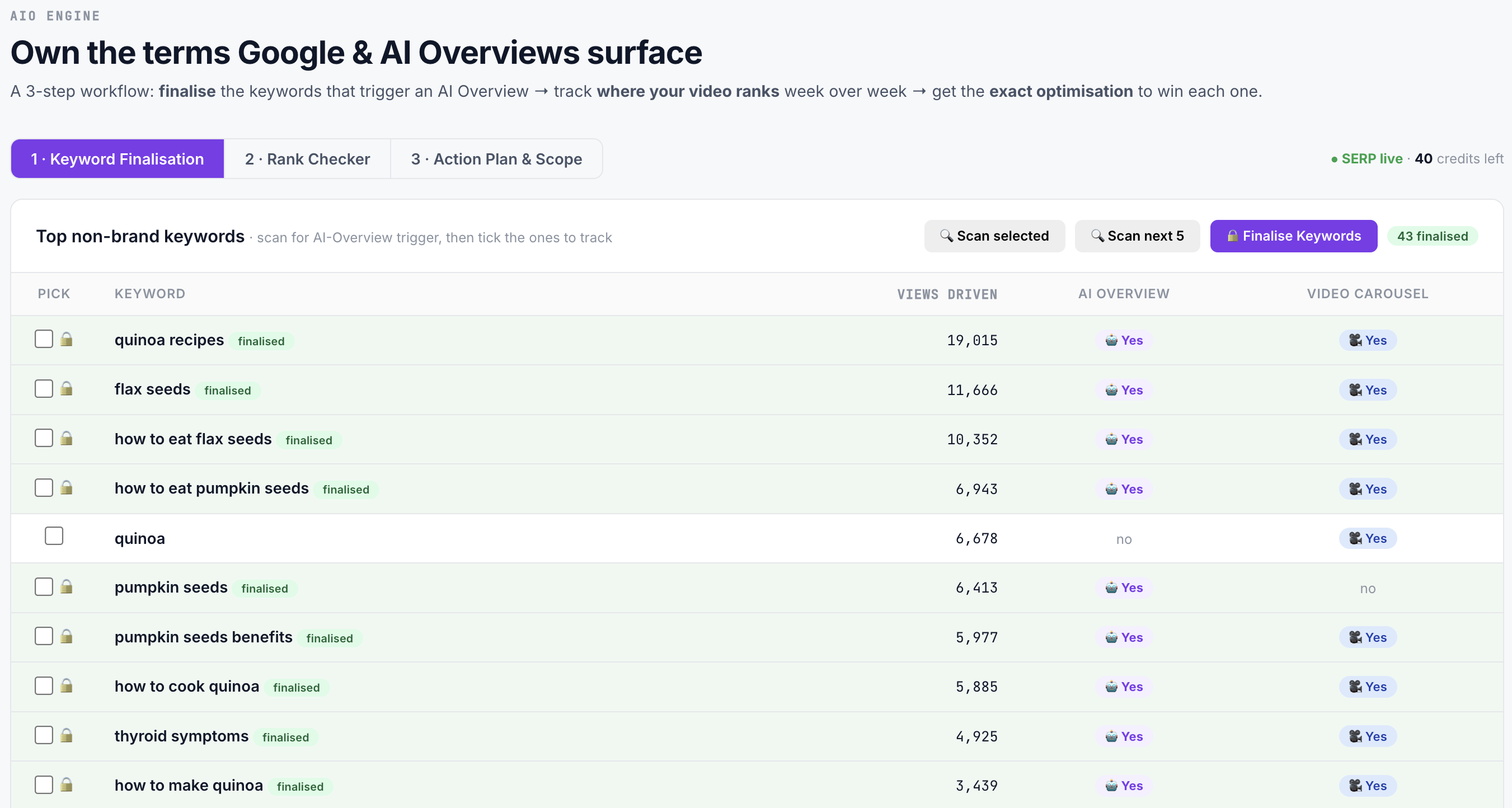
YODA → YODA's AIO Lab treats a doctor's Person entity as the starting condition for every keyword and topic decision on their channel.
How entity SEO compounds into AIO citation
Entity work is the multiplier that makes every other SEO investment pay back faster. A page-level FAQPage schema on an entity Google does not recognise is a claim about a stranger. The same schema on a resolved entity is a citation-eligible signal. This is why brands that skip entity work and jump straight to schema report zero AIO citations six months in, and brands that do entity work first see citations begin to appear inside three months.
Doctor-led content on YouTube behaves the same way. A video from an unresolved Person entity is a video from an unknown doctor. A video from a resolved Person entity — with Wikidata identifier, LinkedIn, NMC registration referenced in the channel description — sits inside a graph Google can reason about. Our YODA system for doctors treats entity resolution as the first-week task on every new channel because the compounding rate depends on it.
The signals to monitor after you have shipped the entity work
- Knowledge Panel appearance on branded query on desktop and mobile, incognito. Track weekly.
- sameAs verification in Google's Rich Results Test for at least three high-authority pages.
- Wikidata sitelinks — once Google acknowledges the Wikidata identifier, the sitelinks module in the Knowledge Panel becomes editable via the Panel's "own this business" flow.
- Branded query lift in GSC — a 15 to 30 percent lift in impressions on the exact brand name within 60 days of entity work is a healthy signal.
- AIO citation appearances logged manually across the 20 highest-intent queries in your specialty, weekly.
Get an entity audit for your healthcare brand
We will map your current entity state across Knowledge Graph, Wikidata, NAP, sameAs, and citations, and lay out the sequenced 90-day programme that earns your Knowledge Panel and unlocks AIO citation eligibility.
Book a free audit WhatsApp ICG
YODA → Once a doctor's Person entity is resolved, YODA's topic-cluster mapping compounds — every video reinforces the same entity Google already recognises.
