


AIO Lab inside YODA.
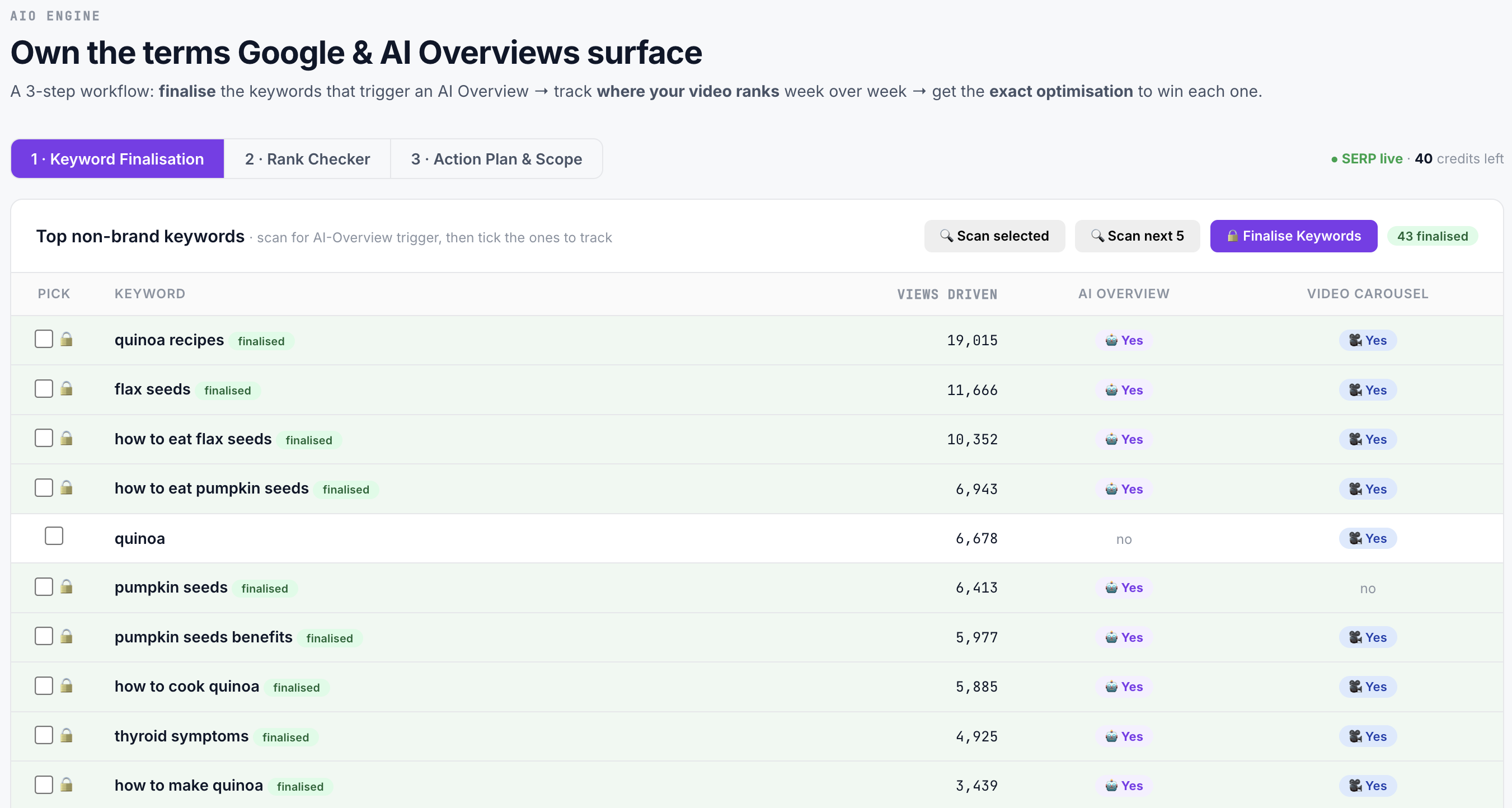
AIO Lab is YODA's dedicated workspace for AI Overview visibility, structured as three tabs — Keyword Finalisation (which healthcare queries are AIO-eligible and currently trigger AIO), Rank Checker (whether the channel already appears in AIO answers), and Comparative (which specialty competitor is winning AIO share).
How it works.
A YouTube performance dashboard tells the operator what already happened on YouTube. AIO Lab tells the operator what is happening on a completely separate surface — the AI Overview panel Google generates above blue-link results. Because AIO uses its own eligibility, trust, and structured-data rules, none of the standard YouTube KPIs — views, watch time, subscriber gain — reveal whether a channel is being cited by AIO. AIO Lab is where that gap is closed. The three tabs mirror the three questions any healthcare marketing lead actually asks about AI Overview: which of my queries even trigger it, am I in the citation set, and if not, who is. Each tab runs off a daily SERP scrape and a specialty-tagged keyword universe.
- Load the keyword universe. Specialty and city tagged; imports from GSC, Search Console, and manual curation.
- Tab 1 — Keyword Finalisation. Every query classified as AIO-triggering, AIO-eligible-but-quiet, or not-eligible; publishing effort routes to the middle bucket first.
- Tab 2 — Rank Checker. For each AIO-triggering query, log cited/not-cited plus slot position for the client channel.
- Tab 3 — Comparative. Same query set, but scoring competitor channels — surfaces the topics where a rival owns AIO share.
- Daily refresh. Money keywords scraped daily; long-tail weekly. AIO panels change composition inside a week.
- Route the gaps. Missing-schema gaps go to the schema queue; missing-topic gaps go to the topic queue; slot-drop gaps get a content refresh.
Why it matters for
Indian healthcare.
AIO citations for healthcare queries carry compliance weight the way blue-link results never did. When AIO cites a video, it summarises the video's claim inside its own generated answer — a single unsupported line in a transcript can be repackaged and served to millions. NMC Code of Ethics governs what a treating doctor can state on camera; a casual "most patients recover fully" becomes a public claim once AIO cites it. ART Act 2021 bars IVF success-rate quotes and comparative language, and AIO will happily surface either from an unaudited transcript. ASCI covers "best" / "leading" / "#1" — AIO Lab flags any tracked query where the client's cited answer contains ASCI-prohibited terms. DPDP Act 2023 applies to patient-testimony transcripts feeding AIO; consent scope has to include downstream AI republishing.
How ICG uses this.
YODA ships AIO Lab as one of its core modules — sitting alongside SEO Lab, Topic Cluster, and Comment Analysis. AIO Lab is what makes YODA the first Indian healthcare YouTube platform to track the third of the three ranking races as a first-class citizen, not a footnote. On every ICG engagement, the AIO Lab keyword universe is seeded from GSC and expanded weekly. When a competitor's channel starts winning AIO citations on a client's core topics, Comparative flags the topic within 24 hours — well before organic click share moves.
| Tab | Question answered | Refresh cadence |
|---|---|---|
| Keyword Finalisation | Which of my queries trigger AIO? Which are eligible but quiet? | Weekly per specialty · city |
| Rank Checker | Am I cited in the AIO answer? Which slot? | Daily on money keywords |
| Comparative | Which competitor is winning AIO share on my topics? | Daily on money keywords · weekly on long-tail |
| Slot-drop alert | Has my citation moved from slot 1 to slot 3+? | Triggered · not scheduled |
| Compliance sweep | Does any cited answer contain ASCI/NMC/ART/DPDP breaches? | Weekly on every citation |
Frequently asked questions.
What does the AIO Lab Keyword Finalisation tab do?
It filters a raw healthcare keyword list into two subsets — queries that Google currently triggers an AI Overview for, and queries that are structurally AIO-eligible but not yet firing. The eligible-but-quiet list is where the earliest citation wins happen, because competition is thin and the AIO panel is still forming. Refreshed weekly per specialty and per city.
How does the Rank Checker tab measure AIO citation?
For every tracked query, Rank Checker records three signals — does the SERP show an AI Overview, is the client channel cited as a source in the AIO answer, and which slot the citation occupies. A binary cited/not-cited alone hides slot position. YODA logs all three daily so a citation slipping from slot one to slot three is caught before it disappears.
What does the Comparative tab actually compare?
It compares AIO citation share across a chosen competitor set inside the client's specialty and city. For any tracked keyword, Comparative shows which channels are being cited, how often each one appears, and which topics are driving their citation wins. The output is a competitor-specific gap list — the topics where a rival owns AIO and the client does not.
Why is AIO tracked separately from YouTube and Google web?
AI Overview is a distinct surface — it selects sources using its own trust and structured-data signals, not YouTube rank or blue-link position. A video ranking one on YouTube can still be absent from every AIO panel because the landing page has no transcript or speakable block. Tracking AIO separately is how YODA isolates fixes without confusing them with YouTube or web ranking work.
Read next.
See AIO Lab
on your YouTube channel.
ICG runs a free 30-min Brand & Growth Diagnostic that plugs into your YouTube channel and runs an AIO Lab pass on your top healthcare queries.
