


How Google Search ads + Google Business Profile generated 881 enquiries for a dermatology clinic
A month of local Search ads with the clinic's Business Profile attached: what we set up, how we tracked it, and what the account showed for 1–30 September 2026. The clinic is anonymised; the numbers are read directly from its Google Ads account.

Assistant Manager, Performance Marketing, Ichelon Consulting Group
Why local intent now beats generic search ads
For years, healthcare Google Ads were built on broad keywords: "best dermatologist", "skin specialist", "acne treatment". They brought clicks, but not always patients. The traffic was wide, but it wasn't always nearby, and it wasn't always ready.
Patient searches have shifted. More of them now include a place: "near me", a city or a neighbourhood. These aren't casual searches. They come from someone who has already decided they need a dermatologist and is now deciding which one, how soon and how close.
That is where Google Search ads combined with the clinic's Google Business Profile come in. Instead of sending a patient to a website and hoping they convert, the ad itself shows the phone number, directions, reviews and distance at the exact moment of intent.
What "GMB ads" means here
There is no "GMB ads" campaign type. The term describes Search campaigns where the Business Profile is linked to Google Ads, so location assets can add the address, distance and star rating to the ad. A plain text ad becomes "2.1 km away · 4.7★ · Call now": a local listing patients already trust.
The patient journey we built for
In a standard set-up the only path is ad → website → form or call, and every extra step loses patients, especially on mobile. Here the patient can skip the website and go straight from the ad to a call or directions. For dermatology, where patients often want to speak to someone before committing, removing that step matters.
The campaign framework
- Planning. Defined the clinic's service lines (general dermatology, acne, vitiligo, hair, cosmetic procedures) and ranked them by demand and margin.
- Audience research. Reviewed CRM data for the age range, gender split and common concerns of patients who had converted before.
- Keyword research. Built clusters around service and location intent ("dermatologist in [city]", "acne treatment near me", "vitiligo doctor [city]"), kept apart from informational searches.
- Geo and radius. Targeted the clinic's real catchment rather than a whole state, with a tighter 5–10 km radius for "near me" searches.
- Location assets. Linked the Business Profile to Google Ads and checked it displayed correctly before scaling budget.
- Business Profile. Filled every field (services, attributes, photos, description), since incomplete profiles are less eligible for prominent placement.
- Reviews. A simple, ethical routine to ask satisfied patients for reviews after a good visit, and a timely reply to every review.
- Ad copy. Concern-led ads ("Acne scars? Consult a dermatologist today") with clear calls to action, within NMC and Google healthcare policies.
- Assets. Call, location and sitelink assets pointing to specific treatment pages.
- Conversion tracking first. Calls, forms, WhatsApp clicks and offline conversion import were live before the campaign launched.
- Bidding. Started with Maximise Conversions to gather data, then moved to Target CPA once volume allowed.
- Budget. Weighted towards the highest-margin, highest-demand services, with a small test budget for emerging ones.
- Weekly optimisation. Search-term reviews, paused weak keywords, and budget moved to what produced calls and directions.
- Negative keywords. Excluded "dermatology course", "dermatologist salary", "jobs" and other non-patient searches.
Results: 1–30 September 2026
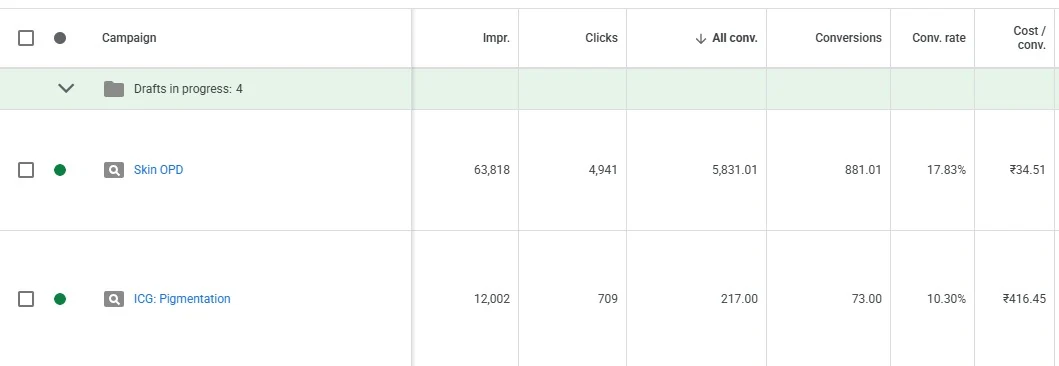
| Campaign | Impressions | Clicks | Enquiries (primary conversions) | Conversion rate | Cost per enquiry |
|---|---|---|---|---|---|
| Skin OPD (consultations) | 63,818 | 4,941 | 881 | 17.8% | ₹34.51 |
| Pigmentation (treatment) | 12,002 | 709 | 73 | 10.3% | ₹416.45 |
What the numbers say
The OPD campaign did the volume work. 881 enquiries at ₹34.51 each came from searches where the patient was close by and ready to book a consultation. A 17.8% click-to-enquiry rate is what happens when the ad already answers "how far" and "how well rated" before the click.
The treatment campaign did the value work. Pigmentation searches are fewer and more competitive, so each enquiry cost ₹416.45. That is still efficient: a pigmentation course is worth many times an OPD visit. Splitting the two campaigns let each bid to its own value instead of one blended average hiding both.
"Enquiries" here are the conversions set as primary in the account. "All conversions", which also includes secondary actions, was higher; we report primary conversions because those are what bidding optimises towards.
Which conversions we measured, and why
| Conversion | What it captures | Weight |
|---|---|---|
| Phone calls | Calls from the ad's call button or the website | Primary |
| Direction requests | Taps on "Directions" from the ad or profile | Primary |
| WhatsApp clicks | Chats opened with the clinic | Primary |
| Appointment forms | Booking requests on the site or in-ad lead forms | Primary |
| Offline conversion import | Booked and treated patients uploaded from the CRM | Primary |
| Website clicks, store visits | Visits to the site; Google's modelled in-person visits | Secondary |
Intent rises down the funnel: a website visit shows curiosity, a call shows readiness, a direction request shows someone has decided to show up. Counting a website visit and a booked treatment as equally valuable would mislead automated bidding, so only patient actions count as primary.
Lessons for other clinics
Do
- Link the Business Profile to Google Ads before launching any local campaign, and use location assets rather than typing the address into ad copy.
- Keep the profile complete and fresh: hours, services, monthly photos, and replies to every review within 48 hours.
- Build separate ad groups per service line, with city and area names in headlines.
- Track WhatsApp clicks separately from calls, and import offline conversions at least weekly.
- Set call schedules to clinic hours and treat direction requests as a leading indicator of walk-ins.
Avoid
- Targeting a whole state instead of the real catchment.
- One generic ad group for every treatment.
- Sending all traffic to a slow homepage that isn't built for mobile.
- Aggressive automated bidding before there is enough conversion data.
- Assuming more clicks means more patients, without tracking what happens after the enquiry.
Related: GMB ads for dermatology clinics · GMB ads for healthcare · dental clinics · physiotherapy clinics · med spas (USA)
Questions about this case study
What were the results of this GMB ads campaign?
Over 1–30 September 2026, the clinic's OPD search campaign with location assets produced 881 enquiries (primary conversions) from 4,941 clicks, a 17.8% conversion rate, at ₹34.51 per enquiry. A separate pigmentation campaign produced 73 enquiries at ₹416.45 each.
What is a GMB ad?
A Google Search ad linked to the clinic's Google Business Profile through location assets, so it shows address, distance, star rating and call or directions buttons.
Why did the two campaigns cost so differently per enquiry?
OPD searches ("dermatologist near me") are frequent and close to a booking decision. Pigmentation treatment searches are fewer and more competitive, and each patient is worth more, so a higher cost per enquiry is still efficient.
Which conversions were tracked?
Calls, direction requests, WhatsApp chats and booking forms were set as primary conversions, with website clicks as secondary and booked treatments imported from the CRM.
Can other specialties use the same approach?
Yes. Dental, physiotherapy, eye care and med spa practices follow the same pattern, with radius, keywords and compliance adjusted per specialty.
Want the same audit for your clinic?
We check your keywords, location assets, conversion tracking and Business Profile, and show where nearby patients are going instead. Google Ads management from ₹25,000/- per month, with Performance-Linked Payout Models available.
Chat with Co-founder