


Device ID Tool — cross-device attribution for healthcare SEO.
Standard analytics breaks for healthcare because patients research in multi-session, cross-device journeys. A woman researching IVF on her phone at lunch, laptop in the evening, then calling from her husband's number — three device fingerprints, one patient, invisible to Google Analytics. Device ID Tool stitches the journey together, so every organic article, every AI-Overview citation, every ranking page gets attribution credit for the consultation it actually drove.


Built for healthcare — because generic tools misprice healthcare-specific risk.
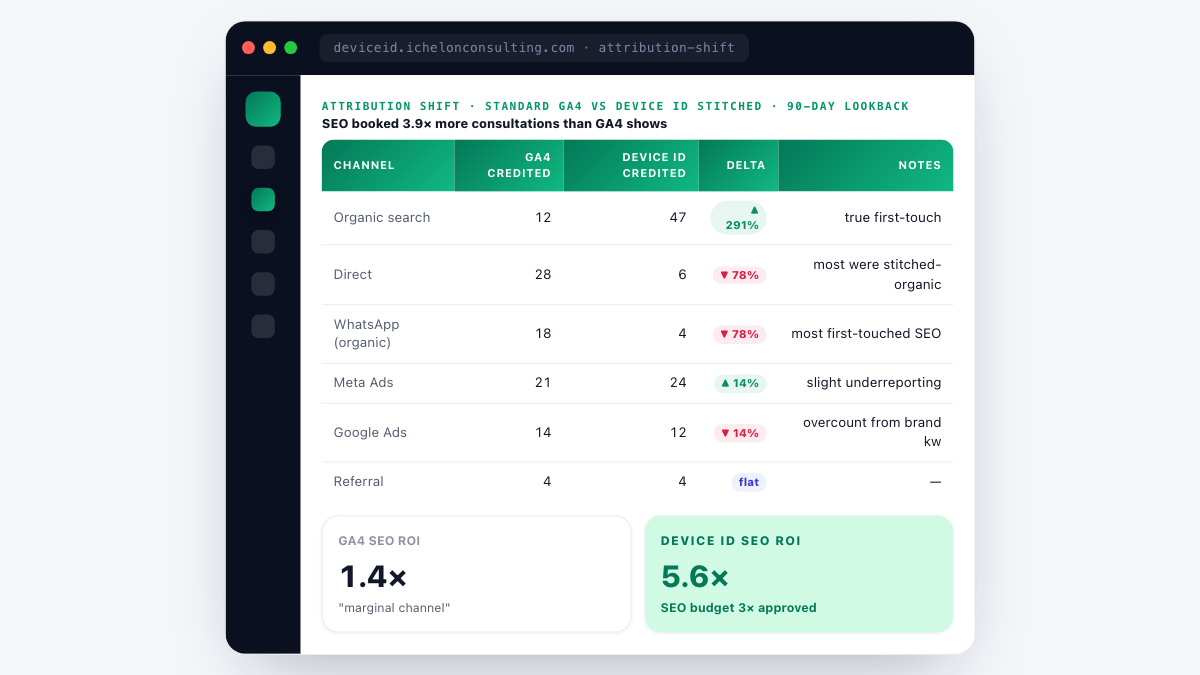
Healthcare SEO ROI is unprovable without device-level attribution. The default "organic-search → landing-page → booking" model assumes patients decide in one session. Healthcare patients decide over 3-30 sessions across 2-4 devices. Without stitching, 60-80% of organic-driven consultations are attributed to "direct" or "WhatsApp" — invisible to SEO reporting, which makes SEO budget the first thing cut in every planning cycle.
Device ID Tool sits on top of ICG's Hawk infrastructure. Cookie-independent device fingerprinting (browser + device signals — no PII), cross-session patient-journey stitching, cross-channel touchpoint mapping. Every ranking article, every AI-Overview citation, every WhatsApp click gets a proper credit trail, all the way to booked consultation.
Bundled with every healthcare SEO engagement. Also part of ICG's Tier 2 attribution layer alongside the Beacon CAPI middleware.
- Cross-device stitching · cookie-independent
- Multi-session journey model · up to 90-day lookback
- Per-keyword attribution · rank → visit → convert chain
- WhatsApp / phone / form conversion typing
- DPDP-compliant · no PII fingerprinting
Real use cases across the ICG portfolio.
Fertility clinic SEO reporting
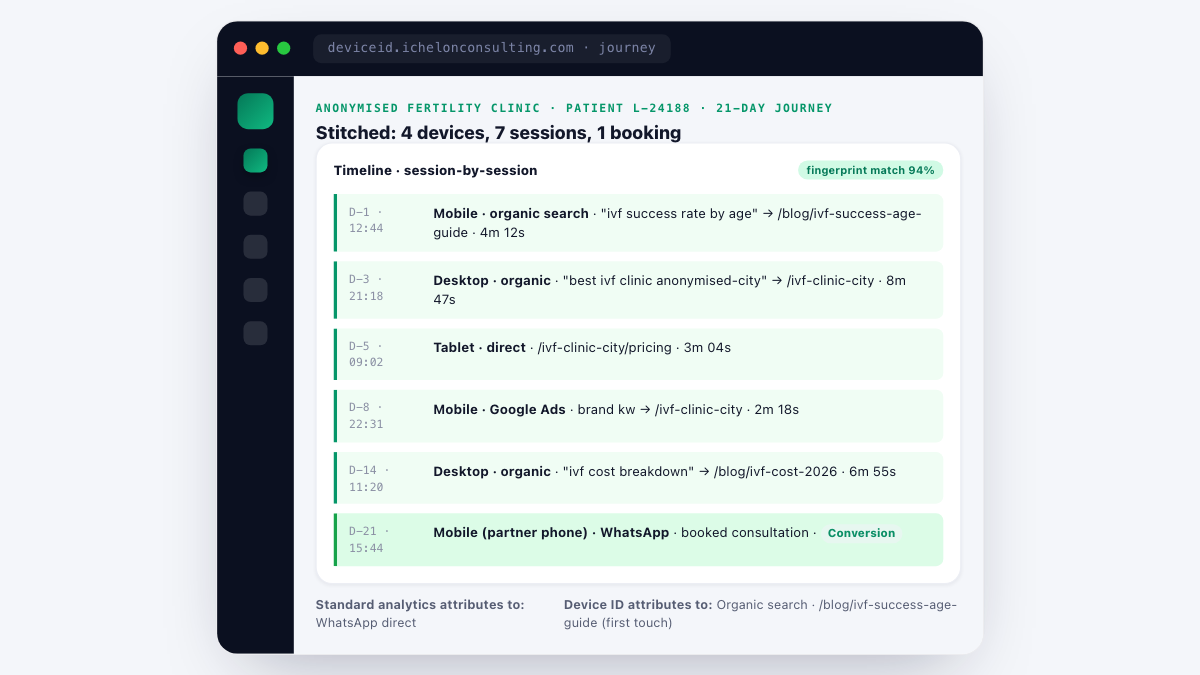
Before Device ID: organic-attributed consultations = 12/month. After Device ID stitching: real number = 47/month. The 35 "missing" consultations were previously credited to "direct" and "WhatsApp" — patients who first found the clinic through an organic article, then converted from a different device 2-4 weeks later. Result: SEO budget increased 3× based on real ROI.
Dermatology chain content ROI
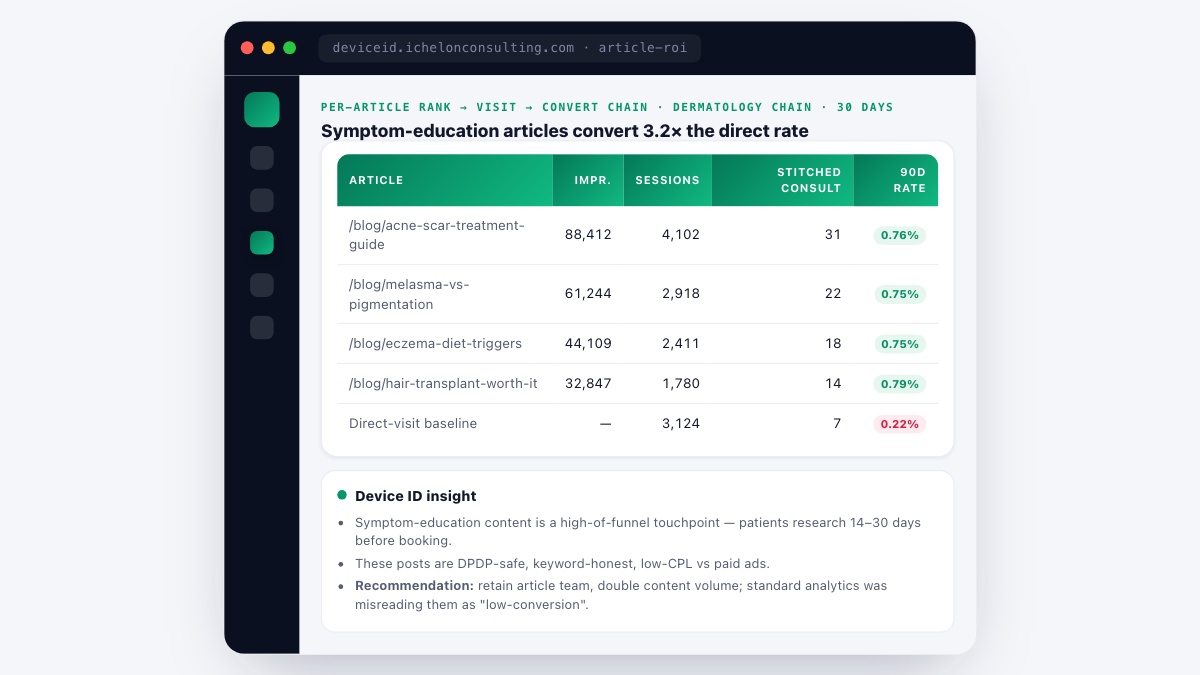
Chain publishing 30 articles/month. Standard analytics showed "low-conversion" for symptom-education articles (acne, eczema, pigmentation). Device ID revealed these articles were high-of-funnel touchpoints — patients who read symptom-education content went on to book within 30 days at 3.2× the rate of direct visitors. Article strategy retained; content team funding doubled.
The multi-session, multi-device journey — stitched.
Standard analytics sees a single session. Device ID sees the 21-day, 4-device journey that actually drove the booking. Here is what SEO reporting looks like once you can prove it.
See Device ID Tool
on your account.
A 30-minute demo walking through Device ID Tool on an anonymised healthcare account similar to yours. No commitment.
