


Pharma YouTube Channel Strategy for B2B India: What Actually Works
Most Indian pharma YouTube channels are built like consumer brand pages, and doctors quietly ignore them. This is the B2B playbook — content pillars, NMC and DPDP guardrails, publishing cadence, and the metrics that actually tie video to MR bookings.
No pitch. Written root-cause diagnosis. AI-powered, healthcare only.
Direct answer
Most Indian pharma YouTube channels are built like consumer brand pages, and doctors quietly ignore them. This is the B2B playbook — content pillars, NMC and DPDP guardrails, publishing cadence, and the metrics that actually tie video to MR bookings.
TL;DR
TL;DR
- Pharma YouTube in India is a B2B channel first. Your real audience is doctors, distributors, procurement heads, hospital pharmacists, and your own medical representatives — not patients.
- The NMC advertising code and the DPDP Act, 2023 rewrite what you can film. Patient testimonials, dosage mentions, and outcome claims are the three fastest ways to get a channel taken down or a legal notice served.
- Working Indian pharma channels publish four to eight videos a month across four pillars: MR field training, KOL panel discussions, therapy-area explainers, and procurement-facing product demos.
- Measure by qualified HCP subscribers, watch-time from verified medical domains, MR call bookings, and rep-share activity — not raw views. A channel with 8,000 doctor subscribers beats one with 80,000 mixed viewers, every time.
Table of Contents
- Why does YouTube matter for Indian B2B pharma in 2026?
- What content pillars work for a pharma YouTube channel in India?
- How do NMC and the DPDP Act shape pharma video content?
- What does the right publishing cadence look like?
- How should pharma brands measure YouTube success in B2B India?
- What common mistakes kill pharma YouTube channels?
- How does ICG approach pharma YouTube differently?
- What does a pharma YouTube investment cost in India?
- Frequently asked questions
Why does YouTube matter for Indian B2B pharma in 2026?
YouTube matters for Indian pharma because it is the only always-on channel where a doctor in Nashik, a hospital procurement head in Cochin, and your own MR in Guwahati all sit inside the same audience pool. Google's own India data pegs YouTube's monthly reach at north of 60 crore users, and NMC's rolls now carry roughly 13 lakh registered allopathic doctors — the overlap is enormous.
The pharma sector in India was pegged at close to USD 50 billion in FY25 and is on track for USD 130 billion by 2030, driven largely by branded generics and specialty molecules. That growth is being fought out in three-tier and four-tier towns where field reps physically cannot cover every clinic in a month. A YouTube channel with the right content pillars becomes the second rep — the one that shows up between visits, on the doctor's phone, at 10 pm.
The second reason is the ABDM effect. With ABHA IDs crossing 70 crore and hospital adoption rising through the NHA's HFR and HPR registries, decision-makers on the buying side of pharma — procurement heads at Apollo-scale chains and standalone 100-bed hospitals in Indore or Nagpur — are being trained to research digitally before a rep meeting. Video is where that research now lives.
What content pillars work for a pharma YouTube channel in India?
Four pillars work in Indian B2B pharma: medical representative (MR) field training, KOL panel discussions, therapy-area explainers pitched at prescribers, and procurement-facing product demos. Everything else — corporate anthem videos, factory tours, CSR films — belongs on LinkedIn or the About page, not on the main YouTube channel.
MR field training
The most under-used pillar. Ten to twelve minute videos where a senior MR or a medical affairs lead walks through the day's detailing story, objection handling, and one clinical study summary. These videos are ostensibly for internal reps, but doctors watch them too — and when doctors watch your training content, the trust curve bends sharply.
KOL panels
Thirty to forty minute recorded discussions with three to four KOLs on a therapy area. Cardiology, oncology, and metabolic disease panels typically pull two to three times the watch-time of shorter formats in India, because the audience is HCPs who want the full argument, not a highlight reel.
Therapy-area explainers
Six to nine minute videos on disease burden, treatment landscape, guideline updates, and health-economics — never on your molecule's efficacy. This is where you build authority without tripping the NMC advertising code.
Procurement demos
Short, honest, no-music videos aimed at hospital pharmacists and purchase committees: pack sizes, cold-chain requirements, GST invoicing quirks, MRP structure, distributor network. Unsexy. Extremely high-intent.
How do NMC and the DPDP Act shape pharma video content?
NMC's Professional Conduct Regulations and the Drugs and Magic Remedies Act govern what you can say about prescription molecules in public video, and the DPDP Act, 2023 governs how you can capture, store, and use any personal data — including a doctor's face or a patient's identifier — that appears on camera. Get any of these wrong and your channel is one strike away from a takedown.
The practical rules our compliance leads apply on every pharma shoot in India:
- No brand name of a prescription molecule in the video title, thumbnail, or first ten seconds of a public video. Molecule names belong in HCP-gated content, not on the open channel.
- No patient testimonials, no before-after clinical outcomes, no efficacy claims. Even a nurse saying "this worked" is a red flag.
- KOL disclosures on-screen: name, hospital, city, and a written note that the KOL has been compensated for their time, not for the opinion.
- Written DPDP-compliant consent forms for every on-camera doctor, MR, and hospital staff member, retained for the life of the video plus three years.
- Comments moderated with a keyword filter — patient queries redirected to a compliant channel, adverse events flagged to the pharmacovigilance inbox within 24 hours.
The channels that survive an internal audit at year-end are the ones that wrote these rules into the shoot brief on day one — not the ones that tried to retrofit compliance during a QC review.
What does the right publishing cadence look like?
The right cadence for an Indian B2B pharma channel is four to eight videos a month for the first year, weighted 50 percent to therapy-area explainers and 25 percent each to KOL panels and MR training. Procurement demos publish quarterly, aligned to distributor cycles.
Four videos a month is the floor. Below that, YouTube's algorithm treats the channel as dormant and stops recommending it to the doctor cohorts you have painfully built. Eight is the ceiling for most Indian pharma teams because production quality collapses beyond that unless you have a dedicated in-house studio in Mumbai or Hyderabad.
A cadence that works across our clients in Ahmedabad, Bengaluru, and the Baddi cluster:
- Week 1 — therapy-area explainer (long-form, 6 to 9 minutes)
- Week 2 — KOL panel excerpt (10 to 12 minutes, plus 3 to 4 Shorts)
- Week 3 — therapy-area explainer or guideline update
- Week 4 — MR training film (internal-first, then made public)
Shorts matter more than most pharma marketers admit. A single well-cut Short from a KOL panel routinely pulls three to five times the impressions of the parent long-form on Indian pharma channels — and because Shorts do not require the viewer to click, they widen the top of the doctor discovery funnel without breaking compliance.
How should pharma brands measure YouTube success in B2B India?
Measure four things: qualified HCP subscribers, watch-time from verified medical domains, MR bookings attributable to video, and internal rep-share activity. Ignore raw view counts unless they come with a clean audience breakdown — a channel of 1 lakh views made up of retail shoppers is worth almost nothing to a B2B pharma team.
The framework we run for pharma clients on YODA, our AI-native YouTube layer, tracks:
| Metric | Why it matters | Benchmark for Indian pharma B2B |
|---|---|---|
| Qualified HCP subscribers | Real prescribers and procurement heads, not general viewers | 1,500 to 4,000 in year one for a mid-size brand |
| Average view duration on KOL panels | Signals actual HCP engagement, not scroll traffic | 4 to 6 minutes on a 30-minute panel |
| CTR from doctor cohorts | Thumbnail and title relevance to prescribers | 6 to 9 percent |
| MR-shared video count per rep per month | Field adoption — the leading indicator for sales impact | 8 to 12 shares per rep |
| Doctor call bookings from video CTAs | The only metric your sales head will care about | 15 to 40 bookings per month at scale |
The best-performing pharma channel we onboarded last year — a specialty cardiology brand headquartered in Pune — hit 2,800 verified doctor subscribers in ten months and booked 62 KOL-led CME sign-ups directly from video CTAs in a single quarter. The channel had 46,000 total views. The view count was almost irrelevant to the business case.
What common mistakes kill pharma YouTube channels in India?
Six mistakes kill pharma YouTube channels in India, and we see the same six almost every time we audit a new pharma account. Most of them are strategy errors, not production errors — you cannot fix them with a better camera.
- Filming for patients on a B2B channel. The moment a pharma channel starts making "what is hypertension" explainers pitched at consumers, the doctor audience stops watching. The two audiences do not overlap on YouTube in India.
- Corporate anthem videos on the home banner. A three-minute "our journey" film is a signal to a prescriber that the channel is a brand exercise, not a resource. Move it to the About tab.
- KOLs without disclosure. Non-compliant, and doctors notice. A missing disclosure line halves the credibility of the entire panel.
- English-only on a national channel. Hindi, Tamil, Telugu, Marathi, and Bengali versions of the same KOL panel routinely triple watch-time in tier-2 and tier-3 cities. Multi-audio uploads or dedicated language playlists are non-negotiable in India.
- Ignoring Shorts. Every pharma team we have onboarded in the last 18 months that dismissed Shorts as "not serious" underperformed on discovery by 60 to 70 percent compared to teams that cut every long-form into three to five Shorts.
- No MR enablement layer. If your reps cannot find, share, and track the videos in the field, the channel is a marketing exercise disconnected from sales. Every video needs a shareable WhatsApp-optimised link and a per-rep tracking parameter.
How does ICG approach pharma YouTube differently?
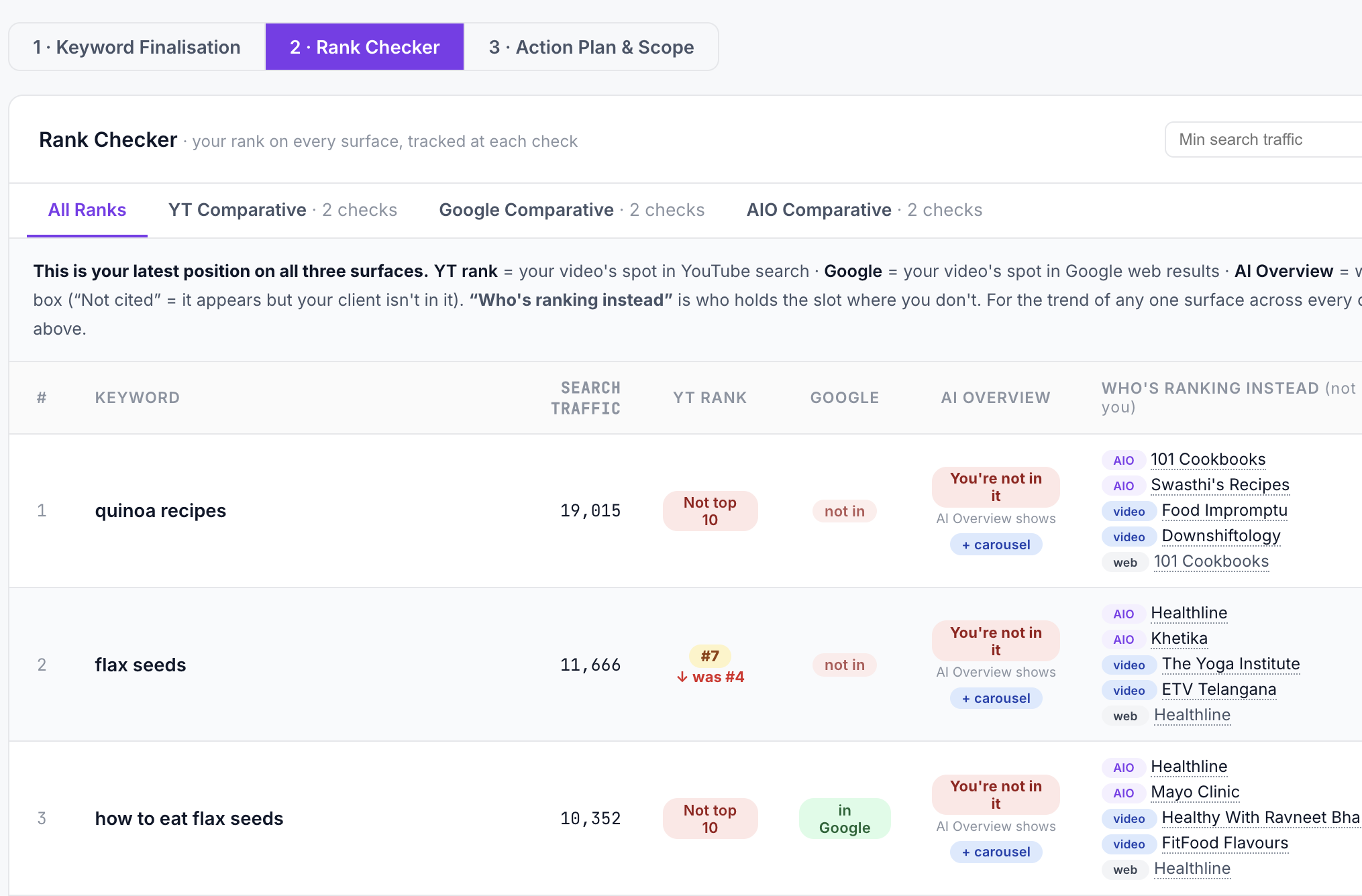 AI Overview citation status per tracked healthcare query with green/yellow/red state" width="1200" height="675" loading="lazy" decoding="async" style="width:100%;height:auto;display:block;">
ICG runs pharma YouTube as a full-stack B2B distribution channel, not a brand studio. That means the strategy sits on the same table as your MR beat plan, your KOL engagement calendar, and your procurement outreach — not on a separate marketing island. We built YODA, our AI-native YouTube layer, specifically because generic agency workflows treat pharma channels like consumer channels and burn the compliance runway.
Concretely, ICG's approach differs on four axes. First, we bake NMC and DPDP guardrails into the shoot brief before a single scene is scripted, so legal review at the end is a formality, not a rewrite. Second, every long-form is planned with its Shorts cut-down and its rep-share asset kit — nothing goes live as an orphan file. Third, we tie every video CTA into either Nexus CRM, our healthcare CRM built for HCP journeys, or your existing lead capture, so MR bookings are attributable at the rep level. Fourth, we run the same competitor-signal engine that powers Prism Spy — our Meta Ads intelligence platform — against pharma YouTube activity in your therapy area, so you know what other Indian pharma brands are shipping in cardiology, oncology, or diabetes before you commission your next quarter's slate.
Meta Catalyst IQ and Prism Pulse handle the paid amplification and Instagram signal for teams that want cross-channel lift on the same content spine. Angryturtle, our Google Business Profile OS, closes the loop for pharma brands with a franchise, hospital, or diagnostic-network footprint that also needs local discovery. And HealthPro 360 sits on the RCM and EHR side for hospital-facing clients whose pharma partners want an integrated view. The stack is designed so a pharma marketer in Mumbai or a hospital marketing director in Chennai does not have to duct-tape six vendors together.
What does a pharma YouTube investment cost in India?
A serious pharma YouTube channel in India runs between Rs 6 lakh and Rs 25 lakh per year in agency and production spend, depending on the number of therapy areas, KOL panels, and language versions. That is separate from paid promotion, which for most Indian pharma teams starts at Rs 50,000 per month on YouTube and grows with the funnel.
ICG's engagement model uses the same 70-30 fixed-plus-variable framework we apply across services: 70 percent of the fee is fixed monthly retainer, and 30 percent is tied to a 12-month outcome target agreed at kickoff — qualified HCP subscribers, verified watch-time thresholds, or MR-attributed bookings, depending on the brand's priority. The three retainer tiers are:
- Foundation — Rs 49,999 per month. Single therapy area, four videos a month, one KOL panel per quarter, one language.
- Growth — Rs 74,999 per month. Two therapy areas, six videos a month, monthly KOL activity, two languages, Shorts pipeline built in.
- Scale — Rs 99,999 per month. Three-plus therapy areas, eight videos a month, dedicated MR enablement layer, three-plus languages, Prism Spy competitor tracking on the therapy areas that matter to you.
For pharma brands running Google Ads or YouTube Ads at 5 lakh a month plus, or YouTube SEO and AIO retainers starting at 50,000 a month, the same 70-30 model extends across the media mix. The point of the framework is simple: nobody on the pharma side wants an agency that only gets paid whether the channel grows or not.
The one thing to remember
 Meta Catalyst IQ long-term comparison view charting Meta Ads performance across quarters with spend, CPQL and volume overlaid" width="1200" height="675" loading="lazy" decoding="async" style="width:100%;height:auto;display:block;">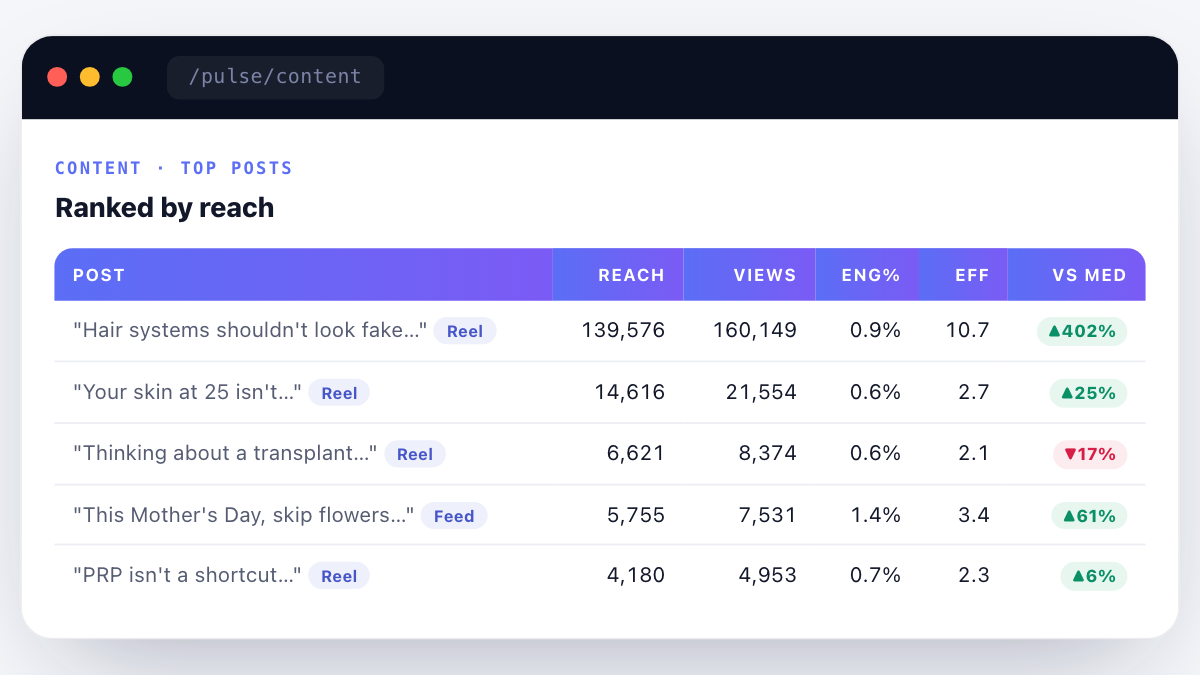

Indian B2B pharma YouTube is not a brand-awareness game — it is a distribution and enablement game. Build the channel for the doctor who has 90 seconds between OPD patients, the procurement head who wants to know if your pack size fits her budget, and the MR who needs a 60-second clip to send on WhatsApp before her next call. Every other decision — cadence, format, thumbnail, language — flows from that. The teams that treat YouTube as the second rep are the teams whose channels are still publishing in year three. Everyone else quietly archives the account after 14 months.
Frequently asked questions
Is a pharma YouTube channel allowed under Indian regulations?
Yes, an educational and B2B-focused pharma YouTube channel is allowed in India provided the content complies with the NMC Professional Conduct Regulations, the Drugs and Magic Remedies Act, and the DPDP Act, 2023. You cannot advertise prescription molecules to the public, cannot use patient testimonials for outcomes, and must handle personal data of on-camera participants under DPDP consent rules.
Should Indian pharma brands run a single national channel or state-level channels?
A single national channel with language-specific playlists and multi-audio uploads works better than fragmented state channels for most Indian pharma brands. It concentrates subscriber growth, simplifies compliance, and lets the algorithm serve region-specific content without splitting your authority signal across five different channel handles.
How long before a pharma YouTube channel starts producing measurable business impact?
Expect four to six months to build a qualified HCP subscriber base of 800 to 1,500 doctors and another two to three months before MR-attributed bookings from video CTAs cross double digits per month. Anyone promising traction inside 90 days on a pharma channel in India is either paying for it entirely through ads or is not measuring the right cohort.
Can we use doctors from our own advisory board as YouTube KOLs?
Yes, and it is usually preferable to external KOLs because the compliance and disclosure trail is cleaner. Your advisory board doctors already have signed consultancy agreements. You still need on-screen disclosure that they have been compensated for their time, and you still need DPDP-compliant on-camera consent for every recording.
Should pharma YouTube videos be gated behind HCP verification?
Gate only the content that names prescription molecules, discusses efficacy data, or shares any dosing or protocol information. Therapy-area explainers, disease-burden content, and CME-style KOL panels can stay open. A hybrid channel with a public educational layer and a gated HCP-verified layer is the most common Indian pharma structure in 2026.
How does ICG measure whether a pharma YouTube channel is worth continuing?
We run a quarterly review against four metrics: qualified HCP subscriber growth, average view duration on KOL panels, MR-attributed bookings from video CTAs, and cost per qualified HCP acquired. If three of the four are trending against benchmark for two consecutive quarters, we recommend a strategy reset — not more spend. Pharma teams appreciate the honesty and it is why our retainers renew.
Are YouTube Shorts appropriate for pharma B2B content?
Yes, provided you treat Shorts as discovery surface, not standalone education. A Short that teases a KOL panel, a therapy-area statistic, or a guideline update — with a compliant caption and no molecule promotion — routinely outperforms the parent long-form in impressions among Indian doctors, and drives the subscribe action that grows the channel.
What team do we need in-house to run a pharma YouTube channel with an agency?
One brand manager as the single point of contact, one medical affairs reviewer with authority to sign off scripts, and one compliance stakeholder from your regulatory or legal function. Everything else — production, editing, KOL coordination, thumbnails, uploads, analytics, MR enablement kits, Shorts — the agency should own end to end. If you are being asked to manage more than that in-house, the engagement is designed wrong.
Book a free Brand & Growth Diagnostic.
60 minutes with a Co-Founder. You leave with a written root-cause analysis of where growth is stalling and what to fix first — whether or not you engage ICG.
Questions readers ask
about this topic.
The three platforms
behind every ICG engagement.
Beacon
CAPI middleware that fixes Event Match Quality, translates CRM statuses to Meta-standard events, dedups across channels.
Agency OS
Live client dashboard. GSC, GA4, Google Ads, Meta Ads, IVR calls in one view. Login anytime, not monthly.
Phoenix
Clinic revenue intelligence over your PMS. Daily action queue: Prevent Loss, Maintain & Engage, Grow Revenue. 46-centre rollout.
Or book a free 30-min audit to see all three in action on your account.
Healthcare brands
that already run on ICG.
A representative slice of the 150+ healthcare brands ICG has delivered for across India. Most engagements remain under NDA.


What ICG clients say · on video.
"ICG's strategic clarity helped us position Lil Chunks for both consumer trust and healthcare credibility."
"Scale up of organic channels and business consulting. ICG has absolute domain authority in their field."
"Working with ICG transformed how we acquire IVF patients in Gurgaon. They understand the fertility journey from inquiry to consult..."
Need help operationalising this?
Every ICG service is healthcare-only, NMC + DPDP-aware, and built around the patient-research patterns that drive Indian healthcare growth in 2026.
More from
ICG.
Healthcare AIO is the discipline of getting your clinic or hospital cited inside Google AI Overviews, ChatGPT and Perplexity answers — not j...
Conversational-search advertising places brand messages inside AI chat answers — ChatGPT, Perplexity, Copilot — rather than beside a results...
NABH digital compliance means every claim, image and testimonial your hospital publishes online matches what an accreditation surveyor can v...
Stop guessing.
Book a Diagnostic.
30 minutes. Free. With the AI-powered healthcare-only marketing agency 150+ brands already run on. No slides, no pitch, no hard close.


