


Patient Story Reels on a Doctor's Instagram: What the NMC Guidelines Allow (2026)
Promotional patient-story Reels are not permitted under the NMC guidelines of 6 October 2026, and consent does not change that (paras 6.2, 8.1(v)). What anonymised educational case discussion can look like, how to de-identify and take consent, and what to do with old Reels.
No pitch. Written root-cause diagnosis. AI-powered, healthcare only.
Direct answer
Promotional patient-story Reels are not permitted under the NMC guidelines of 6 October 2026, and consent does not change that (paras 6.2, 8.1(v)). What anonymised educational case discussion can look like, how to de-identify and take consent, and what to do with old Reels.
TL;DR

Patient-story Reels used to be among the strongest-performing content on doctors' Instagram accounts. Under the NMC's advertising guidelines of 6 October 2026, promotional patient-story Reels are no longer an option. Success stories and promotional case presentations are barred (para 8.1(v)), patient testimonials are barred (para 3.2, Explanation V; para 8.1(xi)), and a signed consent form does not make a prohibited testimonial lawful (para 6.2). What remains is narrower: anonymised case discussion for genuine education, with consent.
This piece replaces our earlier consent playbook for patient-story Reels. For the full rules on testimonials and before-after content, see NMC rules on patient testimonials and before-after photos; for Instagram generally, see NMC guidelines for doctors on social media; and for everything else, our complete guide to the NMC advertising guidelines 2026.
Updated 8 October 2026 to the National Medical Commission's Guidelines on Ethical Advertising and Public Communication by Hospitals/Medical Institutions and Registered Medical Practitioners (public notice No. R-13014/01/2024-Ethics, dated 6 October 2026, in force immediately). Paragraph numbers in this article refer to those guidelines. General information, not legal advice.
Why patient-story Reels performed, and why that is the problem
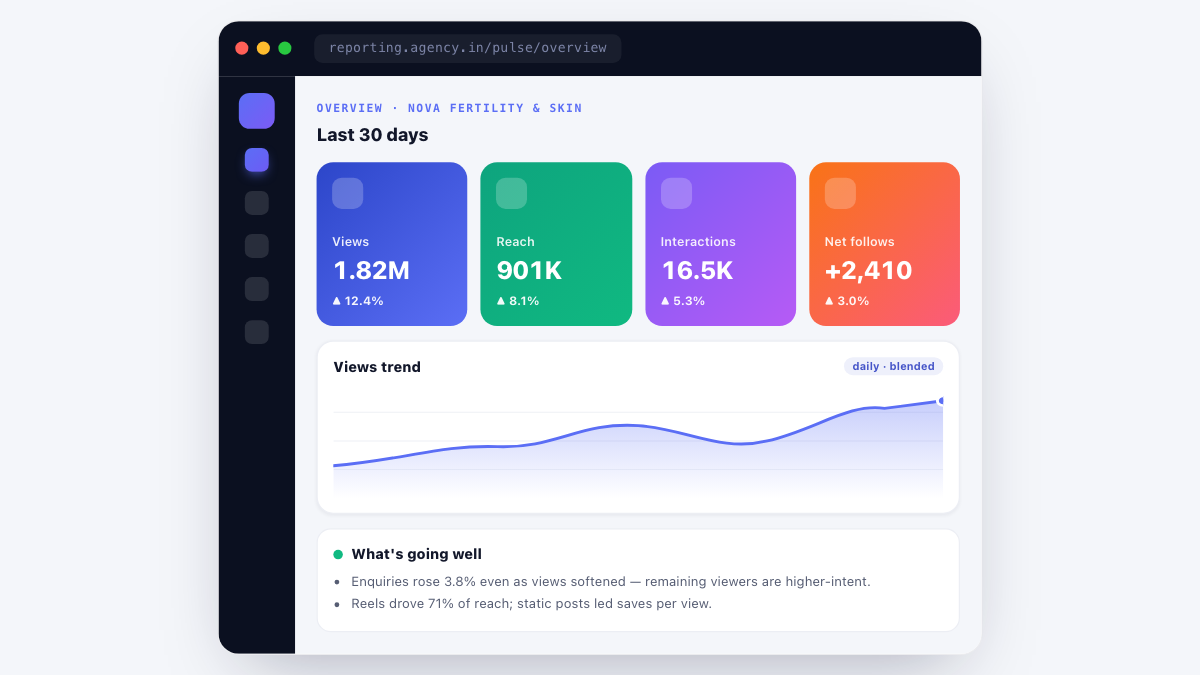
On the doctor accounts we monitored via Prism Pulse, patient-story Reels consistently sat near the top of the account's effectiveness index and drove DMs and WhatsApp enquiries. The reason was simple: a prospective patient watching another patient's journey is weighing the same decision. That pull is exactly what makes them promotion. A Reel that shows a real patient's journey in order to bring in the next patient is a success story or testimonial used for promotion, whatever the framing and however carefully the consent was taken.
What the guidelines say
| Provision | What it says | What it means for patient-story Reels |
|---|---|---|
| Para 8.1(v) | No promotional case presentations, before/after photos, celebrity patients or success stories, except for scientific or educational purposes with anonymised consent. | Patient journeys used to promote the practice are out. Anonymised, consented case material for education is the exception. |
| Para 3.2, Explanation V | An RMP shall not request or share patient testimonials, recommendations, endorsements or reviews for professional promotion on social media. | A doctor may not post or reshare patient-story Reels on Instagram to promote their practice. |
| Para 8.1(xi) | No celebrity, influencer, patient or employee testimonials; no third party used to do indirectly what is prohibited. | Posting through a hospital page, an agency account or a "patient community" handle does not help. |
| Para 6.2 | Consent does not make a prohibited testimonial or before-and-after lawful. | A consent architecture, however thorough, cannot make a promotional patient Reel permissible. |
| Paras 6.4, 7.4 | Identifying features must be blurred or cropped; no identifiable patient data. | Educational case material must be genuinely anonymised. |
| Para 7.2(b) | No synthetic patients, testimonials or endorsements. | No AI-generated "patients" or actors presented as patients telling their story. |
Our earlier advice was that a "process" framing ("here is what I understood before I decided") kept a patient story on the right side of the line, while an "endorsement" framing ("Dr X is the best") crossed it. Under the October 2026 guidelines that distinction no longer saves a promotional patient Reel. Both are success stories or testimonials used for promotion.
What anonymised educational case discussion can look like
The permitted space is case discussion whose purpose is to teach, not to attract patients. In practice that means:
- The doctor explains, the patient does not appear. A clinician walks through a typical case ("a patient in their forties presents with...") to explain how a condition is assessed, what the options are, and what the risks and limits of each option are.
- The case is anonymised. No face, voice, name, distinctive features or contextual detail that would let anyone recognise the patient (paras 6.4, 7.4). If the case draws on a real patient, their consent is taken for that educational use (para 8.1(v)).
- No outcome promises. The discussion covers realistic expectations and risks, not results (paras 8.1(iii) and 8.1(vi)). No before-and-after imagery.
- No call to book. No "DM us", "book your consultation" or offers (paras 8.1(ii), 8.1(x)). Educational content must not solicit patients or promote personal practice (para 5.1).
- Proper disclosure. The post carries the doctor's name, qualifications and registration number (para 3.2, Explanation III), and talks in the doctor's own name and designation without promoting the employer (para 8.2(iii)).
- Labelled if illustrative. If the case is a composite rather than a single real patient, say so on screen. Never present a composite, an actor or an AI-generated person as a real patient (para 7.2).
Content like this will not convert to DMs the way patient stories did, and it should not try to. It earns trust by explaining well, which is the route the guidelines leave open.
What "de-identified" actually means

De-identified does not mean face-blurred. It means removing every element that could allow someone who knows the patient to identify them. For case material this includes:
- Face and any distinctive facial features
- Voice on unedited audio (use captions or a voiceover by the doctor instead)
- Distinctive body features: birthmarks, tattoos, scars, visible dental work, hairline patterns
- Contextual details: the specific ward, the date, a visible name on a chart, a distinctive item of clothing
- Background details that would identify the practice location to the patient's community
- Combinations of age, city, occupation and condition that together point to one person
Our threshold: any educational post that uses material from a real patient carries a signed consent, however complete the concealment looks, because concealment is never as complete as it appears.
Consent for educational case material
Where real case material is used for education, the consent layer still matters. It does not make promotion permissible (para 6.2), but it is required for any permitted use.
| Element | What it contains | Why it matters |
|---|---|---|
| Written consent form | Patient signature, date, the specific educational purpose, where it will appear, and a plain-language description of what will be used and how it will be anonymised | Informed, documented consent for the anonymised educational use that para 8.1(v) allows |
| Takedown clause | The patient can withdraw consent at any time; the material comes down from every surface promptly | Protects patient autonomy and gives the practice a clear rule to act on |
| DPDP-aware storage | Consent forms stored on encrypted, access-controlled storage with defined retention and an access log | The DPDP Act 2023 and Rules 2025 apply (para 7.6) |
| Voluntariness | A statement that care does not depend on agreeing and nothing is offered in return | Consent must be free, and inducements are barred (para 8.1(x)) |
Verbal consent is not enough. A written form takes ten minutes and removes a whole class of risk.
What to do with patient-story Reels already on your account
The guidelines were in force immediately. Reels that are still live remain published today, so existing patient-story content needs the same review as new content:
- List every live post that features a patient across Instagram (Feed and Reels), Facebook, YouTube if cross-posted, the website, and any ad rotations.
- Take down or archive anything promotional: success stories, journeys, testimonials, before-and-afters and anything that reads as an endorsement. Keep a time-stamped log of each removal.
- Request removal from search where the asset was indexed. Some cached traces persist for days; the log shows the takedown was done.
- Keep only genuinely educational, anonymised material that has a valid written consent on file, and check it against the list in the previous section.
The same workflow handles a patient withdrawing consent for educational material: log the request in the consent register, remove the asset from every surface, request search removal, and confirm to the patient in writing.
Keeping it sustainable
One consent register. Maintained by the practice manager: patient, date signed, scope, current status, review date. Scattered forms in email threads and phone folders are what make takedowns slow.
Annual re-verification. For any educational post using real case material that stays live for more than 12 months, check with the patient whether consent still stands. Circumstances change, and some patients prefer older material retired. Prism Pulse flags these posts each quarter.
Quarterly content audit. Fifteen minutes a quarter walking the register and the live feed to confirm nothing promotional has crept back in.
Where this sits in ICG's work with doctors
For individual doctors, ICG supports only genuinely educational content in the doctor's own name and designation (para 8.2(iii)); we no longer produce patient-story Reels. Case-explanation content of the kind described above is part of the education-first approach set out on our social media agency for doctors page.
Want ICG to review your existing patient content against the NMC guidelines? Book a 20-min review →
How ICG works within these guidelines
ICG is a healthcare marketing agency. Our clients are hospitals, clinics and medical institutions, which may publish factual, objective and verifiable information about themselves (paras 8.3 and 9.1). For individual doctors, ICG supports only genuinely educational content in the doctor's own name and designation (para 8.2(iii)). For doctors and their practices, we run patient-education-driven campaigns: awareness content that helps patients understand their condition and their options, published in the doctor's own name and designation (para 8.2(iii)) and kept free of the self-promotion that para 8.1(ii) bars.
The work is education-first and runs across six channels:
- Awareness content on YouTube. Doctor-led educational videos on public health and disease awareness, in the doctor's own name and designation, without promoting the employer organisation (para 8.2(iii)). See YODA and YouTube marketing for healthcare.
- Research articles and blogs that help patients understand their options: information shared in the normal course, not promotion (para 3.2, Explanation I). See healthcare content marketing, ICG research reports and healthcare SEO.
- Expert answers on Reddit and Quora from named, disclosed accounts. No anonymous or fake posts, no undisclosed commercial relationships and no manufactured engagement (paras 8.1(xi) and 8.1(xii)). See Reddit and Quora programmes.
- Awareness campaigns on Meta, run from the hospital's or clinic's own page, with no discounts, offers, free procedures or other inducements (paras 8.1(x) and 8.3). See Meta advertising for hospitals and clinics.
- NMC-compliant Google Ads landing pages: factual departments, services and facilities, with no "best", "No.1", "100% success", "painless" or "guaranteed" claims (paras 8.1(iii) and 8.1(ix)). See Google Ads for hospitals and clinics.
- "Learn More" instead of "Book Now" on patient-facing pages, so that a page informs rather than solicits (paras 8.1(ii) and 8.3(ii)).
All six rest on three kinds of content: scientific (evidence-based, checked by a qualified clinician), persona-based (written for the questions a specific patient group asks) and consumer-based (built from how people search, compare and decide). AI-assisted drafts go through human medical review, and AI-generated content that is published carries an AI source mark (para 7.2). We do not publish patient testimonials, before-and-after images or superiority claims, and we never buy, incentivise or gate reviews.
Free NMC compliance check. We review a hospital's or clinic's website, Google Business Profile and social channels against the October 2026 guidelines and send back a written list of fixes.
See what the check covers · Request the check · Book a 30-minute call
General information, not legal advice. Source: NMC public notice No. R-13014/01/2024-Ethics, 6 October 2026.
Book a free Meta ads account audit.
Raman Soni's team pulls your account, checks CAPI/EMQ, reviews creative for NMC compliance, and shows where CPQL is leaking. 45 minutes, actionable output.
Questions readers ask
about this topic.
The three platforms
behind every ICG engagement.
Beacon
CAPI middleware that fixes Event Match Quality, translates CRM statuses to Meta-standard events, dedups across channels.
Agency OS
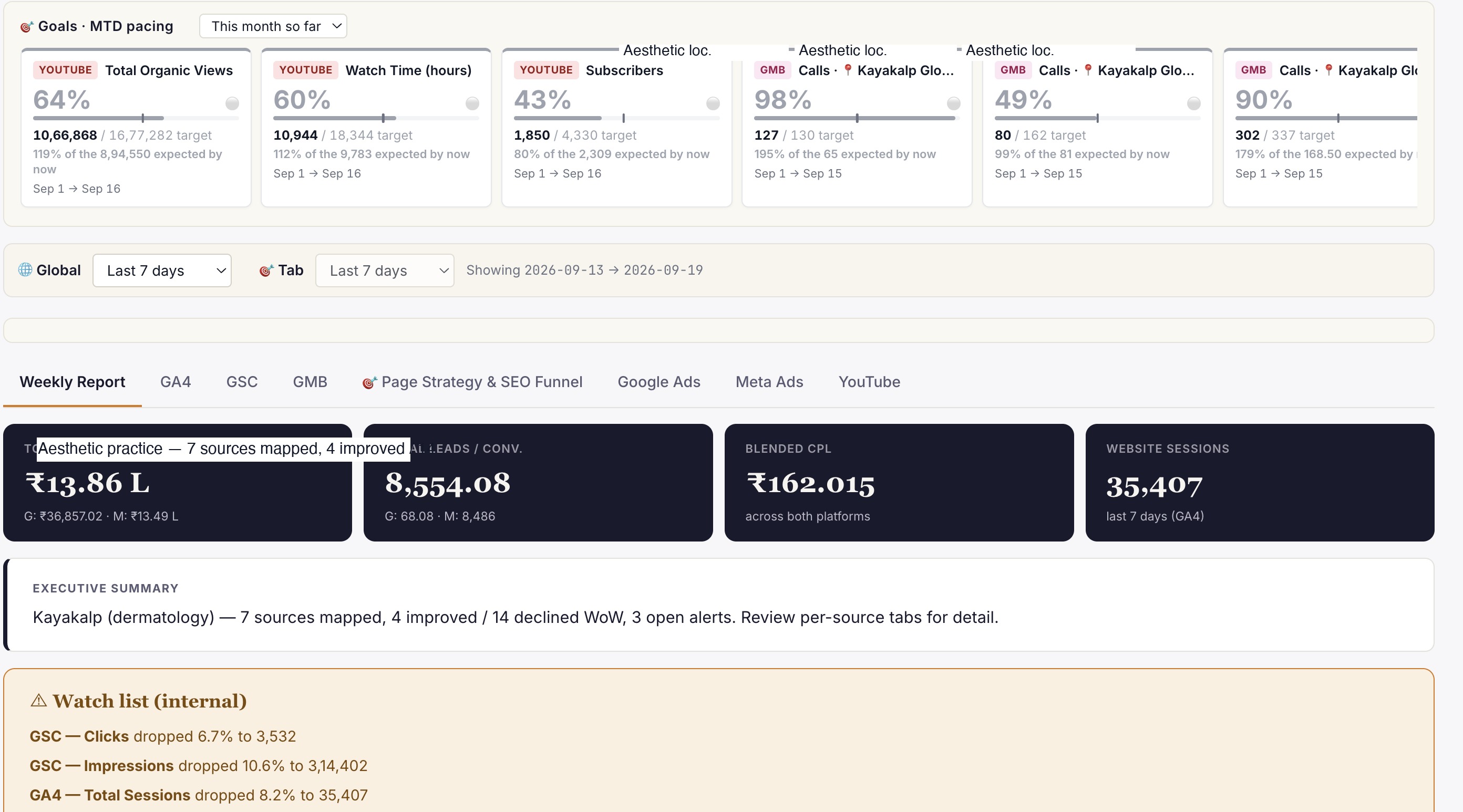
Live client dashboard. GSC, GA4, Google Ads, Meta Ads, IVR calls in one view. Login anytime, not monthly.
Phoenix
Clinic revenue intelligence over your PMS. Daily action queue: Prevent Loss, Maintain & Engage, Grow Revenue. Multi-centre rollout.
Or book a free 30-min audit to see all three in action on your account.
Healthcare brands
that already run on ICG.
A representative slice of the 150+ healthcare brands ICG has delivered for across India. Most engagements remain under NDA.


What ICG clients say · on video.
"Scale up of organic channels and business consulting. ICG has absolute domain authority in their field."
"Working with ICG transformed how we acquire IVF patients in Gurgaon. They understand the fertility journey from inquiry to consult..."
"What Ichelon accomplished — they got all my ideas and worked over 3-4 months to create an amazing, super-customised website."
Need help operationalising this?
Every ICG service is healthcare-only, NMC + DPDP-aware, and built around the patient-research patterns that drive Indian healthcare growth in 2026.
Every practice welcome — packages from ₹20,000/mo.
Goals-Driven engagements · Performance-Linked Payout Models available


More from
ICG.
Five trends shaping Indian healthcare marketing through 2027: AI-first patient research, Conversions API adoption, ABDM discovery, the AEO w...
Healthcare AIO is the discipline of getting your clinic or hospital cited inside Google AI Overviews, ChatGPT and Perplexity answers — not j...
Conversational-search advertising places brand messages inside AI chat answers — ChatGPT, Perplexity, Copilot — rather than beside a results...
Stop guessing.
Book a Diagnostic.
30 minutes. Free. With the AI-powered healthcare-only marketing agency 150+ brands already run on. No slides, no pitch, no hard close.


