


Orthopaedic YouTube Content in India: A Patient Education Framework That Fills OPD Slots
Indian patients watch 4-7 YouTube videos before booking a knee, hip, spine, or ACL consult. Most orthopaedic channels miss that intent window. This is the framework, publishing cadence, and measurement stack Indian orthopaedic practices need to turn YouTube into a predictable OPD engine.
No pitch. Written root-cause diagnosis. AI-powered, healthcare only.
Direct answer
Indian patients watch 4-7 YouTube videos before booking a knee, hip, spine, or ACL consult. Most orthopaedic channels miss that intent window. This is the framework, publishing cadence, and measurement stack Indian orthopaedic practices need to turn YouTube into a predictable OPD...
TL;DR

TL;DR
- Indian patients researching knee replacement, spine pain, ACL tears, and hip surgery typically watch 4 to 7 YouTube videos before they book a consult. Orthopaedic surgeons who publish on a weekly rhythm capture that intent window before the practice down the road does.
- A working orthopaedic channel in India needs three video buckets running in parallel: symptom explainers (top of funnel), procedure walkthroughs (mid funnel), and recovery stories (bottom of funnel). Miss one bucket and the funnel leaks somewhere you cannot see.
- Google's AI Overview, Perplexity, and Gemini now cite YouTube transcripts, not only written articles. Structured descriptions with timestamps, chapters, and an FAQ block routinely get pulled into answer boxes for queries like "how long does ACL recovery take in India."
- Studio production is not the bottleneck. A 90-day publishing rhythm built on a repeatable template beats one glossy shoot every quarter, and it fits inside a resident's schedule if the workflow is designed properly.
Table of contents
- Why this matters for Indian orthopaedic practices
- Why is YouTube the highest-leverage channel for Indian orthopaedic clinics right now?
- What does an Indian orthopaedic patient actually search on YouTube before booking?
- How should you structure an orthopaedic channel so Google and AI answer engines both reward it?
- Which video formats work best for orthopaedic patient education in India?
- How often should an orthopaedic surgeon publish, and who should actually shoot it?
- How do you measure whether YouTube is really driving OPD footfall?
- How does ICG approach orthopaedic YouTube differently?
- Where the 70-30 pricing model fits
- FAQ
Why this matters for Indian orthopaedic practices
Orthopaedics in India sits in a strange spot. The clinical demand is enormous. Knee osteoarthritis in Indians shows up almost a decade earlier than it does in Western populations, hip fractures in the elderly are climbing as life expectancy stretches, and sports injuries in Tier 1 and Tier 2 cities have exploded with the gym-and-marathon culture of the last few years. And yet the way most orthopaedic practices market themselves has barely moved since the mid 2010s. Print inserts, GP referrals, a website nobody updates, and the hope that word of mouth carries the rest.
Meanwhile, the patient has changed completely. A 52 year old woman in Pune with grinding knees does not walk into the neighbourhood GP any more. She types "why do my knees hurt when I climb stairs" into YouTube on her phone at 11 pm. She watches three videos. She sends the best one to her daughter on WhatsApp. Two weeks later, the surgeon who made that video gets a call. This is the search-to-consult path that most Indian orthopaedic marketers still do not see clearly, and it is the reason this framework exists.
India also has some very specific rules that shape what you can and cannot say on video. The NMC's professional conduct regulations restrict superlative claims and testimonials that promise outcomes. The DPDP Act now governs how you handle any patient identifier that appears in a recovery video. ABDM and the ABHA ID are quietly reshaping how patient data flows between the OPD and any downstream marketing system. A US-first YouTube playbook will get you in trouble here. This one is written for the Indian rulebook.
Why is YouTube the highest-leverage channel for Indian orthopaedic clinics right now?
YouTube is the highest-leverage channel because it is the only place where a single 6-minute video, filmed once, keeps compounding for years, gets indexed on Google, gets cited by AI answer engines, gets shared on WhatsApp, and pre-qualifies a patient before they ever walk into the OPD. No other channel does all five at the same time.
Think about the alternatives. Meta Ads and Instagram Reels work, but the moment you stop paying, the tap closes. Google Ads for competitive terms like "knee replacement Delhi" now run at cost per lead figures that make most solo practices flinch. A blog post ranks, but the trust-transfer from reading text about a surgeon you have never seen is weak. YouTube collapses discovery and trust into the same 6 minutes. The patient sees the face, hears the voice, watches the hands describe a joint, and makes a decision.
The second layer of leverage is compounding. A well-made video on "types of knee replacement in India" from 2024 will still be earning views in 2027 if the thumbnail, title, and chapters are structured correctly. That is not true of a Meta Ad, an SMS blast, or a print insert. And a channel with 40 well-structured videos becomes a moat that a new competitor cannot leap over inside a year, no matter how much they spend.
What does an Indian orthopaedic patient actually search on YouTube before booking?
Indian orthopaedic patients search in three distinct waves: symptom queries in local language and English, procedure-comparison queries once a diagnosis lands, and recovery and cost queries in the two weeks before they commit to surgery. A channel that only serves the middle wave misses the majority of intent.
Here is the pattern we see repeatedly across the 150-plus clinics ICG has worked with. A patient in a Tier 2 city like Nashik or Vijayawada starts with something vague: "ghutne ka dard kyu hota hai" or "why does my knee lock." Three weeks later, if a GP has said the word arthroscopy or replacement, the queries sharpen: "difference between partial and total knee replacement," "robotic knee surgery in India," "ACL surgery success rate." In the final week, the queries turn practical: "knee replacement cost in Mumbai," "how long is bed rest after ACL," "when can I climb stairs after hip replacement."
The mistake most orthopaedic channels make is that they only shoot procedure videos, which serve the middle wave. Nobody is producing the symptom-language videos in Hindi, Marathi, Tamil, or Telugu that intercept the earliest search. And almost nobody is filming the 90-second recovery updates that close the final wave. Both of those buckets are where the traffic and the leads actually sit.
How should you structure an orthopaedic channel so Google and AI answer engines both reward it?
Structure the channel around playlists that mirror the patient's decision journey, not around your service list. Each video needs a keyword-led title, a description with timestamps, a transcript in the description body, and an FAQ block at the bottom. That combination is what AI Overview and Perplexity currently reward when they cite video content.
The channel spine that works consistently for Indian orthopaedic practices looks like this:
| Playlist | Funnel stage | Example titles | Ideal length |
|---|---|---|---|
| Symptom explainers | Top | "Why do knees hurt on stairs" · "5 signs your shoulder pain is a rotator cuff tear" | 4-6 min |
| Diagnosis and imaging | Top-mid | "How to read your knee MRI report" · "What a Grade 3 ACL tear looks like" | 6-9 min |
| Procedure walkthroughs | Mid | "Robotic total knee replacement in India: step by step" · "Arthroscopic ACL reconstruction explained" | 8-12 min |
| Cost and stay | Mid-bottom | "Knee replacement cost in India in 2026" · "Insurance approval for hip surgery" | 5-7 min |
| Recovery diaries | Bottom | "Day 14 after knee replacement" · "3 months after ACL: back to running" | 2-4 min |
| Doctor Q&A | All stages | Live monthly Q&A cut into 5 shorts each | 30-45 min live |
Every video description needs the same skeleton: a one-line summary, a timestamp block with chapter markers, a "questions this video answers" list of 3 to 5 phrasings, and the full transcript pasted below. That transcript is what AI answer engines actually crawl. When a patient types "how long is recovery after ACL surgery in India" into Google, the sentence that gets pulled into the AI Overview is usually a spoken sentence from a video transcript, not a written blog paragraph. You cannot skip this step.
Which video formats work best for orthopaedic patient education in India?
Five formats carry almost all the load for Indian orthopaedic channels: the whiteboard explainer, the model-and-bone walkthrough, the OPD talking-head, the patient recovery diary, and the short-form vertical clip. Anything else is a nice-to-have.
The whiteboard explainer works because Indian patients are used to teachers. A surgeon at a whiteboard explaining what happens to cartilage in osteoarthritis reads as authoritative in a way that a slick animation does not. The model-and-bone walkthrough is the highest-trust format we have measured: a real femur model in the surgeon's hands beats any 3D rendering for perceived expertise. The talking-head OPD format is what most channels default to, and it works if the framing is tight and the audio is clean, but it is not the highest performer.
The recovery diary is the sleeper hit. A 90-second vertical clip of a patient on day 7 walking with a walker, day 30 climbing stairs, day 90 on a treadmill, edited into a single 4-minute video, will out-convert almost any procedure explainer for booking intent. The short-form vertical clip lives on Shorts, Reels, and WhatsApp status, and it is how most first-time views land on the channel. Every long video should be sliced into 3 to 5 shorts as a matter of workflow, not as an afterthought.
How often should an orthopaedic surgeon publish, and who should actually shoot it?
The minimum viable cadence is one long-form video and three shorts per week. Below that, the algorithm never learns the channel, and the surgeon's own habit never sets. The surgeon should not be operating the camera. A junior team member with a mid-range phone, a lav mic, and a clip-on light is enough to start.
The workflow we deploy inside ICG's YODA setup looks like this. The surgeon blocks 90 minutes on the same day every week, usually the OPD-off day. In that block, the team shoots four long-form segments back-to-back, each in a single take with minimal scripting. A junior editor turns those four segments into one long video per week and 12 to 20 shorts across the month. The surgeon never touches the edit. The surgeon never writes a title. That is not a good use of their hourly cost.
The other cadence question people get wrong is who narrates. Senior consultants do not need to be on every video. A junior consultant, a physiotherapist, or a dietician can carry symptom explainers, imaging reads, and recovery content perfectly well. Reserve the senior surgeon's face-time for procedure walkthroughs and monthly live Q&As. This preserves the trust asset and multiplies the output.
How do you measure whether YouTube is really driving OPD footfall?
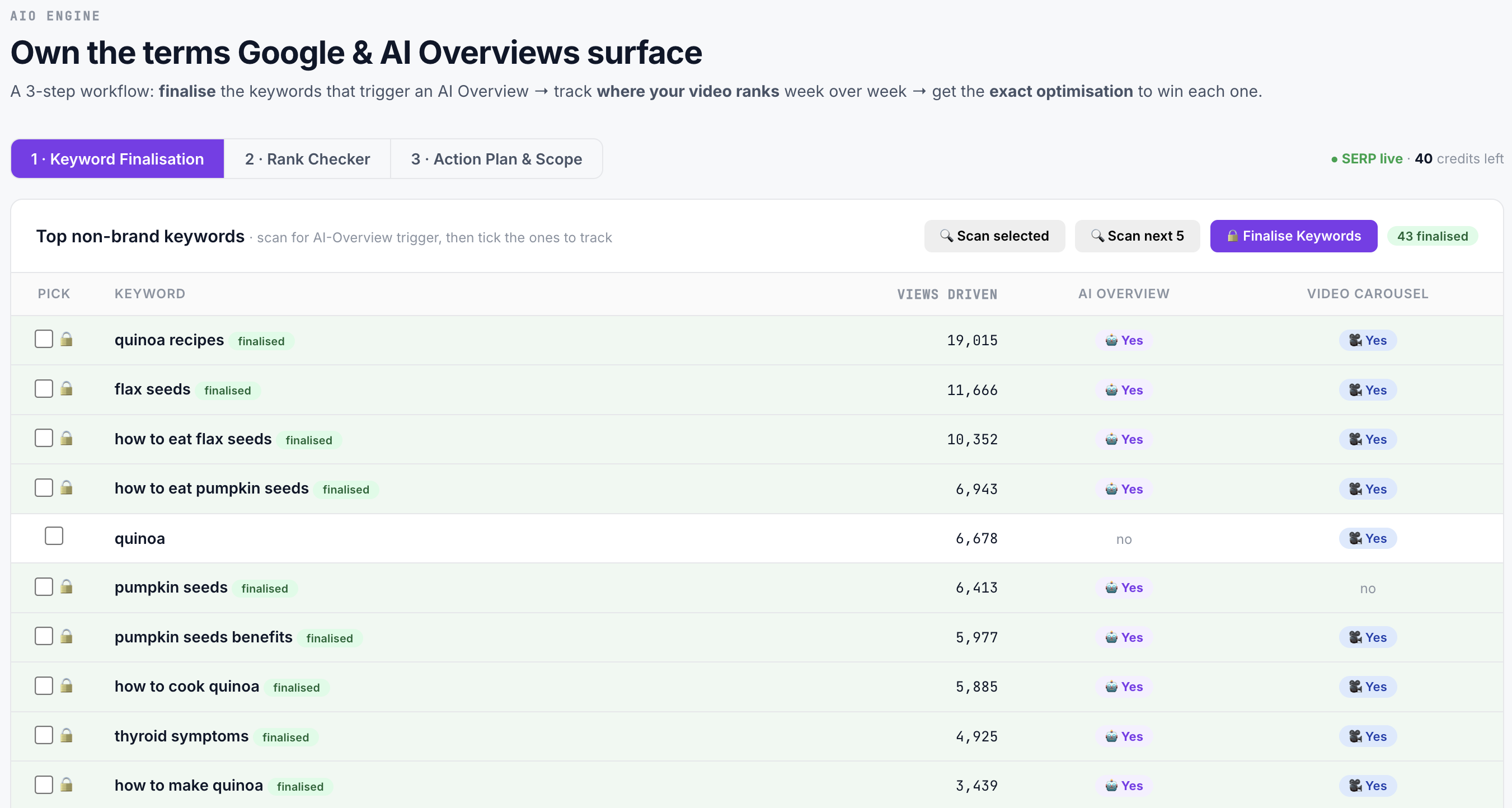
Measure three things and ignore the rest: assisted conversions in GA4 with YouTube as source, WhatsApp inbound with a video-specific CTA phrase, and OPD front-desk intake with a mandatory "how did you hear about us" field. If any of those three is missing, the channel looks like it is not working when it actually is.
The classic mistake is judging YouTube by last-click attribution. A patient watches four videos over three weeks, then Googles the clinic name, clicks the map pack, and calls the front desk. The front desk logs the source as "Google" or "walk-in." YouTube gets zero credit and the surgeon concludes the channel is not driving business. This happens in almost every clinic that has not fixed the attribution stack.
The fix is boring and effective. Put a video-specific CTA phrase into every description and every closing, something like "message us on WhatsApp with the word KNEE." Every message that comes in with that word gets tagged and counted. Add a compulsory dropdown at the front desk with YouTube as an option and audit the field weekly. In GA4, set up YouTube as a channel grouping and look at assisted conversions on a 30-day window, not last click. Inside 90 days, most Indian orthopaedic practices we work with discover that YouTube is either their number one or number two source of qualified OPD footfall, and they simply were not counting it.
How does ICG approach orthopaedic YouTube differently?
ICG treats orthopaedic YouTube as an AI-native content system, not a video production service. That means we plan the channel around the queries that Google's AI Overview and Perplexity are already citing, we build every video description as a machine-readable object, and we wire the entire funnel into a CRM that the OPD front desk actually uses.
Our YODA product handles the AI-native side. It reads the queries in your specialty, spots the videos currently getting cited in AI answer boxes, and reverse engineers the structure that got them cited. Angryturtle handles the Google Business Profile side, so the map-pack presence keeps pace with the YouTube presence. Meta Catalyst IQ takes the highest-performing recovery clips and runs them as intent-warmed Meta Ad creative. Prism Spy tracks what competing orthopaedic hospitals in your city are running as Meta creative so we know when to counter-program. Prism Pulse benchmarks the surgeon's Instagram engagement against peers in the same specialty.
The whole system is stitched together with AtomCRM at Rs 50,000/- setup + Rs 799/- per telecaller for lead capture, tagging, and WhatsApp automation, and HealthPro 360 at Rs 14,999 per month if the hospital needs an RCM and EHR overlay to close the loop from lead to consult to billing. This is not a stack we sell in pieces. It is the operating system that makes YouTube actually pay back for an orthopaedic practice.
Where the 70-30 pricing model fits



ICG runs YouTube and content services on a 70-30 fixed-variable model. Foundation starts at Rs 49,999 per month, Growth at Rs 74,999, and Scale at Rs 99,999. Seventy percent of the retainer is fixed for the deliverables (script planning, edit throughput, description engineering, CRM wiring). The remaining thirty percent ties to a 12-month target on qualified OPD footfall or booked consults on a sliding scale. If we hit the target early, we earn the variable. If we do not, the practice does not carry the full cost. This model exists because most orthopaedic practices have been burned once by an agency that promised views and delivered nothing measurable. The 70-30 structure aligns the risk.
FAQ
These are the questions Indian orthopaedic clinic owners and hospital marketing directors ask us most often when we scope a YouTube engagement.
Book a free 30-minute Brand & Growth Diagnostic.
It's a working session, not a sales pitch — you leave with a written root-cause analysis you can act on, whether or not you engage ICG.
Questions readers ask
about this topic.
The three platforms
behind every ICG engagement.
Beacon
CAPI middleware that fixes Event Match Quality, translates CRM statuses to Meta-standard events, dedups across channels.
Agency OS
Live client dashboard. GSC, GA4, Google Ads, Meta Ads, IVR calls in one view. Login anytime, not monthly.
Phoenix
Clinic revenue intelligence over your PMS. Daily action queue: Prevent Loss, Maintain & Engage, Grow Revenue. Multi-centre rollout.
Or book a free 30-min audit to see all three in action on your account.
Healthcare brands
that already run on ICG.
A representative slice of the 150+ healthcare brands ICG has delivered for across India. Most engagements remain under NDA.


What ICG clients say · on video.
"ICG's healthcare-only focus made the difference. They speak our language and understand patient acquisition specifics."
"ICG's deep understanding of healthcare patient journeys makes their orthopedic campaigns markedly more effective."
Need help operationalising this?
Every ICG service is healthcare-only, NMC + DPDP-aware, and built around the patient-research patterns that drive Indian healthcare growth in 2026.
Every practice welcome — packages from ₹20,000/mo.
Goals-Driven engagements · Performance-Linked Payout Models available



More from
ICG.
Five trends shaping Indian healthcare marketing through 2027: AI-first patient research, Conversions API adoption, ABDM discovery, the AEO w...
Healthcare AIO is the discipline of getting your clinic or hospital cited inside Google AI Overviews, ChatGPT and Perplexity answers — not j...
Conversational-search advertising places brand messages inside AI chat answers — ChatGPT, Perplexity, Copilot — rather than beside a results...
Stop guessing.
Book a Diagnostic.
30 minutes. Free. With the AI-powered healthcare-only marketing agency 150+ brands already run on. No slides, no pitch, no hard close.


