


Instagram Analytics for Medical Brands in India: What Actually Matters
Follower count does not book patients. This guide breaks down the Instagram analytics stack Indian hospitals, clinics, and pharma brands actually need in 2026 — the metrics that predict appointments, DPDP and NMC guardrails, and how to report social in rupees, not likes.
No pitch. Written root-cause diagnosis. AI-powered, healthcare only.
Direct answer
Follower count does not book patients. This guide breaks down the Instagram analytics stack Indian hospitals, clinics, and pharma brands actually need in 2026 — the metrics that predict appointments, DPDP and NMC guardrails, and how to report social in rupees, not likes.
TL;DR
TL;DR
- Instagram analytics for Indian medical brands is not follower count. The four numbers that predict real clinic bookings are profile-visit-to-DM ratio, save rate by specialty, DM first-response time, and Reels reach on non-followers.
- Vanity metrics mislead most healthcare marketing teams. Likes, follower growth, and blended engagement rate do not correlate with appointments in the Indian healthcare buyer journey — Indians save and DM before they book.
- DPDP Act 2023 and the NMC social media advisory now shape what data you can capture. DM logs, patient-identifiable comments, and testimonial screenshots all need explicit consent before they enter any analytics stack.
- A working reporting stack ties Instagram to a CRM. UTMs on link-in-bio, DM tag capture, and specialty-level attribution turn the monthly Instagram report from a screenshot deck into a P&L line item.
Table of contents
- Why this matters for Indian hospital and clinic marketers
- What does Instagram analytics actually mean for a medical brand in India?
- Which Instagram metrics matter for Indian hospitals and clinics — and which are vanity?
- How do you tie Instagram numbers to actual patient appointments?
- How do the DPDP Act and NMC guidelines change Instagram analytics for doctors?
- What Instagram benchmarks should Indian medical brands aim for in 2026?
- How should marketing teams report Instagram to hospital leadership?
- How does ICG approach Instagram analytics for healthcare?
- Where does Instagram analytics fit in the 70-30 model?
- FAQs
Why this matters for Indian hospital and clinic marketers
India crossed 362 million Instagram users in 2025, and roughly 62% of Indians aged 18 to 34 open the app daily. For a dermatology clinic in Bengaluru, an IVF centre in Hyderabad, or a multi-specialty hospital in Kochi, that audience is not "brand awareness." It is the exact demographic that self-diagnoses through Reels, saves before-and-after posts to private collections, and slides into DMs long before they call the reception desk.
The problem is not reach. The problem is that most healthcare marketing teams in India still report Instagram in likes and follower growth — two numbers that have almost zero correlation with real bookings. A dental chain we work with had grown from 40,000 to 78,000 followers over nine months, but bookings from Instagram were flat. The follower count told them nothing. The DM-to-appointment ratio, which had actually dropped from 11% to 4% as their content leaned into low-intent trend Reels, told them everything.
This piece is written for the marketing manager, agency owner, or founder-doctor who has to answer one question: "What did we actually get from Instagram this month?" The answer needs numbers a CFO believes, not a screenshot of a viral Reel.
What does Instagram analytics actually mean for a medical brand in India?
Instagram analytics for a medical brand in India means three overlapping layers working together: native Instagram Insights (reach, saves, DMs), on-site behaviour tracked through UTMs and GA4, and downstream CRM data that closes the loop between a Reel view and a paid consultation. If any of those three is missing, you are guessing.
Layer one is the Insights panel inside the Instagram app or Meta Business Suite — reach, impressions, plays, saves, shares, profile visits, follows from post, and DM initiations. Layer two is website analytics, where UTMs on your link-in-bio, Story sticker links, and paid Instagram ads track which specific post drove which /book-appointment click. Layer three is your CRM: which lead came from an Instagram DM, which specialty they booked into, and what their lifetime value looked like six months later.
Most Indian clinics stop at layer one. That is why their Instagram feels active every week but never seems to justify the Rs 35,000 to Rs 80,000 a month a competent healthcare social team costs. Insights alone will tell you a Reel got 1.2 lakh views. It cannot tell you that only two of those viewers eventually booked a Rs 22,000 root canal.
Which Instagram metrics matter for Indian hospitals and clinics — and which are vanity?
For Indian medical brands, five metrics predict bookings: profile-visit-to-DM rate, save rate on educational content, Reels reach on non-followers, DM first-response time, and story tap-forward rate. The three vanity metrics that mislead most healthcare marketing teams are total follower count, likes per post, and blended engagement rate.
Here is how the metrics that matter map to healthcare buyer intent in India:
| Metric | Why it predicts bookings | Healthy range (India, 2026) |
|---|---|---|
| Profile-visit-to-DM rate | Someone who taps your profile and then DMs has clear intent — they are shortlisting. | 4-9% for clinics, 2-5% for hospitals |
| Save rate on educational posts | Indian patients save cost breakdowns, procedure explainers, and doctor bios to revisit before deciding. | 3-6% of reach |
| Reels reach on non-followers | Non-follower reach is the acquisition channel. Follower-only reach is retention. | 65-80% of total Reels reach |
| DM first-response time | Response speed correlates directly with booking conversion in Indian healthcare DMs. | Under 15 minutes, 9am-9pm IST |
| Story tap-forward rate | Low tap-forwards mean the content is holding attention — the opposite of what most marketers assume. | Under 8% on medical education Stories |
The vanity metrics have a specific problem in healthcare: they can be inflated by content that actively hurts your brand. Trend audio Reels of doctors dancing will spike your likes and followers, but they will not bring in cardiology or IVF consults — and in specialties where trust is the entire product, they can suppress conversion from the audience that actually pays.
How do you tie Instagram numbers to actual patient appointments?
You tie Instagram to appointments through three connected mechanisms: unique UTMs on every link that leaves Instagram, a "How did you hear about us?" field on your booking form with Instagram broken into DM, Story, Reel, and Ad, and DM tagging inside a shared inbox tool that pushes each tagged conversation into your CRM as a lead source.
Skip any one of these and the attribution breaks. UTMs alone will miss the 40-60% of Indian patients who see a Reel, screenshot it, and then Google your clinic name a day later — a pattern our Chennai and Pune orthopaedic clients see consistently. The booking-form field catches those. The DM tag captures conversations that never leave Instagram at all, which for a Mumbai aesthetic clinic can be as much as half of all Instagram-sourced revenue.
Once the data is in a CRM — Nexus CRM (ICG's Rs 14,999 per month healthcare CRM) is built to accept these tags natively, and HealthPro 360 handles the same on the hospital RCM side — you can finally report Instagram in the language leadership speaks: leads generated, cost per qualified lead, conversion to consultation, and lifetime value by acquisition source.
How do the DPDP Act and NMC guidelines change Instagram analytics for doctors?
The DPDP Act 2023 and the NMC's social media advisory have three practical effects on Instagram analytics for Indian medical brands: patient-identifiable DM content cannot be stored in analytics tools without explicit consent, testimonial screenshots need documented approval before they enter reporting decks, and any comment thread with symptom disclosures should be moved out of public view within a defined window.
In practice this means your Instagram analytics stack needs three guardrails built in from day one. First, DM exports for reporting must strip patient names, phone numbers, and any clinical detail before the file leaves the shared inbox — most agencies still email raw DM screenshots to hospital marketing heads, which is a DPDP violation waiting to happen. Second, testimonial reposts need a signed consent form on file, and the analytics report should reference the consent record, not the patient's face. Third, comment moderation itself becomes a metric: how many symptom-disclosure comments were hidden or moved to DMs within 24 hours.
The NMC advisory also restricts drug promotion, before-and-after imagery for certain procedures, and superlative claims. Analytics dashboards for Indian medical brands should therefore track a "compliance-flagged content" count — posts pulled for review — as a leading indicator of regulatory risk, not just a legal footnote. Pharma brand teams operating under ABDM-linked pilots should also isolate any HCP-only content into a separate reporting bucket.
What Instagram benchmarks should Indian medical brands aim for in 2026?
Realistic Instagram benchmarks for Indian medical brands in 2026 are: 65-80% of Reels reach coming from non-followers, save rate of 3-6% on educational content, DM first-response time under 15 minutes during business hours, and a cost per Instagram-attributed appointment of Rs 180-Rs 950 depending on specialty and city tier.
The cost-per-appointment range is wide for good reason. A general dentistry consult in a tier-2 city like Indore or Nagpur can be attributed at Rs 180-Rs 350. An IVF or oncology consultation in Mumbai or Bengaluru, where the sales cycle is 40+ days and the audience is smaller, typically lands at Rs 600-Rs 950. Any healthcare agency claiming a flat Rs 99 cost per lead across specialties is either counting cold DMs as leads or ignoring the closing rate — both fail an honest audit.
On content mix, our Prism Pulse data across 150+ Indian healthcare Instagram accounts shows one consistent pattern: brands that split posting 60% educational Reels, 25% doctor-led Stories, and 15% patient outcomes (with consent) outperform brands that chase trend audio on every metric that matters. Trend Reels bring reach without intent. Doctor-led explainer Reels bring reach with intent — the difference shows up in DM quality within four weeks.
How should marketing teams report Instagram to hospital leadership?
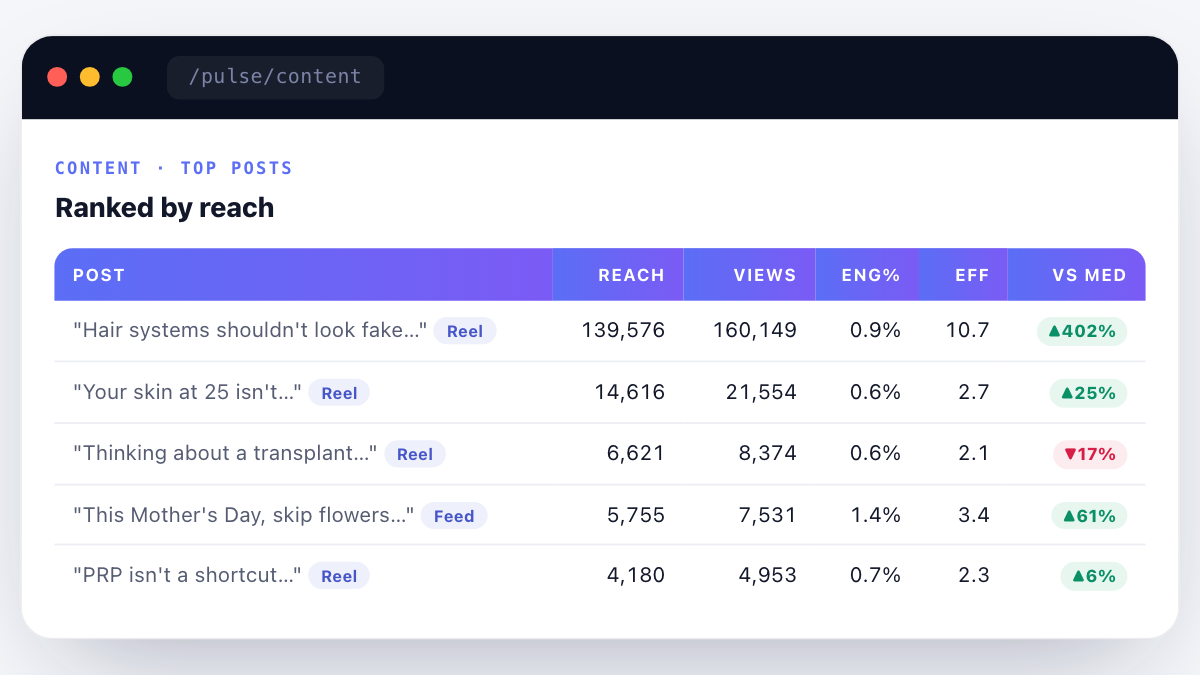
Instagram reports for hospital leadership should be one page, four blocks: leads generated by specialty, cost per qualified lead, conversion to booked consultation, and revenue attributed. Everything else — reach graphs, follower charts, screenshot grids — belongs in an appendix, not the executive summary.
The reason most Instagram reports get quietly ignored by hospital boards is that they answer questions leadership never asked. A hospital CEO in Ahmedabad is not trying to understand "engagement rate." She is trying to decide whether to renew the Rs 75,000-a-month social retainer or move that budget to Google Ads. The report needs to make that decision obvious in 30 seconds.
A useful format we deploy across ICG's hospital clients looks like this: a header showing Instagram-attributed revenue for the month versus spend, a specialty-level table with leads, cost per lead, and booked consults per specialty, a compliance section flagging any content removed or paused, and a "next 30 days" section with two or three specific bets. No screenshots of Reels. No follower graph. If the CFO wants those, they are one click away — but they do not open the report.
How does ICG approach Instagram analytics for healthcare?
ICG treats Instagram analytics as a booking system, not a content report. Every Instagram programme we run is instrumented from day one with UTMs, DM tagging, CRM lead-source capture, and a specialty-level attribution model — so the monthly conversation with the client is about cost per consult by specialty, not about which Reel hit a million views.
The stack that sits under that approach is Prism Pulse (Instagram analytics with healthcare-specific benchmarks and specialty tagging), Meta Catalyst IQ (the paid Meta Ads engine that pushes proven organic Reels into paid distribution), and Prism Spy (competitor Meta Ads intelligence so you know what other clinics in your city are running before their campaigns eat your CPMs). Angryturtle handles the Google Business Profile layer, and YODA handles YouTube — because Indian healthcare buyers rarely convert on Instagram alone. They see the Reel, check the Google profile, watch a doctor's YouTube explainer, and then DM.
The output is not a prettier dashboard. It is a client conversation that starts with "you spent Rs 62,000 on Instagram this month and generated 41 qualified consults across dermatology and dentistry, at an average cost of Rs 1,512 per booked consult, against an average consult revenue of Rs 4,800." That is a P&L conversation, not a marketing update.
Where does Instagram analytics fit in the 70-30 model?


Instagram analytics sits inside ICG's 70-30 fixed-variable retainer model. Foundation (Rs 49,999 per month) covers the analytics wiring, basic reporting, and specialty-level tagging. Growth (Rs 74,999 per month) adds paid Instagram distribution through Meta Catalyst IQ and monthly competitor analysis via Prism Spy. Scale (Rs 99,999 per month) layers in full-funnel attribution across Instagram, YouTube, Google, and Google Business Profile with weekly reviews.
The 70-30 model means 70% of the retainer is fixed monthly work — content, analytics, DM management, compliance moderation — and 30% is variable, tied to booked-consult growth. It is the pricing frame we default to for hospital marketing directors and multi-specialty clinic chains who want accountability without the fully unpredictable spend of a pure performance contract.
FAQs
Book a free Meta ads account audit.
Raman Soni's team pulls your account, checks CAPI/EMQ, reviews creative for NMC compliance, and shows where CPQL is leaking. 45 minutes, actionable output.
Questions readers ask
about this topic.
The three platforms
behind every ICG engagement.
Beacon
CAPI middleware that fixes Event Match Quality, translates CRM statuses to Meta-standard events, dedups across channels.
Agency OS
Live client dashboard. GSC, GA4, Google Ads, Meta Ads, IVR calls in one view. Login anytime, not monthly.
Phoenix
Clinic revenue intelligence over your PMS. Daily action queue: Prevent Loss, Maintain & Engage, Grow Revenue. 46-centre rollout.
Or book a free 30-min audit to see all three in action on your account.
Healthcare brands
that already run on ICG.
A representative slice of the 150+ healthcare brands ICG has delivered for across India. Most engagements remain under NDA.


What ICG clients say · on video.
"Scale up of organic channels and business consulting. ICG has absolute domain authority in their field."
"Working with ICG transformed how we acquire IVF patients in Gurgaon. They understand the fertility journey from inquiry to consult..."
"What Ichelon accomplished — they got all my ideas and worked over 3-4 months to create an amazing, super-customised website."
Need help operationalising this?
Every ICG service is healthcare-only, NMC + DPDP-aware, and built around the patient-research patterns that drive Indian healthcare growth in 2026.
More from
ICG.
Healthcare AIO is the discipline of getting your clinic or hospital cited inside Google AI Overviews, ChatGPT and Perplexity answers — not j...
Conversational-search advertising places brand messages inside AI chat answers — ChatGPT, Perplexity, Copilot — rather than beside a results...
NABH digital compliance means every claim, image and testimonial your hospital publishes online matches what an accreditation surveyor can v...
Stop guessing.
Book a Diagnostic.
30 minutes. Free. With the AI-powered healthcare-only marketing agency 150+ brands already run on. No slides, no pitch, no hard close.


