


How to Choose a Healthcare SEO Agency in India — What a Real Audit Looks Like
TL;DR: This framework scores four options — a healthcare SEO specialist, a generalist SEO agency, an in-house hire, and a content-mill vendor — against whether their deliverable is a real technical audit or a rebadged crawl export. SEO is the channel where the work is hardest t
No pitch. Written root-cause diagnosis. AI-powered, healthcare only.
Direct answer
TL;DR: This framework scores four options — a healthcare SEO specialist, a generalist SEO agency, an in-house hire, and a content-mill vendor — against whether their deliverable is a real technical audit or a rebadged crawl export. SEO is the channel where the work is hardest t
TL;DR

Author: Hanuman Sihag, Head of Innovation Chamber & SEO Lead · Reviewer: Abhash Kumar, Co-Founder, Strategy · Last updated 2026-07-30 · Editorial standards
TL;DR: This framework scores four options — a healthcare SEO specialist, a generalist SEO agency, an in-house hire, and a content-mill vendor — against whether their deliverable is a real technical audit or a rebadged crawl export. SEO is the channel where the work is hardest to verify, because it's largely invisible and results lag by months. A specialist agency, including ICG, is not the right fit for every practice; the framework says which conditions rule it out.
Table of contents
- When you actually need an SEO agency
- The scoring framework
- Red flags
- Cost expectations
- Timeline
- The honest archetype recommendations
- FAQ
Choosing between a healthcare SEO specialist, a generalist agency, an in-house hire and everything in between comes down to one question a buyer rarely knows to ask: is the deliverable a real audit, or an activity log dressed up as one. The framework below is built to answer that question before a contract is signed, not after.
When you actually need an SEO agency
Traffic to a specialty page that used to convert has quietly flattened over two quarters, and nobody on the team can say why. That's usually the moment a hospital or clinic starts working out how to choose an SEO agency for a hospital, rather than before — the decision tends to arrive as a reaction to a specific symptom, not a planned initiative.
A handful of symptoms tend to precede a real SEO hire:
- Organic enquiries flat or falling despite steady content output
- A competitor's location or specialty page consistently outranking an equivalent page of yours
- A redesign or CMS migration that tanked rankings and never recovered
- An internal team that can write content but can't diagnose why a page stopped ranking
This is narrower than the question of hiring a marketing agency generally — the broader decision, covering paid media, creative and brand alongside SEO, is covered in ICG's healthcare marketing agency decision framework. This page is specifically about the SEO function: what a real technical audit contains, and how to tell one from a crawl-tool export with a logo on the cover page.
The scoring framework: what separates a real SEO partner from an activity log
A genuine healthcare technical SEO audit contains specific things, and a buyer who knows the list can disqualify half a shortlist with one question. It has crawl and indexation analysis with URL-level findings, not a summary paragraph. It has an internal-linking and cannibalisation review. It checks schema coverage against the medical schema types — MedicalOrganization, Physician, MedicalClinic, FAQPage, MedicalWebPage. It measures Core Web Vitals on the site's actual templates, not a generic lab score pulled from a testing tool. And it ends in a prioritised fix list with effort estimates attached to each item, not a wall of findings with no order to them. A PDF that is a rebadged crawl-tool export, however well formatted, is not an audit — this matters enough that it's worth naming as the single question that filters a shortlist fastest.
Healthcare is the field Google's own Search Quality Rater Guidelines treat as the canonical Your-Money-Your-Life example — the landscape ICG's own healthcare SEO practice works in — which is precisely why healthcare seo agency selection criteria need to go further than a generic agency checklist. The Google Search Central SEO starter guide is the reference point for the technical claims below; ICG's own approach to the same criteria is described at ICG's SEO service page. Medical seo agency evaluation, in practice, is this: can the candidate produce the artefact above, and can they defend every line in it when asked.
Technical and structural competence (0–2 each)
Cannibalisation detection and resolution. Score 2 if the agency checks its own city-page and specialty-page templates for self-competition as a matter of course — this is the criterion no competitor checklist carries, because city and specialty templates at scale generate near-duplicate URLs that most agencies never check for. Score 0 if cannibalisation isn't mentioned until you raise it.
Schema literacy, stated accurately. Schema is not a ranking factor — it changes how a result is presented, not whether it ranks. An agency that claims schema markup will lift rankings has told you something useful about itself. Score 2 for an accurate answer, 0 for the ranking claim.
Core Web Vitals measured on real templates. Score 2 if the number comes from the site's actual specialty and location pages, 0 if it's a single homepage score presented as representative of the whole site.
Content and compliance competence (0–2 each)
NMC's 2026 advertising guidelines fluency applied to content built for rankings. Testimonial and outcome-claim pages written to win a keyword create a compliance exposure the clinic carries, not the agency, once a complaint arrives — the NMC's 2026 advertising guidelines sets the boundary here regardless of what the keyword data suggests would rank. Score 2 if the agency raises this constraint before you do.
A stated point of view on answer-engine citation. By 2026 the relevant question isn't only whether a page ranks in blue links — it's whether an agency has any plan for the page being cited by an AI answer engine at all. Score 2 for a considered answer, 0 for a blank look.
Reporting and accountability (0–2 each)
A named business metric the agency is accountable for. Qualified enquiries or cost per qualified lead count; a ranking report for keywords nobody searches, or for a city the clinic doesn't serve, does not.
A fix-list ownership plan. Score 2 if someone is named as accountable for closing findings, not just producing them — an audit that lists forty issues and assigns none of them to anyone is a document, not a plan.
| Score | Interpretation |
|---|---|
| 12–14 | Strong shortlist candidate across technical, content and reporting competence |
| 7–11 | Workable, with named gaps to close in the contract before signature |
| 0–6 | Not ready — the gaps are structural, not something a proposal can patch |
Red flags: the deliverable that means nothing
A ranking report with no enquiry data attached to it is the deliverable that means nothing, and it's worth naming as its own category of failure rather than folding it into "reporting problems" generally. A page can rank first and produce zero qualified enquiries; a report that never connects the two numbers is measuring the wrong thing on purpose or by accident, and either way it doesn't tell you what you paid for.
A few other tells matter almost as much:
- A guaranteed ranking or traffic number quoted before any audit has been run
- A "content calendar" with no technical component attached to it
- Refusal to explain how cannibalisation across templates is checked
- Schema pitched as something that will directly improve rankings
- Willingness to write outcome-claim or testimonial content to win a keyword — an NMC's 2026 advertising guidelines exposure the clinic carries, not the agency
Any one of these is worth a direct question on the next call. Two or more together are worth walking away from before the proposal goes any further.
Cost expectations: retainer versus project versus audit
Healthcare SEO pricing in India is structured three distinct ways, and the structure decides what a low number actually buys before the headline figure does. A retainer buys ongoing capacity — content, technical monitoring, reporting — for as long as the contract runs. A one-off audit buys a diagnostic with a defined end point: a report, a fix list, and nothing ongoing after delivery. A project fee buys a fixed deliverable, usually a migration or a specific technical rebuild, priced once.
What a low retainer necessarily excludes is usually the technical work and the development time a fix list requires — an agency quoting a low monthly figure has often quietly dropped the crawl-and-indexation work, the schema implementation, or both, and is selling content production alone under an SEO label. An audit priced as a loss-leader, cheap or free to win the account, quite often precedes a retainer the clinic didn't plan its budget around, because the audit's own fix list becomes the sales pitch for the retainer that follows it.
The question almost nobody asks upfront: who pays for the developer time a technical fix list actually requires. A fix list is only as good as the hours available to implement it, and if those hours sit with the clinic's own (often overstretched) development resource rather than the agency, that's a real cost that belongs in the budgeting conversation from day one — not a detail that surfaces in month two.
What is published: across ICG's public CPQL dataset, the median cost per qualified lead is ₹1,220 against a ₹2,100 market median. Full methodology and specialty-level breakdowns are at ICG's CPQL benchmarks (46 active healthcare client engagements, rolling 12-month window Jul 2025 to Jul 2026, Delhi NCR, Mumbai, Bangalore, Chennai, Hyderabad, Kolkata, last verified 2026-07-26). A separate page on healthcare SEO pricing specifically is planned; until it's live, treat any specific rupee figure quoted for SEO retainers as unverified, wherever it comes from.
Timeline: why SEO timelines are quoted wrong
SEO results lag the work by months, because of how crawl and index cycles operate and because new or rewritten content needs time to accumulate the signals that move it up a results page. That separation between cause and effect is the single biggest difference between SEO and a paid channel: Google Ads and Meta produce a number every day, and SEO produces a report that describes what happened weeks ago.
Ranking movement and enquiry-volume movement are not the same signal, and they arrive on different clocks. A page can climb several positions before a single additional enquiry shows up, because ranking position and searcher intent at that position aren't the same thing. Using ICG's CPQL benchmarks (₹1,220 median vs ₹2,100 market) as a reference point, ninety days is roughly the earliest point a well-run SEO engagement should show movement in cost per lead — not in raw ranking positions, and not necessarily in enquiry volume yet.
A 30-day promise of material ranking movement is the same tell the red-flags section above already covers, restated on a clock: nothing in a real technical fix — reindexing, schema propagation, content maturing in the index — resolves that fast, and an agency claiming otherwise is quoting a timeline the mechanics of the channel don't support.
The honest archetype recommendations
ICG publishes this page and appears as one of the archetypes scored below. A hospital SEO agency india search usually turns up commercial pages from every archetype named here, none of them positioned to tell a buyer honestly where each one falls short.
When a healthcare SEO specialist is the right answer
A healthcare SEO specialist earns its higher rate the moment cannibalisation, schema, and compliance-aware content all need to be handled by the same team, because a generalist typically has depth in one of those three and not the other two. This is the row ICG occupies. Its real limitation: specialist pricing runs above a freelancer's, and minimum engagement size tends to exclude very small, single-location accounts. When this fails: a single-location practice with a simple, low-competition footprint pays for compliance and cannibalisation depth it may never actually need.
When a generalist SEO agency is the right answer
Where regulated content and cannibalisation risk are genuinely minor, a generalist's broader channel range can outweigh healthcare-specific depth, and there's no reason to pay a specialist premium for a problem that isn't really present. When this fails: the moment testimonial or outcome-claim content enters the brief, a generalist's blind spot on NMC's 2026 advertising guidelines becomes the client's compliance exposure, not the agency's — the same exposure named in the red-flags section above, arriving through a different door.
When an in-house SEO hire is the right answer
A hospital with one marketing coordinator already producing content and a developer on retainer for fixes is closer to ready for an in-house seo vs agency healthcare decision than most practices assume, because the two hardest resources to arrange — someone who can write and someone who can implement — are already in place. When this fails: one hire covering technical diagnosis, content and compliance simultaneously reproduces the exact gaps the scoring framework above tests for, because no single generalist hire is strong across all three at once.
When a content-mill vendor is the right answer
Content-mill vendors work by templating page structures across many clients at once, which is what keeps their price low and is also what usually produces the cannibalisation problem the scoring framework above asks about. When this fails: nearly always, for a hospital or clinic — the narrow case where it doesn't is a single non-clinical landing page with no compliance surface at all, which describes almost nothing a hospital actually publishes.
When ICG is not the right answer
- Practices with no website control or no development resource to implement fixes
- Single-location practices whose realistic ceiling is local search, where a local-SEO-only provider is cheaper and sufficient
- Organisations unwilling to change on-page content for compliance reasons
- Anyone wanting rankings without content investment
None of this makes ICG, or any specialist agency, "the best" option in the abstract — ASCI guidelines 2022 constrain that kind of unsubstantiated claim, and the honest answer depends on where a given practice sits against the criteria above. Where NMC compliance for content built to rank is the deciding factor, ICG's NMC Section 6 compliance guide covers the doctor-specific detail this page doesn't repeat, and the sibling framework for choosing a Google Business Profile management provider is at ICG's GMB decision framework.
FAQ

How do I tell a real audit from a rebadged crawl-tool export? Ask for URL-level findings, not a summary score, and ask specifically how cannibalisation across city and specialty pages was checked. A crawl-tool export has generic findings that could apply to any site; a real audit references your actual templates by name.
How long before I should expect movement in rankings or enquiries? Cost per qualified lead is the earliest signal, typically at 90 days in a well-run engagement. Ranking movement and enquiry-volume movement run on separate clocks, and enquiry volume is usually the last of the two to move.
Should I hire an in-house SEO person instead of an agency? If a marketing coordinator already producing content and a developer available for technical fixes both exist, in-house is closer to viable than most practices assume. A single hire expected to cover technical diagnosis, content and compliance alone tends to reproduce the same gaps an agency exists to close.
Who pays for the developer time a technical fix list requires? This depends on the contract, and it's the most commonly missed line item in an SEO budgeting conversation — decide upfront whether implementation hours sit with the clinic's own developer or are quoted separately by the agency.
Does schema actually improve rankings? No. Schema affects how a result is presented in search — rich results, FAQ snippets — not whether it ranks. An agency claiming schema will lift rankings has misdescribed what the markup does.
What does cannibalisation mean for a hospital or clinic website, and how do I ask an agency about it? It's when two or more of your own pages — often near-identical city or specialty templates — compete against each other for the same search, splitting authority that should concentrate on one page. Ask directly how the agency detects and resolves this across your own site structure.
What should an SEO agency be accountable for in reporting? A named business metric — qualified enquiries or cost per qualified lead — not a ranking report for keywords nobody searches or a city the clinic doesn't serve. A report that never connects rankings to enquiries is an activity log.
Is a healthcare-specialist SEO agency worth the extra cost over a generalist? Where cannibalisation risk, schema accuracy and compliance-aware content all matter together, yes, because a generalist rarely has depth across all three. Where the site is simple and low-competition, the specialist premium is harder to justify.
Book a free SEO diagnostic.
Hanuman Sihag's team runs a live crawl, checks technical health, cannibalisation, schema coverage and content gaps. 60 minutes, prioritised fix list.
The three platforms
behind every ICG engagement.
Beacon
CAPI middleware that fixes Event Match Quality, translates CRM statuses to Meta-standard events, dedups across channels.
Agency OS
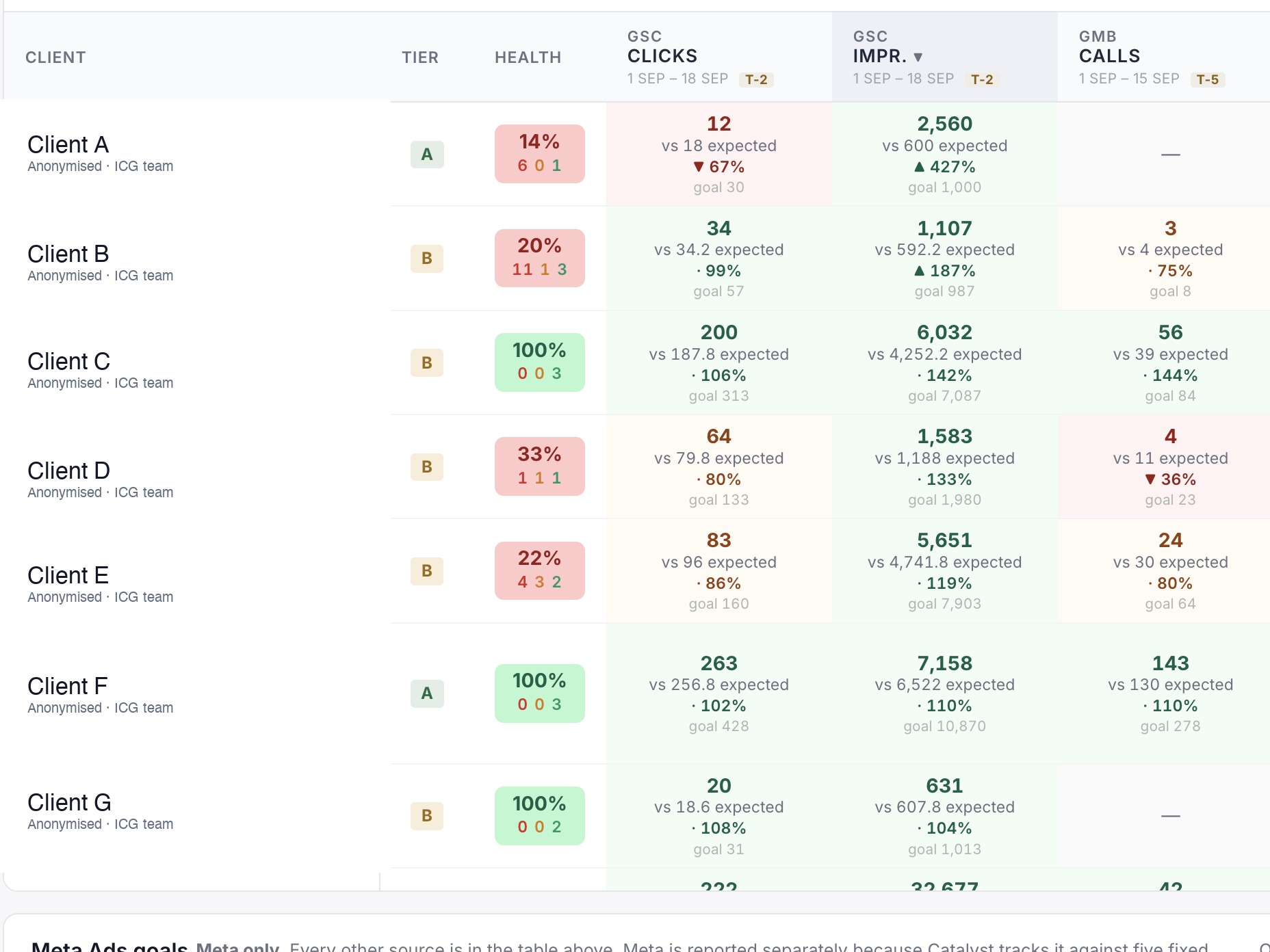
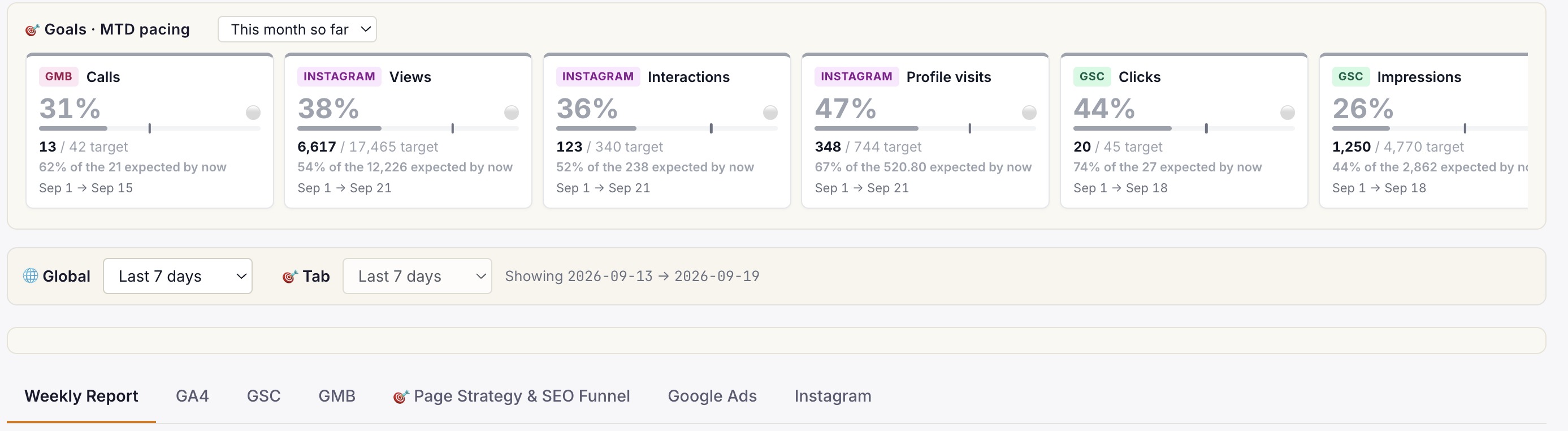
Live client dashboard. GSC, GA4, Google Ads, Meta Ads, IVR calls in one view. Login anytime, not monthly.
Phoenix
Clinic revenue intelligence over your PMS. Daily action queue: Prevent Loss, Maintain & Engage, Grow Revenue. Multi-centre rollout.
Or book a free 30-min audit to see all three in action on your account.
Healthcare brands
that already run on ICG.
A representative slice of the 150+ healthcare brands ICG has delivered for across India. Most engagements remain under NDA.


What ICG clients say · on video.
"Scale up of organic channels and business consulting. ICG has absolute domain authority in their field."
"Working with ICG transformed how we acquire IVF patients in Gurgaon. They understand the fertility journey from inquiry to consult..."
"What Ichelon accomplished — they got all my ideas and worked over 3-4 months to create an amazing, super-customised website."
The intelligence stack behind this playbook.
Every ICG engagement runs on the Search Intelligence Trifecta — Angryturtle for GMB, SIE for search and AI Overview, YODA for YouTube. Live product screens below.
Need help operationalising this?
Every ICG service is healthcare-only, NMC + DPDP-aware, and built around the patient-research patterns that drive Indian healthcare growth in 2026.
Every practice welcome — packages from ₹20,000/mo.
Goals-Driven engagements · Performance-Linked Payout Models available
More from
ICG.
Five trends shaping Indian healthcare marketing through 2027: AI-first patient research, Conversions API adoption, ABDM discovery, the AEO w...
Healthcare AIO is the discipline of getting your clinic or hospital cited inside Google AI Overviews, ChatGPT and Perplexity answers — not j...
Conversational-search advertising places brand messages inside AI chat answers — ChatGPT, Perplexity, Copilot — rather than beside a results...
Stop guessing.
Book a Diagnostic.
30 minutes. Free. With the AI-powered healthcare-only marketing agency 150+ brands already run on. No slides, no pitch, no hard close.


