


Healthcare Content Marketing Strategy India 2026: The Complete Framework
A working 2026 framework for healthcare content marketing in India — NMC and DPDP Act compliance, AI answer boxes, doctor-forward YouTube, GBP dominance, WhatsApp reply loops and a 12-month roadmap from 150+ clinic engagements.
No pitch. Written root-cause diagnosis. AI-powered, healthcare only.
Direct answer
A working 2026 framework for healthcare content marketing in India — NMC and DPDP Act compliance, AI answer boxes, doctor-forward YouTube, GBP dominance, WhatsApp reply loops and a 12-month roadmap from 150+ clinic engagements.
TL;DR
TL;DR
- Healthcare content marketing in India in 2026 sits at the intersection of NMC-compliant medical claims, DPDP Act 2023 consent architecture, ABDM interoperability and, increasingly, answer engines that summarise your content before a patient ever visits the site.
- The old playbook — a few SEO blogs, some Google Ads, a generic "10 tips" listicle — breaks against three new realities: AI Overviews compressing top-of-funnel clicks, Instagram and YouTube dominating discovery for under-40 patients, and rising paid-media CAC pushing hospitals back into owned content.
- In our audits of 150+ clinics and 300+ live healthcare brands, the single biggest gap is rarely "we do not create content." It is "we create content that neither Google nor patients can act on."
- A working 2026 architecture combines a topical pillar system for SEO, a doctor-forward YouTube presence for trust, Google Business Profile as the local discovery layer, WhatsApp as the reply layer, and Meta creative for demand harvesting.
- Compliance is not a legal footnote. Under DPDP Act 2023 and NMC advertising guidelines, one non-compliant reel can trigger platform takedowns, regulator notices, and lost consent for an entire patient database.
- ICG's 70-30 pricing model (Foundation Rs 49,999 / Growth Rs 74,999 / Scale Rs 99,999) ties 30 percent of the monthly fee to a 12-month traffic target, aligning agency skin-in-the-game with the hospital's own leads-per-day north star.
- A realistic 12-month plan sequences: months 1-3 foundation and technical clean-up, months 4-6 topical depth and doctor-led video, months 7-9 answer-engine and local dominance, months 10-12 conversion, retention and pricing leverage.
Table of contents
- Why this pillar matters for Indian healthcare in 2026
- Foundation: what healthcare content marketing actually means in India
- The Indian patient and B2B buyer journey in 2026
- Content architecture: pillars, clusters and the trust layer
- Channel architecture: search, YouTube, GBP, Meta and WhatsApp
- AI Overviews and answer-engine readiness
- Compliance: NMC, DPDP Act 2023, ABDM and platform policy
- Benchmarks from ICG's 150-clinic portfolio
- Buyer archetypes and tailored recommendations
- Common mistakes we still see in 2026
- The 70-30 pricing model, explained
- The 12-month execution roadmap
- Key takeaways
- FAQ
Why this pillar matters for Indian healthcare in 2026
Something structural shifted between late 2024 and mid-2026, and most hospital marketing teams in India are still under-reacting to it. Three things happened at once. Search results started opening with an AI-generated summary that answered the query before the user scrolled. Instagram and YouTube quietly overtook Google as the first discovery touchpoint for under-40 patients researching cosmetic, fertility, dental and mental-health services. And the DPDP Act 2023 rules moved from draft into enforcement, with the health sector explicitly flagged as high-risk.
Meanwhile, paid-media CAC kept climbing. Hospital chains that were happy paying Rs 900-1,100 per qualified lead on Meta in 2023 are now quoting Rs 1,600-2,200 in Tier-1 metros for the same lead quality. That gap has to be closed somewhere, and content — owned, organic, compounding — is where most CMOs are now looking.
This pillar is written for the people making those decisions: hospital marketing directors, group CMOs at multi-city IVF or dental chains, single-owner clinic founders who wear the marketing hat themselves, pharma brand managers running HCP or patient-education programmes, and evaluators at agencies or investors who need to benchmark what "good" looks like. It is deliberately India-first. It references NMC, DPDP, ABDM, Indian cities, Rupees, and the archetypes we actually meet in the field. It does not try to translate an American playbook into a Delhi context.
Section takeaway: The 2024-26 shift is not a channel change. It is a compression of the funnel by AI, a re-weighting of trust toward doctors on video, and a regulator that finally has teeth. Anyone still running a 2019 playbook is bleeding.
Foundation: what healthcare content marketing actually means in India
Healthcare content marketing is often confused with three adjacent things: SEO, social media, and paid ads. It overlaps with all three, but the discipline is narrower. Content marketing is the deliberate creation and distribution of owned assets — articles, videos, tools, calculators, downloadables, doctor explainers — that are useful enough that people find them, share them, and trust the brand a little more each time. In healthcare specifically, "useful enough" carries a heavier load: the reader is often anxious, comparing 3-4 providers, and the decision affects a family member's health.
The three jobs healthcare content has to do
Every asset we build for a hospital or clinic client must earn its keep on at least one of three axes, and ideally two. First, discovery: does it help a new person find the brand via search, video, or feed? Second, trust: does it move a warm reader from "aware" to "willing to enquire"? Third, retention: does it deepen the relationship with an existing patient or referring doctor?
Most hospitals in India are heavily indexed on discovery content — SEO blogs, GBP posts, city landing pages. They are chronically under-invested in trust content (doctor videos, case walkthroughs, before-after ethics-compliant explainers) and almost never do retention content (post-treatment education, referring-doctor updates, patient community).
Why B2C and B2B content have to coexist in the same plan
A subtlety unique to Indian healthcare: most hospitals and mid-sized chains are simultaneously B2C (patients booking appointments) and B2B (referring doctors, corporate tie-ups, insurance TPAs, government empanelment). A content plan that treats these as separate work-streams almost always breaks. Content that helps a patient understand IVF protocols also has to hold up when a referring gynaecologist reads it. Content aimed at corporate HR teams has to survive a Google search where a patient lands on the same page.
The practical fix, which we push across our portfolio, is to design content that is patient-first in language but clinician-defensible in substance. This is where doctor authorship and named bylines earn their weight — not for E-E-A-T alone, but because the same asset then works across both audiences without needing separate microsites.
The Indian-language and vernacular question
For hospitals outside the top eight metros, and for any brand serving Tier 2-3 patients, English-only content leaves 40-60 percent of the addressable audience un-served. The pragmatic 2026 answer is not "translate everything into ten languages." It is: identify the 20-30 highest-intent money queries in your city, publish those in English plus one regional language, and let the long tail stay English. Voice search in Hindi, Bengali, Tamil, Telugu and Marathi is now large enough that a well-structured Hindi FAQ block on an IVF page will pull traffic that English alone cannot.
Section takeaway: Content marketing in Indian healthcare is a triangle of discovery, trust and retention — and B2C and B2B audiences share the same assets more than most teams admit. Design for both, in the right language mix.
The Indian patient and B2B buyer journey in 2026
The classic funnel — awareness, consideration, decision — still applies, but the way each stage actually behaves in an Indian healthcare purchase has evolved. What used to be a linear 5-7 day journey for a Rs 1.5 lakh dental implant is now a stop-start 3-5 week journey that jumps between platforms and involves two or three family members.
Awareness: where they hear the category name
For elective and semi-elective care — cosmetic, fertility, dental aesthetics, mental health, weight-loss surgery — awareness now begins on Instagram and YouTube far more often than on Google. A patient sees a reel about hair transplant recovery, follows a doctor for two weeks, then searches "hair transplant cost Delhi" only after they are already emotionally committed to exploring the option. By the time they hit the SEO layer, they are not doing awareness research — they are price-benchmarking against a decision they have already partially made.
Consideration: the comparison loop
Here the funnel gets messy. Indian healthcare buyers rarely commit to one provider on one visit. They open 3-5 tabs, compare cost pages, read Google reviews (this is where GBP does its real work), watch one or two doctor videos, ask on a family WhatsApp group, and often call two clinics for informal quotes before scheduling a consult. AI answer boxes shorten this by summarising costs and pros/cons — which either helps you (if you show up as a source) or bypasses you entirely (if you don't).
Decision and the WhatsApp handshake
The decision itself almost always closes on a phone call or a WhatsApp exchange, not on a web form. This is the single biggest gap between the content the marketing team measures (page views, form fills) and the content the sales team actually needs (WhatsApp-ready one-pagers, doctor bio PDFs, cost breakdowns they can send in a chat). A content plan that stops at "form submitted" is missing the last mile where the deal is actually won.
Section takeaway: In 2026 Indian healthcare, awareness lives on video, consideration lives in browser tabs and AI summaries, and decisions close on WhatsApp. Build content for all three moments, not just the middle one.
Content architecture: pillars, clusters and the trust layer
The single most durable content structure we have built and rebuilt across our portfolio is a three-layer stack: pillars, clusters and a trust layer that wraps around both. It is boring, it is old, and it still outperforms everything else — provided each layer is done seriously.
Pillars: the anchor pages that carry the money keywords
A pillar is a 4,000-6,000 word comprehensive guide that owns a category-defining query. For a fertility chain, that is a page like "IVF cost in India 2026." For a dental group, it might be "full mouth dental implants India cost and timeline." Pillars are load-bearing: they are the pages you interlink into from everywhere else, the pages that most naturally get cited in AI Overviews, and the pages that keep ranking for years if maintained.
Most Indian healthcare sites have 0-3 real pillar pages. They have hundreds of thin "condition" pages that dilute topical authority instead of concentrating it. The 2026 move is to consolidate: pick 8-15 pillars per specialty and pour depth into them, rather than sprinkling 300 half-articles across the domain.
Clusters: the supporting content that feeds pillars
Around each pillar sit 15-40 cluster articles that answer narrower questions — cost breakdowns, city-specific variations, procedure comparisons, insurance coverage, recovery timelines, doctor-selection guides. Every cluster article links up to its pillar and horizontally to 2-4 sibling clusters. Done right, this creates a semantic web that Google reads as topical authority and AI answer engines mine for source citations.
The trap here: clusters written by generalist SEO writers with no clinical review read as generic listicles. Google's helpful-content system now down-ranks these fast. The rule we enforce internally is that every clinical claim in a cluster piece is either sourced or reviewed by a named clinician on the site.
The trust layer: bylines, credentials, and named-expert pages
Sitting above pillars and clusters is what we call the trust layer — the collection of assets that make the whole content operation credible. It includes named doctor bio pages with credentials, a proper "about" page that names founders and leadership, an "editorial policy" page that spells out how content is reviewed, and named bylines on every article. This layer is what converts a technically-strong SEO piece into a piece that ranks and converts.
Increasingly, this trust layer is also what AI answer engines look at when deciding whether to cite a source. A page written by "Team [Hospital]" with no named author is a weaker citation candidate than the same page written by "Dr. [Name], Head of Reproductive Medicine" with a linked bio and credentials.
Section takeaway: Build 8-15 pillars deep, 15-40 clusters wide per pillar, and wrap the whole system in a named-expert trust layer. Depth beats breadth in 2026.
Channel architecture: search, YouTube, GBP, Meta and WhatsApp
Content only earns its keep when it is distributed through channels that match how Indian patients actually behave. In 2026, the five channels that matter for healthcare in India are organic search, YouTube, Google Business Profile, Meta (Instagram plus Facebook), and WhatsApp. Each does a different job, and none of them can carry the whole load alone.
Organic search: still the compounding engine
Search remains the highest-ROI channel over any 12-24 month window because each ranking page keeps working long after it is published. The change in 2026 is that search now feeds two audiences: the human user who clicks through, and the AI system that summarises the page for an Overview. Content has to be written for both. Pages with clean H2 structure, direct question-answer pairs, tables where useful, and short definitive sentences get pulled into AI summaries; the same clarity helps human conversion.
YouTube: the trust and long-tail combined channel
YouTube is under-used by Indian hospitals and over-used badly. Under-used because most brands post one testimonial a quarter. Used badly because when they do post, it is heavily produced, low-frequency, and never optimised for search. The 2026 move is doctor-forward, high-frequency, search-optimised video — five to twelve short doctor explainers a month, each targeting a real query, published with proper titles, descriptions and chapters. This is where our YODA product sits: an AI-native workflow to plan, script, produce and optimise healthcare YouTube at that cadence without burning the marketing team out.
Google Business Profile: the local dominance layer
For any brick-and-mortar healthcare business, GBP is the highest-leverage single asset in the entire stack. A well-run GBP with 200+ recent reviews, weekly posts, category-correct services, geo-tagged photos and Q&A actively answered will outperform a Rs 3 lakh/month Google Ads spend in the same city, in the same category, on any 12-month view. Our Angryturtle product exists specifically to run this at scale across single-clinic and multi-location groups, because doing it manually across 30-40 locations is where marketing teams silently fail.
Meta: the demand harvest layer
Instagram and Facebook are where new demand is created and captured for elective care. The content playbook here is different from search: short-form video, doctor personality, before-after within platform and MCI guidelines, and creative variation at high frequency. What kills most hospital Meta accounts is not lack of budget — it is creative fatigue and generic agency reels that could belong to any clinic. Meta Catalyst IQ, our creative-intelligence layer, exists to solve exactly this: monitoring what is actually working across the healthcare creative landscape and feeding it back into the client's own creative pipeline.
WhatsApp: the reply and conversion layer
WhatsApp does not create demand. It closes it. Every other channel funnels enquiries into a WhatsApp conversation, and the speed, quality and structure of that reply determines conversion. In our 150-clinic audits, the median reply time is 47 minutes, and roughly 30-40 percent of enquiries never get a reply at all — usually because the number is a shared inbox, or because after-hours enquiries get lost. Fixing this alone typically lifts booked-consult rates by 25-40 percent, before any content or media change.
Section takeaway: Five channels, five distinct jobs. Search compounds, YouTube builds trust, GBP dominates local, Meta harvests demand, WhatsApp closes. Miss any one and the funnel leaks.
AI Overviews and answer-engine readiness
The largest single change to healthcare content in the last 18 months is that a growing share of top-of-funnel queries are being answered inside the search results page itself, without a click. This is true both on Google's AI Overviews and on standalone answer engines like ChatGPT, Perplexity, Claude and Gemini. For informational queries — "what is the recovery time after knee replacement," "IVF success rates by age" — the answer engine reads several sources, synthesises an answer, and shows citations. Users often stop there.
What this actually means for click-through
The naive reading is "SEO is dead." The correct reading is that click-through on purely informational queries is compressing, while click-through on high-intent commercial queries — "IVF cost Bangalore," "best paediatric dental clinic Gurgaon" — is largely intact. Content strategy has to shift its centre of gravity toward the commercial-intent middle of the funnel, where a click still matters, and simultaneously toward being cited in the informational answers upstream (which still delivers brand exposure even without a click).
How AI engines actually pick sources
From our own testing across hundreds of healthcare queries, the patterns are consistent. Answer engines prefer pages with: clear question-answer structure (H2 as a question, direct answer in the first sentence), named authors with credentials, freshness signals (recent updates, dated reviews), scannable structure (tables, bullets, short paragraphs), and consistent factual claims across the page. Pages that read as sales copy — heavy on adjectives, light on specifics — rarely get cited.
Practical checklist for AIO readiness
The 2026 checklist we run on every priority page: does the H1 match a real user query; does the opening paragraph answer the query in two sentences; is there a named author with a linked bio; are the top three sub-questions covered as H2 questions with immediate direct answers; is there at least one table where a comparison makes sense; and is there a dated "last reviewed" marker. Pages that pass this checklist get pulled into AI answers at roughly three-to-four times the rate of pages that do not.
Section takeaway: Answer engines are not the enemy of content — they are a new distribution surface. Write for the human and the machine at the same time, and cite yourself into the answer.
Compliance: NMC, DPDP Act 2023, ABDM and platform policy


Compliance in Indian healthcare content is not a legal team problem to solve after publishing. It is a design constraint on the content itself. Get this wrong and you lose more than a legal notice — you lose ad accounts, patient consent, and, in some cases, medical council standing for the doctors on your site.
NMC and medical advertising guidance
The National Medical Commission's professional-conduct regulations restrict what a registered medical practitioner can claim in advertising. Superlatives ("best," "number one"), guaranteed outcomes, and comparative claims against other doctors or hospitals are broadly disallowed. Before-and-after imagery is a grey area with strict consent requirements. Testimonials from patients naming procedures are heavily restricted. A hospital content operation that treats these as suggestions rather than rules eventually gets a notice, and the cost of one notice — in legal fees, in doctor time, in reputation — is far higher than the cost of writing compliant content from the start.
DPDP Act 2023: consent, purpose limitation and data fiduciary duties
The Digital Personal Data Protection Act 2023, with rules operationalised through 2025-26, treats health data as a high-risk category. For content marketing, three practical constraints matter most. First, every lead form must have specific-purpose consent (a single "I agree to be contacted" is not enough; consent must name each processing purpose). Second, retention has to be time-bound — the practice of keeping leads forever "in case" is now a compliance risk. Third, any sharing with a third party (agency, ad platform, WhatsApp automation tool) has to be disclosed. Content that drives enquiries has to land in a system that respects these rules, which is why we build lead capture through DPDP-aware forms rather than off-the-shelf embeds.
ABDM and interoperability signals
The Ayushman Bharat Digital Mission changes the B2B side of healthcare content. Referring doctors, TPAs and government empanelment increasingly expect ABDM-linked identifiers on hospital-facing content and hospital pages themselves. Being visibly ABDM-compliant on your site is now a small but real trust signal for the B2B audience.
Platform policy: Meta, Google and YouTube healthcare rules
Beyond Indian regulators, the platforms themselves have healthcare-specific creative and advertising policies. Meta restricts certain before-after imagery, some medical-claim language, and requires special certification for certain categories. Google Ads has healthcare-verification programmes for regulated categories. YouTube has medical-misinformation policies that can strike down entire channels. Any content plan that ignores platform policy will eventually face account-level penalties, which are far harder to reverse than individual asset takedowns.
Section takeaway: Design content for NMC, DPDP, ABDM and platform policy from the first draft, not after publishing. Compliance is a content-design input, not a legal review afterthought.
Benchmarks from ICG's 150-clinic portfolio
Numbers without context mislead. The benchmarks below come from our own work with 150+ clinics and 300+ live healthcare brands and should be read as ranges, not as guarantees. They vary by city, specialty, competitive intensity, and whether the brand is starting from zero or from a partial existing presence.
| Metric | Typical range (Tier 1) | Typical range (Tier 2) | Notes |
|---|---|---|---|
| Cost per qualified lead, Meta | Rs 1,400 - 2,200 | Rs 700 - 1,300 | Elective care; higher for oncology or cardiac |
| Cost per qualified lead, Google Search | Rs 1,600 - 2,800 | Rs 900 - 1,700 | Depends on brand strength |
| Organic traffic ramp, month 12 | 3-6x baseline | 4-8x baseline | From a genuine content investment |
| GBP-driven direction requests, month 6 | +120-200% | +150-250% | With active GBP operations |
| WhatsApp reply time, median before intervention | 47 min | 62 min | Down to under 5 min with proper stack |
| YouTube subscriber growth, doctor channel, month 12 | 2,000-8,000 | 1,000-5,000 | With 5-12 videos/month cadence |
Two observations from our data set. First, Tier 2 cities consistently deliver better cost-per-lead than Tier 1 for elective care, because competitive intensity has not yet caught up with rising patient demand — this window is closing fast. Second, the biggest single lift in the first 90 days of any engagement is usually WhatsApp reply-time reduction, not content or media, which is the ordering problem most agencies get backwards.
Section takeaway: Benchmarks are ranges, not promises. Read them by tier and specialty, and remember that reply-time fixes usually beat content fixes in the first quarter.
Buyer archetypes and tailored recommendations
The right content strategy depends on the buyer. Below are four Indian healthcare buyer archetypes we work with regularly, with a compressed recommendation for each.
Archetype 1: The single-city, single-specialty founder-clinic
A dental clinic in Indiranagar. A fertility centre in Jayanagar. Founded by a doctor, marketing done by the doctor's spouse or a junior in-house lead. Budget of Rs 40,000 - 90,000 per month for the entire external stack. For this archetype, GBP dominance plus 2-3 pillar pages plus consistent doctor Instagram plus a WhatsApp reply discipline delivers 80 percent of the outcome. Our Foundation tier at Rs 49,999 was designed for exactly this profile, and the 70-30 model gives them a partner that only wins big when they do.
Archetype 2: The mid-tier multi-location chain
A dental group with 6-15 locations across two or three cities. An IVF chain with 4-8 centres. A dermatology chain expanding beyond its founding city. Marketing led by a marketing manager who reports to the founder-CEO. Budget of Rs 2-8 lakh per month across content, media, tech and agency. Here the architecture gets more complex: location pages that do not cannibalise each other, GBP operations at scale (this is where Angryturtle earns its keep), a real content team producing per-specialty pillars, YouTube at group and doctor level, and CRM discipline. Growth tier at Rs 74,999 fits the content-plus-SEO piece; the media and tooling sit alongside.
Archetype 3: The large hospital or hospital chain
A 300+ bed tertiary hospital or a chain across 4-8 cities. A CMO with a full marketing team. Multiple specialties, referring-doctor programmes, corporate tie-ups, insurance TPAs. Budget of Rs 15 lakh or more per month across the marketing operation. The content problem here is coordination, not creation: dozens of specialties competing for editorial attention, brand consistency across 20-40 doctors on video, and the RCM overlay to make sure enquiries become patients become paid discharges. This is where our HealthPro 360 layer (Rs 14,999/month) fits in for hospitals wanting an RCM and EHR-adjacent operational overlay, and the Scale tier at Rs 99,999 supports the content and SEO engine.
Archetype 4: The pharma or healthcare-adjacent brand
A pharma company running HCP or patient-education campaigns, a medical-devices brand, a diagnostic chain launching a new service line, a hospital-linked wellness brand. Compliance overhead is highest here; the audience is often a mix of doctors, chemists and end-consumers. Content strategy leans toward long-form HCP resources, doctor-panel videos, symptom-education content that is defensible under NMC and platform policies, and a strong CRM to segment audiences properly. Nexus CRM (Rs 14,999/month) is where we typically house this segmentation for our pharma clients.
Section takeaway: Match the architecture to the archetype. A founder-clinic and a hospital chain both need "content marketing," but the tools, cadence and pricing look nothing alike.
Common mistakes we still see in 2026
Even in 2026, the same content mistakes keep showing up across audits. In no particular order, these are the ones that cost the most money.
- Publishing without a named author. "Posted by Admin" or "Team [Hospital]" is a trust killer and an AIO killer. Every clinical article needs a real, credentialed byline.
- Chasing keyword count instead of topical depth. Twenty thin articles on "IVF" beat by one comprehensive pillar plus fifteen clusters, every time.
- Ignoring GBP because it feels unglamorous. For local healthcare, GBP is the highest-leverage single asset. Neglecting it while spending on Meta is like leaving the front door locked.
- Treating YouTube as an occasional testimonial upload. Doctor-forward, search-optimised, high-frequency video is now table stakes for elective specialties. Anything less is invisible.
- Building lead forms without DPDP-compliant consent. A form built in 2022 is almost certainly non-compliant now. Fix the consent architecture before adding traffic to it.
- Letting WhatsApp be a shared personal number. Median reply time in our audits is 47 minutes; the median enquiry decides in 30. The math does not work.
- Writing content that reads as sales copy. Superlatives, "best-in-class," "world-class" — this language now underperforms plain, specific writing on both human conversion and AI citation.
- Measuring only what is easy to measure. Page views and form fills without a booked-consult and paid-treatment link back to the content that started the journey. Attribution has to close the loop.
Section takeaway: The mistakes are boring, predictable, and expensive. Fixing three of them in the first ninety days typically outperforms any new-channel launch.
The 70-30 pricing model, explained
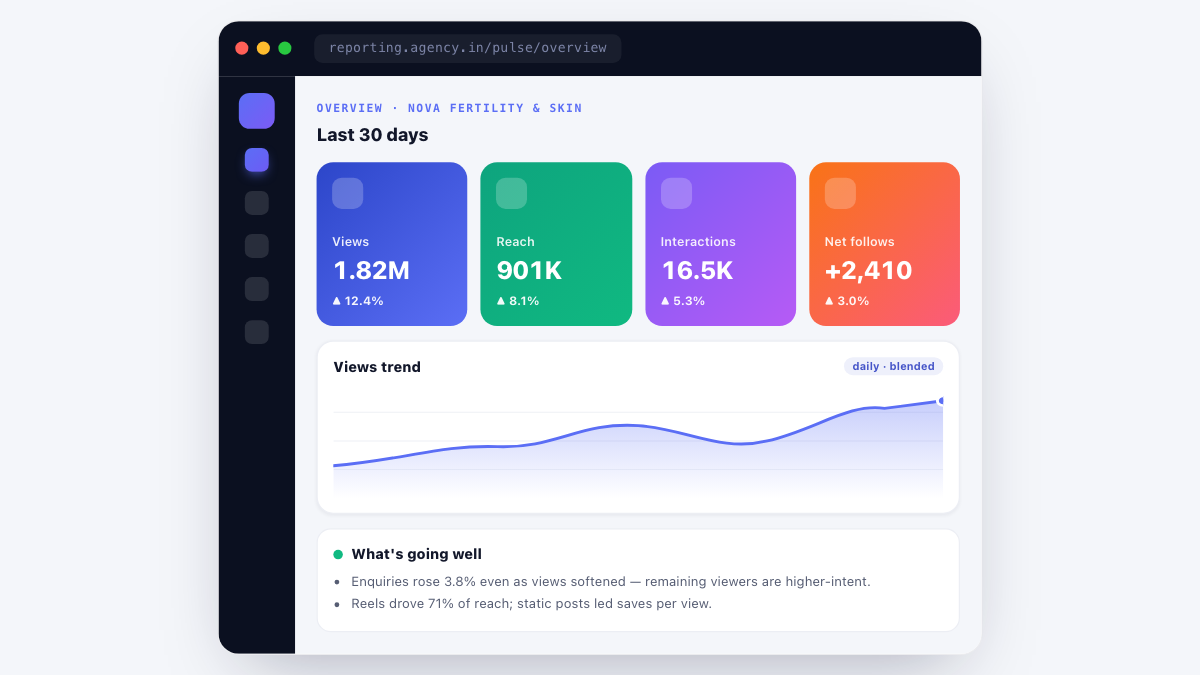 Prism Pulse Overview dashboard for a healthcare Instagram account showing 30-day views, reach, interactions and net follows with an AI-summarised what-is-working panel" width="1200" height="675" loading="lazy" decoding="async" style="width:100%;height:auto;display:block;">
Most healthcare marketing engagements in India are priced on inputs — hours, articles, posts, campaigns. This creates a well-documented problem: agencies get paid regardless of outcome, hospitals get frustrated, and the relationship becomes transactional. We designed our pricing differently.
Under the 70-30 model, seventy percent of the monthly fee is fixed, covering the deterministic work: content production, technical SEO, GBP operations, tracking, reporting. Thirty percent is tied to a mutually agreed 12-month traffic target, on a sliding-scale slab — a partial hit pays partial variable, a full hit pays full, and an over-delivery pays a defined bonus. The three tiers are Foundation at Rs 49,999 per month, Growth at Rs 74,999, and Scale at Rs 99,999, each with progressively larger scope and correspondingly larger targets.
The same model extends to paid media once budgets cross five lakh a month, and to YouTube SEO / AIO work once the budget crosses Rs 50,000 a month. The point of the model is not the discount — it is the alignment. When 30 percent of our fee depends on hitting your target, our internal prioritisation stops being about "what is easy to deliver this month" and starts being about "what will actually move the number."
Section takeaway: Ask any prospective agency to put 20-30 percent of fee at risk against a real outcome. The answer tells you everything about how they think about your business.
The 12-month execution roadmap
A realistic content marketing engagement in Indian healthcare takes 12 months to prove itself, 18-24 months to fully compound. Anything faster is either luck or a very small base. The plan below is the sequence we use as a default, adjusted per archetype.
Quarter 1 (months 1-3): foundation and technical clean-up
Audit the site against NMC, DPDP, and technical SEO standards. Fix the trust layer: about page, doctor bios, editorial policy, named bylines everywhere. Get GBP into shape — categories, services, photos, review flow, weekly posts. Set up WhatsApp with proper business tooling and reply SLAs. Ship the first 2-3 pillar pages. Set up analytics and CRM so that every subsequent piece of work can be attributed.
Quarter 2 (months 4-6): topical depth and doctor video
Build out cluster content around the first pillars — 30-60 pieces depending on tier. Launch or restart the YouTube channel with 5-12 doctor videos per month. Start Meta creative iteration at frequency. Continue GBP momentum. First real traffic and enquiry lift becomes visible late in this quarter.
Quarter 3 (months 7-9): answer-engine and local dominance
Optimise the existing content stack for AI Overviews — rewrite openings, add structured FAQs, add tables, ensure named authorship on every piece. Expand pillars into adjacent specialties or cities. Add city-level landing pages if the archetype is multi-location. Push GBP to review dominance in the primary catchment. Traffic and organic enquiries compound noticeably by month 9.
Quarter 4 (months 10-12): conversion, retention and pricing leverage
By now the top of the funnel is working. The focus shifts to conversion: WhatsApp reply automation, doctor-selection tools, cost calculators, better consult booking. Retention content begins: patient education post-treatment, referring-doctor updates, corporate-tie-up content. Pricing leverage becomes possible — the brand is now visible enough that it can push package pricing up 8-15 percent without lead volume dropping.
Section takeaway: Twelve months, four quarters, four distinct jobs. Anyone selling you results faster than this is selling you luck.
Key takeaways
- Healthcare content marketing in India in 2026 has three new realities: AI Overviews eating clicks, YouTube and Instagram leading discovery for under-40s, and the DPDP Act enforcing consent in ways that reshape lead capture.
- The right content architecture is a small number of deep pillars, a wider set of clusters around each, and a named-expert trust layer that makes both credible.
- Five channels do five different jobs — search compounds, YouTube builds trust, GBP dominates local, Meta harvests demand, WhatsApp closes — and missing any of them leaks the funnel.
- Compliance with NMC, DPDP Act 2023, ABDM and platform policy is a content-design input from the first draft, not a legal-review step at the end.
- The largest first-quarter lift in most healthcare engagements comes from fixing WhatsApp reply-time, not from new content or new media.
- Buyer archetype dictates tooling: a single-city founder-clinic needs different infrastructure from a multi-location chain from a tertiary hospital from a pharma brand.
- ICG's 70-30 pricing model (Foundation Rs 49,999 / Growth Rs 74,999 / Scale Rs 99,999) exists to align agency prioritisation with hospital outcomes over a 12-month window.
- A realistic execution roadmap is four quarters — foundation, depth, answer-engine and local dominance, then conversion and retention — and 12 months is the minimum honest timeframe for meaningful results.
FAQ
How long does healthcare content marketing take to show results in India?
First measurable lifts — GBP direction requests, WhatsApp enquiry quality, initial rankings on long-tail queries — usually show up between months two and four. Meaningful organic traffic and enquiry compounding shows up between months six and nine. Full compounding, where owned content starts materially reducing paid-media dependency, typically takes 12-18 months. Anyone promising faster is either underestimating the work or overpromising.
How much should an Indian hospital or clinic spend on content marketing per month?
For a single-city founder-clinic, Rs 40,000 - 90,000 per month covers a serious foundation. For a mid-tier multi-location chain, Rs 2-8 lakh per month across content, GBP, YouTube and paid overlay is typical. Large hospitals with multi-specialty scope usually invest Rs 15 lakh or more per month across the full marketing operation. The right number depends on the north-star leads-per-day target and the current cost-per-lead on paid channels.
Is SEO still worth doing when AI Overviews are eating clicks?
Yes, and arguably more than before. AI Overviews compress click-through on informational queries but leave high-intent commercial queries largely intact. The correct response is to build content that gets cited inside AI answers (brand exposure without a click) and to concentrate depth around commercial-intent queries where clicks still convert. SEO is not dying; the composition of what wins is changing.
Should our doctors be on YouTube?
For elective specialties — fertility, cosmetic, dental, dermatology, mental health, weight-loss — yes, and the earlier the better. Under-40 patients now discover doctors on video before they Google them. Doctor-forward, high-frequency, search-optimised YouTube is where trust is built at scale in 2026. For emergency-only or purely inpatient specialties the case is weaker, though still positive for brand.
What does DPDP Act 2023 actually change for our lead forms?
Three things. Consent must be specific to each processing purpose (not a single bundled checkbox). Retention has to be time-bound, not indefinite. Any sharing with third parties — agencies, ad platforms, automation tools — has to be disclosed. Practically, this means rebuilding forms with granular consent, adding a data-retention policy, and ensuring the CRM that receives leads is DPDP-aware.
How important is Google Business Profile compared to a website?
For any brick-and-mortar healthcare business with local catchment, GBP is often the single highest-ROI asset in the stack. A well-run GBP with active reviews, weekly posts and geo-tagged photos regularly outperforms substantial Google Ads budgets in the same category. The website matters — it is the trust and conversion layer — but GBP is often where the first-touch discovery happens. Both are needed; neither can substitute for the other.
Can we compare our clinic to a named competitor in content?
Under NMC advertising guidance, direct comparative claims against other named doctors or hospitals are broadly disallowed. The safer and more effective approach is to compare categories, treatment approaches, or technology types — not named entities. This also happens to be what AI answer engines prefer to cite, since neutral category comparisons read as informational rather than promotional.
Do we need separate content for referring doctors and patients?
Rarely. Well-written healthcare content that is patient-first in language but clinician-defensible in substance works for both audiences. The exception is HCP-only technical material — study data, dosing tables, mechanism-of-action detail — which belongs behind an HCP-gated section. Trying to run two separate content operations for the same brand is expensive and usually leads to one of them going stale.
What is the fastest single fix in the first 90 days of a healthcare engagement?
WhatsApp reply-time. In our audits, median reply time is 47 minutes and 30-40 percent of enquiries never get replied to at all. Fixing this alone typically lifts booked-consult rates by 25-40 percent — before any content or media change. It is almost never the first thing marketing teams look at, and it is almost always the highest-leverage first move.
How does the 70-30 pricing model actually work in practice?
Seventy percent of the monthly fee is fixed and covers deterministic work — content production, technical SEO, GBP operations, tracking, reporting. Thirty percent is tied to a 12-month traffic target on a sliding-scale slab: partial delivery pays partial, full delivery pays full, and over-delivery pays a defined bonus. This aligns the agency's internal prioritisation with the hospital's actual growth targets rather than with input hours.
Which of ICG's own products should a mid-sized dental chain look at first?
For a multi-location dental group, the usual sequencing is: Angryturtle for GBP operations across locations from day one, YODA for doctor YouTube starting around month two or three, Meta Catalyst IQ once the Meta creative pipeline is in place, and Nexus CRM if the existing patient-database and lead-management stack is thin. HealthPro 360 becomes relevant when the group grows into RCM and hospital-scale operational overlay needs.
Do we need to translate our website into regional languages?
Not everything. The pragmatic answer for hospitals outside the top eight metros is to translate the 20-30 highest-intent commercial pages plus core FAQs into one regional language, and leave the long tail in English. Hindi, Bengali, Tamil, Telugu and Marathi voice search is now large enough that even a partial vernacular presence pulls traffic that English alone will not.
Book a free Brand & Growth Diagnostic.
60 minutes with a Co-Founder. You leave with a written root-cause analysis of where growth is stalling and what to fix first — whether or not you engage ICG.
Questions readers ask
about this topic.
The three platforms
behind every ICG engagement.
Beacon
CAPI middleware that fixes Event Match Quality, translates CRM statuses to Meta-standard events, dedups across channels.
Agency OS
Live client dashboard. GSC, GA4, Google Ads, Meta Ads, IVR calls in one view. Login anytime, not monthly.
Phoenix
Clinic revenue intelligence over your PMS. Daily action queue: Prevent Loss, Maintain & Engage, Grow Revenue. 46-centre rollout.
Or book a free 30-min audit to see all three in action on your account.
Healthcare brands
that already run on ICG.
A representative slice of the 150+ healthcare brands ICG has delivered for across India. Most engagements remain under NDA.


What ICG clients say · on video.
"Scale up of organic channels and business consulting. ICG has absolute domain authority in their field."
"Working with ICG transformed how we acquire IVF patients in Gurgaon. They understand the fertility journey from inquiry to consult..."
"What Ichelon accomplished — they got all my ideas and worked over 3-4 months to create an amazing, super-customised website."
Need help operationalising this?
Every ICG service is healthcare-only, NMC + DPDP-aware, and built around the patient-research patterns that drive Indian healthcare growth in 2026.
More from
ICG.
Healthcare AIO is the discipline of getting your clinic or hospital cited inside Google AI Overviews, ChatGPT and Perplexity answers — not j...
Conversational-search advertising places brand messages inside AI chat answers — ChatGPT, Perplexity, Copilot — rather than beside a results...
NABH digital compliance means every claim, image and testimonial your hospital publishes online matches what an accreditation surveyor can v...
Stop guessing.
Book a Diagnostic.
30 minutes. Free. With the AI-powered healthcare-only marketing agency 150+ brands already run on. No slides, no pitch, no hard close.


