


Healthcare Content Agency Categories in India: What to Actually Buy
A category-first buyer guide for Indian healthcare marketing directors weighing freelance pools, generalist marketplaces, boutique specialists, enterprise agencies, and AI-native performance stacks. Eight comparison axes, four buyer archetypes, honest recommendations.
No pitch. Written root-cause diagnosis. AI-powered, healthcare only.
Direct answer
A category-first buyer guide for Indian healthcare marketing directors weighing freelance pools, generalist marketplaces, boutique specialists, enterprise agencies, and AI-native performance stacks. Eight comparison axes, four buyer archetypes, honest recommendations.
TL;DR
TL;DR — Pick a tier based on velocity, medical rigour, and channel width, not price alone
- There are broadly five category tiers of healthcare content providers serving Indian hospitals and clinics today: freelance solo pools, generalist content marketplaces, boutique healthcare specialists, full-service enterprise agencies, and AI-native performance stacks.
- The right tier for a single-doctor clinic is almost never the right tier for a 100-bed multi-specialty hospital. Match tier to velocity needs, medical review depth, and how many channels you must feed monthly.
- Eight axes decide fit: NMC ad-code literacy, DPDP Act 2023 readiness, ABDM alignment, monthly throughput, clinical review workflow, SEO/AIO rigour, distribution channels covered, and pricing accountability.
- Indian buyers should ask every shortlisted category to show de-identified samples, a written NMC ad-code checklist, and a DPDP consent map before signing. Anyone who cannot produce these is a category mismatch.
- Feature-based selection beats vendor-based selection. Compare what the tier can deliver against your channel footprint and compliance load, then negotiate a hybrid.
Table of Contents
- Why category selection is the real decision for Indian healthcare buyers
- The five agency category tiers, defined
- Eight axes to compare on
- The full comparison table
- Per-axis deep dives
- Which tier fits which Indian buyer
- How ICG plays a neutral advisor role
- The 70-30 pricing lens for services
- Frequently asked questions
Why category selection is the real decision for Indian healthcare buyers
Most healthcare marketing directors in India start their agency search with a shortlist of names. That is the wrong starting point. The Indian healthcare content market has quietly split into five distinct categories, and each category ships a fundamentally different unit of work — different velocity, different medical-review depth, different compliance appetite, different reporting rigour. Two shortlisted providers from different tiers are not really competitors; they solve different problems.
The stakes have also changed. The National Medical Commission's advertisement code puts personal legal liability on the registered practitioner whose name appears on any marketing material. The Digital Personal Data Protection Act 2023 has turned every lead capture form, WhatsApp opt-in, and appointment booking widget into a consent-and-purpose-limitation exercise. The Ayushman Bharat Digital Mission is quietly rewiring how patient identity and health records flow between apps, insurers, and provider portals — content that ignores ABDM taxonomies will age badly.
Layered on top of this, Indian search behaviour has shifted to voice, vernacular, and AI-overview answers. Winning organic today requires an entity-graph mindset that most general content shops still do not have. A hospital administrator picking a partner on price alone in 2026 is essentially picking blind. Category selection is the leverage point.
The five agency category tiers, defined
Before comparing, it helps to name the categories cleanly. These labels describe capability shape, not brands.
- Tier A — Freelance Solo Pool. Individual writers or small collectives, often ex-clinical or ex-journalist, sourced through platforms or referrals. Contract per article. No agency wrapper.
- Tier B — Generalist Content Marketplace. Cloud platforms that route briefs to a distributed writer pool across industries. Healthcare is one vertical among many. Self-serve dashboards, credit-based pricing.
- Tier C — Boutique Healthcare Specialist. Small agencies of five to twenty people that only serve hospitals, clinics, IVF centres, dental chains, and diagnostic labs. Named editors, medical review built in.
- Tier D — Full-Service Enterprise Digital Agency. Multi-hundred-person shops running content, paid media, creative, and technology across many industries. Healthcare is a vertical practice inside a larger book.
- Tier E — AI-Native Healthcare Performance Stack. A newer category. Founder-led operators that combine healthcare-only positioning with proprietary product infrastructure — programmatic SEO engines, GBP automation, AI-native YouTube systems, Meta Ads intelligence — and price outcomes rather than deliverables.
Eight axes to compare on
 Meta Catalyst IQ Master Dashboard showing account-level KPIs, spend, CPQL and campaign health for a healthcare Meta Ads account" width="1200" height="675" loading="lazy" decoding="async" style="width:100%;height:auto;display:block;">
Every serious Indian healthcare buyer should compare shortlisted categories on the same eight axes. These are the axes that predict outcomes over a twelve-month engagement.
- Healthcare domain depth (NMC ad code, DCI norms, PC-PNDT, MTP Act literacy)
- DPDP Act 2023 compliance readiness
- ABDM alignment and health-record awareness
- Monthly content velocity and throughput reliability
- Clinical medical review workflow
- SEO and AI-overview technical rigour
- Multi-channel distribution muscle (website, GBP, YouTube, Meta, WhatsApp)
- Pricing model transparency and outcome accountability
The full comparison table
| Axis | Tier A — Freelance Solo | Tier B — Generalist Marketplace | Tier C — Boutique Healthcare Specialist | Tier D — Full-Service Enterprise Agency | Tier E — AI-Native Healthcare Performance Stack |
|---|---|---|---|---|---|
| NMC / DCI / PC-PNDT literacy | Variable, writer-dependent | Generic, template-driven | Strong, domain-native | Moderate, uneven across teams | Strong, codified in playbooks |
| DPDP Act 2023 readiness | Rarely addressed | Basic cookie/consent templates | Consent-map advisory | Legal function, slow to reach content | Built into lead-capture patterns |
| ABDM alignment | Almost never | Absent | Increasing awareness | Enterprise integration talk, thin execution | Referenced in taxonomy and schema |
| Monthly throughput | 4-12 pieces | 10-40 pieces | 15-50 pieces | 30-150 pieces | 50-500+ pieces via programmatic engines |
| Medical review workflow | Optional add-on | Not offered | Named medical editor | SME network, slow SLAs | Named clinical reviewers plus AI pre-check |
| SEO / AIO technical rigour | Minimal | Template schema | Solid on-page, patchy technical | Deep technical, generic entity work | Programmatic schema, entity graph, AIO tracking |
| Distribution channels covered | Blog only | Blog and social feeds | Blog, GBP, YouTube basics | Full media mix | Blog, GBP OS, AI-native YouTube, Meta Ads intel, WhatsApp |
| Pricing accountability | Per-piece | Credit-based, no outcome | Monthly retainer, milestone-linked | Retainer plus percentage of media | Fixed-plus-variable, outcome-linked (e.g. 70-30 split) |
Per-axis deep dives — what to actually look for
Axis 1: NMC, DCI, PC-PNDT and MTP Act literacy
The National Medical Commission's advertisement code is not a suggestion. It prohibits testimonials that promise cures, comparative claims against other practitioners, and any language that guarantees outcomes. The Dental Council of India has parallel restrictions, and speciality-specific statutes like PC-PNDT and the MTP Act govern what fertility, radiology, and gynaecology practices may or may not publish. Freelance and generalist marketplace tiers rely on the client to catch violations post-facto — a costly assumption. Boutique healthcare specialists and AI-native performance stacks usually maintain a written checklist that every piece runs through before publication. Ask any shortlisted partner for their ad-code review protocol in writing. If they cannot produce a one-page document, they are a category away from where you need them.
Axis 2: DPDP Act 2023 readiness
The DPDP Act reframes every appointment form, lead magnet, chatbot, and WhatsApp Business flow as a personal-data collection surface with consent, purpose limitation, retention, and grievance obligations. Content agencies touch this surface constantly — landing pages, gated whitepapers, WhatsApp opt-in copy, cookie banners, retargeting pixels. The right category will bring a consent-map to the first workshop, showing which fields collect what data, under which legal basis, for how long. Generalist marketplaces and freelance pools rarely do this work. Enterprise agencies have legal teams but the guidance often does not reach the content desk in time. Healthcare-specialist boutiques and AI-native stacks build DPDP language into the templates themselves.
Axis 3: ABDM alignment and health-record awareness
The Ayushman Bharat Digital Mission is slowly becoming the identity and record backbone for Indian healthcare. Content that references ABDM taxonomies, HPR-linked practitioner profiles, ABHA-based patient onboarding, and empanelled facility categories will age much better than content that does not. Most freelance and marketplace-tier content ignores ABDM entirely — it reads like 2019 material. Enterprise agencies talk about integration but rarely embed the vocabulary into blogs, service pages, and paid ad copy. AI-native performance stacks and forward-leaning boutiques increasingly weave ABHA, HFR, HPR, and unified health interface references into copy and schema, which pays off as ABDM adoption compounds.
Axis 4: Monthly throughput and reliability
A 300-bed hospital with fourteen specialities and three cities needs, at minimum, 60 to 120 published pieces a month across blog, GBP posts, YouTube descriptions, service-page updates, and Meta creative variations. A single dental clinic needs 8 to 15. Freelance pools cap out fast. Marketplaces scale but sacrifice medical accuracy. Boutiques usually cap at 40 to 60 per client per month. Enterprise agencies can flex to 150, but with uneven quality. AI-native performance stacks now use programmatic engines — data-driven money-page systems, GBP automation, AI-native video pipelines — to reach 200-500+ output units per month per client without collapsing quality. Ask for a rolling six-month throughput chart, not a promise.
Axis 5: Clinical medical review workflow
Medical review is where most content quietly fails. The correct pattern is a named clinician — MBBS, MDS, MD, or DNB depending on the vertical — reviewing before publication, and a version-controlled trail showing who reviewed what. Freelance and marketplace tiers usually offer no review, or a paid add-on that is skipped for speed. Boutique specialists appoint a medical editor per account. Enterprise agencies rely on a subject-matter-expert network, which is often slow. AI-native stacks combine a first-pass AI pre-check for factual density and unsupported claims with a named clinical reviewer for the final sign-off. Insist on seeing the reviewer's degree and registration number on at least a sample of past work.
Axis 6: SEO and AI-overview technical rigour
Winning organic in Indian healthcare now requires three technical disciplines: an entity graph that ties your doctors, procedures, facilities, and locations into structured data; AI-overview-optimised answer formats that get extracted into generative answers on Google and other assistants; and Core Web Vitals hygiene. Freelance and marketplace tiers rarely address any of this. Boutique specialists execute solid on-page SEO but often lack the technical bench. Enterprise agencies have deep technical teams but reuse generic entity work across verticals. AI-native performance stacks build programmatic schema injection, first-party AIO tracking dashboards, and speakable-schema patterns as part of the default deliverable. Ask what percentage of the partner's published pieces carry FAQPage, HowTo, MedicalWebPage, or Physician schema.
Axis 7: Multi-channel distribution muscle
Content that lives only on a blog is a wasted investment in 2026. Indian healthcare buyers now consume across Google Business Profile, YouTube, Instagram Reels, WhatsApp broadcasts, and increasingly voice assistants. A category tier is only as strong as the number of channels it can activate from a single content brief. Freelance and marketplace tiers cover blog and light social. Boutiques add GBP and YouTube basics. Enterprise agencies cover full media mix but with heavy hand-offs between teams. AI-native performance stacks operate purpose-built product infrastructure — a GBP operating system for local dominance, an AI-native YouTube engine for video SEO, a Meta Ads intelligence layer for competitive spend visibility, an Instagram analytics engine — all fed by the same content spine. This creates channel compounding rather than channel duplication.
Axis 8: Pricing model and outcome accountability
Per-article pricing rewards volume, not outcomes. Credit-based marketplace pricing does the same. Retainer-only pricing rewards stability but can drift into complacency. The most durable models split fees between a fixed component that pays for reliable capacity and a variable component tied to a jointly agreed twelve-month outcome — organic clicks, qualified leads, GBP calls, YouTube subscribers. The AI-native performance-stack tier increasingly uses this fixed-plus-variable shape because it aligns incentives on both sides. Indian buyers should ask for pricing that names the outcome, the measurement source, and the sliding-scale slabs in writing.
Which tier fits which Indian buyer
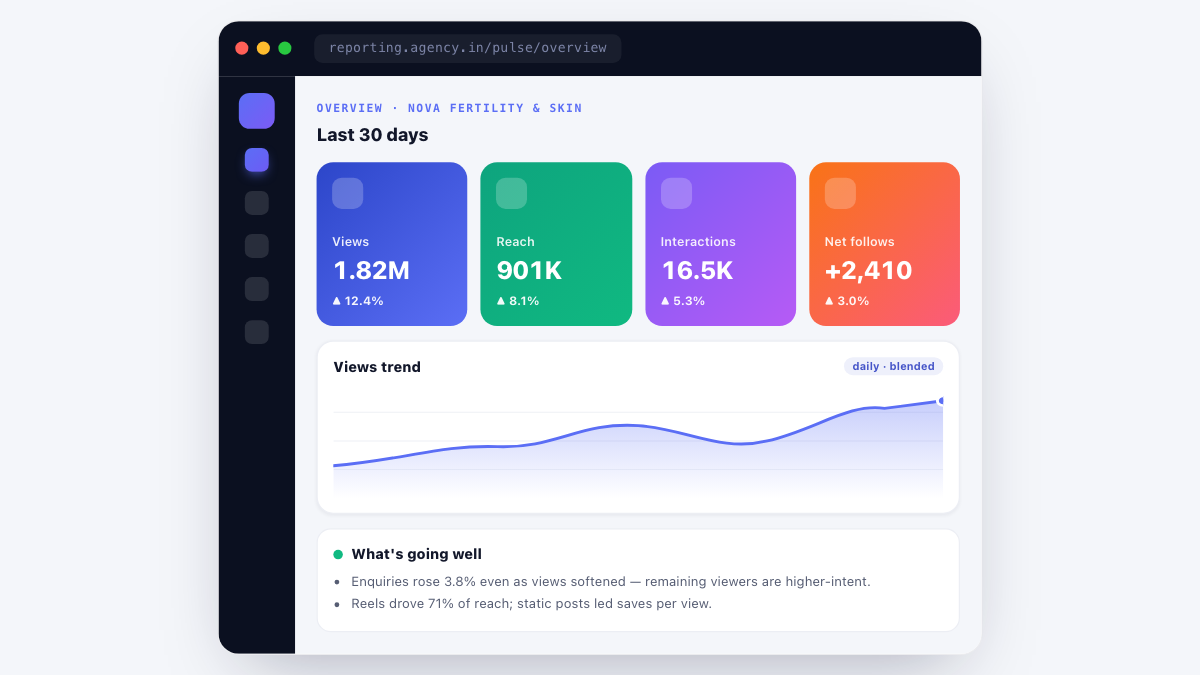 Prism Pulse Overview dashboard for a healthcare Instagram account showing 30-day views, reach, interactions and net follows with an AI-summarised what-is-working panel" width="1200" height="675" loading="lazy" decoding="async" style="width:100%;height:auto;display:block;">
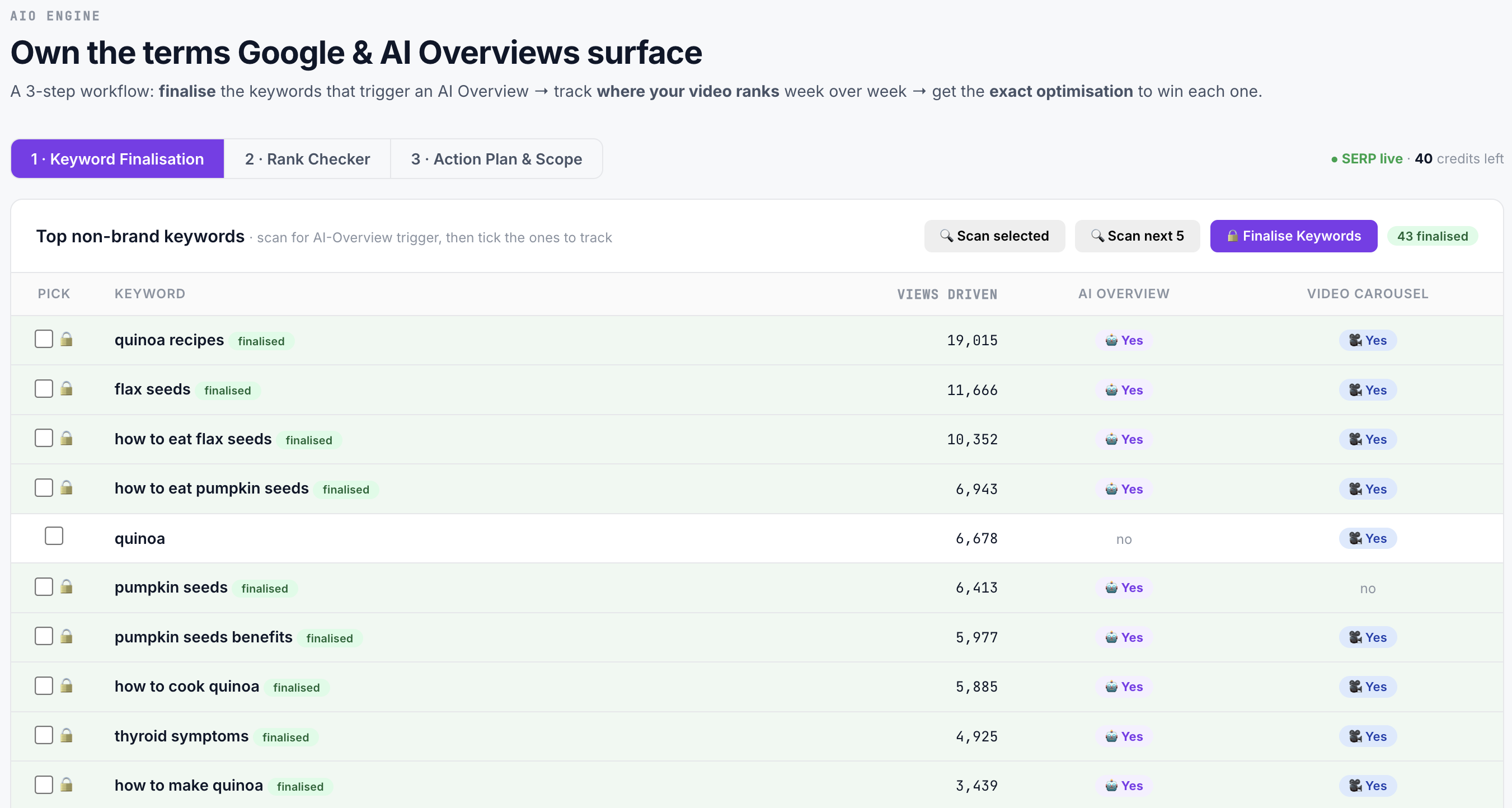 AI Overview opportunity across YouTube search, Google web and Google AI Overview" width="1200" height="675" loading="lazy" decoding="async" style="width:100%;height:auto;display:block;">
Buyer archetype 1: Single-doctor dental or aesthetic clinic in a Tier-2 city
Monthly marketing budget in the ₹40,000 to ₹90,000 range. Two to five staff. Growth priority is walk-ins from within a 6 to 8 km radius. This buyer usually does not need Tier D or Tier E immediately. Tier A (a vetted freelance pool) or Tier C (a boutique specialist) is the right fit, augmented by a GBP-focused product-led tool from a Tier E provider if available on a self-serve basis. The trap for this buyer is signing with Tier B — the throughput looks attractive but medical review is absent, and NMC exposure sits entirely on the practitioner.
Buyer archetype 2: 100-bed multi-specialty hospital, cardiology and orthopaedics-heavy
Monthly marketing budget in the ₹3 to ₹8 lakh range. In-house marketing manager, no full team. Growth priority is high-intent leads for surgery and diagnostics, plus GBP dominance across two or three catchment areas. This buyer is best served by Tier C or Tier E. Tier D is often overkill and slow. Tier B and Tier A cannot handle the throughput and medical review requirement together. The winning shape is usually a Tier E partner running the programmatic and channel infrastructure, with an in-house content editor plus one Tier C or Tier A writer on retainer for long-form thought-leadership pieces authored by the hospital's clinicians.
Buyer archetype 3: Mid-tier IVF or dental chain, five to fifteen centres across two states
Monthly marketing budget in the ₹8 to ₹25 lakh range. Marketing team of three to eight. Growth priority is multi-city SEO with strong GBP and YouTube signals, along with paid performance across Meta and Google. This buyer needs Tier E as the primary operator — the throughput, channel breadth, and pricing accountability requirements are beyond what Tier C can sustain, and Tier D typically dilutes healthcare specificity. Consider a Tier D partner only for large brand campaigns or television.
Buyer archetype 4: 500+ bed hospital group or listed diagnostic chain
Monthly marketing budget in the ₹25 lakh and above range. Full in-house marketing team. Growth priority is enterprise-grade brand plus performance, complex compliance surface, investor-grade reporting. This buyer usually blends Tier D for brand and above-the-line with Tier E for performance content, GBP operations, YouTube, and Meta intelligence. A Tier C boutique often plays a specialist role on a single high-value line, such as oncology or transplant. Tier A and Tier B rarely feature.
How ICG plays a neutral advisor role
Ichelon Consulting Group sits inside Tier E — an AI-native healthcare performance stack — with 300+ live healthcare clients and product infrastructure spanning GBP automation, AI-native YouTube, Meta Ads intelligence, Instagram analytics, and healthcare-specific CRM overlays. But the more useful stance ICG takes with Indian buyers is that of a neutral category advisor during the shortlisting stage. A single-doctor dental clinic in a Tier-2 city may be better served by a freelance pair plus a self-serve GBP tool than by a full engagement. A 500-bed hospital group may need a hybrid of Tier D and Tier E rather than pure Tier E. ICG's founding team publishes category maps, evaluation checklists, and pricing benchmarks precisely so Indian buyers can make feature-based decisions rather than pitch-based ones. When ICG is the right fit, we say so with evidence. When another category is the right fit, we say that too.
The 70-30 pricing lens for services
For engagements that touch performance services — SEO, Google Ads, Meta Ads, YouTube, and AIO — ICG uses a 70-30 pricing model that neatly illustrates outcome-linked pricing. Seventy percent of the monthly fee is fixed and pays for reliable capacity: writers, editors, technical SEO, GBP ops, ad ops, reviewers. Thirty percent is variable and pays out on a sliding-scale slab tied to a jointly agreed twelve-month target such as organic clicks, qualified enquiries, or booked consultations. Foundation-tier retainers begin at ₹49,999 per month, Growth at ₹74,999, and Scale at ₹99,999, with the same 70-30 shape extending to Google Ads engagements on media budgets of ₹5 lakh and above, and to YouTube and AIO engagements from ₹50,000 monthly. Indian buyers evaluating any category tier should ask whether an equivalent split is available — even if the exact ratio differs. The point is that some meaningful part of the fee should ride on the outcome the buyer actually cares about.
Frequently asked questions
Is a healthcare-specialist boutique always better than a full-service enterprise agency?
Not always. Boutiques win on medical accuracy, ad-code literacy, and cultural fluency inside a hospital. Enterprise agencies win when the engagement also needs television, out-of-home, celebrity endorsements, or complex creative production. For most 100 to 250-bed Indian hospitals, a boutique or an AI-native stack outperforms enterprise. For 500-bed chains and listed diagnostic groups, a hybrid usually wins.
How many pieces of content should a mid-sized Indian hospital publish each month?
A useful floor is 40 to 60 pieces per month across blog posts, GBP posts, service-page refreshes, YouTube descriptions, and Meta creative variations. Hospitals with more than seven active specialities usually need 80 to 120. If a partner cannot show a rolling six-month record of hitting these numbers without medical review shortcuts, they belong in a smaller-scale engagement.
Do we need to worry about DPDP Act 2023 for marketing content?
Yes, meaningfully. DPDP obligations attach the moment a form, chatbot, or WhatsApp opt-in collects personal information. Marketing pages carry the primary consent surface. A partner in the wrong category tier will hand you templated cookie banners without addressing purpose limitation, retention, or grievance flow — the areas the Data Protection Board is most likely to examine.
Can AI-generated healthcare content pass NMC scrutiny?
AI drafts can be a starting point, but no NMC-compliant workflow ends at AI. A named clinician must review and sign off before publication. The AI-native performance-stack category treats AI as a productivity layer and preserves human clinical review; the marketplace tier often does not. If a partner cannot describe the human-in-the-loop step clearly, that is a signal.
What is a fair monthly retainer band for an Indian mid-sized hospital in 2026?
Retainers for content plus SEO plus GBP plus light social typically sit between ₹1.5 lakh and ₹4 lakh per month for a 100 to 250-bed multi-specialty hospital, depending on speciality mix and city. Add another ₹2 to ₹8 lakh for paid media management if Google and Meta budgets exceed ₹5 lakh in media spend. Ask for an outcome-linked component in every quote.
How do I evaluate a partner's ABDM readiness in a shortlisting call?
Ask two questions. First, can you show me a service page that references ABHA-based onboarding correctly? Second, does your schema markup include HFR-linked facility identifiers where relevant? Category tiers that answer both cleanly are ahead of the market. Tiers that give vague answers are still using pre-ABDM playbooks.
Does outsourcing GBP operations really move the needle for a single-clinic practice?
Consistent GBP posting, review response, Q&A management, and image refresh is one of the highest-ROI activities for a Tier-2 or Tier-3 city clinic. It routinely outperforms blog investment for local walk-in generation in the first ninety days. A product-led GBP operating system from a Tier E provider often costs a fraction of a full retainer and delivers most of the local-search upside.
How should we structure a pilot before signing an annual contract?
Run a 60 to 90-day paid pilot at 40 to 60 percent of the intended monthly scope. Define three success metrics up front: an organic traffic delta on a defined cluster, a lead-quality score, and an ad-code compliance rate on a sample audit. Any category tier confident in its work will accept these conditions.
What is the biggest mistake Indian healthcare buyers make when picking an agency?
Optimising for the lowest per-article cost. That decision cascades into thin medical review, weak schema, missing DPDP coverage, and eventually a rebuild eighteen months later. The correct optimisation is cost per compliant, medically reviewed, distribution-ready unit of content. That number often favours Tier C or Tier E even when the sticker price looks higher.
Book a free 30-minute Brand & Growth Diagnostic.
It's a working session, not a sales pitch — you leave with a written root-cause analysis you can act on, whether or not you engage ICG.
Questions readers ask
about this topic.
The three platforms
behind every ICG engagement.
Beacon
CAPI middleware that fixes Event Match Quality, translates CRM statuses to Meta-standard events, dedups across channels.
Agency OS
Live client dashboard. GSC, GA4, Google Ads, Meta Ads, IVR calls in one view. Login anytime, not monthly.
Phoenix
Clinic revenue intelligence over your PMS. Daily action queue: Prevent Loss, Maintain & Engage, Grow Revenue. 46-centre rollout.
Or book a free 30-min audit to see all three in action on your account.
Healthcare brands
that already run on ICG.
A representative slice of the 150+ healthcare brands ICG has delivered for across India. Most engagements remain under NDA.


What ICG clients say · on video.
"Scale up of organic channels and business consulting. ICG has absolute domain authority in their field."
"Working with ICG transformed how we acquire IVF patients in Gurgaon. They understand the fertility journey from inquiry to consult..."
"What Ichelon accomplished — they got all my ideas and worked over 3-4 months to create an amazing, super-customised website."
Need help operationalising this?
Every ICG service is healthcare-only, NMC + DPDP-aware, and built around the patient-research patterns that drive Indian healthcare growth in 2026.
More from
ICG.
Healthcare AIO is the discipline of getting your clinic or hospital cited inside Google AI Overviews, ChatGPT and Perplexity answers — not j...
Conversational-search advertising places brand messages inside AI chat answers — ChatGPT, Perplexity, Copilot — rather than beside a results...
NABH digital compliance means every claim, image and testimonial your hospital publishes online matches what an accreditation surveyor can v...
Stop guessing.
Book a Diagnostic.
30 minutes. Free. With the AI-powered healthcare-only marketing agency 150+ brands already run on. No slides, no pitch, no hard close.


